
REVIEW · KIMONO & CULTURE EXPERIENCES
Kyoto : Family-Friendly Sword Lesson at Samurai Ninja Museum
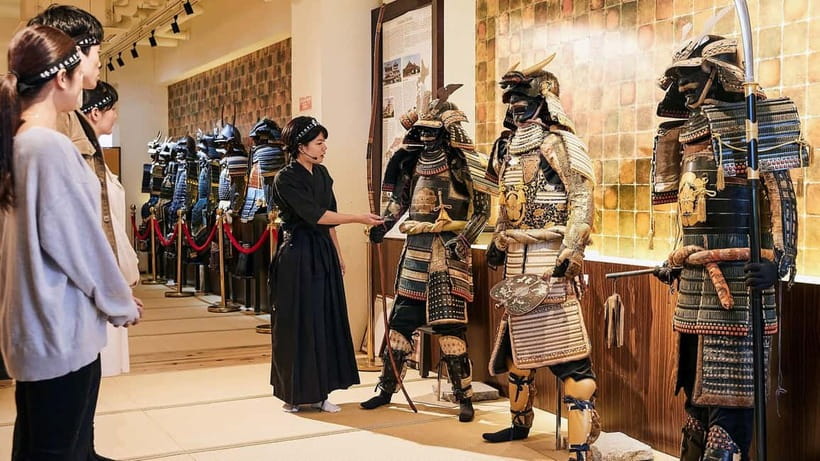
Kyoto’s Samurai Ninja Museum turns a simple photo stop into a hands-on lesson. You dress in hakama, armor, and a samurai helmet, watch a katana demonstration, then practice a short sequence of movements under an English-speaking instructor.
I like the mix of real instruction and playful theater, especially the chance to learn two kata, or choreographed movement sequences. I also like that the session includes ninja weapon trials and themed photos, so children and adults have something to enjoy. The main consideration is that this is an introductory activity, not serious martial-arts training, and the advertised group-size information is not perfectly consistent.
In This Review
- Key points at a glance
- A sword lesson, not just a costume photo
- Getting dressed in hakama and armor
- Learning the basic katana movements
- Photos with a samurai backdrop
- From samurai swords to ninja weapons
- The Samurai and Ninja Museum visit
- What the two-hour schedule means for you
- Is $66 per person a fair price?
- How family-friendly is it?
- The instructors shape the experience
- Who should book this Kyoto activity?
- Should you book the Samurai Ninja Museum experience?
- FAQ
- How long does the samurai experience last?
- How much does the experience cost?
- Is the lesson taught in English?
- What clothing and equipment are included?
- Are photographs included?
- Can children participate?
- Is transportation included?
- Can I cancel for a refund?
Key points at a glance
- Two hours of hands-on activity: The session includes dressing up, a sword lesson, photo time, and ninja weapon trials.
- You learn two kata: The lesson gives you a simple sequence of katana movements rather than only handing you a prop sword.
- English-speaking instruction: Instructors have included Ken, Raito, Nobu, and Jukia.
- Samurai and ninja activities together: After the sword lesson, you can try ninja weapons and visit the Samurai and Ninja Museum.
- Good for families: Children under three cannot enter, but older children can take part with adults.
- $66 per person: The price is reasonable if you want instruction, costumes, museum access, and photos in one compact Kyoto activity.
A sword lesson, not just a costume photo
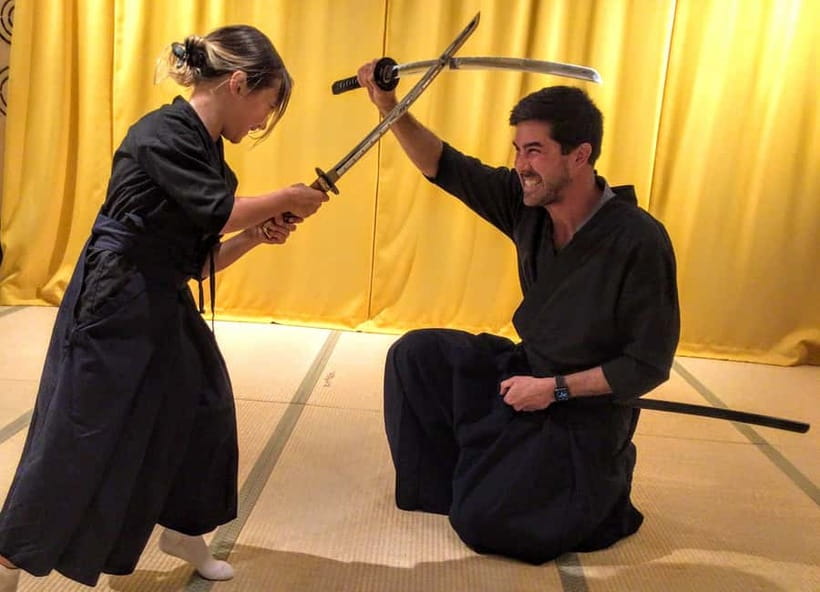
The best part of this Kyoto experience is the order of events. You do not simply put on an outfit and pose for a picture. First, you get an introduction to the samurai world, then watch a demonstration of how to hold and swing the sword, and only after that try the movements yourself.
That structure gives the costumes some purpose. Once you are holding a katana and repeating a taught sequence, the session feels more like a staged lesson than a dressing-up corner. You still should not expect combat training, but the activity gives you a basic sense of the focus and form connected with samurai sword work.
The English-speaking instructor is important here. Clear direction matters when you are learning unfamiliar movements, and the instructors named for this experience include Ken, Raito, Nobu, and Jukia. The exact teacher depends on the session, but the format is designed for visitors who do not speak Japanese.
More Kimono & Culture Experiences in Kyoto
- Kyoto Geisha Walking Tour: Gion District & Hidden Gems
★ 4.7 · 3,273 reviews - Kyoto: Gion Magical Night Walking Tour with Geisha Trivia
★ 4.9 · 2,393 reviews - Kyoto: Gion Geisha District Walking Tour – Stories of Geisha
★ 4.7 · 2,187 reviews
Getting dressed in hakama and armor
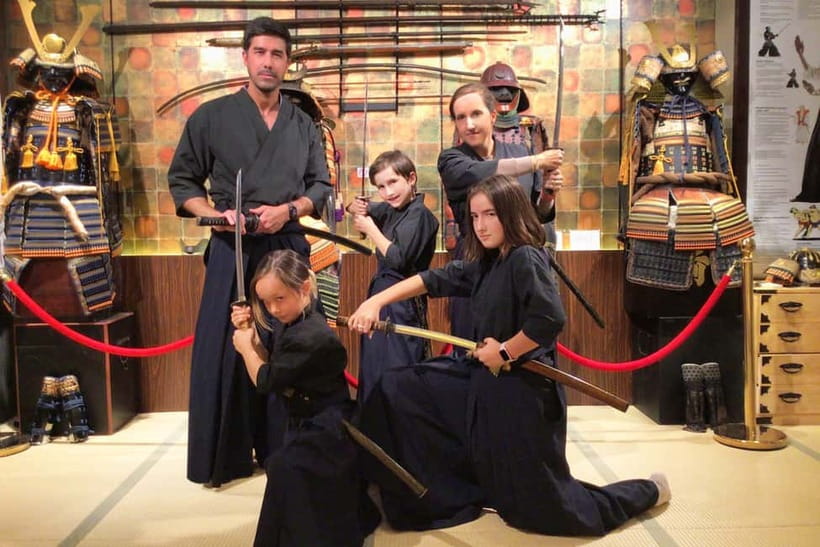
The costume portion includes hakama, a samurai helmet, and samurai armor. Hakama are the loose, traditional-style trousers associated with formal Japanese clothing and martial arts. The armor and helmet complete the look, making this part especially appealing to children who want a strong visual change from ordinary sightseeing clothes.
You should think of the outfit as part of the lesson, not a museum-quality historical reproduction. The activity is built for participation and photographs, so the clothing helps you look the part while you learn. It also gives families a shared activity that works across age groups.
The dressing process takes time from the two-hour session, but that is not wasted time if you want photos. If your group is interested in the sword lesson only, the costume and posing may feel like a large part of the visit. If you want a memorable Kyoto keepsake, the outfits are a major reason to book.
Learning the basic katana movements
After the introduction, the instructor demonstrates how to swing the sword properly. You then try the movements yourself, with the lesson centered on basic kata.
One particularly useful detail is that the session can include two kata sequences. That gives you something to remember and repeat for the camera, rather than a single swing with no context. The teaching remains suitable for beginners, so you do not need previous sword experience.
The activity is best approached as a controlled performance lesson. You are learning posture, timing, and a short pattern of movements, not practicing with sharpened weapons or preparing for a martial arts competition. That makes it a comfortable choice for a family outing, though adults seeking serious instruction should keep their expectations modest.
The instructor-led format also helps prevent the activity from becoming chaotic. You watch first, then follow directions. In a small class, you may get a better chance to repeat the sequence and ask for help, although the booking details describe the group in two different ways: one section says limited to 10 participants, while another gives a maximum of 22. Confirm the expected group size when you book if that matters to you.
Photos with a samurai backdrop
The photo session is one of the clearest reasons to choose this activity over a standard museum visit. You can pose with swords in front of studio or samurai-themed backgrounds, wearing the hakama, armor, and helmet included in the experience.
These are posed souvenir photos rather than candid street scenes. That distinction matters. You are not documenting everyday Kyoto life, but you are creating a playful record of your visit in a setting designed for the samurai theme.
Families should allow time for everyone to have a turn. Children often enjoy the visual transformation, while adults may prefer a few group photographs in full costume. The sword lesson gives the pictures more character because you can repeat the kata positions instead of standing stiffly with a prop.
The studio setting is also practical. Kyoto’s weather does not control this part of the activity, and you do not need to search for a dramatic outdoor location. The tradeoff is that the images will feel staged by design.
Same city, a completely different kind of day:
- PERFECT KYOTO 1-Day Bus Tour
★ 5.0 · 13,518 reviews - Kyoto: Fushimi Inari, Kinkakuji, Bamboo Grove 1 Day Bus Tour
★ 4.8 · 4,316 reviews - Kyoto: Tea Ceremony in a Traditional Tea House in Kiyomizu
★ 4.9 · 3,519 reviews - Kyoto: Tea Ceremony Ju-An at Jotokuji Temple
★ 4.9 · 3,207 reviews
From samurai swords to ninja weapons
The experience adds a second theme with a ninja weapons trial. This keeps the visit moving after the katana lesson and gives children a different challenge.
The activity information specifically includes a chance to try shuriken, the throwing stars associated with ninja imagery. The museum visit and target practice can be a fun contrast to the more formal sword lesson. You move from learning a sequence of movements to trying a separate skill with a clear visual goal.
This portion is also why the experience works well for mixed-age groups. One person may be most interested in samurai clothing and photos, while another prefers the ninja activity. You do not have to choose between the two themes.
Still, keep the historical framing in proportion. The activity presents samurai and ninja culture in an accessible, theatrical way. It offers an introduction and a memorable activity, not a full scholarly museum program or a complete account of Japanese military history.
The Samurai and Ninja Museum visit
The museum portion adds context to the costumes and equipment. A guided visit is included, and the guide explains the samurai and ninja material in English.
This is valuable because the session is not only about pretending to be a warrior. You get a chance to connect the sword lesson and weapons trial with the figures and objects presented at the museum. The visit helps answer the basic questions a first-time visitor may have about what samurai were, how their weapons were used, and why ninja remain such a strong part of popular culture.
The museum stop is compact enough to fit within the two-hour format. That also means you should not expect a large institution requiring half a day. If you want extensive displays, long labels, or a detailed academic treatment, this activity may feel light. If you want a clear introduction paired with hands-on fun, the balance works better.
The guided part is particularly useful for families. A guide can keep the explanation focused and give younger children something to watch and do instead of asking them to read long museum panels.
What the two-hour schedule means for you
Two hours is a convenient length for a Kyoto itinerary. You can fit the experience between other plans without giving up an entire day, and the variety helps the time pass quickly.
The likely flow is straightforward:
- Introduction to samurai and the activity
- Dressing in hakama, armor, and helmet
- Sword demonstration
- Practice with the katana and two basic kata
- Themed photographs
- Museum visit
- Ninja weapon trial
The exact order may vary, but the supplied details support this general shape. The session combines instruction, costume use, a guided cultural component, and active practice.
That variety is the key. A two-hour costume-only visit might feel thin, while a two-hour technical sword class might be too demanding for a family holiday. Here, each part changes the pace. You listen, move, pose, look at displays, and try a different weapon activity.
The limitation is that no single part can be very long. The sword instruction will be introductory, the museum visit will be focused, and the photo time may be shared with other participants. I would book this for a lively sampler, not for deep study of samurai traditions.
Is $66 per person a fair price?
At $66 per person, the value depends on what you want from the outing. You are paying for a two-hour experience that combines several separate elements: a sword lesson, use of hakama, armor and helmet, themed photo opportunities, a museum visit, and a ninja weapons trial.
That is a stronger package than a simple costume rental or a museum admission ticket. If your family would otherwise pay separately for an activity, a photo experience, and a cultural visit, combining them can make the price feel sensible.
The value is also better for people who enjoy participation. You are not paying only to watch a demonstration. You handle the sword under instruction, practice kata, dress in the costume, and try ninja weapons.
On the other hand, the price may feel high if you are mainly looking for a few photographs. You should also remember that transportation to and from the activity is not included. Add the cost and time of reaching the venue from your Kyoto accommodation.
Free cancellation up to 24 hours before the activity gives you some protection if your plans change. The reserve-now, pay-later option also helps if you are arranging a busy Kyoto schedule. Check the available start times before committing, since the activity lasts two hours and the precise schedule is not fixed in the information provided.
How family-friendly is it?
The activity is clearly aimed at families and first-time participants. Children under three cannot enter the samurai venue, so families with toddlers need another plan for that child. Older children can take part, and the costumes, short movements, photos, and ninja activity give them several ways to stay interested.
The lesson also suits adults. You do not need to leave the children to watch from the side. Parents can wear the costume, learn the kata, and appear in the group pictures too.
I would choose this for a family that enjoys active attractions and does not mind a little theatrical fun. It is less suitable for a child who dislikes dressing up, waiting for turns, or following an instructor’s movements.
The activity is wheelchair accessible and stroller accessible, and it is near public transportation. Those details make it easier to fit into a Kyoto day, though the provided information does not describe the exact route, changing arrangements, or any restrictions within the activity space. If you need a particular accessibility setup, confirm it before arrival.
The instructors shape the experience
A good instructor matters more here than at a self-guided museum. You are learning a sequence, handling a sword, and taking part in a staged performance. Clear demonstrations and a friendly manner can turn a basic activity into a memorable one.
The named instructors connected with sessions include Ken, Raito, Nobu, and Jukia. Ken has led the dressing, the kata lesson, and the museum portion, while Raito has been singled out for his teaching. Nobu and Jukia have also led highly rated sessions.
Do not book based on a promise of one particular instructor unless the booking system allows you to select that person. Instead, use the names as a sign that the experience has multiple English-speaking teachers familiar with the format.
The small-group setup is another positive feature. The activity is advertised as limited to 10 participants, though the same information also states a maximum of 22. Ask about the expected number if individual attention is a major concern.
Who should book this Kyoto activity?
I would recommend it to families with children older than three, couples who want unusual photos, and first-time visitors looking for a cultural activity that does not require a full day.
It also suits fans of samurai films, Japanese history, martial arts, and costume experiences. The sword lesson adds enough structure to make the visit feel purposeful, while the ninja weapons trial keeps it playful.
I would hesitate if you want authentic combat training, a long museum visit, or a quiet cultural tour. The experience uses samurai and ninja themes in a friendly, accessible setting. That is its strength, but it also sets the limit.
The activity can work well on a rainy day because the main elements take place at the venue, though transportation is your responsibility. Since the venue is near public transportation, it should be practical to reach, but you need to plan that part yourself.
Should you book the Samurai Ninja Museum experience?
Book it if you want a compact Kyoto outing where you can learn a short katana sequence, wear samurai clothing, visit a themed museum, and try ninja weapons. The mix is especially good for families because it gives children an active role and gives adults more than a quick photo opportunity.
Skip it if your main goal is serious sword study or a detailed examination of Japanese history. At $66 per person, the price makes the most sense when you take part in every element, from the lesson to the museum visit and photographs.
For many visitors, this is a cheerful two-hour break from temple sightseeing. It will not replace a major Kyoto cultural site, but it can add a memorable, hands-on experience to your trip.
FAQ
How long does the samurai experience last?
The activity lasts two hours.
How much does the experience cost?
The listed price is $66 per person.
Is the lesson taught in English?
Yes. The instructor language is English.
What clothing and equipment are included?
The experience includes use of hakama, a samurai helmet, and samurai armor, along with the samurai sword lesson.
Are photographs included?
The activity includes themed photo opportunities with swords and samurai-style backgrounds.
Can children participate?
Children can participate, but children under three cannot enter the samurai venue.
Is transportation included?
No. Transportation to and from the activity is not included.
Can I cancel for a refund?
Yes. You can cancel up to 24 hours in advance for a full refund.
More Museums in Kyoto
- Kyoto: Tea Museum Tickets and Matcha Grinding Experience
★ 4.9 · 739 reviews - Skip the lines Basic Ticket at SAMURAI NINJA MUSEUM KYOTO
★ 4.5 · 632 reviews - Kyoto : Geiko Maiko Dance of Kyoto & Visits of Gion Museum
★ 4.6 · 415 reviews - Kyoto: Samurai Ninja Museum guided tour
★ 4.8 · 145 reviews
More Workshops in Kyoto
- Kyoto: 45-Minute Tea Ceremony Lesson Experience
★ 4.3 · 2,378 reviews - Ramen Cooking Class at Ramen Factory in Kyoto
★ 5.0 · 1,937 reviews - Kyoto : Chopsticks Making Workshop in Gion with Engraving Option
★ 5.0 · 958 reviews - Kyoto: Samurai Sword Class by Experts in Traditional Arts
★ 4.9 · 657 reviews
Just added around Kyoto
- Taste of Nishiki Market Walking Food Tour with Local guide★ 5.0 · 17 reviews
- Kyoto: Sushi Making Class with Sushi Chef★ 4.8 · 64 reviews
- Kyoto: City Secrets eBike Tour★ 4.9 · 196 reviews
- Sacred Pathways: Discover the Philosopher’s Path of Kyoto★ 4.9 · 20 reviews
- Private Tour to Monkey Park and Arashiyama Highlights★ 5.0 · 22 reviews
- Private Nara Tour from Osaka – Meet at Your Hotel★ 5.0 · 22 reviews
- Private Sake Tasting in Central Kyoto with Sake Sommelier★ 5.0 · 13 reviews
- Kyoto : Private Custom Walking Tour With A Local Guide★ 4.6 · 144 reviews
Kimono & Culture Experiences, compared.
Kyoto Geisha Walking Tour: Gion District & Hidden Gems
Read our review →
Gion Magical Night Walking Tour with Geisha Trivia
Read our review →
Gion Geisha District Walking Tour – Stories of Geisha
Read our review →
Best of Kyoto: Gion, Geisha, Pagodas & Cobblestones
Read our review →
Kyoto Gion Geisha District Walking Tour – The Stories of Geisha
Read our review →
Browse the lists this tour appears in