
REVIEW · SAKE & BAR HOPPING TOURS
Private Pewter Sake Cup Experience with a Kyoto Artisan
Creating a sake cup here means more than buying a souvenir. You strike the metal yourself, turning a plain pewter cup into a small object marked by your own hands. Artisan Kanako guides the work in a private workshop outside central Kyoto, where the pace is calm and the craft takes center stage.
I like the freedom to build your own pattern with different hammers, and I like that you can stamp initials, numbers, or a date on the base. The main catch is the location: reaching this quiet part of northern Kyoto takes extra time, so this is not a quick activity between temples in the city center.
In This Review
- Key points to know before booking
- A hands-on souvenir, not a shop purchase
- Choosing a hammer and making the pattern
- Adding initials, dates, and small personal details
- Filing the rim and making the cup comfortable
- What pewter adds to the experience
- A private workshop with a personal pace
- Reaching Saluk in northern Kyoto
- Is $144.96 a fair price?
- What you take home
- Who will enjoy this most?
- Booking and cancellation details
- Should you book the pewter cup workshop?
- FAQ
- Where does the pewter sake cup experience take place?
- How long does the activity last?
- Is the workshop private?
- What will I make during the workshop?
- Can I add initials or a date?
- What size is the finished cup?
- Can I cancel for a refund?
Key points to know before booking
- Your cup is genuinely handmade: You hammer the pewter while rotating it on an anvil, creating a pattern no one else will have.
- Kanako teaches every stage: English instructions cover hammering, filing, shaping the rim, and safe final polishing.
- The workshop is private: Only your group participates, making this a good choice for couples, families, or friends.
- You can personalize the base: Add letters, initials, numbers, or a meaningful date.
- The setting is part of the appeal: Saluk is in a peaceful area north of central Kyoto, with a scenic train ride forming part of the journey for some visitors.
- The finished cup is compact and useful: It measures about 64 millimeters across, stands 53 millimeters high, and holds about 90 milliliters.
A hands-on souvenir, not a shop purchase
Kyoto offers no shortage of souvenirs. Many are beautiful, but most are already finished when you buy them. This workshop gives you a different kind of keepsake: a cup shaped by repeated taps, small corrections, and your own sense of design.
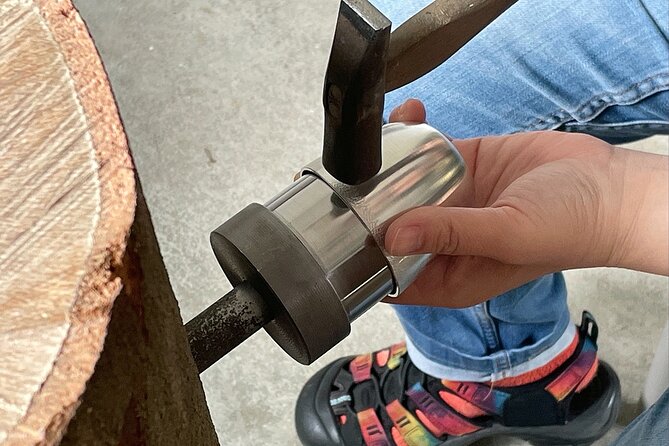
The starting point is a pewter cup prepared for decoration. You choose from several hammers, each producing a different mark. Some create small, tight impressions. Others leave broader or more pronounced patterns. You place the cup on an anvil, strike it, rotate it, and continue until the surface begins to take on its own character.
That sounds simple, but it rewards patience. A heavy-handed approach will not necessarily produce the best result. You need to watch the pattern develop and adjust your rhythm as you work. This gives the session a pleasant focus. For a couple or family, it also creates a shared project without requiring anyone to be an experienced craftsperson.
Kanako’s role matters here. She provides clear instructions in English and helps beginners understand how the hammer, the cup, and the rotation work together. You are not left to guess why a mark looks different or how to correct an uneven section.
More Sake & Bar Hopping Tours in Kyoto
- Kyoto Night Foodie Tour in Gion (9+ dishes + 6 Sake tastings)
★ 5.0 · 1,762 reviews - 3-Hour Kyoto Insider Sake Brewery Tour with Tastings & Pairings
★ 5.0 · 917 reviews - Arashiyama Bamboo, Temple, Monkeys, or Secret Sake Brewery
★ 4.8 · 886 reviews
Choosing a hammer and making the pattern
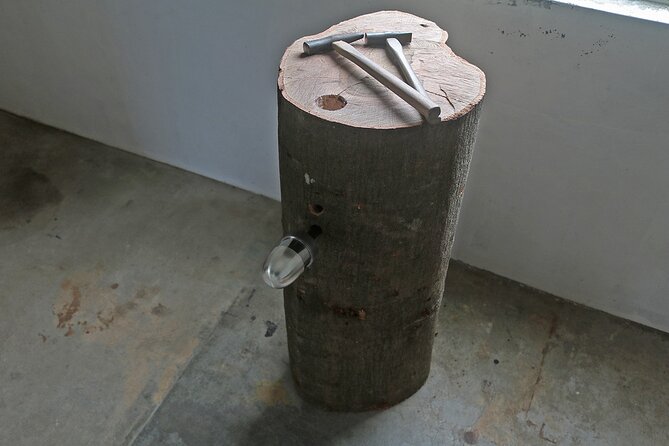
The hammering is the heart of the activity. You can use one hammer throughout, or combine several types to create a more varied surface. The result depends on both the tool and the way you strike.
This is where your cup becomes personal. Two people following the same basic instructions can produce very different finishes. One cup might have a regular, sparkling texture. Another might show a looser pattern with more variation. You can also take a more experimental approach, as one participant did by moving beyond the suggested design. Kanako can help you keep the result attractive and functional even when you try something unusual.
The work is physical, but it is not described as demanding. The experience is built for beginners, and the instructor remains close by. Still, you should expect to use your hands steadily for part of the two and a half hours. If you prefer simply watching a craft demonstration, this is not that kind of activity.
The best tip is to slow down. The cup is small, and the surface changes gradually. Rushing can make the pattern harder to control. Take time to look at the metal as you rotate it, and ask for guidance if you are unsure about the next mark.
Adding initials, dates, and small personal details
Once the main surface is decorated, you may stamp letters, numbers, initials, or a date onto the base. This is a modest detail, but it changes the meaning of the finished piece.
For a couple, a wedding or anniversary date would make sense. Families might choose initials or a shared year. A solo visitor could mark the month of a Kyoto trip. The stamp is not a replacement for the hand-hammered pattern, but it gives the cup a clear connection to your visit.
Personalization is especially useful if you plan to give the cup as a gift. You are not handing someone a generic Japanese object. You are giving them a small piece of work with a date or message tied to a particular moment.
You do not need to bring materials. Everything needed for the cup is provided at the workshop, which makes packing and preparation easy. Wear something in which you can work comfortably, but the supplied information does not list a special clothing requirement.
Filing the rim and making the cup comfortable
After the pattern and optional stamping are complete, you use a file to adjust the height and bevel the rim. This part may seem less artistic than hammering, but it is essential. A drinking cup needs to feel right in your hand and against your mouth.
The rim is filed at an angle to create a more pleasant drinking edge. You also help refine the shape and proportions of the cup. This is one reason the experience feels more substantial than a quick decorating class. You are not only making marks on a surface. You are helping finish an object that needs to work.
For safety, Kanako completes the final polishing with a rotary machine. That is a sensible division of labor. You get the satisfaction of doing the visible craft work, while the potentially risky final step is handled by the professional.
The finished cup is about 64 millimeters in diameter and 53 millimeters high. Its normal capacity is roughly 90 milliliters, or about 115 milliliters if filled to the rim. Those are tasting-cup proportions, not a large drinking vessel, so you can expect small pours rather than a generous tumbler.
Same city, a completely different kind of day:
- PERFECT KYOTO 1-Day Bus Tour
★ 5.0 · 13,518 reviews - Kyoto: Fushimi Inari, Kinkakuji, Bamboo Grove 1 Day Bus Tour
★ 4.8 · 4,316 reviews - Kyoto: Tea Ceremony in a Traditional Tea House in Kiyomizu
★ 4.9 · 3,519 reviews - Kyoto Geisha Walking Tour: Gion District & Hidden Gems
★ 4.7 · 3,273 reviews
What pewter adds to the experience
Pewter gives the cup a different feel from ceramic or glass. It is a metal with a soft, muted appearance, and the hammered surface catches light in small changing patches. The marks you make are part of the design rather than a flaw to hide.
The cup is also versatile. You can use it for sake, but it is suitable for whiskey, chilled green tea, and other drinks. That makes the souvenir more practical than an object that sits on a shelf.
The workshop also provides a useful introduction to why pewter has a place in Japanese craft traditions. You learn through handling it, not just through a lecture. The material responds to each tool in a way you can see and feel immediately.
One participant who did not drink alcohol used green tea in the finished cup. That is worth noting if sake is not part of your routine. The activity is about making and using the cup, not about alcohol consumption.
A private workshop with a personal pace
This is a private activity, so only your group participates. That distinction matters. You do not need to keep pace with strangers, and the instructor can give attention to each person’s design.
A private format works particularly well for couples. You can make matching cups with different patterns, or create contrasting designs that reflect your personalities. It also suits families, as long as everyone can take part in the hands-on work.
The setting has been described as calm and welcoming, with tea and snacks offered during at least some sessions. Kanako’s hospitality is part of the experience. She talks about her craft, answers questions, and makes room for conversation beyond the mechanics of the cup.
That personal contact gives the workshop a warm, local quality. You are visiting an artisan’s working environment rather than entering a large commercial attraction. The trade-off is that the experience may feel less polished or predictable than a packaged museum activity. That is part of its charm, but it is worth knowing if you prefer a tightly scripted tour.
Reaching Saluk in northern Kyoto
The meeting point is Craft Gallery SALUK at Shizuichinonakachō in Sakyo Ward, Kyoto. The activity ends at the same place.
This is outside the main sightseeing core. Several participants describe the approach as a scenic train ride of about an hour from Kyoto Station, and one account notes that Kanako and her husband helped with a more convenient station drop-off afterward. Because transportation details can vary, check the directions supplied with your booking and allow generous time.
Do not schedule this immediately before a fixed reservation on the opposite side of Kyoto. The workshop itself lasts about two hours and thirty minutes, and the ride to and from the northern area adds to the commitment.
The extra journey is the clearest drawback. If your Kyoto plan is built around Nishiki Market, Gion, Kiyomizu-dera, and other central sights, getting to Saluk takes planning. On the other hand, the quieter setting is exactly what makes the experience feel removed from the city’s busy sightseeing routes.
You can use public transportation, and the meeting point is near transit. Confirmation arrives when you book, and the mobile ticket is convenient for a day when you are already carrying maps and train information.
Is $144.96 a fair price?
At $144.96 per person, this is not a budget souvenir stop. You are paying for a private class, an artisan’s time, the pewter cup and materials, instruction, finishing work, and the chance to personalize the piece.
The value depends on what you want from Kyoto. If you only want an inexpensive cup, local shops offer simpler options. If you want a polished demonstration with no hands-on effort, this may also be more than you need.
I think the price makes better sense for someone who values time with a craftsperson and wants an object with a story. You spend roughly half a day including transport, and you leave with something functional rather than a mass-produced trinket. For a special trip, engagement, anniversary, family reunion, or final evening in Kyoto, that personal element can justify the cost.
The private format also improves the value for a small group. Everyone receives direct attention, and each person makes a separate cup. You are not paying for a seat in a large class where the instructor must divide attention among many participants.
What you take home
The cup is finished and polished for you, then packed for the journey home. Some cups have been presented in wooden boxes, which makes storage and gifting easier.
The object is small enough to be a practical souvenir, but it still carries visible evidence of the making process. When you use it later, the unevenness of the pattern becomes a reminder of the afternoon rather than a defect.
Use it for sake, whiskey, chilled green tea, or another drink that suits a small serving. The size also makes it a natural cup for occasional use rather than an everyday water glass.
Take care when packing it, even if it is boxed. The value is not just in the pewter. It is in the connection to the workshop, Kanako, and the northern Kyoto setting. A little protection in your luggage is sensible.
Who will enjoy this most?
I would recommend this to you if you like making things, want a quieter side of Kyoto, or prefer souvenirs with a personal story. It is a strong choice for couples and families because everyone can create a different result while sharing the same process.
It also suits visitors interested in Japanese craft, metalwork, or local creative traditions. You do not need prior experience. Clear English instruction and patient guidance make the activity approachable for beginners.
This may not suit you if your Kyoto schedule is extremely tight, if you dislike repetitive handwork, or if you want to remain in the city center. The trip to the workshop is part of the day, not a minor transfer.
The activity is open to most participants, and service animals are allowed. No special materials are required, and the class is private. Those practical points make it easy to fit into a range of trips, provided you plan the transportation carefully.
Booking and cancellation details
The experience is often reserved about 37 days ahead, so book early if your Kyoto dates are fixed. Confirmation is provided at booking, and you receive a mobile ticket.
You can cancel for a full refund up to 24 hours before the scheduled start time. Changes or cancellations made inside that 24-hour window are not accepted for a refund, with cut-off times based on local Kyoto time.
Should you book the pewter cup workshop?
Book it if you want to slow down, meet an artisan, and bring home a souvenir that could never be duplicated exactly. The hammering, stamping, filing, and final polishing give you a real sense of how the cup comes together.
Skip it if you have only a short stay and cannot spare the travel time beyond central Kyoto. The price is high for a small cup, but fair for a private craft lesson and a finished object made under professional guidance.
For the right visitor, this is one of the more personal ways to spend an afternoon in Kyoto. You leave with a useful cup, a better feel for pewter work, and a memory attached to every mark on the metal.
FAQ
Where does the pewter sake cup experience take place?
It takes place at Craft Gallery SALUK, located at Shizuichinonakachō in Sakyo Ward, Kyoto, Japan.
How long does the activity last?
The workshop lasts approximately two hours and thirty minutes.
Is the workshop private?
Yes. Only your group participates in the activity.
What will I make during the workshop?
You will decorate and finish a pewter sake cup by hammering patterns into it, filing the height and rim, and adding optional letters or numbers.
Can I add initials or a date?
Yes. You may stamp letters, numbers, initials, or a date onto the base of the cup.
What size is the finished cup?
The cup measures about 64 millimeters in diameter and 53 millimeters in height. It holds about 90 milliliters, or about 115 milliliters when filled to the rim.
Can I cancel for a refund?
Yes. You can receive a full refund if you cancel at least 24 hours before the experience starts. Cancellations or changes made less than 24 hours before the start time are not refunded.
More Food & Drink in Kyoto
- Kyoto Nishiki Market Food and Culture Walking Tour
★ 5.0 · 412 reviews - Kyoto: Gion Food Tour 13 Dishes at 4 Eateries
★ 5.0 · 408 reviews - 1.5-Hour Kyoto Insider Sake Experience with 7 Tastings & Pairings
★ 5.0 · 297 reviews - Kyoto: Insider Sake Experience with 7 Tastings and Snacks
★ 5.0 · 266 reviews
More Drinking Tours in Kyoto
- Kyoto: Izakaya Bars Guided Walking Tour
★ 4.9 · 815 reviews - Kyoto: Insider Sake Brewery Tour with Sake and Food Pairing
★ 5.0 · 704 reviews - Kyoto Sake Brewery & Tasting Walking Tour
★ 5.0 · 623 reviews - Kyoto Bar Hopping Night Tour
★ 5.0 · 613 reviews
Just added around Kyoto
- Private Guided Traditional Buddhist Cooking in Japan★ 5.0 · 16 reviews
- Kyoto: Gion Geisha District & Sake-in-Hand Walking Tour★ 5.0 · 37 reviews
- Your Private Vacation Photography Session In Kyoto★ 5.0 · 110 reviews
- Kyoto: Zen Meditation at a Private Temple with a Monk★ 5.0 · 25 reviews
- Traditional Japanese Washi Papermaking- Kyoto morning★ 5.0 · 77 reviews
- Kyoto Wagashi(Japanese sweets) Cooking Class near Fushimiinari★ 5.0 · 60 reviews
- Kyoto:Family-Friendly Kimono & Yukata Experience at WARGO★ 5.0 · 147 reviews
- Private Cooking Class Udon in Kyoto Japan★ 5.0 · 23 reviews
Sake & Bar Hopping Tours, compared.

Tokyo Bar Hopping Tour in Shinjuku (All-You-Can-Drink + Dinner)
Read our review →
Best of Shinjuku: Izakaya Food Tour (4 Stops, 14+ Tastings)
Read our review →
Kyoto Night Foodie Tour in Gion (9+ dishes + 6 Sake tastings)
Read our review →
Shibuya Meltdown Nightlife Tour: All-You-Can-Drink Bar Hopping
Read our review →
1-Day Snow Monkeys, Zenko-ji Temple & Sake in Nagano
Read our review →
Osaka Bar Hopping Night Walking Tour in Namba (3 bars, 6 tastes)
Read our review →
3-Hour Kyoto Insider Sake Brewery Tour with Tastings & Pairings
Read our review →
Browse the lists this tour appears in