REVIEW · KIMONO & CULTURE EXPERIENCES
Kyoto: Gion Geisha District & Sake-in-Hand Walking Tour
Kyoto’s Gion district is at its most atmospheric after dark, when lanterns soften the wooden facades and the narrow lanes feel far removed from the city’s main roads. This small-group walk pairs geisha culture and local history with sake tasting, giving you an easy way to see several famous corners without sorting out the maze yourself.
I like two things here: the group is capped at 10, and the route mixes famous sights with quieter lanes. I also like that guides such as Shumpei, Shunpei, and Mune have brought personal stories, answered questions about daily life in Japan, and offered sake from different parts of the country.
The main drawback is the amount of walking packed into a short outing. One dissatisfied participant also felt the guide did not provide enough conversation, and the tour can finish closer to one hour than one and a half, so your experience will depend quite a bit on the guide and group dynamic.
In This Review
- Key points to know before booking
- Why Gion works so well at night
- Hanamikoji Street and the wooden heart of Gion
- Yasui-Konpiragu and the meaning behind the shrine
- Yasaka Pagoda and the old Higashiyama slopes
- Ninenzaka, Sannenzaka, and Nene-no-Michi
- Yasaka Shrine, the natural finish
- What the sake tasting adds
- Guide quality can shape the whole evening
- Is $27.84 good value?
- Practical details for a comfortable walk
- Who will enjoy this Gion walk most?
- Should you book it?
- FAQ
- How much does the Gion sake walking tour cost?
- How long does the tour last?
- Where does the tour begin?
- Where does the tour end?
- Is sake included?
- How old must you be to join?
- How many people can join the tour?
- Should I wear special clothing?
- Can I cancel for a full refund?
Key points to know before booking

- Lantern-lit Gion after dark: The evening setting gives Hanamikoji Street, Yasaka Shrine, and the old lanes a softer, quieter character.
- A small group of up to 10: This makes it easier to ask questions and stay together in tight alleys.
- Sake tasting is part of the walk: You may sample sake from several Japanese regions, with snacks included according to the experience details shared by past participants.
- A route through Gion and Higashiyama: The walk includes Yasui-Konpiragu, Yasaka Pagoda, Ninenzaka, Sannenzaka, Nene-no-Michi, and Yasaka Shrine.
- Plan for an active evening: You will walk through narrow streets and over stone-paved slopes, so comfortable shoes matter.
- Adults only: Every participant must be at least 20 years old because alcohol is served.
Why Gion works so well at night
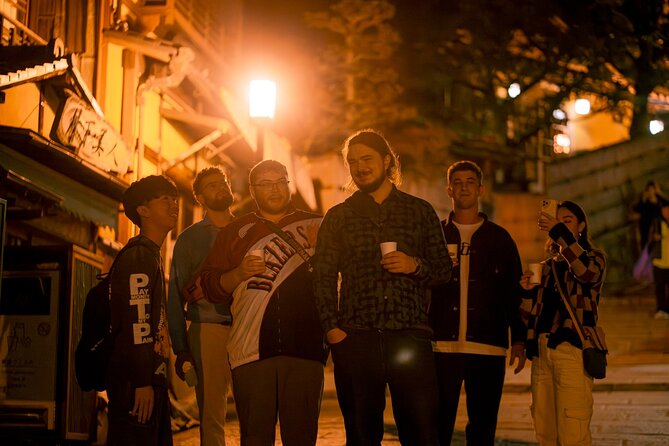
Gion is Kyoto’s best-known geisha district, but it is easy to misunderstand if you only arrive with a camera and no context. The district is not a theme park. It is a living neighborhood of restaurants, teahouses, shrines, and traditional wooden machiya houses.
That is where a local guide earns the price of admission. You get help reading the area with respect, along with explanations of geiko and maiko culture, samurai customs, Zen meditation, and the role of the shrines along the route.
The evening timing is important. Lanterns and quiet side streets create the mood people hope for in Gion, and you may spot a geiko or maiko moving between appointments. That sight is never guaranteed, and you should not treat anyone working in the district as a photo prop. Keep your voice down and follow the guide’s lead.
The route begins near the Kamo River at Kikunoi Roan, in the Saitocho area. The river is one of Kyoto’s most pleasant reference points, with paths and open views that contrast with the enclosed lanes ahead. From here, you move toward Gion and then continue east into Higashiyama.
More Kimono & Culture Experiences in Kyoto
- Kyoto Geisha Walking Tour: Gion District & Hidden Gems
★ 4.7 · 3,273 reviews - Kyoto: Gion Magical Night Walking Tour with Geisha Trivia
★ 4.9 · 2,393 reviews - Kyoto: Gion Geisha District Walking Tour – Stories of Geisha
★ 4.7 · 2,187 reviews
Hanamikoji Street and the wooden heart of Gion
The first major stop is Gion itself, followed by Hanamikoji Street. Hanamikoji is one of the district’s most recognizable roads, lined with carefully preserved wooden machiya and traditional establishments.
This is a good place to hear how the geisha world fits into Kyoto’s broader culture. Your guide can explain the difference between geiko and maiko, describe the work behind an evening performance, and point out details you could easily miss while walking alone.
The setting is beautiful, but it can also be busy. Hanamikoji is a public street in an active neighborhood, not a stage set. You may find photographers and other tour groups here, especially at popular times. The small-group format helps, but it cannot make the street empty.
The tour’s sake element adds a social rhythm to the walk. Instead of stopping for a long formal tasting, you can expect sake to be sampled during the outing. This suits you if you enjoy a casual drink while walking and learning. It will feel less satisfying if you want a seated tasting with detailed instruction about brewing, aroma, and food pairing.
Yasui-Konpiragu and the meaning behind the shrine
Yasui-Konpiragu is a small but memorable Shinto shrine with a distinctive purpose. It is associated with breaking unwanted relationships and forming better ones. Its large enmusubi and en-kiri stone, covered with prayer papers, gives the site an immediate visual focus.
This stop adds something personal to the route. You are not only looking at architecture. You are seeing how people use a shrine to mark a change in their lives, ask for help, or leave behind an unhealthy connection.
The guide commentary matters here because the shrine’s meaning is easy to miss if you simply walk past it. Allow about 15 minutes, enough time to hear the story and take in the site without turning the visit into a long temple stop.
Yasaka Pagoda and the old Higashiyama slopes
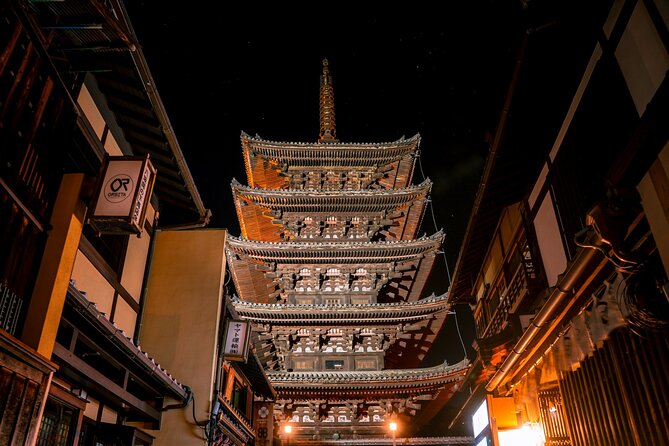
Hokan-ji Temple, better known as Yasaka Pagoda, is one of Kyoto’s most recognizable views. The five-story pagoda rises above the surrounding streets and gives this part of Higashiyama its classic postcard shape.
The pagoda dates to the sixth century, making it one of the oldest landmarks on the route. At night, its silhouette and nearby traditional buildings can make an especially strong impression. This is one of the best photo stops, though the streets around it can be tight and busy.
You do not appear to get a long interior temple visit here. The stop is brief, around 15 minutes, and works mainly as a chance to understand the landmark, see the surrounding streets, and continue through Higashiyama.
From the pagoda, the route heads toward Ninenzaka and Sannenzaka. These stone-paved pedestrian streets are lined with old wooden buildings and shops. Their gentle slopes are manageable for most people with moderate fitness, but they are not ideal for anyone hoping to avoid hills or uneven surfaces.
More Sake & Bar Hopping Tours in Kyoto
- Kyoto Night Foodie Tour in Gion (9+ dishes + 6 Sake tastings)
★ 5.0 · 1,762 reviews - 3-Hour Kyoto Insider Sake Brewery Tour with Tastings & Pairings
★ 5.0 · 917 reviews - Arashiyama Bamboo, Temple, Monkeys, or Secret Sake Brewery
★ 4.8 · 886 reviews - Kyoto: Izakaya Bars Guided Walking Tour
★ 4.9 · 815 reviews
Ninenzaka, Sannenzaka, and Nene-no-Michi

Ninenzaka and Sannenzaka are among Kyoto’s most attractive old streets. Their preserved facades, stone paving, and narrow scale make them feel very different from modern Kyoto.
The listed time at each is short, about five minutes. Think of these stops as part of the walking experience rather than full sightseeing visits. You will pause for orientation and photographs, then keep moving.
That short timing has an upside. You can see the streets without spending the whole evening in one crowded shopping area. The downside is that anyone wanting time to browse stores, enter temples, or take careful photographs will need to return independently.
Nene-no-Michi offers a quieter change of pace. Named for Nene, the wife of Toyotomi Hideyoshi, this stone path links the area around Kodaiji with Maruyama Park. It is a pleasant stretch for listening to the guide and noticing the contrast between the tourist lanes and the more peaceful paths nearby.
The tour does not list admission tickets for these stops, and the experience is built around walking outside. That keeps the price low, but it also means you should not expect extended indoor visits or reserved access.
Yasaka Shrine, the natural finish
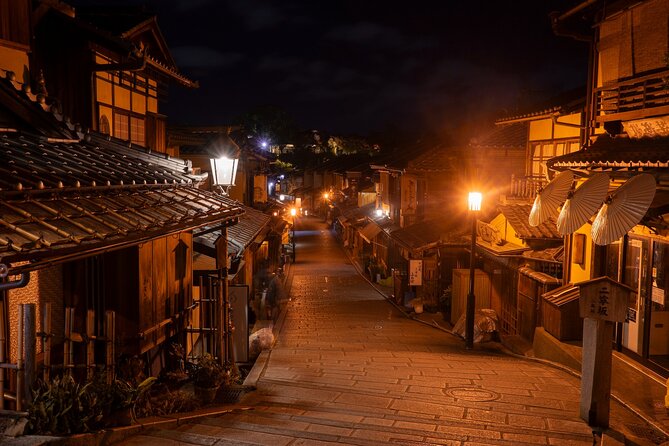
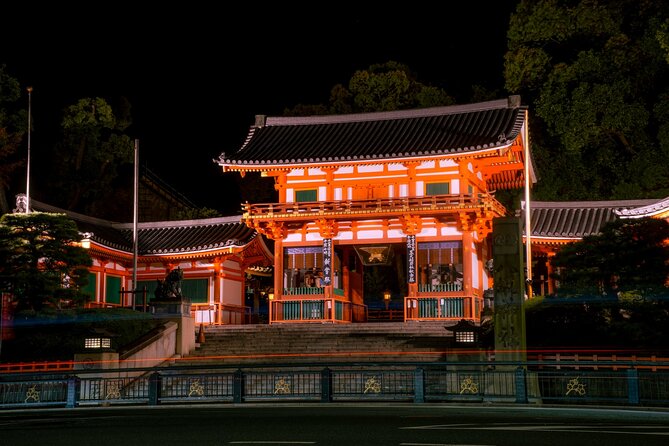
The walk ends at Yasaka Shrine, also called Gion Shrine. This major Shinto site dates to 656 and has long been tied to the life of Gion.
The shrine is a fitting finish because it brings together the district’s religious and cultural sides. After walking through teahouse lanes, old merchant streets, and temple views, you arrive at a place that has shaped the neighborhood for centuries.
You have about 20 minutes here, the longest stop on the route. That gives you time to look around and ask final questions before the group separates.
The tour ends at the shrine rather than returning to the starting point. This is useful if you plan to continue around Gion or head toward nearby sights. It is less convenient if your hotel is back near the Kamo River. The operator notes that most buses may have stopped running by the end, but staff can help you arrange a taxi or return to the starting point.
What the sake tasting adds
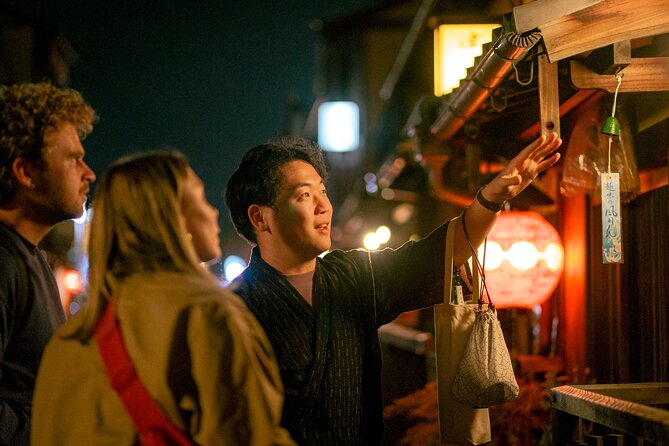
Sake is more than a novelty here. Used well, it gives the walk a relaxed social feel and offers a small introduction to regional Japanese tastes. Several experiences with guides such as Shumpei included samples from different parts of Japan, allowing you to compare styles rather than drink only one bottle.
Snacks may also be provided. The available information does not specify exactly what they are, so you should not book this as a meal or substantial food stop.
The phrase sake-in-hand should be taken literally as a casual walking-tasting concept, not as a polished bar experience. One participant found the sake and snack presentation too basic for the price. I would frame it this way: the drink is a pleasant bonus that improves the atmosphere, but the main product is the guided night walk.
You must be at least 20 to take part, and alcohol should be consumed responsibly. If you do not drink, this may not be the best match, since the sake is a central feature rather than an incidental extra.
Guide quality can shape the whole evening

The strongest experiences have come from guides who make the walk conversational. Shumpei was praised for being friendly, answering questions about life in Japan, and making the outing feel personal. Shunpei received similar praise for combining site information with easy conversation. Mune was also singled out for a friendly approach and good sake choices.
That personal exchange is one of the tour’s biggest strengths. You can ask about cultural differences, local customs, shrines, and the modern life of Kyoto. A small group makes this easier than a large bus tour or a scripted audio guide.
Still, the quality is not perfectly uniform. One participant found little interaction and felt the guide mainly knew the route without sharing enough content. Another felt the walk ended after about 70 minutes instead of the expected 90.
That does not make the tour a poor choice, but it is worth understanding the format. You are booking a compact walking experience, not a guaranteed lecture with a fixed running time. If you want the richest result, arrive with questions. Ask about geiko culture, the history of Gion, sake regions, shrine customs, or what daily life is like in Kyoto. An engaged group usually gives the guide more to work with.
Is $27.84 good value?
At $27.84 per person, the price is reasonable if you want three things in one short outing: a local guide, an evening walk through Gion and Higashiyama, and sake tasting.
You are not paying for entrance tickets, a meal, transport, or a long formal performance. The value comes from orientation and context. Gion’s narrow streets are easy to wander without understanding, and the guide helps connect the buildings, shrines, and customs into a coherent route.
The small maximum of 10 is important. A large group would be awkward on Ninenzaka, Sannenzaka, and the back lanes of Gion. With fewer people, you have a better chance to hear the guide and ask questions.
The price is less compelling if you want a long tour, extensive food, or guaranteed geisha sightings. You can walk through many of these streets for free on your own. The tour earns its keep through cultural explanation, route-finding, and the included sake.
Practical details for a comfortable walk
The tour lasts approximately one hour to one and a half hours. Because the route covers several districts, you should wear comfortable shoes and clothing. Expect narrow streets, stone paving, and some slopes.
It is near public transportation at the starting point, but the tour finishes at Yasaka Shrine. Plan your onward route before you begin, especially if you are staying outside central Kyoto.
The activity requires a moderate level of physical fitness. It is not described as wheelchair accessible, and the stone-paved slopes and narrow lanes may be difficult for anyone with mobility concerns.
Keep your voice low in residential areas. This is not just a matter of etiquette. Quiet behavior helps preserve the nighttime character that makes the walk appealing in the first place.
You receive booking confirmation at the time of purchase. Free cancellation is available up to 24 hours before the start time, with no refund inside that window. The outing depends on good weather and a minimum number of participants. If the operator cancels for either reason, you can choose another date or experience, or receive a full refund.
Who will enjoy this Gion walk most?
I would choose this tour if you are visiting Kyoto for the first time and want a gentle introduction to Gion after sunset. It also suits anyone curious about geisha culture but unsure how to explore the district respectfully.
It is a good fit for couples, friends, and solo visitors who enjoy walking and informal conversation. The sake tasting makes it especially appealing if you like trying local drinks without committing to a full restaurant or brewery visit.
You may want something else if you prefer a structured cultural lecture, a seated sake seminar, a longer itinerary, or guaranteed time inside temples and shrines. You should also skip it if you do not drink alcohol or dislike walking on uneven streets.
Should you book it?
Book this Gion Geisha District and Sake-in-Hand Walking Tour if you want a low-cost, atmospheric evening with a small group and a guide who can add human context to Kyoto’s famous streets. The best version of the experience combines lantern-lit Gion, quiet Higashiyama lanes, shrine stories, and a few regional sake samples.
Go in with realistic expectations. The route is short, the tasting is casual, and guide interaction can vary. If those limits suit you, the tour offers a practical and memorable first look at Kyoto after dark, with enough cultural background to help you explore Gion more thoughtfully afterward.
FAQ
How much does the Gion sake walking tour cost?
The listed price is $27.84 per person. Group discounts may be available.
How long does the tour last?
The approximate duration is one hour to one hour and 30 minutes. The exact length may vary.
Where does the tour begin?
The meeting point is Kikunoi Roan at 118 Saitocho, Shijo-sagaru, Shimogyo Ward, Kyoto, 600-8012, near the Kamo River.
Where does the tour end?
The tour ends at Yasaka Shrine, at 625 Gionmachi Kitagawa, Higashiyama Ward, Kyoto, 605-0073.
Is sake included?
Yes. The experience includes a local sake tasting. Sake from different regions of Japan may be offered, and snacks have also been provided on some outings.
How old must you be to join?
All participants must be at least 20 years old because alcohol is served.
How many people can join the tour?
The maximum group size is 10 participants.
Should I wear special clothing?
You should wear comfortable clothing and walking shoes. The route involves a lot of walking, stone-paved streets, narrow lanes, and some slopes.
Can I cancel for a full refund?
Yes, if you cancel at least 24 hours before the experience start time. Cancellations or changes made within 24 hours are not refundable. If bad weather or insufficient participation causes the operator to cancel, you can receive a full refund or choose another option.
More Drinking Tours in Kyoto
- Kyoto: Insider Sake Brewery Tour with Sake and Food Pairing
★ 5.0 · 704 reviews - Kyoto Sake Brewery & Tasting Walking Tour
★ 5.0 · 623 reviews - Kyoto Bar Hopping Night Tour
★ 5.0 · 613 reviews - Kyoto Local Bar Crawl in Kawaramachi Area
★ 5.0 · 378 reviews
More Walking Tours in Kyoto
- Private Kyoto Tour with a Local, Highlights & Hidden Gems, Personalised
★ 5.0 · 1,543 reviews - Kyoto Gion Geisha District Walking Tour – The Stories of Geisha
★ 5.0 · 1,441 reviews - Nishiki Market Brunch Walking Tour (7 Tastings + Brunch)
★ 5.0 · 1,355 reviews - Kyoto Arashiyama Walking Tour: Bamboo, Monkeys, Gardens & Secrets
★ 5.0 · 1,216 reviews
Just added around Kyoto
- Private Guided Traditional Buddhist Cooking in Japan★ 5.0 · 16 reviews
- Your Private Vacation Photography Session In Kyoto★ 5.0 · 110 reviews
- Kyoto: Zen Meditation at a Private Temple with a Monk★ 5.0 · 25 reviews
- Private Pewter Sake Cup Experience with a Kyoto Artisan★ 5.0 · 31 reviews
- Traditional Japanese Washi Papermaking- Kyoto morning★ 5.0 · 77 reviews
- Kyoto Wagashi(Japanese sweets) Cooking Class near Fushimiinari★ 5.0 · 60 reviews
- Kyoto Private 6 hour Tour: English Speaking Driver Only, No Guide★ 5.0 · 88 reviews
- Kyoto:Family-Friendly Kimono & Yukata Experience at WARGO★ 5.0 · 147 reviews
Kimono & Culture Experiences, compared.

Kyoto Geisha Walking Tour: Gion District & Hidden Gems
Read our review →
Gion Magical Night Walking Tour with Geisha Trivia
Read our review →
Gion Geisha District Walking Tour – Stories of Geisha
Read our review →
Best of Kyoto: Gion, Geisha, Pagodas & Cobblestones
Read our review →

Kyoto Gion Geisha District Walking Tour – The Stories of Geisha
Read our review →