REVIEW · MORNING
Traditional Japanese Washi Papermaking- Kyoto morning
Kyoto has no shortage of temples, gardens, and crowded shopping streets. This class gives you something different: a chance to make traditional washi paper from raw materials and shape it into a souvenir with your own hands. You work in a small Japanese-style house with bilingual instructors, often Hiro and Junko, who explain the craft patiently and clearly.
I like the peaceful, four-person setting, which means you get real help instead of being lost in a large group. I also like the choice of seasonal decorations, including cherry blossoms, maple leaves, and paper cut-outs. The main consideration is time: the basic class lasts about one hour, and the standard session may feel short if you want to make several gifts. You can add another hour for unlimited papermaking, but that costs extra.
In This Review
- Key points to know before booking
- Why Kyoto washi paper makes a better souvenir
- Arriving at KamiTOwa in central Kyoto
- A calm introduction from Hiro and Junko
- Making your first sheet of washi paper
- Choosing between postcards, a mat, a lantern, and a panel
- What the 60-minute format really feels like
- The small group is a major advantage
- The shop adds a pleasant extra stop
- Is the $33.03 price good value?
- Practical details for your Kyoto morning
- Who should book this washi workshop?
- Should you book Traditional Japanese Washi Papermaking?
- FAQ
- Where does the washi papermaking class take place?
- How long does the workshop last?
- Is the class taught in English?
- How many people can join the class?
- What can I make during the workshop?
- Is transportation included?
- Can children participate?
- How close is the workshop to public transportation?
Key points to know before booking
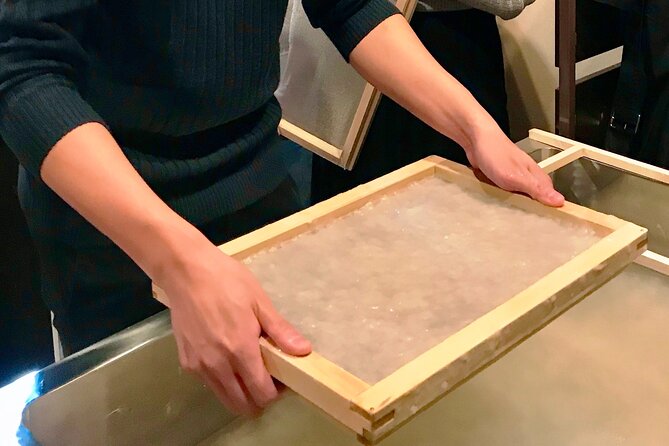
- You make the paper yourself: This is not a demonstration only. You handle the materials and create a finished piece.
- The group is capped at four people: Expect close guidance in a quiet, small studio.
- Seasonal decorations add personality: Use pressed flowers, leaves, and paper shapes to design your work.
- Hiro and Junko teach in Japanese and English: Instructions are easy to follow, with help available throughout.
- The regular class takes about 60 minutes: Postcards are the simplest choice, while lanterns and larger pieces may require an added fee or extra time.
- The studio is easy to reach: It is a six-minute walk from Karasuma Oike Station Exit 6 and about nine minutes from Shijo Station Exit 24 or Karasuma Station.
Why Kyoto washi paper makes a better souvenir
A shop-bought souvenir can remind you of Kyoto. A piece of paper you made, decorated, and carried home tells a more personal story.
Washi is traditional Japanese paper, valued for its careful production and distinctive texture. This workshop lets you see the craft in a practical way rather than only viewing finished paper goods behind glass. You start with raw materials, form your own paper, and add decorative details before turning it into something useful or displayable.
That hands-on chain matters. You are not simply sticking a printed image onto a card. You get a feel for the care involved in producing a sheet of paper, then decide how flowers, leaves, and cut-outs should sit on its surface. Even a simple postcard becomes a small record of your time in Japan.
The class also gives you a calm break from Kyoto’s busy central streets. It works especially well on a rainy morning or between visits to nearby shopping areas. You can spend an hour making something quietly, then continue with your day.
A few more Kyoto trips to weigh up
- Kyoto Early Morning Tour with English-Speaking Guide
★ 5.0 · 1,427 reviews - Kyoto: Early Morning Tour with English-Speaking Guide
★ 4.9 · 1,128 reviews - From Kyoto: Nara Guided Morning Tour
★ 4.6 · 335 reviews
Arriving at KamiTOwa in central Kyoto
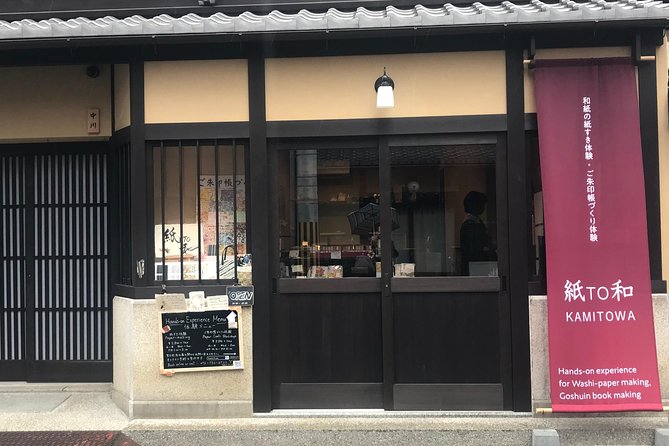
You make your own way to 345 Sanjōchō, Nakagyo Ward, where the class takes place at the KamiTOwa workshop. The meeting point is also the end point, so there is no need to arrange a second pickup.
The location is close to several rail and subway stops. Karasuma Oike Station on the Kyoto Metro Karasuma Line is about a six-minute walk from Exit 6. From Shijo Station Exit 24, or Karasuma Station on the Hankyu Line, the walk is about nine minutes. Those short walks make the class easy to fit into a day based around central Kyoto.
The setting is part of the appeal. This is a traditional Japanese-style house and small shop rather than a large commercial classroom. The compact setting helps the class feel personal, though it also means the group is limited to a maximum of four people. Book ahead if your schedule is fixed.
You receive confirmation when you book, and a mobile ticket is provided. Transportation is not included, so you need to cover your own train, subway, or walking costs.
A calm introduction from Hiro and Junko
After introductions, Hiro and Junko explain the papermaking process in Japanese and English. The instructors are described as friendly, patient, and helpful, with special care given to children and first-time crafters.
The teaching style suits people who prefer clear guidance rather than a formal lecture. You learn what you need for each stage, then try it yourself under close supervision. If you are unsure how to arrange your design or handle the paper, help is close by because the group is so small.
A short educational video may also be shown during drying time. It explains more about the process and background of Japanese papermaking, adding useful context while your work is prepared. This is a good touch because the class moves quickly, and the video helps fill in the parts of the craft that cannot be covered through your own short session.
The experience is suitable for most people, including children who are accompanied by an adult. It has worked well for families with children as young as seven, as well as teenagers and adults. Young children may need help with careful placement and handling, but the workshop is not limited to experienced artists.
Making your first sheet of washi paper
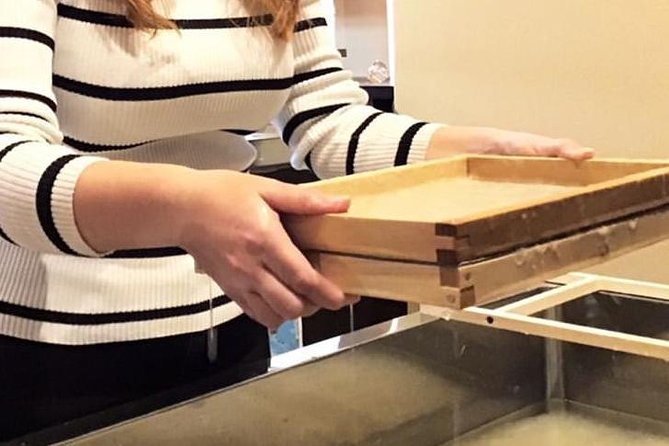
The central activity is making paper from raw materials. Your instructor explains each part of the process, then you follow along rather than simply watching.
You will work with the paper mixture and form your own sheet. The process has many stages, but the class is organized so you can complete the essential work in about an hour. This makes it approachable even if you have never tried papermaking or any Japanese craft before.
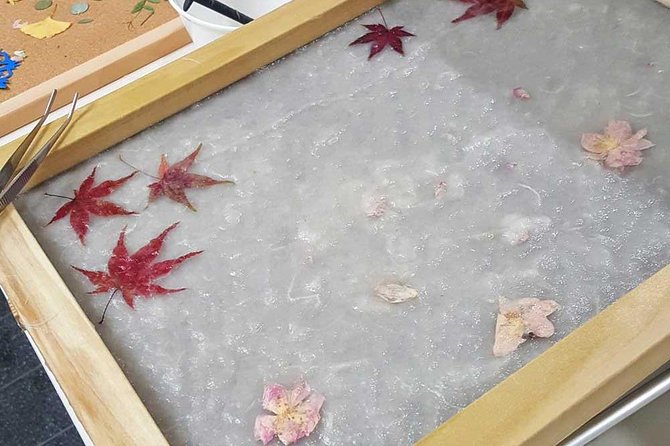
The most enjoyable part for many people is the design stage. You choose from seasonal pressed flowers and leaves, including cherry blossoms and maple leaves, along with paper cut-outs. You place these elements on the sheet to create a pattern that feels like your own.
The materials give you a natural Kyoto connection without forcing a particular design. Cherry blossoms bring a familiar spring image, while maple leaves suggest autumn. You can keep the arrangement simple or spend more time considering the balance of shapes and colors.
I would take a moment before placing anything. Once the decoration is arranged, the sheet becomes your personal composition, and small changes can make a big difference. If you are making this with a child, letting them choose the flowers and paper shapes is likely to be more rewarding than trying to control the final design.
Same city, a completely different kind of day:
- PERFECT KYOTO 1-Day Bus Tour
★ 5.0 · 13,518 reviews - Kyoto: Fushimi Inari, Kinkakuji, Bamboo Grove 1 Day Bus Tour
★ 4.8 · 4,316 reviews - Kyoto: Tea Ceremony in a Traditional Tea House in Kiyomizu
★ 4.9 · 3,519 reviews - Kyoto Geisha Walking Tour: Gion District & Hidden Gems
★ 4.7 · 3,273 reviews
Choosing between postcards, a mat, a lantern, and a panel
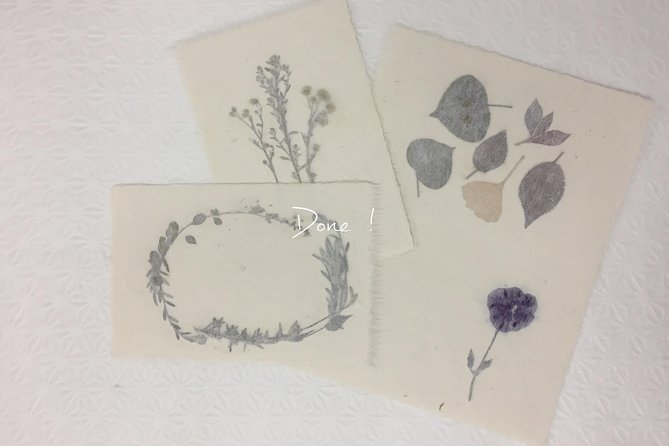
The basic activity includes the making and decorating process, but the final format depends on what you choose.
A set of postcards is the straightforward option. It gives you several small pieces to take home or share with family and friends. One description of the class specifies four regular cards as the included choice, making this a practical option if you want multiple souvenirs rather than one larger object.
A table mat gives your decorated paper a more useful household role. It is larger than a card and lets you enjoy the design as part of your daily surroundings. A tapestry panel offers a more decorative result and can work well if you want to display the paper rather than write on it.
The wraparound lampshade is the most distinctive choice. It turns your handmade paper into something that can be displayed at home, and you can expect an additional charge for some larger or upgraded options. One participant chose a lantern for a small supplement and was pleased with the result.
Check the exact extra fee and what is included when booking or on arrival. The supplied information confirms that some options cost extra, but it does not give a full price list. The basic price is therefore easiest to judge if you plan to make postcards or another standard item.
What the 60-minute format really feels like
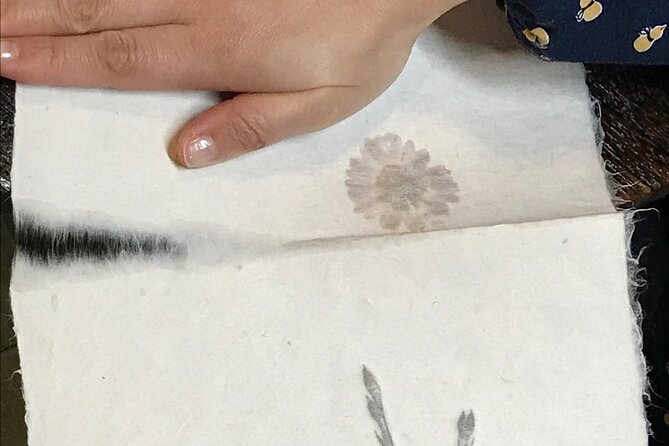
An hour is enough to make a memorable object, but it is not a leisurely full-day craft course.
The class moves from introduction to instruction, paper making, decoration, and finishing in a compact period. You get the satisfaction of completing a project from beginning to end, but you will not have unlimited time to experiment with many sheets unless you pay for the additional hour.
That short format is useful for a busy Kyoto itinerary. You can fit the class into a morning before lunch, shopping, or sightseeing. The studio is also close to the covered market area, making it practical to combine with a visit nearby.
If you are traveling with children, the hour is a sensible length. It keeps the activity focused and gives them a finished souvenir before attention begins to fade. If you are a serious paper enthusiast or want to produce several gifts, add the extra hour if available. The additional time is specifically described as unlimited papermaking at your own expense.
Remember that handmade paper may need care after class. You will leave with your work, and it needs to be carried unless you arrange otherwise. The finished products are packaged well, but I would still plan to keep them flat and protected during the rest of your trip.
The small group is a major advantage
The maximum group size of four is one of the strongest reasons to choose this activity over a large craft workshop.
With only a few people in the room, the instructors can watch each stage and correct small mistakes before they affect your paper. You can also ask questions about the process, materials, or design without waiting for a guide to finish with a crowd.
This setup is particularly helpful for families. An adult can assist a child while the instructor continues to guide everyone. It also suits couples, friends, and solo visitors who want a quiet activity without the social pressure of a large class.
The trade-off is availability. A four-person limit means fewer spaces at each start time. If you want a particular morning, booking early is sensible.
The shop adds a pleasant extra stop
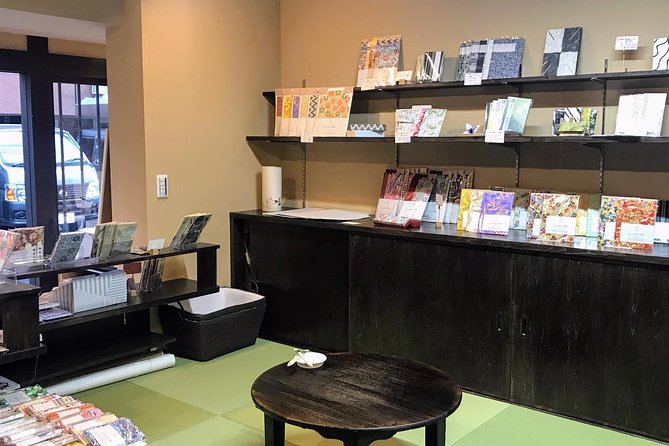
The workshop is connected with a small shop selling paper goods and other local creations. You can browse after the class and compare your handmade work with finished items made by skilled artisans.
There is no need to purchase anything. The shop is an optional part of the visit, not a sales presentation built into the class. Still, it can help you understand how washi is used beyond postcards and mats.
I like this combination because it puts your new skill in context. After making one sheet yourself, you look at other paper products with more respect for the workmanship involved. It also gives you another chance to find a Kyoto gift if your suitcase has room.
Is the $33.03 price good value?
At $33.03 per person, the class is reasonably priced for a one-hour cultural activity in central Kyoto. Taxes, fees, and handling charges are included, so the advertised price does not leave you adding those costs later. You still pay for transportation and any optional upgrade or extra hour.
The value depends on what you want. If you want a long, technical lesson in Japanese papermaking, this is too short. If you want a guided cultural activity, a quiet change of pace, and a handmade souvenir, the price makes sense.
You are paying for more than the paper itself. The fee covers instruction, materials, design elements, and the chance to complete a project with help from bilingual teachers. A standard set of postcards gives you several items, while a lantern, table mat, or panel may provide more lasting display value at an added cost.
For families, the value improves because the activity suits a wide age range and does not require prior craft experience. For solo visitors, the four-person limit gives you more personal attention than you normally get at this price.
Practical details for your Kyoto morning
The class begins and ends at the same central Kyoto address. Plan your route using Karasuma Oike, Shijo, or Karasuma Station, and allow time for the walk from the correct exit.
Wear something you can work comfortably in. The provided information does not list a dress code, but papermaking is a hands-on activity, so you should avoid bringing anything you would worry about getting damp or marked.
Children must be accompanied by an adult. Most people can take part, and the class is operated in Japanese and English. The mobile ticket is convenient for a phone-based itinerary.
The experience has free cancellation if you cancel at least 24 hours before the local start time. Cancellations or changes made less than 24 hours before the start are not refunded or accepted, so keep that deadline in mind when building your Kyoto schedule.
Who should book this washi workshop?
I would recommend it most strongly to:
- Families looking for a creative activity that works for children and adults
- Couples or friends who want a handmade keepsake rather than a mass-produced souvenir
- Solo visitors seeking a quiet morning activity in central Kyoto
- Craft lovers interested in traditional Japanese techniques
- Anyone who needs an indoor plan for a rainy day
- Visitors who enjoy learning a little cultural background while making something practical
It is less suitable if you want a long workshop with advanced instruction, many repeated attempts, or a full explanation of every stage of professional washi production. The one-hour format gives you an accessible introduction, not an apprenticeship.
Should you book Traditional Japanese Washi Papermaking?
Yes, if you value personal souvenirs and small-group instruction. The class gives you a real hand in making the paper, decorating it with seasonal materials, and taking home a finished object. Hiro and Junko provide bilingual guidance, and the calm studio makes a welcome pause from Kyoto’s busy sights.
Choose the standard postcard option if you want several affordable gifts. Pay extra for a lantern, table mat, or larger panel if you want a more substantial keepsake, and consider adding the second hour if you know you will want more time.
At $33.03, this is a sensible choice for a one-hour cultural experience near central Kyoto. Book it when you want to slow down, make something rather than simply buy something, and leave Japan with a souvenir that carries your own design.
FAQ
Where does the washi papermaking class take place?
The class takes place at KamiTOwa, 345 Sanjōchō, Nakagyo Ward, Kyoto, Japan. The activity begins and ends at the same meeting point.
How long does the workshop last?
The standard experience lasts approximately one hour. You can add an additional hour of unlimited papermaking at your own expense.
Is the class taught in English?
Yes. The instructors operate in both Japanese and English.
How many people can join the class?
The activity has a maximum of four participants.
What can I make during the workshop?
You can make and decorate washi paper for postcards, a table mat, a wraparound lampshade, or a tapestry panel. Some choices may require an additional fee.
Is transportation included?
No. You make your own way to the workshop, and transportation to and from the location is not included.
Can children participate?
Yes. Children can participate, but they must be accompanied by an adult.
How close is the workshop to public transportation?
It is about a six-minute walk from Exit 6 of Karasuma Oike Station and about a nine-minute walk from Exit 24 of Shijo Station or Karasuma Station on the Hankyu Line.
Just added around Kyoto
- Private Guided Traditional Buddhist Cooking in Japan★ 5.0 · 16 reviews
- Kyoto: Gion Geisha District & Sake-in-Hand Walking Tour★ 5.0 · 37 reviews
- Your Private Vacation Photography Session In Kyoto★ 5.0 · 110 reviews
- Kyoto: Zen Meditation at a Private Temple with a Monk★ 5.0 · 25 reviews
- Kyoto Wagashi(Japanese sweets) Cooking Class near Fushimiinari★ 5.0 · 60 reviews
- Private Pewter Sake Cup Experience with a Kyoto Artisan★ 5.0 · 31 reviews
- Kyoto Private 6 hour Tour: English Speaking Driver Only, No Guide★ 5.0 · 88 reviews
- Kyoto:Family-Friendly Kimono & Yukata Experience at WARGO★ 5.0 · 147 reviews
Morning, compared.
Kyoto Early Morning Tour with English-Speaking Guide
Read our review →Early Morning Tour with English-Speaking Guide
Read our review →
World Heritage Shirakawa-go Morning Guided Tour
Read our review →
Nara Early Morning Tour (Kyoto or Osaka Departure Available)
Read our review →
Hiroshima in a Nutshell: Morning Bike Adventure
Read our review →