
REVIEW · SUMO EXPERIENCES
Tokyo: Sumo Morning Training Visit
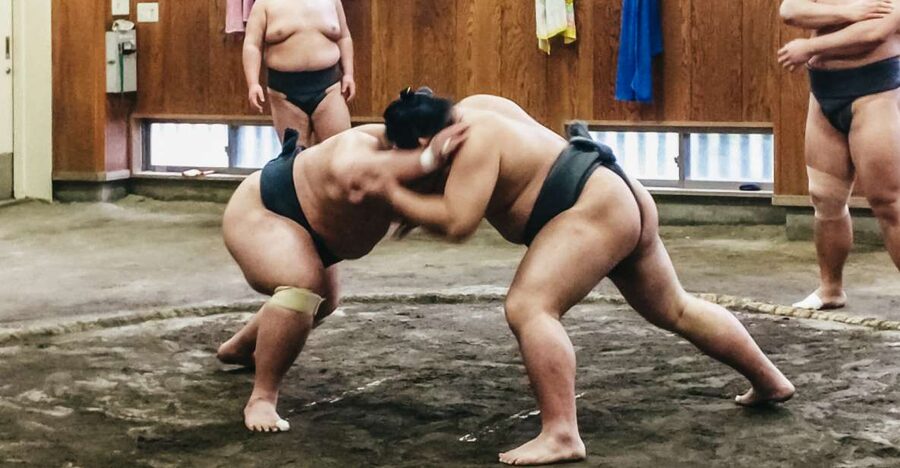
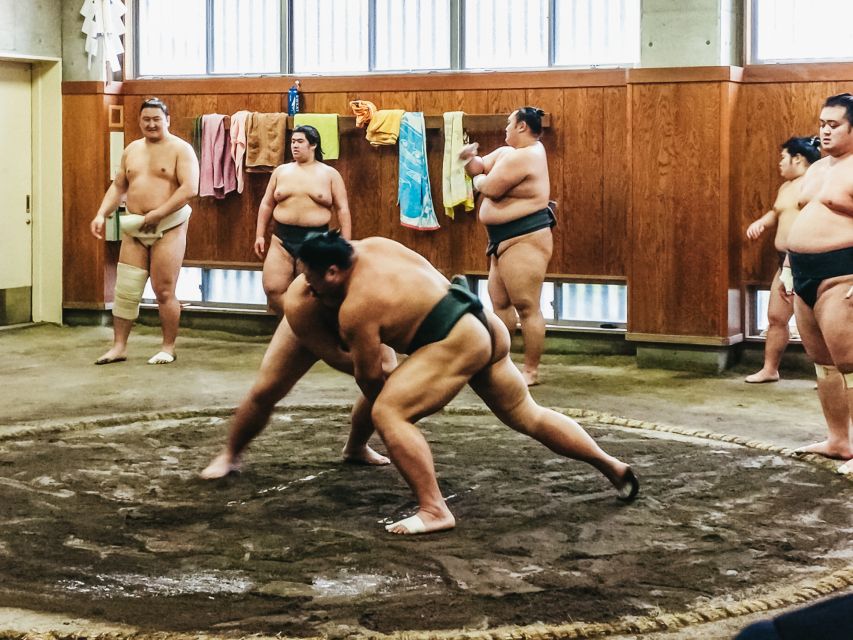
Professional wrestlers slam into one another only a few feet away, then reset and repeat the drill. This is not a staged sumo show. You are watching a working morning practice inside a real Tokyo stable, where strength, balance, ritual, and discipline matter more than entertainment.
I like the close view of serious training and the rare chance to enter a place most visitors see only from outside. I also like the group photo at the end, which gives the visit a clear personal finish. The main drawback is comfort: you may sit quietly on the floor for an hour or much longer, with no food, drinks, or casual movement.
In This Review
- Key points to know before you book
- Inside a Tokyo sumo stable
- What the one-hour visit really looks like
- The training is the show
- A close look at Japanese discipline
- Seating, sightlines, and comfort
- The guide and the educational side
- Finding the correct meeting point
- Optional hotel transfer
- Tournament months require special planning
- Value at $77 per person
- Who should book this experience
- Should you book the Tokyo sumo training visit?
- FAQ
- Where does the sumo training visit meet?
- How long does the activity last?
- Can I choose the sumo stable?
- Is the activity guided in English?
- Can I take photographs or record video?
- Can I take a picture with the wrestlers?
- Do I sit on the floor?
- Can I bring food, drinks, luggage, or a large bag?
- Is hotel pickup available?
Key points to know before you book
- Real stable, not a theatrical demonstration: You watch active professional wrestlers complete warmups, drills, pushing exercises, and sometimes sparring.
- Meeting details arrive late: The exact stable and meeting instructions are normally sent by email about two or three days before the visit.
- Tournament months change the experience: In January, May, and September, training may last only about 30 minutes.
- Floor seating requires patience: Arrive early for a better view, and ask ahead about a chair if your knees or hips make floor sitting difficult.
- Silence is part of the etiquette: Phones must be silent, loud talking is forbidden, and flash photography is not allowed.
- The $77 price buys access, not a full lesson: You get the stable visit and group photo, but detailed explanations may be limited.
Inside a Tokyo sumo stable
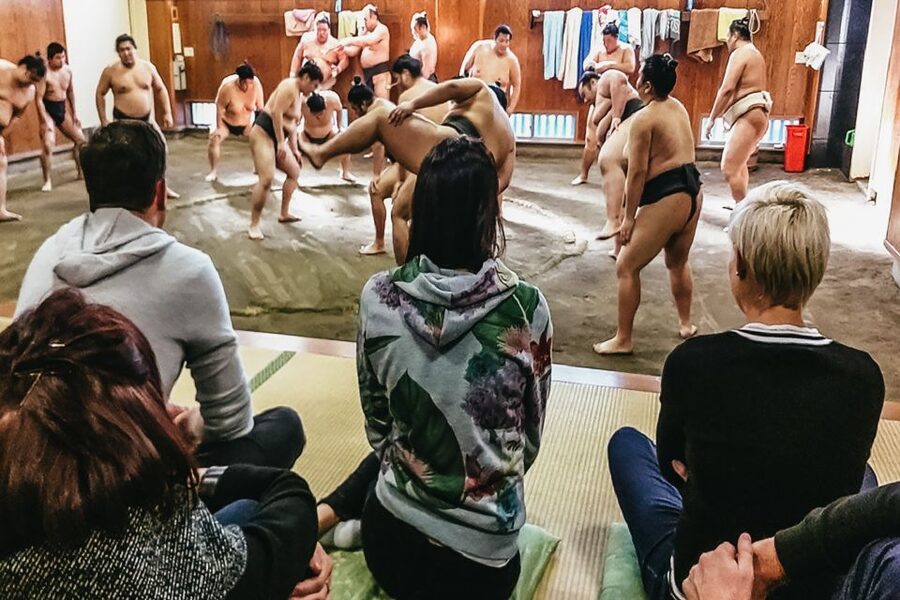
The best part of this experience is the setting. A tournament takes place in a large arena, with spectators separated from the action by distance, noise, and ceremony. At a stable, you sit near the practice area and watch wrestlers work through the movements that prepare them for competition.
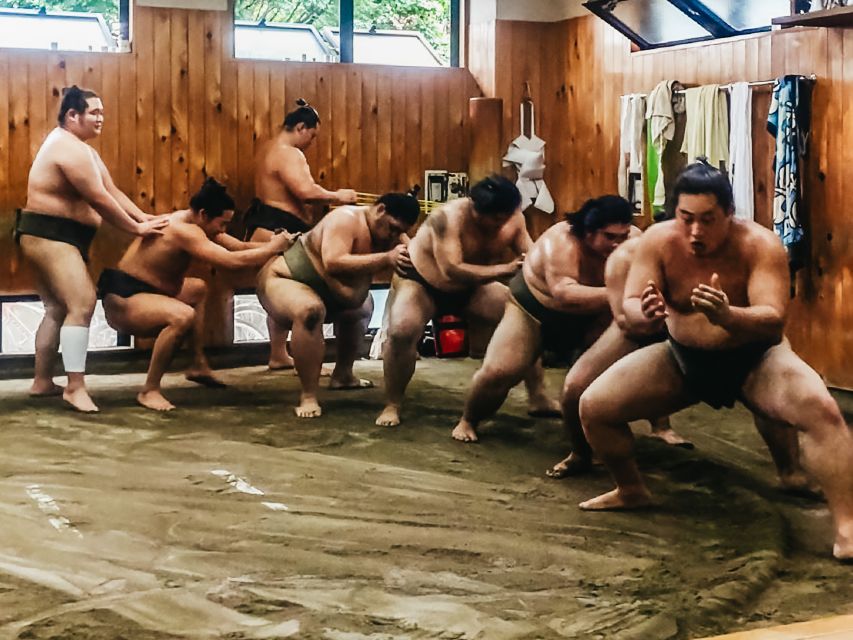
You may see stretching, warmups, repeated footwork, pushing drills, and bouts of sparring. The action can look simple at first. Then a wrestler drives forward, absorbs the force, shifts his balance, and sends another large body across the clay. From this distance, you can hear the impact and see the effort in a way television cannot show.
The training is not arranged for your convenience. Some sessions are intense, some are quieter, and the schedule can change with the wrestlers condition. One visit may include vigorous sparring, while another may focus more on warmups and controlled drills. That uncertainty is part of the bargain when you choose a real practice instead of a performance.
The stable is also a place of work and tradition. You are entering only with the guide, and your conduct affects the wrestlers concentration. Expect to sit still, keep your voice low, and watch without trying to turn the session into a photo opportunity.
More Sumo Experiences in Tokyo
- Tokyo: Sumo Show and Dining Experience
★ 4.8 · 2,742 reviews - the SUMO show
★ 5.0 · 1,960 reviews - Tokyo Shinjuku Sumo Show & Experience with Photo
★ 5.0 · 1,750 reviews
What the one-hour visit really looks like
The advertised duration is one hour, and normal training is described as lasting about 60 minutes. Actual timing can be longer. Some sessions have lasted 90 minutes or two hours, and at least one account described nearly three hours of floor sitting.
That difference matters when planning your morning. Do not schedule a tight museum booking or an important train immediately afterward. If the session continues beyond the stated hour, you may leave early, but leaving before the end means giving up the group picture.
The visit usually follows this general pattern:
- You meet the host at the assigned location.
- The host checks your name and brings you into the stable.
- You take a seat around the practice area.
- Wrestlers complete their morning training.
- You remain quiet and avoid flash photography or unauthorized video.
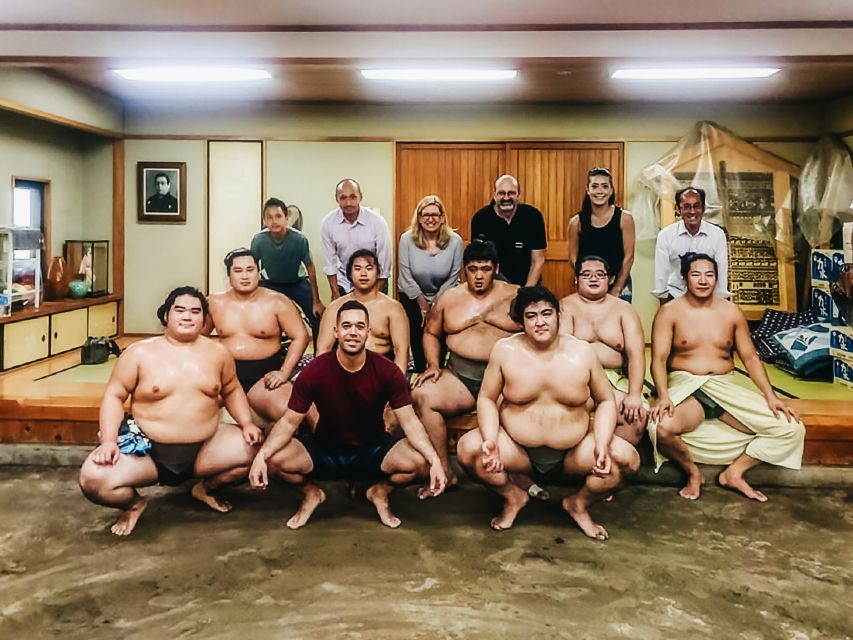
- At the end, you join a group picture with the wrestlers.
The group photo is included, but it is not a private portrait session. Several people may be photographed together, and the timing depends on the stable and the wrestlers. Treat it as a keepsake rather than the main reason to book.
The training is the show
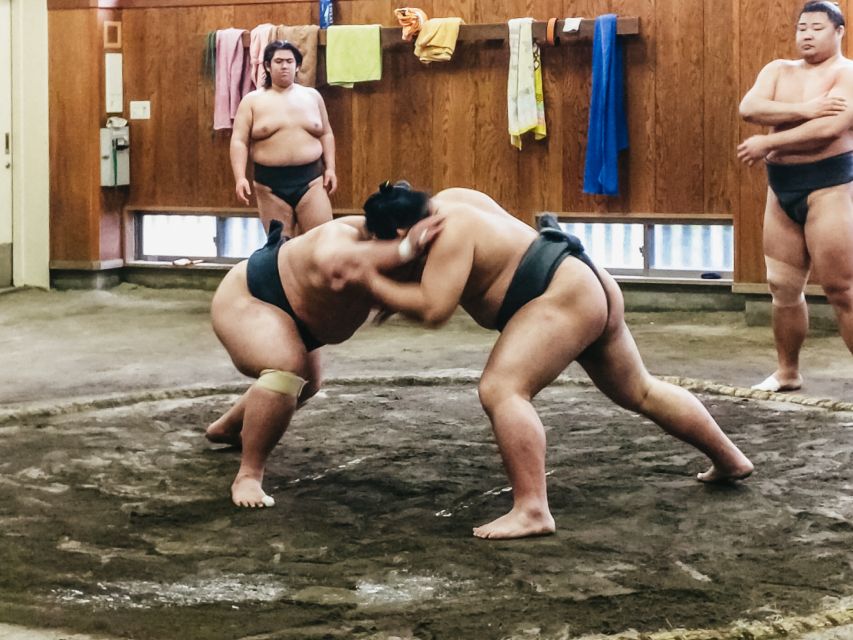
Sumo becomes much more interesting once you stop viewing it as two large men simply pushing each other. The training reveals speed, balance, timing, and control. Even a short exchange can show how quickly a wrestler reacts and how much technique is hidden beneath the size.
A warmup can look repetitive, but repetition is the point. Wrestlers practice the same movements until they become automatic. The physical demand is easy to underestimate from a distance. Up close, the sound of feet, hands, and bodies meeting the practice surface gives the session real force.
You may see sparring, but no specific contest is guaranteed. Some sessions feature wrestlers going hard against each other. Others may include more restrained work, particularly if the stable is preparing for a tournament or adjusting to the condition of its wrestlers.
That is why I would not book this expecting a set program. You are observing a live practice, not buying a ticket to a miniature tournament. The reward is authenticity. The tradeoff is that the morning may not deliver the exact movements or matchups you hoped to see.
A close look at Japanese discipline
The quiet rules are not minor details. Inside the stable, talking loudly and making noise is prohibited. Phones must be switched to silent mode. Hats and sunglasses are not allowed, and you cannot bring food, drinks, luggage, or large bags inside.
Flash photography is forbidden. Video recording requires permission, so assume you cannot film unless the host clearly allows it. A face mask or protective covering is also listed as something to bring.
You should arrive ready to sit without fidgeting. Feet should not point toward the practice area, and leaning against walls may be viewed badly. The atmosphere is respectful rather than casual. One account described people being corrected for leaving, sleeping, or disturbing the training.
That may sound strict, but it helps explain why the visit feels different from a standard sightseeing stop. You are not walking through a display or watching a rehearsed cultural presentation. You are borrowing a place of work for a short time.
Same city, a completely different kind of day:
- Mt Fuji and Hakone 1-Day Bus Tour Return by Bullet Train
★ 5.0 · 26,383 reviews - 1-Day Tokyo Bus Tour
★ 5.0 · 14,250 reviews - Tokyo: TOKYO SKYTREE® Admission ticket
★ 4.5 · 11,192 reviews - Tokyo: teamLab Planets TOKYO Digital Art Museum Entry Ticket
★ 4.6 · 9,779 reviews
Seating, sightlines, and comfort
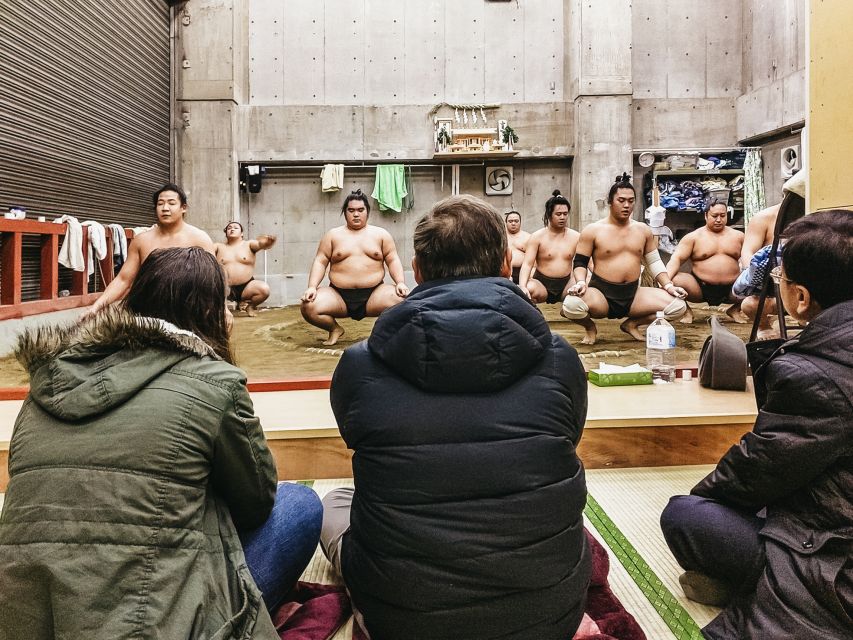
Floor seating is the biggest practical challenge. You may be seated on the floor for the entire training period, and cushions are not necessarily provided. A session that lasts two hours can become uncomfortable, especially if you have knee, hip, or back problems.
If you need a chair, arrange it in advance. Do not assume one will be available when you arrive. The seating arrangement is generally free seating, so arriving on time or early can improve your view. If you arrive late, you may end up in the back, where people in front can block parts of the practice area.
The meeting instructions say not to arrive early and ring the doorbell or enter before check-in. This is an important distinction: arrive at the stated meeting time, then wait for the host. Once inside, follow the assigned seating instructions.
There may be no convenient chance to eat, drink, or use a toilet during the session. Plan before you enter. Large bags and luggage are not allowed, so leave heavy belongings elsewhere.
This is not an ideal activity for someone who cannot sit on the floor. It can still work for families, but young children need to remain quiet and still. A three-year-old was captivated by the practice, and children aged nine and twelve managed the session well, but every child is different.
The guide and the educational side
An English-speaking host or greeter is included, but the role may be limited. The host may check names, explain where to meet, manage entry, and help with the group photo. Do not count on a full lesson about sumo.
Several useful subjects are left unexplained during the visit. You might want to know what each warmup movement means, why wrestlers repeat certain drills, how a wrestler enters the sport, or what sumo wrestlers eat. You may also want help identifying the rituals and gestures taking place around the practice area.
Some people found the English communication adequate, while others experienced miscommunication or little interaction from the guide. That does not necessarily harm the viewing itself, but it affects the value if you want cultural interpretation.
I recommend reading a short introduction to sumo before you go. Learn a few basic terms and watch a tournament bout so the training has context. You will get more from the quiet moments if you know what to look for.
This is also where the $77 price needs a fair reading. The fee is paying for access to a working stable, coordination, an English-speaking host, and the chance to watch professionals at close range. It is not paying for a detailed guided class. If you want a lecture, a demonstration, or step-by-step explanations, this may feel expensive.
Finding the correct meeting point
The logistics require care. The location shown on Google Maps may not be the actual meeting point. The stable is assigned later, and the final place and directions are normally sent by email about two or three days before the date.
The automatic voucher and account page may show sample information. Use the stable listed on the voucher and check the separate confirmation email. Do not rely on an old address from a booking page or assume you can choose a stable in a preferred neighborhood. Specific location requests cannot be accommodated.
This late confirmation can be inconvenient, especially if you are organizing a packed Tokyo schedule. On the positive side, the contact number in the confirmation email can be useful if you are lost or running late. Prompt help has been available in the past, even early in the morning.
Arrive on time. The stable can be difficult to find from a train station, and entering is allowed only with the guide. Missing the group can mean missing part of the practice. The meeting instructions also say that a no-show 10 minutes after an optional pickup time counts as a waiver.
Optional hotel transfer
A one-way hotel pickup can be added, but it is limited. Your hotel must be within Tokyo’s 23 wards, have a front desk, and accommodate a Japanese-speaking driver. The driver does not speak English, and the maximum is four passengers.
You need to send the hotel name, check-in date, reservation name, and a Japanese mobile number after booking. Pickup time is sent by email at least one day before the activity.
This option may help if you are worried about finding the stable in the early morning. It is not a full round-trip transfer, and hotel drop-off is not included. For independent visitors who are comfortable using Tokyo trains, making your own way may offer better value. For a small group with luggage-free early plans, the transfer can reduce stress.
Tournament months require special planning
Tokyo hosts Grand Sumo Tournaments in January, May, and September. During those months, stable training may be shortened to about 30 minutes. The shorter session does not qualify for a refund.
This is a crucial booking choice. If you want to watch the longest possible practice, avoid those months or confirm your expectations before paying. If you are visiting during a tournament month, the stable still gives you a close look at sumo preparation, but you may see only warmups or a shorter practice rather than extended sparring.
One useful comparison is the tournament itself. If your main goal is to see actual competition, an arena ticket may be the better use of your money. If your goal is proximity and access to the training environment, this stable visit offers something the tournament cannot.
Value at $77 per person
At $77, this is not a cheap morning activity. The price makes more sense if you place high value on access. A working stable is not a normal sightseeing site, and independent entry is not something you can simply arrange by walking in.
The experience earns its price when you care about:
- Seeing professionals train at close range
- Entering an authentic sumo stable with a host
- Observing the discipline and physical strain behind the sport
- Taking a group photo with the wrestlers
- Choosing a cultural activity that does not involve a staged show
The value drops if you need comfort, extensive English explanation, or a guaranteed amount of wrestling. During tournament months, the 30-minute session can feel especially costly. A few people also found the viewing area crowded or the last row difficult for seeing the action.
Compared with a full tournament day, the stable visit is shorter and less dramatic, but it offers a different kind of access. You see preparation rather than competition. For many people, that close look at daily work is the more memorable part.
Who should book this experience
I would recommend it to anyone with a strong interest in Japanese sports, traditional culture, photography without flash, or behind-the-scenes experiences. It also suits you if you prefer a real working setting to a polished tourist performance.
It is a good choice for older children who can stay quiet and still. It can be a highlight for families, but young children should understand the rules before entering. The wrestlers may pose for the final photo, but this is not a meet-and-greet where you can chat freely.
You should think twice if you have knee problems, dislike floor seating, need frequent breaks, or want a lively guide. You should also skip it if you cannot accept changes to the training schedule or the possibility of a shorter session in January, May, or September.
For the best experience, I would:
- Read the final meeting email carefully
- Confirm the address against the voucher
- Arrive at the stated time and aim for an early position
- Use the toilet before entering
- Wear clothing that makes floor sitting easier
- Bring a mask or protective covering
- Leave large bags, food, and drinks behind
- Learn basic sumo terms before the visit
- Ask in advance about a chair if needed
- Keep your phone silent and your camera flash off
Should you book the Tokyo sumo training visit?
Book it if you want authentic access and close viewing, and if you can accept silence, uncertain timing, and hard seating. The strongest part is the physical reality of the training: the sound, repetition, speed, and effort are difficult to appreciate from a stadium seat or television screen.
Skip it if you want a guaranteed bout, a long explanation in English, or a comfortable one-hour tour. Also reconsider during a Tokyo tournament month unless you are satisfied with a possible 30-minute session.
For the right person, this is a memorable way to see sumo as a craft rather than a spectacle. Just arrive prepared: the stable sets the rules, the wrestlers set the pace, and your job is to watch respectfully.
FAQ
Where does the sumo training visit meet?
The exact meeting point is decided shortly before the scheduled date. You normally receive the location and directions by email about two or three days in advance. Google Maps may show a different location, so use the final instructions and the stable listed on your voucher.
How long does the activity last?
The stated duration is one hour, and normal training usually lasts about 60 minutes. Some sessions can continue for 90 minutes or two hours. During the Tokyo Grand Sumo Tournaments in January, May, and September, training may last only about 30 minutes.
Can I choose the sumo stable?
No. All stables are within Tokyo, but specific stable or neighborhood requests cannot be accommodated.
Is the activity guided in English?
An English-speaking host or greeter is provided. The host may mainly manage check-in and entry, and detailed explanations about sumo rituals, training, and history are not guaranteed.
Can I take photographs or record video?
You may take photographs without flash. Flash photography is forbidden, and video recording is allowed only with prior permission.
Can I take a picture with the wrestlers?
Yes. A group picture with the wrestlers is included. If you leave before training ends, you will not receive the group picture.
Do I sit on the floor?
Floor seating is used, and you may need to remain seated for the full training period. If you need a chair, arrange it in advance. Cushions are not guaranteed.
Can I bring food, drinks, luggage, or a large bag?
No. Food, drinks, luggage, and large bags are not allowed inside the stable. Smoking indoors is also prohibited.
Is hotel pickup available?
An optional one-way hotel pickup is available within Tokyo’s 23 wards. The maximum is four passengers, the driver speaks Japanese rather than English, and the hotel must have a front desk. Hotel drop-off is not included.
More Morning in Tokyo
- Tokyo: Sumo Morning Practice Viewing Tour
★ 4.8 · 570 reviews - Tokyo: Sumo Morning Practice Tour at Sumida City
★ 4.8 · 308 reviews - Tokyo Sumo Morning Practice Tour at Stable
★ 5.0 · 298 reviews - Tokyo Ryogoku Sumo Morning Practice + Photo Shoot with Wrestlers
★ 4.5 · 277 reviews
Just added around Tokyo
- Tokyo: Customizable Private Guided Walking Tour★ 4.5 · 129 reviews
- Private Harajuku Omotesando Architecture Tour★ 4.9 · 18 reviews
- Tokyo: Guided Helicopter Ride★ 4.9 · 24 reviews
- Tokyo: Guided Walking Tour of Tsukiji Market with Lunch★ 4.4 · 24 reviews
- Tokyo: Private Personalized Local Food Tour★ 4.5 · 101 reviews
- Tokyo: Gotokuji Cat Temple, Shinjuku Cat Cafe & 3D Cat Tour★ 4.9 · 38 reviews
- Tokyo GINZA: KONPARU Japanese Cabaret Show with Drink★ 4.8 · 38 reviews
- Tokyo: Guided Walking Tour of Tsukiji Market with Breakfast★ 4.4 · 134 reviews
Sumo Experiences, compared.
Sumo Show Experience with Chicken Hot Pot and a Photo
Read our review →
Tokyo Shinjuku Sumo Show & Experience with Photo
Read our review →
Sumo Show & Experience w/ Optional Kimono & Hot Pot
Read our review →
Authentic Sumo Experience in Tokyo: Enter the Sanctuary
Read our review →Browse the lists this tour appears in