REVIEW · TICKETS
Tokyo: TOKYO SKYTREE® Admission ticket
Tokyo Skytree gives you the best possible lesson in Tokyo’s sheer size. From the 350-meter Tembo Deck, the city spreads in every direction, with the Sumida River, Tokyo Bay, Tokyo Tower, Tokyo Dome, and sometimes Mount Fuji visible through the windows. The elevator ride is part of the fun: it carries you upward at remarkable speed, yet feels smooth and controlled.
I like the ticket’s simple setup and the chance to choose your height. The voucher can save time at the ticket counter, and the evening view is especially good as Tokyo changes from daylight to a field of lights. The main catch is weather. Clouds or haze can reduce the view to white sky, and sunset periods may bring long waits for elevators.
In This Review
- Key points to know
- Tokyo Skytree at 350 meters
- Should you pay for the 450-meter Tembo Galleria?
- The glass floor on Floor 340
- Why timing matters so much
- Getting inside and using the voucher
- The elevator ride is part of the attraction
- What you can actually see from above
- Food, shops, and Tokyo Solamachi
- Price and overall value at $13
- Who will enjoy Tokyo Skytree most?
- Is the Tokyo Skytree ticket worth booking?
- FAQ
- Where do I exchange the voucher for the Tokyo Skytree ticket?
- What does the standard ticket include?
- Does the ticket skip all lines?
- How long is the ticket valid?
- Can I see Mount Fuji from Tokyo Skytree?
- Are there cafés inside Tokyo Skytree?
- What else can I do after visiting the tower?
Key points to know
- The 350-meter deck is the essential visit: It offers broad 360-degree views and usually gives you all the context you need.
- The 450-meter Tembo Galleria costs extra: Its sloping skywalk gives a higher and more dramatic angle, but the view is similar.
- The glass floor is on Floor 340: It is a small section, fun for a quick photo, but not a major attraction for everyone.
- Dusk is the best all-round time: You can catch daylight, sunset, and Tokyo’s lights in one visit, though this is also a popular period.
- The voucher is collected on the 4th floor: It helps avoid a ticket-buying queue, but you may still wait for security or elevators.
- Tokyo Solamachi extends the outing: Shops, restaurants, a planetarium, and a large food court make it easy to spend more time here.
Tokyo Skytree at 350 meters
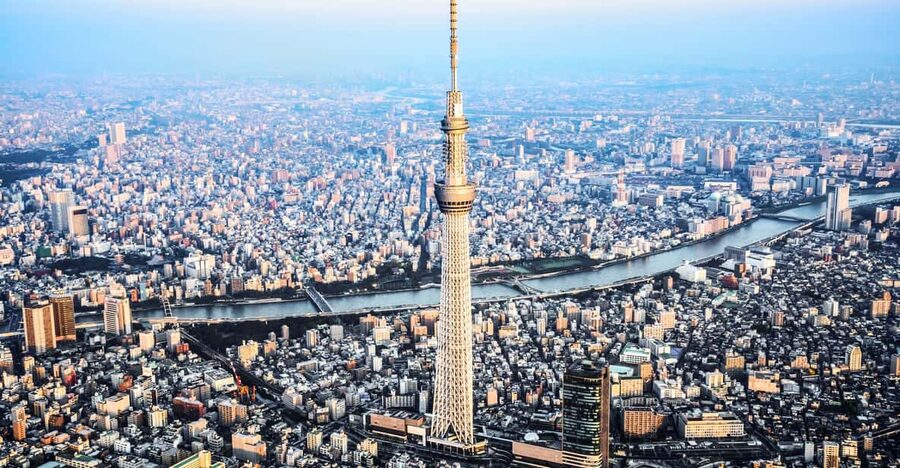
The main experience begins on the Tembo Deck, 350 meters above Tokyo. This is the level included with the standard admission, and it is the part I would consider essential for a first visit.
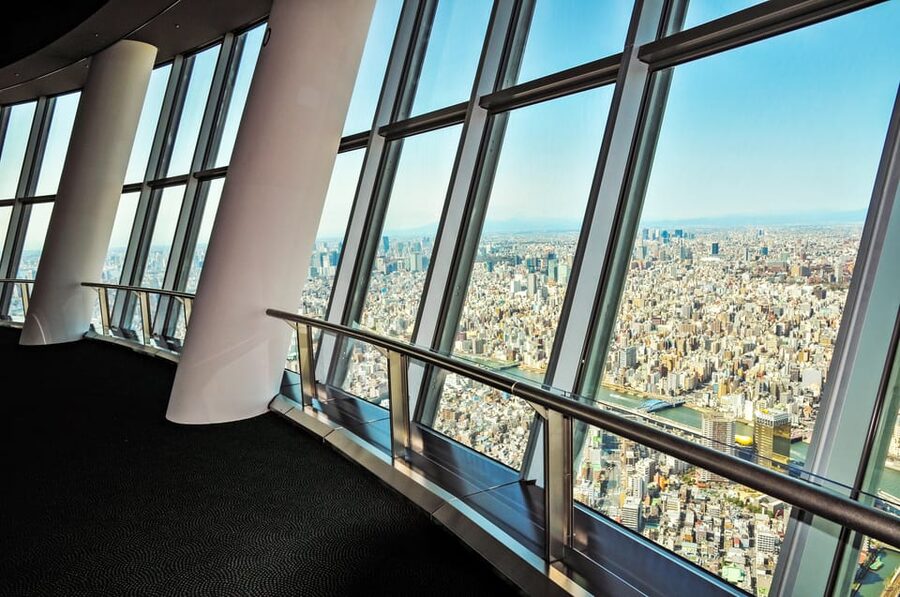
The deck is large and circular, with windows all around. You are not looking at one framed city view. You are looking across a huge sweep of Tokyo, from low-rise neighborhoods and railway lines to distant towers and the winding Sumida River.
The view helps you understand Tokyo in a way that street-level sightseeing cannot. Areas that feel separate on a subway map appear to join into one vast urban spread. Asakusa and the Sumida area sit close below, while Tokyo Bay and the central districts stretch away in the distance.
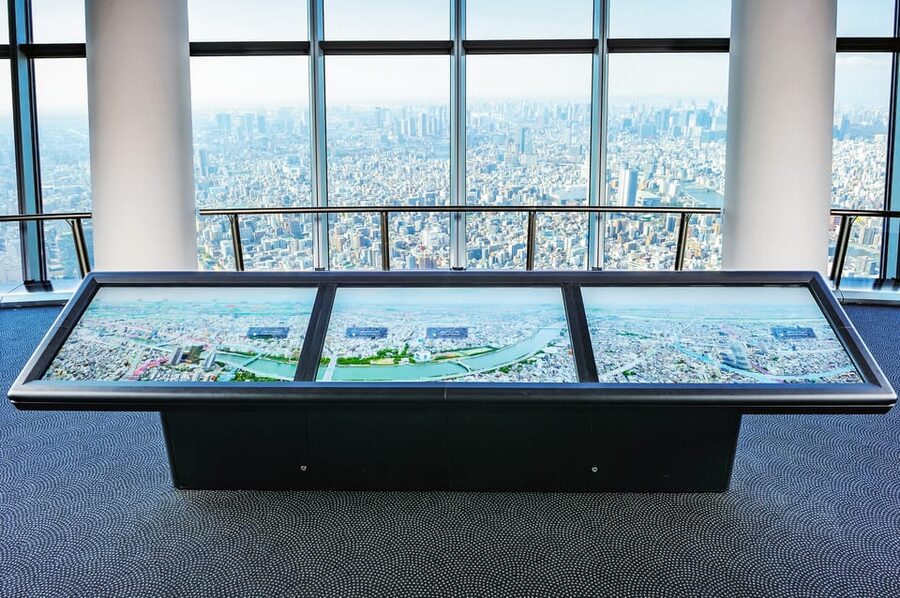
Interactive displays help identify points of interest. Look for Tokyo Dome, Tokyo Tower, Tokyo Bay, and, on a clear day, Mount Fuji. The mountain is not guaranteed. Several people have had a clear view even when mist surrounded the tower, while others reached the top and saw only cloud. Check the forecast and keep your expectations flexible.
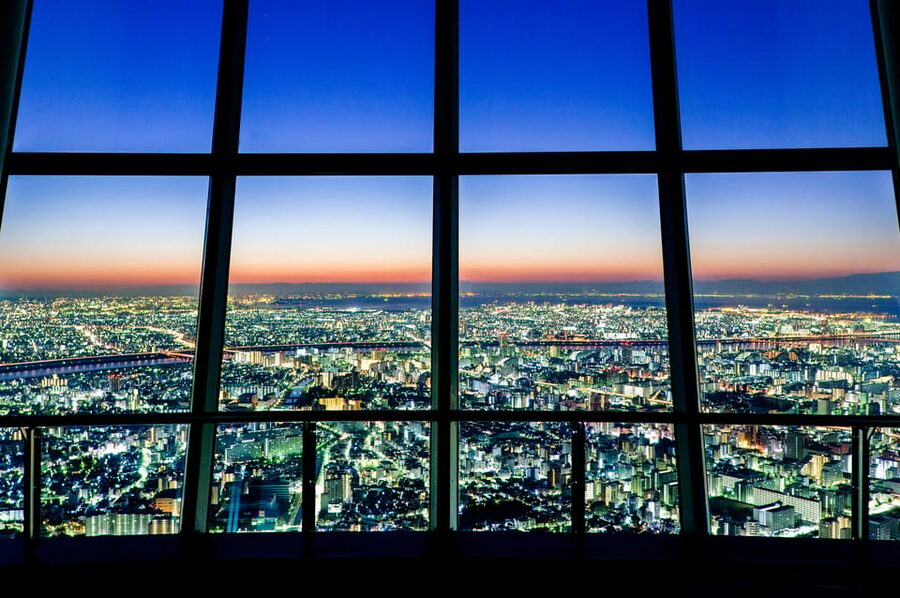
The deck is also a good place to watch the city change. In daylight, you can pick out rivers, roads, and neighborhoods. At night, the view becomes less about individual landmarks and more about the enormous spread of lights. I find the evening version more atmospheric, but the daytime view gives you better geographical perspective.
A few more Tokyo trips to weigh up
- Tokyo: teamLab Planets TOKYO Digital Art Museum Entry Ticket
★ 4.6 · 9,779 reviews - Tokyo: Hop-On Hop-Off Sightseeing Bus Ticket
★ 3.9 · 4,207 reviews - Tokyo Tower: Admission Ticket
★ 4.6 · 3,661 reviews
Should you pay for the 450-meter Tembo Galleria?

The optional Tembo Galleria takes you to 450 meters, the highest viewing level in this experience. You reach it by another elevator from the 350-meter deck.
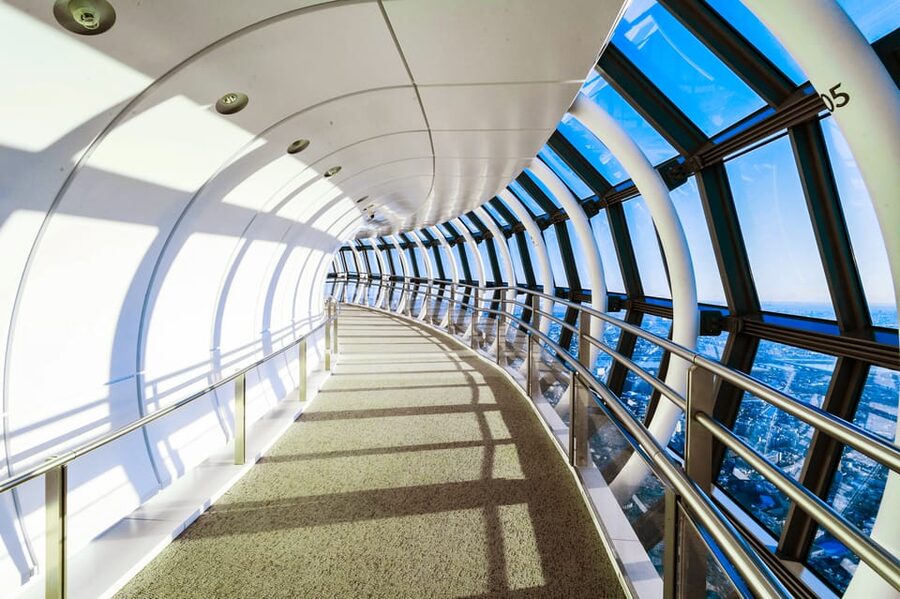
The Galleria is different from a simple enclosed observation room. A long, sloping ramp curls upward around the tower, giving you changing views as you walk. You can look down toward Tokyo and out across the horizon, with the higher position making the city feel even more distant and expansive.
I recommend adding it if you enjoy towers, engineering, and high-altitude views. The upper level is often described as less crowded and can make picture-taking easier. It also gives you the satisfying feeling of reaching the tower’s full public viewing height.
Still, the extra ticket is not essential for everyone. The basic deck already gives you 360-degree views, and the scenery from 450 meters is broadly the same city seen from a higher angle. One practical difference is that the upper level can be hazier than the lower deck, especially around sunset.
If you are watching your budget, the 350-meter ticket is enough. If this is a major Tokyo highlight, or you want the full tower experience, choose both levels when booking. Pay attention to the ticket option, since it is easy to assume the highest deck is included when it may not be.
The glass floor on Floor 340
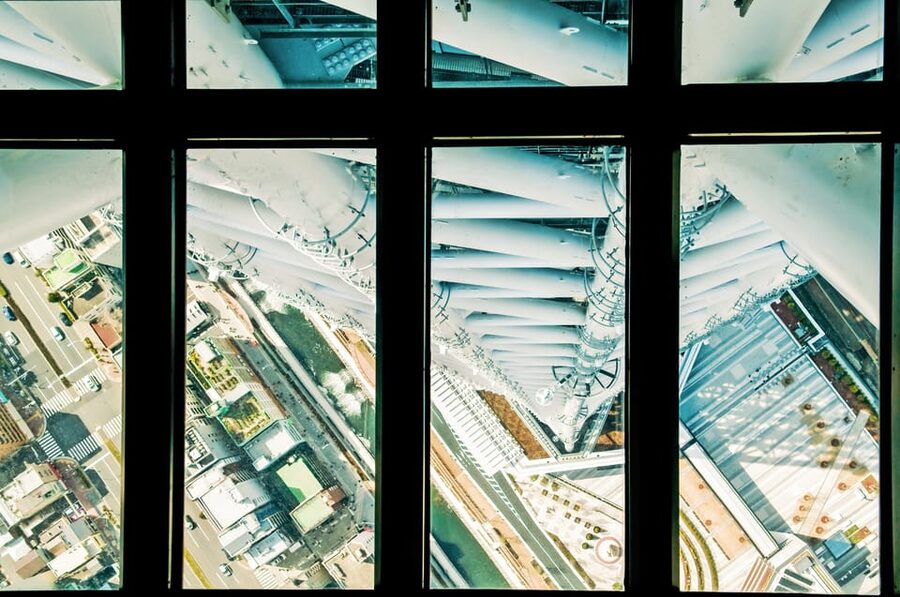
On the way down, stop at Floor 340 for the glass-floor section. You can look straight toward the ground through a sturdy transparent panel.
This is a quick thrill rather than a full attraction. The section is small, and some people find it more amusing than frightening. Children often enjoy it, while anyone uneasy with heights can simply walk around it. The floor may also need cleaning after heavy use, so it is best treated as a brief stop rather than the main reason to buy the ticket.
Floor 340 is also home to Skytree Café 340, which has seating for 64 people. It is the better café choice if you want to sit down, rest, and look out at Tokyo with a drink or light snack.
For a quicker break, Skytree Café 350 is on the main observation deck. It is described as Japan’s highest café and provides standing space with open views. I would choose Café 350 for a short pause during sightseeing and Café 340 when you want to linger.
Why timing matters so much
Your ticket is valid for one day, but availability is tied to starting times, so choose carefully. The most popular period is late afternoon, when you can see the city in daylight, watch the sun go down, and remain for the first wave of lights.
That timing has a cost. Sunset can be crowded, with waits reported for the elevator going up and again when descending. One particularly busy visit involved about an hour before the upward ride and close to 50 minutes for the return. That is not the normal experience every day, but it shows why a dusk visit needs patience.
Morning is a calmer choice. A Saturday arrival around 9:30am allowed a relatively quiet visit and clear views, including Mount Fuji. Early evening and later night visits can also work well. At around 6:30pm, you may find plenty of room and good night views, while a visit around 8:30pm can show Tokyo fully lit.
For photography, I like the idea of a late afternoon slot, but only if you are willing to accept crowds. For easier movement, choose morning or a later evening period. Clear winter days may offer the best chance of seeing Mount Fuji, but no time guarantees visibility.
Same city, a completely different kind of day:
- Mt Fuji and Hakone 1-Day Bus Tour Return by Bullet Train
★ 5.0 · 26,383 reviews - 1-Day Tokyo Bus Tour
★ 5.0 · 14,250 reviews - Mt Fuji & Hakone Cruise, Drum Show Bullet Train 1 Day from Tokyo
★ 4.0 · 7,413 reviews - Tokyo: Shinjuku Food Tour (13 Dishes at 4 Local Eateries)
★ 5.0 · 6,603 reviews
Getting inside and using the voucher
Go to Tokyo Skytree and head to the 4th floor. The voucher is exchanged there for the admission ticket on the day of your visit. The location can be confusing because the building has several levels and entrances, so allow extra time to find the correct 4th-floor entrance.
The QR code process has generally been straightforward, including use at a self-service collection machine. Staff direct people efficiently, and English and Japanese assistance is available. One useful distinction: skipping the ticket line does not mean skipping every queue. You may still wait for security, the first elevator, or the elevator to the Galleria.
Timing instructions deserve attention. One account says the ticket could be redeemed no earlier than 30 minutes before the booked time, while other admissions were accepted early or late. Treat those exceptions as luck, not policy. Follow the time on your voucher and arrive with enough room to find the counter.
There is no need to expect a traditional guided tour. This is mainly a self-guided observation visit, with staff and greeters helping you move through the building. Safety information may not always be delivered in English, so pay attention to signs and staff directions.
The elevator ride is part of the attraction
The trip upward is remarkably fast. The elevators travel from the 4th floor to the Tembo Deck in a smooth rush, and then another lift takes you to the Galleria if your ticket includes it.
For anyone who dislikes heights, the elevator is enclosed and quick. You do not spend a long time exposed during the ascent. The main sensation is speed, followed by the sudden change in scale when the doors open and Tokyo appears below.
Queues for the elevators vary. On quiet mornings, you may move through with little delay. At busy sunset times, the elevator line can become the slowest part of the visit. Once inside the deck, staff keep people moving and help prevent bottlenecks at the windows.
What you can actually see from above
Tokyo Skytree is especially valuable because it gives you both landmarks and scale. Tokyo Tower, Tokyo Dome, and Tokyo Bay help you orient yourself. The Sumida River provides a natural line through the urban view, while Mount Fuji gives you a dramatic distant target when the air is clear.
The view from 350 meters can be better than the upper level on a hazy day. Atmospheric conditions matter, and the extra 100 meters cannot fix poor visibility. If the lower deck looks clear but the Galleria is misty, spend more time on Floor 350 rather than assuming higher must mean better.
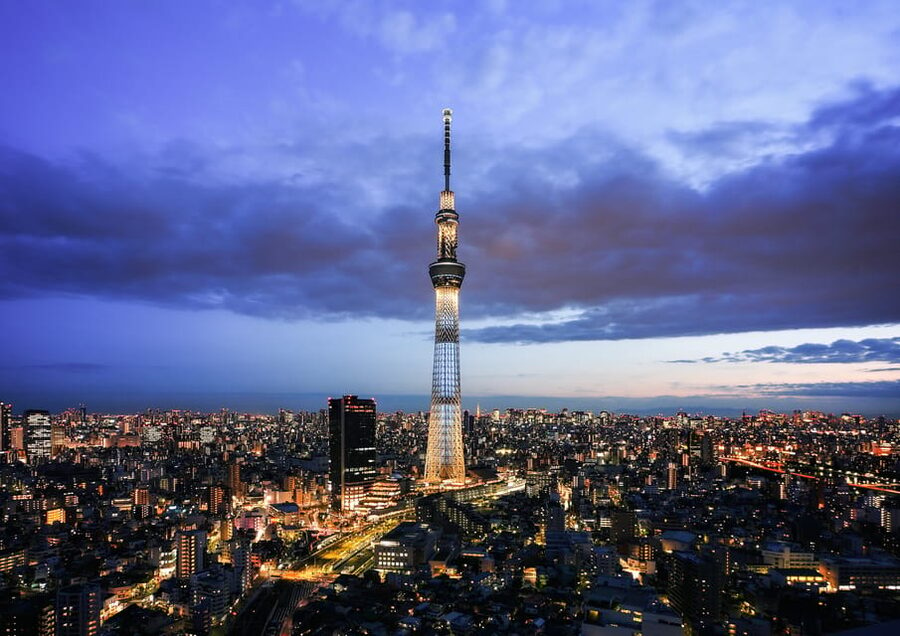
At night, individual buildings become less important. Tokyo looks like a broad net of lights, and the view makes the city’s size easier to grasp. This is the strongest reason to visit after dark. You can also see the tower itself illuminated from the surrounding Tokyo Skytree Town, especially around the entrance stairs.
The experience is less intimate than a neighborhood walk. You will not hear street sounds or see daily life close up. What you gain is a rare sense of Tokyo as one connected city.
Food, shops, and Tokyo Solamachi
You do not need to leave immediately after the observation decks. Tokyo Solamachi, the complex within Tokyo Skytree Town, has about 300 shops and restaurants, plus a planetarium.
The lower-level food court is a practical advantage. It gives you many choices after the tower, so you do not need to settle for a snack at the observation deck. You can make the visit a short two-hour stop or build a longer outing around food, shopping, and the planetarium.
Inside the tower, the two Skytree Cafés serve drinks and light snacks. Café 350 is best for a quick standing break with the view still in front of you. Café 340 offers seating for 64 and a more relaxed pause, though you may need to wait for a table at a busy time.
The gift shop on Floor 345 is an easy stop during the descent. It is useful if you want a small souvenir without adding another shopping destination to your day.
Price and overall value at $13
At $13 per person, the standard ticket is reasonably priced for a major Tokyo viewpoint. You are paying for access to Japan’s tallest tower, rapid elevators, the 350-meter deck, interactive displays, and the glass-floor stop.
The value is strongest when the air is clear and you stay long enough to see more than one version of Tokyo. A morning visit gives you orientation and detail. A dusk visit can provide daylight, sunset, and night views in one go. A night visit gives you the most cinematic city lights.
The 450-meter upgrade is a personal choice. It makes sense if you want the highest available viewpoint, prefer the sloping skywalk, or want to spend more time taking pictures. It is less compelling if you mainly want a good city panorama at the lowest price.
Tokyo also has free high viewpoints, including the Tokyo Metropolitan Government Building. Those alternatives give you a central view and allow you to see Tokyo Skytree from outside. Skytree gives you the opposite perspective: you are inside the landmark, looking over the city. I would not treat the free alternatives and Skytree as exact substitutes, since they answer different sightseeing questions.
Who will enjoy Tokyo Skytree most?
I would recommend this ticket to first-time visitors who want a clear sense of Tokyo’s scale. It also suits photographers, families, tower enthusiasts, and anyone planning time around Asakusa and the Sumida area.
The glass floor adds a small moment of fun for children, while the cafés and shopping complex make the visit easier for mixed groups. You can take a break without ending the outing.
People who dislike crowds should avoid sunset unless the changing light matters more than convenience. People who dislike heights can stay on the main deck, skip the glass panel, and use the enclosed elevators. The open city view may still feel intense, but the building is organized and staff are close by.
A combo ticket is also available that pairs Tokyo Skytree with TeamLab Planets TOKYO. That option could suit you if both attractions are already on your plan, but compare the combined cost and locations before choosing it.
Is the Tokyo Skytree ticket worth booking?
Yes, if you want one of Tokyo’s clearest views from above and the weather forecast looks promising. I would choose the 350-meter ticket for solid value, then add the Tembo Galleria if reaching 450 meters is part of the appeal.
Book ahead when you care about a particular time, especially sunset. Arrive at the 4th floor with your QR voucher ready, and remember that a ticket that skips the purchase line may not remove elevator waits.
Choose morning for a calmer visit, dusk for the full day-to-night change, or later evening for Tokyo’s lights and potentially lighter crowds. The tower cannot control haze, but on a clear day it gives you one of the most useful views in the city.
FAQ
Where do I exchange the voucher for the Tokyo Skytree ticket?
Go to the ticket counter or collection area on the 4th floor of Tokyo Skytree. You exchange the voucher and collect the admission ticket on the day of your visit.
What does the standard ticket include?
The standard ticket includes admission to the Tembo Deck at 350 meters. Access to the 450-meter Tembo Galleria is included only when you select that option.
Does the ticket skip all lines?
No. It can help you avoid the regular ticket-purchase line, but you may still wait for security and elevators, especially during busy sunset periods.
How long is the ticket valid?
The activity is valid for one day. Starting times are available during booking, so check the available time options before choosing your visit.
Can I see Mount Fuji from Tokyo Skytree?
You can sometimes see Mount Fuji from the observation decks, but visibility depends on weather and haze. A clear day gives you the best chance.
Are there cafés inside Tokyo Skytree?
Yes. Skytree Café 350 is on the 350th floor and offers drinks and light snacks with standing views. Skytree Café 340 is on the 340th floor and has seating for 64 people.
What else can I do after visiting the tower?
You can explore Tokyo Solamachi in Tokyo Skytree Town. It has about 300 shops and restaurants, a planetarium, and a food court.
Just added around Tokyo
- Tokyo: Customizable Private Guided Walking Tour★ 4.5 · 129 reviews
- Private Harajuku Omotesando Architecture Tour★ 4.9 · 18 reviews
- Tokyo: Private Personalized Local Food Tour★ 4.5 · 101 reviews
- Tokyo: Guided Helicopter Ride★ 4.9 · 24 reviews
- Tokyo: Guided Walking Tour of Tsukiji Market with Lunch★ 4.4 · 24 reviews
- Tokyo GINZA: KONPARU Japanese Cabaret Show with Drink★ 4.8 · 38 reviews
- Tokyo: Guided Walking Tour of Tsukiji Market with Breakfast★ 4.4 · 134 reviews
- Tokyo: Gotokuji Cat Temple, Shinjuku Cat Cafe & 3D Cat Tour★ 4.9 · 38 reviews
Tickets, compared.

teamLab Planets TOKYO Digital Art Museum Entry Ticket
Read our review →
Japanese Dance Cabaret Theater Asakusa-Kaguwa Ticket
Read our review →
Kamakura & Enoshima Day Trip including Temple Tickets
Read our review →