
REVIEW · SUMO EXPERIENCES
Tokyo Sumo Morning Practice Tour at Stable
Tokyo sumo practice is not a staged dinner show. You sit quietly inside a working stable while professional wrestlers train at close range, repeating throws, footwork, stretches, and full-contact bouts. The scale is striking, but the real lesson is the discipline behind it.
I like the authentic setting and the chance to see many exchanges in one morning, often with more continuous action than you would see at a formal tournament. I also like the guides, who explain the Shinto rituals, rankings, daily life, and tournament system as the practice unfolds. The main drawback is the early start, plus the fact that commentary can be hard to hear through the headsets.
In This Review
- Key points before you book
- Why a morning stable visit feels different
- Meeting near Ryogoku Station at 7:45am
- The short introduction to sumo history and ritual
- Watching the wrestlers train at close range
- The rules of respectful watching
- Photos and the final walk back
- Is the $83.57 price fair?
- Who will enjoy this most
- Practical advice for a better morning
- Should you book the Tokyo sumo morning practice tour?
- FAQ
- Where does the tour meet?
- What time does the tour begin?
- How long does the experience last?
- How old must children be to enter?
- Can I take photographs?
- Can I take a photograph with a sumo wrestler?
- Can I eat or drink inside the stable?
- Can I leave during the practice?
- Can I cancel for a refund?
Key points before you book
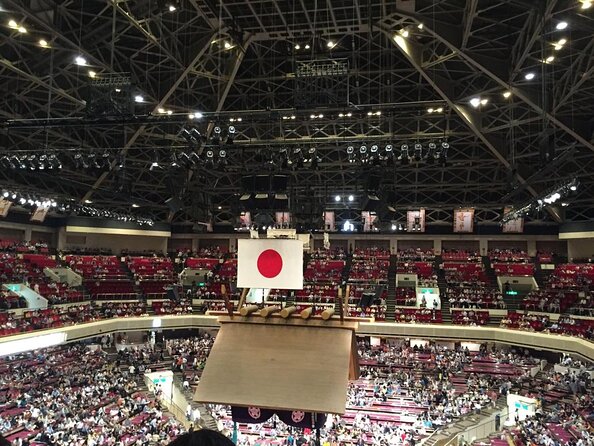
- Practice takes place in a real sumo stable, not a theater or restaurant built for tourists.
- Meet at about 7:45am near Ryogoku Station, then continue to the stable, sometimes by train.
- Expect close viewing from low seats or stools, with the best places usually going first. Front seats may be reserved for sponsors.
- The tour lasts about two hours, but the actual practice can run shorter or longer.
- Guides explain sumo history, rankings, rituals, and the six annual Grand Tournaments.
- Silence and strict etiquette matter, and children age 11 and under cannot enter.
Why a morning stable visit feels different
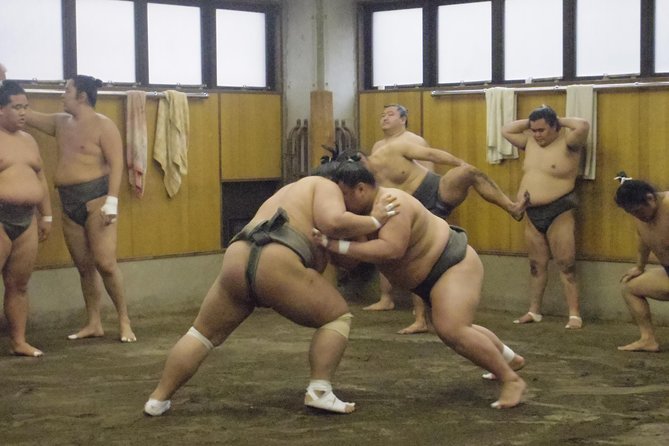
A formal sumo tournament is polished, ceremonial, and exciting. A morning practice session shows you the work beneath the spectacle. There are no long waits between bouts and no need to follow a full tournament schedule. The wrestlers simply train, rest, stretch, and test one another under the stable’s daily routine.
That difference gives this experience its value. You may see dozens of short practice bouts, along with repeated exercises that reveal how much effort goes into balance, leg strength, timing, and controlled impact. The action can feel raw and unfiltered because the wrestlers are not performing a show for the group.
You also get a closer look at the stable as a place of training and communal life. The ring is sacred, and the sandy area around it is not an open performance space. You remain seated and watch from the edge, close enough to see the wrestlers’ concentration and the force of each movement.
The atmosphere is serious. This is not the right activity if you want to chat, take constant photos, or move around freely. It is ideal if you can sit quietly for a long stretch and let the routine reveal itself.
More Sumo Experiences in Tokyo
- Tokyo: Sumo Show and Dining Experience
★ 4.8 · 2,742 reviews - the SUMO show
★ 5.0 · 1,960 reviews - Tokyo Shinjuku Sumo Show & Experience with Photo
★ 5.0 · 1,750 reviews
Meeting near Ryogoku Station at 7:45am
The morning begins early at a meeting point near Ryogoku Station, with the supplied directions pointing to the Ryogoku Station Gallery area. Your guide gathers the group and explains what will happen before leading you to the stable. Depending on the selected plan, the exact meeting place can differ, so check your confirmation carefully.
This is one part of the experience where you should allow extra time. One participant had trouble finding the meeting point and another found that Google Maps placed the destination about a block away. The instructions say 7:45am, so arrive early rather than trying to find the guide at the last moment.
The group can include up to 20 people. That is small enough for a personal feel, but it is not a private visit. Your position inside the stable can affect your view, and early arrival may help you join the line sooner. The front area can be reserved for sponsors or other official visitors, with the next rows available to the tour group.
Use the restroom before meeting. The stable is a working facility, not a public attraction designed around visitor comfort, and leaving in the middle of practice is strongly discouraged.
The short introduction to sumo history and ritual
Before you take your seat, your guide sets the scene. You learn that sumo has links to Shinto traditions and that its roots reach back at least 1,500 years. The modern sport is also a major national spectator event, with its religious customs still visible in the ring rituals and stable life.
The introduction covers Japan’s six annual Grand Tournaments. Each lasts 15 days. Three take place in Tokyo, while Osaka, Nagoya, and Fukuoka each host one. This context helps you understand why practice matters. Wrestlers are not simply doing fitness drills. They are preparing for rankings, bouts, and the next stage of a demanding professional career.
Guides also explain the ranking system and the lifestyle expected inside a stable. The best commentary helps you see the difference between a warm-up, a technical drill, and a serious practice bout. It also gives you clues about which wrestlers are rising and which are more seasoned.
Several guides have received especially warm praise for their delivery. Seiji is described as kind and clear, while Yumi is a dedicated sumo enthusiast who provided discreet commentary through an earpiece. Cameo has been praised for a careful briefing and a useful question period afterward. Noriko and Nobu have also been singled out for making the process easy to follow.
Guide assignments can change, so you should not book solely because of one name. The important point is that the guide serves as your bridge into a world with many rules that are not obvious from the doorway.
Watching the wrestlers train at close range
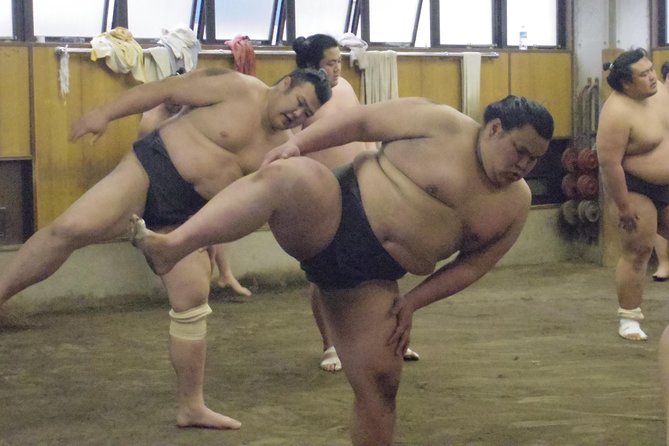
Once seated, the main event begins. The wrestlers work through their daily routine while you watch in silence. You may see stretching, footwork, repeated practice movements, and sparring between members of the stable.
The most powerful moments usually come during the full-contact exchanges. Two wrestlers may collide, push, pivot, and try to force the other out of the ring. Unlike a tournament bout, practice can continue in quick succession, so you get a clear sense of repetition and fatigue. The athletes are not saving themselves for a single public match.
That constant activity is one reason I find this more revealing than a tournament for first-time visitors. At a tournament, ceremony and scheduling are part of the experience. Here, you see the mechanics of improvement. You can watch a wrestler try the same movement again, recover, and face another opponent.
Your distance from the ring depends on the seating arrangement. Some participants have watched from stools, while others describe sitting on mats or low seating. The precise setup can vary, but the viewing area is close to the practice space. Even from farther back, you should have a direct view, although the front rows give you a stronger sense of the physical force.
The guide may use an audio headset to explain what you are seeing. This is helpful when the system works well, especially if you know little about sumo. Some people have found the earpieces difficult to hear because of static or low volume. The commentary can also compete with the visual action. I would treat the headset as a useful aid, not a reason to take your eyes off the ring.
Same city, a completely different kind of day:
- Mt Fuji and Hakone 1-Day Bus Tour Return by Bullet Train
★ 5.0 · 26,383 reviews - 1-Day Tokyo Bus Tour
★ 5.0 · 14,250 reviews - Tokyo: TOKYO SKYTREE® Admission ticket
★ 4.5 · 11,192 reviews - Tokyo: teamLab Planets TOKYO Digital Art Museum Entry Ticket
★ 4.6 · 9,779 reviews
The rules of respectful watching
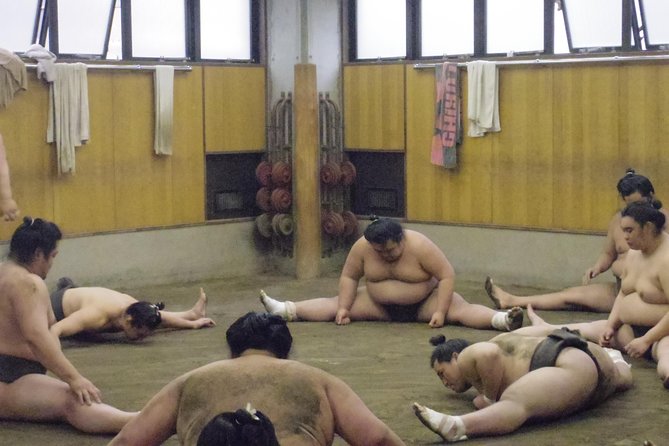
The stable’s rules are not decorative. They protect the wrestlers’ concentration and honor the ring’s sacred role.
Keep your cellphone on silent. Photos are allowed only without flash or shutter sounds. Video is not allowed, and you must not use images in an unauthorized way. Do not ask wrestlers for photographs while practice is still underway.
You cannot step onto the ring or the sandy ground around it. Do not stretch your legs toward the ring, since showing the soles of your feet to the wrestlers is considered rude. Hats and sunglasses are not allowed inside.
You should also avoid leaving halfway through practice. The group is expected to stay until the end, and moving out can distract the athletes. Eating and drinking are not normally allowed. During the hot summer months, water and sports drinks are permitted inside, since the stable has no air conditioning.
Summer heat deserves serious attention. Bring water if you are visiting in that season, along with an ice pack or cold towel. If you feel unwell, do not join the activity. This is a close, quiet indoor setting with no easy way to cool down.
Photos and the final walk back
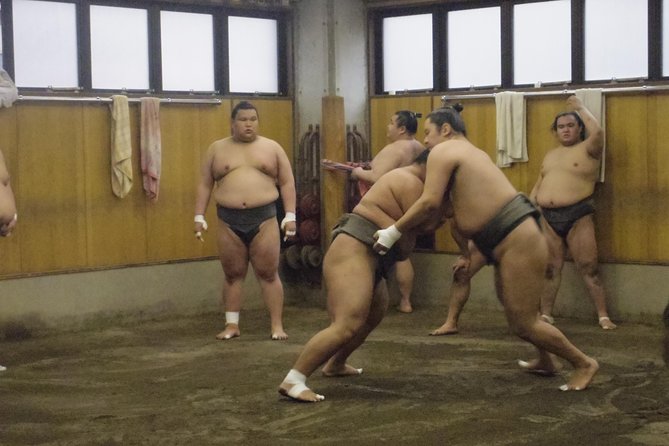
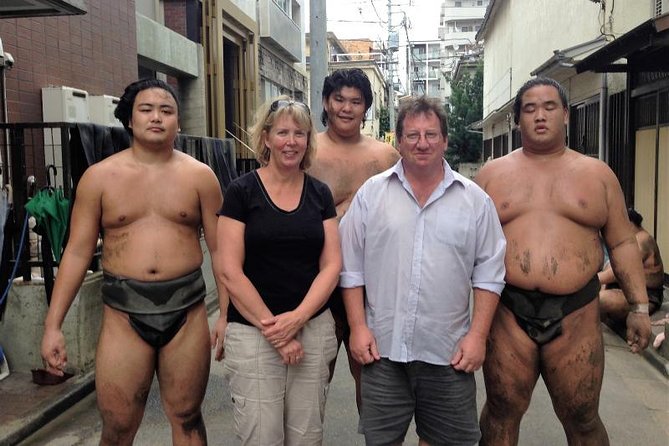
At the end of practice, there may be a brief chance to photograph the wrestlers. Some participants have been able to take group photos with one or two athletes, and this can be a memorable finish. It is not guaranteed that every visit will offer the same photo arrangement, so think of it as a possible extra rather than the main purpose of the morning.
Photo time can be short, sometimes only a few minutes. Be ready when the guide gives instructions, but remain respectful and do not crowd the wrestlers. The stable is still their workplace, and the group must leave promptly.
Your guide then walks you back to the station, where the activity ends. The stated duration is about two hours, with roughly 15 minutes for the meeting and introduction and around 90 minutes inside the stable. Practice content controls the exact timing, so the morning can finish somewhat earlier or later.
Is the $83.57 price fair?
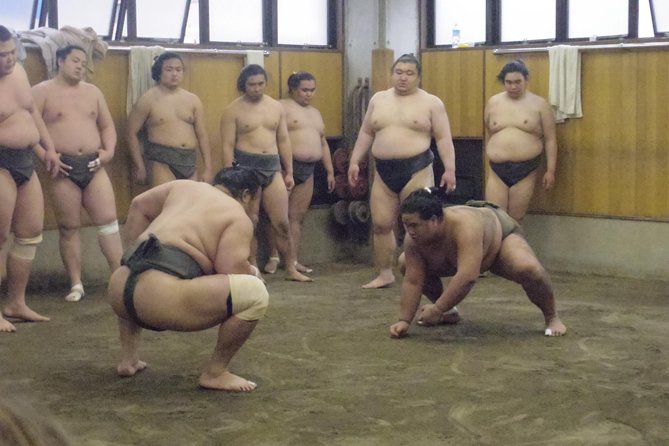
At $83.57 per person, this is not a bargain attraction. You are paying for access to a working stable, a guide who explains a complex sport, transport guidance, and a rare chance to watch professional wrestlers from close range.
The value depends on what you want from Tokyo. If you only want to see sumo athletes and take photos, the price may feel high, especially if practice is short or your seat is not ideal. A formal tournament ticket may make more sense if you want the full public spectacle, ceremony, and competition atmosphere.
I think the price is easier to justify if you care about context and access. The stable is not a tourist theater, and the morning reveals training that you cannot understand from television alone. You may see many more bouts than expected, and the guide’s explanation gives meaning to the movements, ranking system, and daily routine.
The experience is also less predictable than a scheduled performance. A sponsor or senior figure may visit, producing a longer and more intense practice, but you should not count on that. You are buying access to a real routine, not a guaranteed cast of wrestlers or a fixed sequence of events.
Free cancellation is available if you cancel at least 24 hours before the local start time. Changes or cancellations made later are not accepted for a refund.
Who will enjoy this most
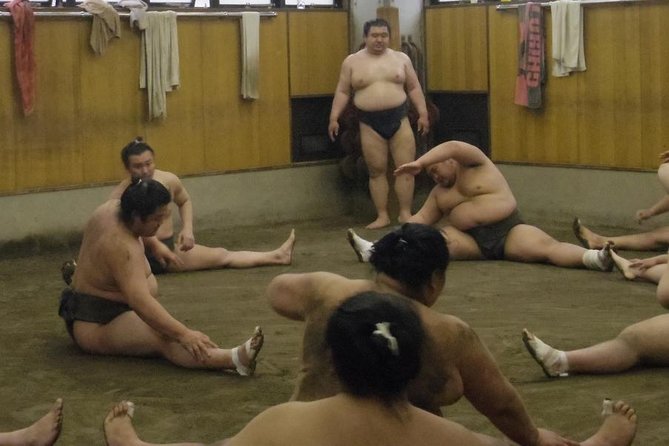
I recommend this for first-time visitors to Tokyo who want a cultural experience that feels more personal than a standard show. It is especially good for anyone curious about Japanese religious traditions, professional sports, discipline, and the everyday life behind a public spectacle.
It suits adults and children age 12 or older who can remain quiet and seated. Younger children cannot enter the stable. It also works well for people with limited time, since the visit takes only one morning and begins near a major station.
You should think twice if you dislike early starts, hot indoor spaces, strict rules, or long periods of silent observation. It may also disappoint you if you expect a long meet-and-greet, a guaranteed photo session, or a formal question-and-answer period.
The audio setup is another consideration. The guide’s explanations can add a great deal, but some participants have found the headsets unclear or distracting. If you have trouble hearing, focus on the practice and ask the guide questions before or after the session when possible.
Practical advice for a better morning
Arrive early at the confirmed meeting point. This helps with both navigation and seating, since the front area may be reserved and the next available seats can fill quickly.
Wear clothes that let you sit comfortably and quietly. You will not be able to lounge with your legs pointed toward the ring, and you should be prepared to remain in place for the practice.
Use the restroom before meeting. Keep your phone silent, disable shutter sounds, and leave video recording equipment unused. Remove your hat and sunglasses before entering.
In summer, carry a cold towel or small ice pack. Water and sports drinks are allowed during the hot months, but regular eating and drinking are not. Most importantly, do not plan another appointment so tightly that you must leave before the practice ends.
Should you book the Tokyo sumo morning practice tour?
Book it if you want to see sumo as work, not just as a colorful Japanese spectacle. The close seating, repeated practice bouts, and explanations of rankings and ritual can give you a much stronger understanding of the sport than a quick photo opportunity ever could.
I would not book it for a loose, social attraction. You must follow stable etiquette, accept uncertain practice timing, and remain quiet. The audio may be imperfect, and the price is substantial for a two-hour activity.
For the right person, though, this is a rare look behind the ring. You may leave with more respect for the athletes, a better grasp of how tournaments work, and a photograph that recalls a very unusual Tokyo morning. If those are your priorities, the early alarm and $83.57 fare are easier to defend.
FAQ
Where does the tour meet?
The meeting point is near Ryogoku Station, with the listed itinerary identifying the Ryogoku Station Gallery area. The exact location can differ by plan, so check your confirmation email.
What time does the tour begin?
The listed meeting time is 7:45am. You should arrive early, especially because the meeting point can be difficult to find and seating may depend on arrival order.
How long does the experience last?
The tour lasts about two hours. The stable practice itself is listed at approximately 90 minutes, but the total time can be shorter or longer depending on the practice.
How old must children be to enter?
The minimum age is 12. Children age 11 and under cannot enter the stable.
Can I take photographs?
Yes, photos are allowed without flash or shutter sounds. Video is not allowed, and unauthorized use of photographs is prohibited.
Can I take a photograph with a sumo wrestler?
A short photo opportunity may be available after practice. You cannot ask wrestlers to pose while practice is still taking place, and the timing and number of participating wrestlers can vary.
Can I eat or drink inside the stable?
Eating and drinking are not allowed under normal conditions. During summer, water and sports drinks are permitted because Tokyo can be very hot and the stable has no air conditioning.
Can I leave during the practice?
You should make every effort to stay until the end. Leaving during practice can distract the wrestlers, and once you leave the stable, you cannot re-enter.
Can I cancel for a refund?
You can receive a full refund if you cancel at least 24 hours before the experience start time. Cancellations or changes made less than 24 hours in advance are not accepted.
More Morning in Tokyo
- Tokyo: Sumo Morning Practice Viewing Tour
★ 4.8 · 570 reviews - Tokyo: Sumo Morning Training Visit
★ 4.4 · 370 reviews - Tokyo: Sumo Morning Practice Tour at Sumida City
★ 4.8 · 308 reviews - Tokyo Ryogoku Sumo Morning Practice + Photo Shoot with Wrestlers
★ 4.5 · 277 reviews
Just added around Tokyo
- Tokyo: Customizable Private Guided Walking Tour★ 4.5 · 129 reviews
- Private Harajuku Omotesando Architecture Tour★ 4.9 · 18 reviews
- Tokyo: Guided Helicopter Ride★ 4.9 · 24 reviews
- Tokyo: Guided Walking Tour of Tsukiji Market with Lunch★ 4.4 · 24 reviews
- Tokyo: Private Personalized Local Food Tour★ 4.5 · 101 reviews
- Tokyo GINZA: KONPARU Japanese Cabaret Show with Drink★ 4.8 · 38 reviews
- Tokyo: Guided Walking Tour of Tsukiji Market with Breakfast★ 4.4 · 134 reviews
- Tokyo: Gotokuji Cat Temple, Shinjuku Cat Cafe & 3D Cat Tour★ 4.9 · 38 reviews
Sumo Experiences, compared.
Sumo Show Experience with Chicken Hot Pot and a Photo
Read our review →
Tokyo Shinjuku Sumo Show & Experience with Photo
Read our review →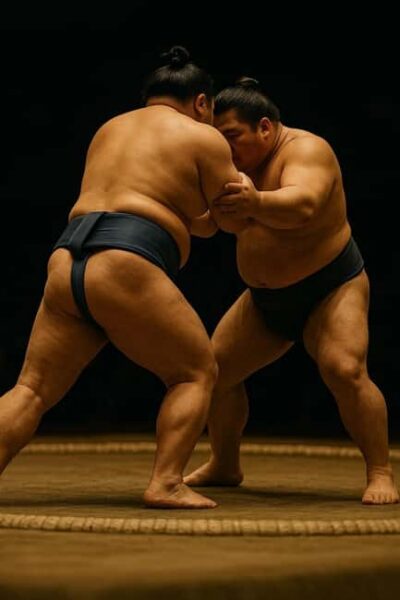
Sumo Show & Experience w/ Optional Kimono & Hot Pot
Read our review →
Authentic Sumo Experience in Tokyo: Enter the Sanctuary
Read our review →Browse the lists this tour appears in