
REVIEW · KIMONO & CULTURE EXPERIENCES
Ninja 2-hour Hands-on Lesson by Japanese master in Kyoto -Medium
Kyoto’s Ninja Dojo and Store turns ninja lore into a hands-on two-hour class. You begin with meditation and breathing, then move through stealth walking, sword work, shuriken, kunai, rope skills, and blow darts. The small group, capped at six, keeps the lesson personal instead of turning it into a staged photo stop.
I like two things right away: the English-speaking Japanese master teaches the movements clearly, and the rented ninja outfit makes the whole session feel like a proper activity rather than a quick demonstration. The class also works well for families, couples, solo participants, and adults who are not especially limber.
The main consideration is price. At $95.51 per person, this is not a cheap souvenir activity, and the class is built more around fun, practice, and ninja tradition than a full academic study of ninja history. If you want an active Kyoto memory, it offers good value. If you only want historical explanation, choose a museum or guided cultural tour instead.
In This Review
- Key points at a glance
- What the Kyoto ninja lesson really offers
- Changing into ninja clothing upstairs
- Starting with kuji-in meditation and ninja breathing
- Learning to walk like a ninja
- Sword training and traditional tools
- Target practice with shuriken and blow darts
- A trick house introduction and the lesson’s pace
- Why the six-person limit matters
- Photos, videos, and the store
- Is $95.51 good value?
- Practical details before you book
- Who should book this Kyoto ninja class?
- Should you book it?
- FAQ
- How long does the ninja lesson last?
- Where does the experience begin and end?
- How many people can join the class?
- Is ninja clothing included?
- Is the lesson taught in English?
- What techniques can you practice?
- Can I cancel for a refund?
Key points at a glance
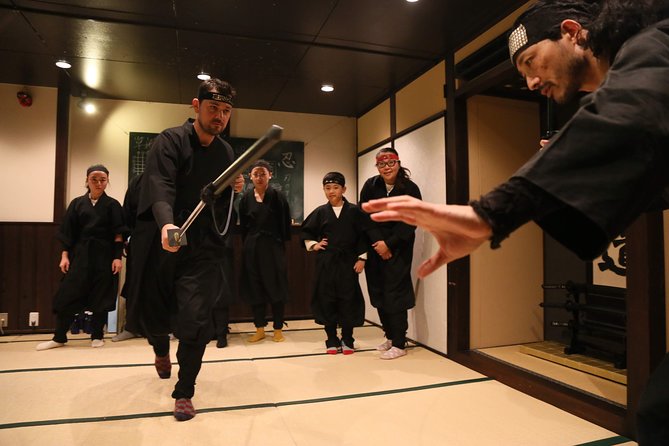
- Six-person maximum: The small class size gives you more time to handle equipment and ask questions.
- A full set of techniques: The lesson can include kuji-in meditation, ninja breathing, stealth walking, sword training, kunai, kusarigama, rope methods, shuriken, and blow darts.
- Ninja clothing included: You change into rented training clothes before the lesson, making photos more fun.
- English instruction: A Japanese master trained in Ninja-Arts teaches the class in English.
- Family-friendly format: Children as young as five have taken part, while middle-aged adults have also found the movements manageable.
- Photos and videos: Staff may take pictures and video during the session and send them by email afterward.
What the Kyoto ninja lesson really offers
This is not a martial arts course that turns you into a trained fighter in two hours. It is a lively introduction to ninja ideas, tools, movement, and discipline, with plenty of chances to try things yourself.
That distinction matters. The appeal is not mastering one skill. It is the steady change of pace: quiet meditation, careful breathing, controlled walking, a sword lesson, target practice, and a few wonderfully theatrical ninja tricks.
The class takes place at NINJA DOJO and STORE KYOTO in Shimogyo Ward, at 528 Hakurakutenchō, 2F, Kyoto 600-8422. The meeting and finish point are the same. The scheduled start is 10:00 am, and the mobile ticket makes entry simple.
You should allow a little time to find the building and arrive early. The meeting point is upstairs, and the usual routine includes leaving shoes at the door and using slippers provided in shoe boxes. That small detail is easy to miss if you rush in at the start time.
More Kimono & Culture Experiences in Kyoto
- Kyoto Geisha Walking Tour: Gion District & Hidden Gems
★ 4.7 · 3,273 reviews - Kyoto: Gion Magical Night Walking Tour with Geisha Trivia
★ 4.9 · 2,393 reviews - Kyoto: Gion Geisha District Walking Tour – Stories of Geisha
★ 4.7 · 2,187 reviews
Changing into ninja clothing upstairs
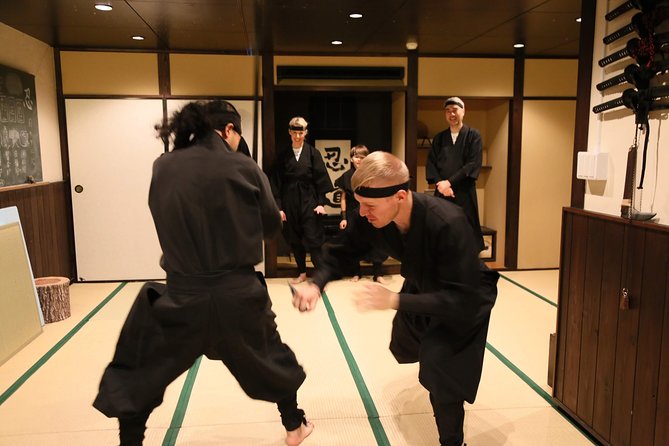
The clothing rental is one of the best parts of the experience. You do not simply stand beside a display of weapons while an instructor talks. You dress for the session, which changes the mood at once and gives you a more memorable set of photos.
Staff help with the outfit when needed. The clothing is designed for the activity, so you can move through the basic exercises without worrying about your normal sightseeing clothes. You will still want comfortable clothing underneath and socks suitable for indoor practice.
Families should expect a little time spent getting children ready. That is part of the fun, but it also means the class feels more like a workshop than a tightly timed stage show.
Once everyone is dressed, the instructor sets the tone. The teaching style combines humor, clear demonstrations, and enough discipline to keep the group focused. That balance is especially useful when children and adults share a class.
Starting with kuji-in meditation and ninja breathing
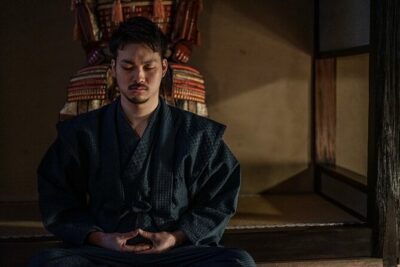
The lesson begins in a quieter way than you might expect. You are introduced to ninja meditation, known as Kuji-In, along with breathing practice. These opening exercises connect the physical skills to the mental side of ninja training.
I like this beginning because it gives the session some substance. Without it, the activity could become a simple sequence of costume photos and weapon handling. Meditation and breathing provide a sense of control and concentration before the faster exercises begin.
You should not expect a long spiritual retreat. The meditation forms part of an entry-level lesson, so the emphasis is on learning the basic idea and trying the movements yourself. The instructor explains what to do, demonstrates the gestures, and keeps the atmosphere approachable.
This part suits adults as much as children. It slows everyone down, gives the group a shared starting point, and shows that ninja training is not only about dramatic weapons.
Learning to walk like a ninja
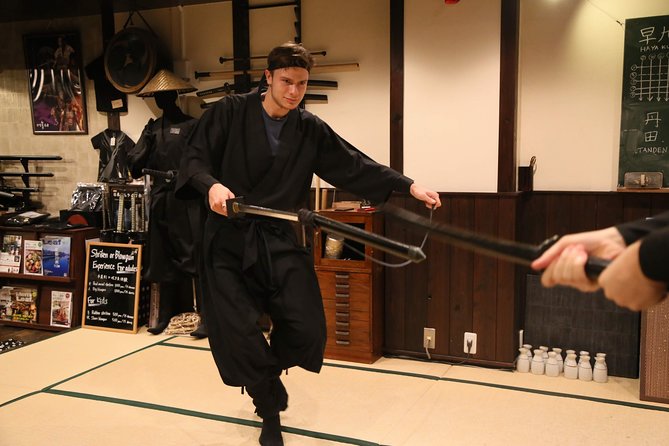
Next comes ninja walking. The lesson looks at how to move quietly and with control, rather than charging across the room like a movie character.
The exercise is simple enough for beginners, but it asks you to pay attention to balance, posture, and foot placement. You might find it more demanding than expected, particularly after a full morning of sightseeing. The good news is that the class is designed for beginners, and the instructor demonstrates each movement before asking you to try.
A small group helps here. With no more than six people, the instructor can watch how the group is moving and correct basic mistakes. You are not lost in a crowd, and you get a fair chance to practice instead of waiting through long turns.
The session also includes an introduction to the gimmicks and traps found in a ninja trick house. This gives you a look at the clever, playful side of ninja culture. It is best understood as a demonstration and introductory activity, not a full tour of a historic ninja residence.
Same city, a completely different kind of day:
- PERFECT KYOTO 1-Day Bus Tour
★ 5.0 · 13,518 reviews - Kyoto: Fushimi Inari, Kinkakuji, Bamboo Grove 1 Day Bus Tour
★ 4.8 · 4,316 reviews - Kyoto: Tea Ceremony in a Traditional Tea House in Kiyomizu
★ 4.9 · 3,519 reviews - Kyoto: Tea Ceremony Ju-An at Jotokuji Temple
★ 4.9 · 3,207 reviews
Sword training and traditional tools
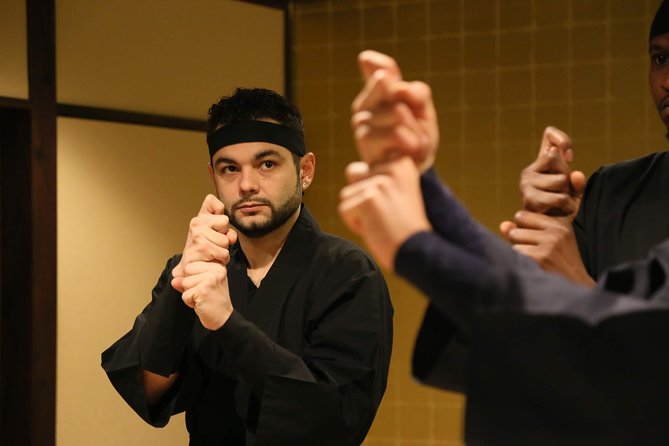
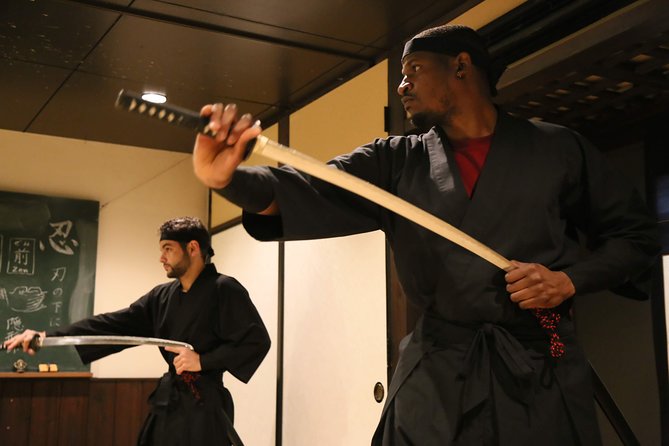
The sword lesson is likely to be the main draw for many people. You learn basic ways to handle a ninja sword, with the instructor showing the movement before you practice it.
Safety and control are central to this part. The lesson is structured for beginners, so you are not expected to arrive with martial arts experience. You follow the instructor’s pace and learn the mechanics in a controlled indoor setting.
The class then expands beyond the sword. Depending on the lesson flow, you may work with:
- Kunai, a dagger-like ninja tool
- Kusarigama, a sickle with a chain
- Rope techniques
- Kunai with rope
- Shuriken, commonly called ninja stars
- Stick-type shuriken
- Ninja blowgun with blow darts
The variety is what makes the $95.51 price easier to assess. You are not paying for one short sword demonstration. You receive a guided introduction to many tools and techniques, with time to try them rather than only watch.
Some participants have described the weapons as authentic rather than toy-like, but you should still think of this as a supervised cultural activity. The point is learning and controlled practice, not combat training.
Target practice with shuriken and blow darts
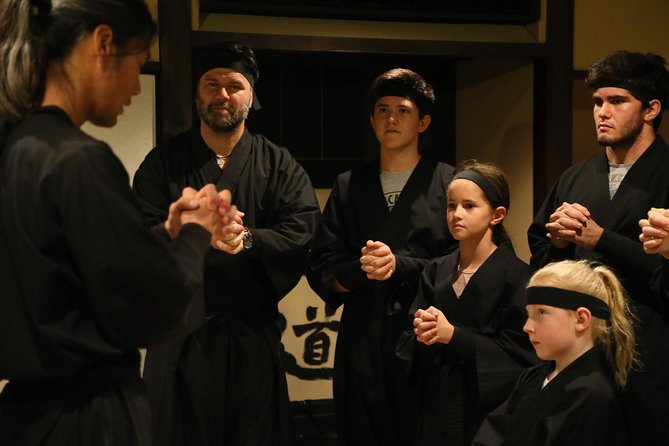
The target work brings out the playful side of the class. You may throw shuriken and try kunai or other tools at targets, then test the ninja blowgun with blow darts.
This is where the lesson works particularly well for families. Children get a clear goal and immediate feedback, while adults can enjoy the same challenge without needing athletic skill. The instructor’s demonstrations help you understand how technique matters more than strength.
You will probably not hit every target. That is part of the charm. The class is not scored as a serious competition, and the instructors keep the mood light while still explaining the proper method.
The sword-with-shuriken segment and stick-type shuriken add variety to the practice. These details make the workshop feel carefully planned rather than padded with one repeated activity.
A trick house introduction and the lesson’s pace
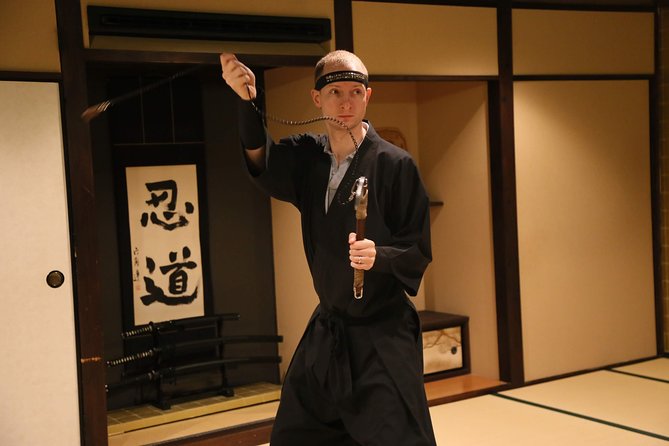
The ninja trick house material adds a different kind of interest. Instead of focusing only on weapons, the class introduces the gimmicks and traps associated with ninja spaces.
This section helps explain why ninja culture has such strong appeal. It blends practical movement, secrecy, clever design, and theatrical surprise. You get a taste of those ideas without needing to spend a full day at a separate attraction.
The pace is active, but not frantic. The lesson moves from concentration to movement, then from weapon instruction to target practice. That rhythm helps hold the attention of younger children and keeps adults from feeling as if they are being put through a formal military drill.
The advertised elementary lesson includes the entry-level material plus five additional techniques. The full list is long, so the exact time given to each item can vary. If you are most interested in sword work or shuriken, tell the instructor early so you understand how the session will be organized.
Why the six-person limit matters
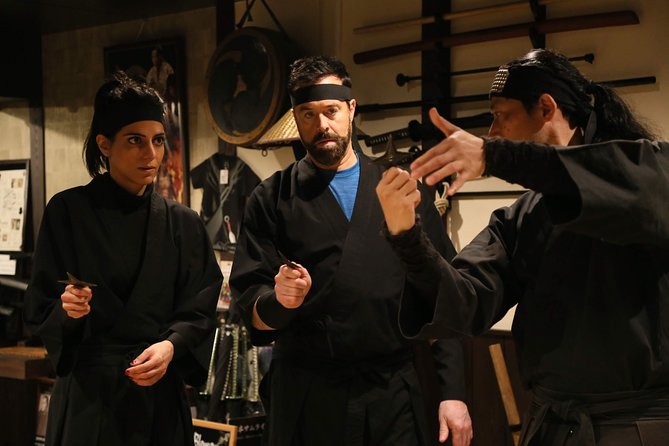
The maximum of six is a real benefit. In a larger group, hands-on activities can mean standing around while other people take their turn. Here, the ratio of instructor attention to participants is much better.
You also get a more relaxed setting for questions. One participant may want more cultural context, another may want help with a sword movement, and a child may need instructions repeated. The small group makes that easier.
The format has worked for mixed ages. Families with children aged five to twelve have taken part, as have teenagers, couples, solo adults, and people in their fifties. One useful sign is that the class has also suited a middle-aged couple who did not consider themselves very limber.
That does not mean every movement will feel effortless. You should still expect to stand, kneel, turn, and handle equipment. Tell the staff about any physical concern before starting, and follow their instructions closely.
Photos, videos, and the store
A staff member may photograph and film parts of the lesson with a professional camera. The images and videos can be sent by email, often through Google Photos, after the class. Same-day delivery has been provided, though you should treat that as a helpful feature rather than the central promise of the experience.
The photos are especially useful because the outfit, weapons, and training positions are difficult to capture while you are participating. If you are taking the class solo, this gives you a record of the activity without having to ask another participant to take every picture.
The store is part of the same stop and offers ninja-related purchases. You can browse after the lesson, but buying something is not required and food and drinks are not included.
Is $95.51 good value?
At $95.51 per person, the class costs more than a basic cultural demonstration. I would judge its value by the amount of participation included.
You receive about two hours of instruction, rented clothing, entry, an English-speaking Japanese master, and access to a wide range of techniques. The six-person cap also matters. It means you are paying for active time, not simply admission to a room.
For a family, the price can add up quickly. Still, it may be worth it if you want one activity that keeps children and adults involved together. The class has been enjoyed by families with boys and girls, as well as couples and solo participants.
For a solo visitor, the value is also fairly strong if you want something social and different from temple visits. You can join a small class without needing to organize a private group.
The weaker value case is for someone mainly seeking detailed ninja history. The lesson includes cultural explanation and ninja philosophy, but its heart is practical training. One participant wanted more history, which is a fair limitation to keep in mind.
Practical details before you book
The experience starts at 10:00 am and ends back at the dojo. Since hotel pickup and drop-off are not included, plan your own route to the address in Shimogyo Ward. The location is near public transportation.
A mobile ticket is accepted, and booking confirmation is provided at the time of reservation. Service animals are allowed, and most people can participate, but the class still includes physical movements and weapon handling.
The activity requires good weather under its operating policy. If poor weather causes cancellation, you are offered another date or a full refund. A minimum number of participants is also required, so a cancellation for that reason brings the same choice of another date or a refund.
You can cancel for a full refund up to 24 hours before the start time. Changes or cancellations inside 24 hours are not accepted and are not refunded. Keep that deadline in mind when building a Kyoto schedule around trains, flights, or other timed bookings.
Who should book this Kyoto ninja class?
I would choose this for families looking for a shared activity, especially if your children are excited by ninja stories but need something more active than sightseeing. The class has also suited children from about five years old through the teenage years.
It works well for couples and solo adults, too. You do not need to be flexible, athletic, or experienced in martial arts. A sense of play is more important.
It is a particularly good choice for someone who wants photos in a full ninja outfit, enjoys trying unusual equipment, or wants a break from temples and gardens. The English instruction makes the process easier, and the small class gives you room to follow along.
I would hesitate if you dislike costume activities, have little interest in weapons, or want a serious historical lecture. The lesson has cultural content, but it is designed to be fun, physical, and interactive.
Should you book it?
Book it if you want a hands-on Kyoto experience that mixes ninja philosophy with sword practice, target throwing, rope techniques, and blow darts. The small group, English instruction, clothing rental, and possible photo delivery give the $95.51 price a solid case.
Skip it if your priority is low-cost sightseeing or a detailed study of ninja history. For everyone else, especially families and first-time visitors to Kyoto, this is an easy activity to fit into a morning and a lively way to remember the city beyond its temples.
FAQ
How long does the ninja lesson last?
The lesson lasts approximately two hours and starts at 10:00 am.
Where does the experience begin and end?
It begins at NINJA DOJO and STORE KYOTO, 528 Hakurakutenchō, 2F, Shimogyo Ward, Kyoto 600-8422. The activity ends back at the same meeting point.
How many people can join the class?
The class has a maximum of six participants.
Is ninja clothing included?
Yes. Ninja clothing rental is included and is worn during the training.
Is the lesson taught in English?
Yes. A Japanese master trained in Ninja-Arts teaches the lesson in English.
What techniques can you practice?
The lesson can include Kuji-In meditation, ninja breathing, ninja walking, ninja sword training, kunai, kusarigama, rope techniques, kunai with rope, shuriken, stick-type shuriken, and a ninja blowgun with blow darts.
Can I cancel for a refund?
You can cancel up to 24 hours before the start time for a full refund. Cancellations or changes made less than 24 hours before the start time are not accepted and are not refunded.
More 2-Hour Experiences in Kyoto
- Kyoto Gion: 2-Hour Geisha Culture & History Walking Tour
★ 5.0 · 1,186 reviews - Kyoto: 2-Hour Maiko Makeover and Photo Studio Shoot
★ 4.7 · 122 reviews - Osaka: 2-Hour Nightlife District Walking & Local Food Culture
★ 5.0 · 199 reviews - Ninja Samurai 2-hour hands-on lesson by Japanese master in Tokyo
★ 5.0 · 194 reviews
More Workshops in Kyoto
- Kyoto: 45-Minute Tea Ceremony Lesson Experience
★ 4.3 · 2,378 reviews - Ramen Cooking Class at Ramen Factory in Kyoto
★ 5.0 · 1,937 reviews - Kyoto : Chopsticks Making Workshop in Gion with Engraving Option
★ 5.0 · 958 reviews - Kyoto: Samurai Sword Class by Experts in Traditional Arts
★ 4.9 · 657 reviews
Just added around Kyoto
- Taste of Nishiki Market Walking Food Tour with Local guide★ 5.0 · 17 reviews
- Kyoto: Sushi Making Class with Sushi Chef★ 4.8 · 64 reviews
- Kyoto: City Secrets eBike Tour★ 4.9 · 196 reviews
- Sacred Pathways: Discover the Philosopher’s Path of Kyoto★ 4.9 · 20 reviews
- Private Tour to Monkey Park and Arashiyama Highlights★ 5.0 · 22 reviews
- Private Nara Tour from Osaka – Meet at Your Hotel★ 5.0 · 22 reviews
- Private Sake Tasting in Central Kyoto with Sake Sommelier★ 5.0 · 13 reviews
- Kyoto : Private Custom Walking Tour With A Local Guide★ 4.6 · 144 reviews
Kimono & Culture Experiences, compared.
Kyoto Geisha Walking Tour: Gion District & Hidden Gems
Read our review →
Gion Magical Night Walking Tour with Geisha Trivia
Read our review →
Gion Geisha District Walking Tour – Stories of Geisha
Read our review →
Best of Kyoto: Gion, Geisha, Pagodas & Cobblestones
Read our review →
Kyoto Gion Geisha District Walking Tour – The Stories of Geisha
Read our review →
Browse the lists this tour appears in