
REVIEW · KIMONO & CULTURE EXPERIENCES
One Hour Geisha Show in Kyoto
Kyoto’s Maiko culture is usually glimpsed from a distance, if at all. Here, you sit close enough to see the careful movement of a real Maiko, an apprentice Geisha, then speak with her through a guide and take photos together. With only about 40 Maikos said to remain in Kyoto, this is a rare look at a living art.
I especially like the open Q&A and the traditional game, which turn a formal dance into a friendly cultural exchange. I also like the tea and Japanese snacks in the Tea House option. The main thing to know is that the Maiko does not perform nonstop for an hour. The dances are short by design, followed by conversation, photos, and play.
In This Review
- Key points before you book
- Meeting a Maiko in Kyoto
- The first dance, about five minutes of quiet grace
- Tea, snacks, and the traditional game
- Tea House or Gion Theater?
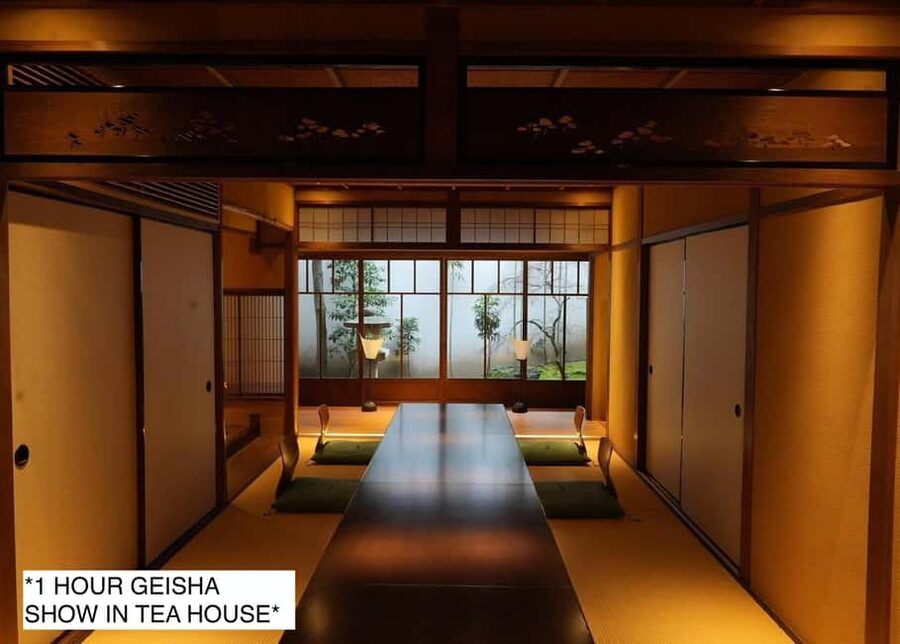
- The Tea House option
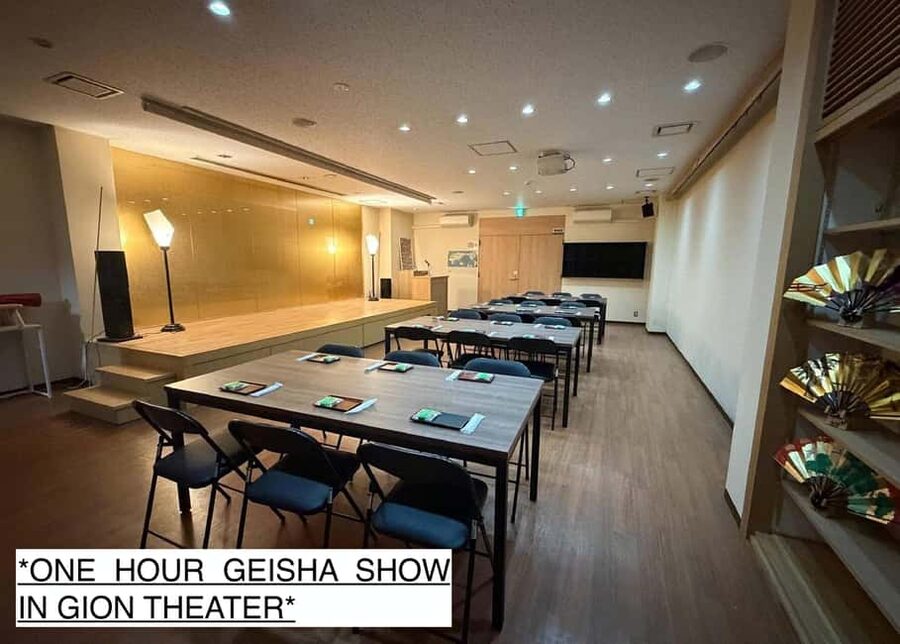
- The Gion Theater option
- Kitano Tenmangu Shrine adds a useful second setting
- Is $50 a fair price?
- What to wear and what to expect on arrival
- Who will enjoy this most?
- Should you book the Kyoto Maiko show?
- FAQ
- How long does the Maiko experience last?
- How long does the Maiko dance?
- Can I take photographs and videos?
- Is the Maiko a real Geisha?
- What is included in the Tea House option?
- Does every option include the shrine visit?
- Is the activity wheelchair accessible?
- How many people can join the activity?
- What should I bring?
- Can I cancel for a refund?
Key points before you book
- Two short dances show the art at its best: Expect performances of about five minutes each, not a continuous one-hour stage show.
- The Tea House option adds Kyoto atmosphere: You sit in a Japanese Kyo-Machi-ya house and may visit Kitano Tenmangu Shrine with the Maiko afterward.
- The Gion Theater option is a different setting: It takes place in a showhouse and is the wheelchair-accessible choice.
- Photos and videos are welcome: You also get time for a personal photo with the Maiko.
- The guide makes the cultural details understandable: Guides including Genki, Rin, Akari, Ai, Chihiro, and Taira Yoshino have helped explain the customs and translate questions.
- Bring socks: Bare feet are not allowed, and the Tea House option is not wheelchair accessible.
Meeting a Maiko in Kyoto
The most valuable part of this one-hour Kyoto show is the direct contact. You are not simply watching a costumed stage act. The Maiko explains aspects of her appearance, including her clothing, hair, makeup, and accessories, then answers questions about her work and life through the tour guide.
That context matters. A Maiko’s appearance is highly formal, and each detail has meaning. Without explanation, you might notice the elaborate hairstyle or long sleeves but miss why they are important. The guide gives you a way to understand what you are seeing without turning the occasion into a dry lecture.
GuideMe Japan runs the experience in English and Korean. Names that have appeared in the guide team include Genki, Rin, Akari, Ai, Chihiro, and Taira Yoshino. Genki has been especially useful as an interpreter between the Maiko and the audience, while other guides have been praised for warm introductions and clear explanations.
You should also know that this is a group activity. The Tea House option allows up to 23 people, while the Gion Theater option can hold up to 30. Those numbers are not huge, but they are large enough that the room may feel less personal than the promotional photographs suggest.
More Kimono & Culture Experiences in Kyoto
- Kyoto Geisha Walking Tour: Gion District & Hidden Gems
★ 4.7 · 3,273 reviews - Kyoto: Gion Magical Night Walking Tour with Geisha Trivia
★ 4.9 · 2,393 reviews - Kyoto: Gion Geisha District Walking Tour – Stories of Geisha
★ 4.7 · 2,187 reviews
The first dance, about five minutes of quiet grace
The Maiko begins with a traditional dance lasting about five minutes. A second dance follows, also about five minutes, and the performances are arranged so people on different sides of the table can see properly.
The movements are controlled and deliberate. This is not a high-energy show with constant action. The appeal lies in posture, hand gestures, the sound of the music, and the way the Maiko uses her costume as part of the performance.
The short format is worth understanding before you arrive. Maiko performances are intentionally brief, preserving their sense of ceremony and exclusivity. If you expect 60 minutes of uninterrupted dancing, you may feel disappointed. If you see the dance as the centerpiece of a wider cultural meeting, the timing makes more sense.
I like this format because it leaves room for questions. You get to admire the performance, then ask what you just saw. That connection between watching and understanding is one of the strongest reasons to choose this experience over a simple stage show.
Photography and video are welcome, which is unusual for an intimate cultural presentation. Still, you will get better images by staying attentive during the dance rather than treating it as a photo session from the first moment. Save the posed picture for the later photo period.
Tea, snacks, and the traditional game
The Tea House option includes tea and traditional Japanese snacks. Depending on your choice, you may receive hot matcha or water, and the tea gives the opening of the event a calm, distinctly Japanese rhythm.
The snacks are a small inclusion, not a meal. Additional food and drinks are not included, so eat beforehand if you are arriving hungry. I see the refreshments as part of the setting rather than a reason to book on their own.
After the dances and Q&A, you can play a traditional Japanese game with the Maiko. The game named in the experience details is Konpira Fune Fune, and it involves quick hand movements and rhythm. It is simple to join, but do not expect an easy victory. Several accounts of the activity describe losing with good humor.
This is a smart part of the program. The dance can feel formal and distant, while the game gives everyone a chance to relax. You are still taking part in a cultural activity, but the mood becomes more playful.
A personal photo with the Maiko comes afterward. One participant also received a name sticker for luck, though you should not assume every booking includes a specific gift. The important point is that the photo opportunity is built into the schedule, rather than left to chance.
Tea House or Gion Theater?
You need to read the option name carefully when booking. These are not two versions of the same room.
Same city, a completely different kind of day:
- PERFECT KYOTO 1-Day Bus Tour
★ 5.0 · 13,518 reviews - Kyoto: Fushimi Inari, Kinkakuji, Bamboo Grove 1 Day Bus Tour
★ 4.8 · 4,316 reviews - Kyoto: Tea Ceremony in a Traditional Tea House in Kiyomizu
★ 4.9 · 3,519 reviews - Kyoto: Tea Ceremony Ju-An at Jotokuji Temple
★ 4.9 · 3,207 reviews
The Tea House option
The Tea House show takes place in a Japanese Kyo-Machi-ya, or Kyoto-style house. This setting gives the event a more traditional feel, with tea, snacks, and a 30-minute guided session at Kitano Tenmangu Shrine included.
The shrine visit is a major difference. After the indoor program, you may walk with the Maiko to Kitano Tenmangu Shrine, where the guide provides a short tour. This adds about 30 minutes and connects the performance with one of Kyoto’s important religious sites.
The Tea House option is limited to 23 people, which may help the room feel more manageable. It is not wheelchair accessible, and the no-bare-feet rule means you must wear socks.
The Gion Theater option
The Gion Theater option takes place in a showhouse rather than a private-style Kyo-Machi-ya setting. It is the larger option, with a maximum of 30 people, and it is wheelchair accessible.
The theater choice does not include the Tea House walking tour to Kitano Tenmangu Shrine. It may suit you better if step-free access matters or if you prefer a straightforward indoor performance with less movement between locations.
Do not book one option assuming you will receive the features of the other. The meeting point varies, and the shrine visit belongs only to the Tea House choice.
Kitano Tenmangu Shrine adds a useful second setting
For the Tea House booking, the visit to Kitano Tenmangu Shrine lasts about 30 minutes. The shrine gives you a change of pace after the indoor show and lets you see the Maiko in an outdoor Kyoto setting.
The tour details do not promise a long shrine tour, so keep your expectations modest. This is a brief guided session, not a full afternoon at the shrine. Its value is the added time with the Maiko and the chance to connect the performance with Kyoto’s religious spaces.
The itinerary lists several possible drop-off points: Umeno, Kitano Tenmangu Shrine, and 302-2 Daikokuchō. The starting point may also vary by option, so check the exact meeting instructions after booking and keep a phone number available during your stay in Japan.
Is $50 a fair price?
At $50 per person, this is not a bargain attraction in the usual sense. It is also not simply a one-hour dance recital. Your payment covers a live Maiko performance, an English or Korean guide, cultural explanations, questions, photos, a traditional game, and, with the Tea House option, tea, snacks, and the shrine session.
For me, the value depends on what you want from Kyoto. If you only want to watch a longer dance show, you may find the performance time too short. If you want a personal introduction to Maiko culture, the cost is easier to justify because the Q&A and photo period are central parts of the event.
The Tea House option gives the stronger value if you want more time and more variety. Its 30-minute shrine visit extends the outing to as much as 105 minutes, rather than just one hour. The Gion Theater option may be the better practical choice for wheelchair users or anyone who wants to stay indoors.
Group size affects the calculation. A maximum of 23 people at the Tea House and 30 at the theater means you are paying for a guided group activity, not a private meeting. You should expect your questions and photo turn to share time with others.
What to wear and what to expect on arrival
Wear socks. This is required, especially for the Tea House setting, and bare feet are not allowed. Comfortable clothing is sensible because you may sit for the performance and, with the Tea House option, walk to the shrine.
Baby strollers, alcohol, and drugs are not allowed. The activity is not suitable for people over 95, according to the booking conditions.
The confirmation arrives at booking. You should provide a phone number that works during your stay in Japan and is reachable on WhatsApp. If you are arranging the booking for someone else, use the actual participant’s number so the local team can send clear meeting instructions and updates.
The guides speak English or Korean. If your group includes people using different languages, explanations may take longer or feel less smooth. One practical tip is to listen carefully to the guide’s translation before taking pictures, since the cultural explanation is one of the best parts of the event.
Free cancellation is available up to 24 hours before the activity for a full refund. You can also reserve and pay later, which helps if you are still adjusting your Kyoto schedule.
Who will enjoy this most?
I would recommend the show to you if you want a close look at traditional performance rather than a large commercial spectacle. It suits first-time Kyoto visitors, people interested in Japanese arts, and anyone who values a chance to ask direct questions.
It is also a good choice for photographers, since pictures and videos are permitted and a personal photo is included in the flow of the event. You should still come for the culture, not only the image. The dance is short, and the best memories may come from the conversation or the game.
Families with young children should consider the setting and rules carefully. Strollers are not allowed, and the quiet performance may not suit every child. The activity also has age-related restrictions for people over 95.
Choose the Tea House version if you want tea, snacks, a traditional house, and the shrine visit. Choose the Gion Theater version if wheelchair access is important or you prefer to avoid the walking portion.
Should you book the Kyoto Maiko show?
You should book this experience if the chance to meet a Maiko matters more to you than getting a long performance. The strongest parts are the graceful dances, the clear explanations about dress and custom, the open questions, and the relaxed game afterward.
I would not book it expecting an hour of continuous entertainment. The actual dancing lasts roughly ten minutes in total, with the rest devoted to conversation, photos, tea, and play. That short performance is part of the tradition, not a flaw, but it is essential to understand before paying.
For the fullest outing, select the Tea House option and allow up to 105 minutes. For wheelchair access, choose Gion Theater. At $50, this is a fair cultural splurge for someone who wants a personal and memorable Kyoto encounter, provided you choose the right version and arrive with socks.
FAQ
How long does the Maiko experience last?
The activity lasts between one hour and 105 minutes, depending on the option and whether the Kitano Tenmangu Shrine session is included.
How long does the Maiko dance?
The program includes two traditional dances of about five minutes each. The Maiko does not perform continuously for one hour.
Can I take photographs and videos?
Yes. Photography and video are welcome, and there is time for a personal photo with the Maiko.
Is the Maiko a real Geisha?
The experience features a real Maiko, who is an apprentice Geisha.
What is included in the Tea House option?
The Tea House option includes the one-hour show, tea, traditional Japanese snacks, a professional guide, and a 30-minute Kitano Tenmangu Shrine session with the Maiko.
Does every option include the shrine visit?
No. The Kitano Tenmangu Shrine walking session is only included with the Tea House option.
Is the activity wheelchair accessible?
The Gion Theater option is wheelchair accessible. The Tea House option is not wheelchair accessible.
How many people can join the activity?
The Tea House option has a maximum of 23 people. The Gion Theater option has a maximum of 30 people.
What should I bring?
You should bring or wear socks. Bare feet are not allowed.
Can I cancel for a refund?
Yes. You can cancel up to 24 hours in advance for a full refund. Reserve now and pay later is also available.
More 1-Hour Experiences in Kyoto
- Ninja 1-hour Hands-on Lesson by Japanese master in Kyoto -Entry
★ 5.0 · 489 reviews - Kyoto: Hands-on Takoyaki and Okonomiyaki Cooking (1 Hour)
★ 4.7 · 25 reviews - Ring making experience Completed in about 1 hour!
★ 5.0 · 141 reviews - Tokyo: 1-Hour Private Photoshoot
★ 5.0 · 16 reviews
More Show in Kyoto
- Kyoto Gion Cultural Walk & Geisha Show with Dining Options
★ 5.0 · 518 reviews - Kyoto Gion Cultural Walk & Geisha Show with Dining Options
★ 5.0 · 483 reviews - 1 Hour Geisha Show in Kyoto
★ 5.0 · 452 reviews - Kyoto: Samurai Kenbu Traditional Sword Dancing Show
★ 4.5 · 426 reviews
Just added around Kyoto
- Taste of Nishiki Market Walking Food Tour with Local guide★ 5.0 · 17 reviews
- Kyoto: Sushi Making Class with Sushi Chef★ 4.8 · 64 reviews
- Kyoto: City Secrets eBike Tour★ 4.9 · 196 reviews
- Sacred Pathways: Discover the Philosopher’s Path of Kyoto★ 4.9 · 20 reviews
- Private Tour to Monkey Park and Arashiyama Highlights★ 5.0 · 22 reviews
- Private Nara Tour from Osaka – Meet at Your Hotel★ 5.0 · 22 reviews
- Private Sake Tasting in Central Kyoto with Sake Sommelier★ 5.0 · 13 reviews
- Kyoto : Private Custom Walking Tour With A Local Guide★ 4.6 · 144 reviews
Kimono & Culture Experiences, compared.
Kyoto Geisha Walking Tour: Gion District & Hidden Gems
Read our review →
Gion Magical Night Walking Tour with Geisha Trivia
Read our review →
Gion Geisha District Walking Tour – Stories of Geisha
Read our review →
Best of Kyoto: Gion, Geisha, Pagodas & Cobblestones
Read our review →
Kyoto Gion Geisha District Walking Tour – The Stories of Geisha
Read our review →
Browse the lists this tour appears in