
REVIEW · KIMONO & CULTURE EXPERIENCES
Ninja 1-hour Hands-on Lesson by Japanese master in Kyoto -Entry
The best part of this Kyoto experience is that you do not just pose in a costume. You learn basic ninja breathing, walking, meditation, and weapon skills inside a dojo with secret doors and trap-house features. Sho and Jack are among the English-speaking instructors, and both bring humor and clear demonstrations to the lesson.
I like the small maximum of six, which gives you real time with the sword, shuriken, kunai, and blowgun. I also like the family-friendly format: a seven-year-old, older children, teenagers, and adults can all take part. The main drawback is the short one-hour format. It is lively and fun, but it offers only a brief introduction rather than serious martial-arts training or a full study of ninja history.
In This Review
- Key points to know
- Entering the Kyoto Ninja Dojo
- The first lessons: breathing, meditation, and quiet movement
- Secret rooms, trap features, and the ninja walk
- Sword training with a Japanese sensei
- Kunai, shuriken, and blowgun practice
- What the one-hour schedule really means
- Is the $80.58 price good value?
- Who will enjoy this class most?
- Where the experience feels authentic, and where it feels staged
- Practical details before you book
- Should you book the Kyoto Ninja lesson?
- FAQ
- Where does the ninja lesson start and finish?
- How long does the ninja class last?
- What activities are included?
- Are ninja clothes included?
- Is the lesson taught in English?
- How many people can join the class?
- Can I cancel for a full refund?
Key points to know
- Secret dojo features: See an introduction to ninja traps and gimmicks, including hidden doors and a floor section that calls for a careful ninja walk.
- Several weapons in one hour: Practice with a sword, kunai dagger, shuriken throwing stars, and ninja blowgun darts.
- English-speaking instruction: Japanese sensei teach the class in English, with guides such as Sho and Jack praised for clear explanations and humor.
- Small-group lesson: The class accepts no more than six people, giving you more practice time than a large stage show.
- Ninja clothing included: You change into ninja clothes for the lesson, making the activity more fun for children and better for photographs.
- A good indoor break: The dojo offers an air-conditioned hour away from Kyoto’s temples and outdoor sightseeing.
Entering the Kyoto Ninja Dojo
The class begins at NINJA DOJO and STORE KYOTO, at 528 Hakurakutenchō, 2F, in Kyoto’s Shimogyo Ward, postal code 600-8422. The activity returns to this same meeting point, so you do not need to arrange a separate ride at the end.
The location is near public transportation, which helps when you are fitting the lesson between central Kyoto sights. Still, give yourself enough time to find the building and reach the second floor. The booking information does not include hotel pickup, so you are responsible for getting there.
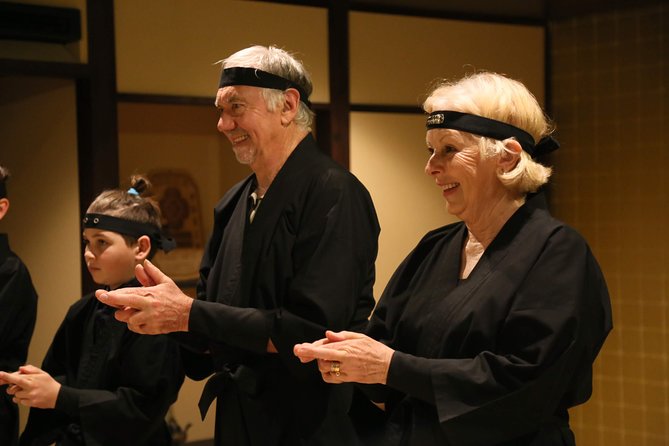
Once inside, the mood shifts from ordinary city sightseeing to a compact training room. You receive ninja clothes to wear during the lesson, and that simple change helps everyone take the activity less seriously in the best possible way. Children tend to enjoy the costume at once, while adults often relax after the first few minutes of dressing up and taking photographs.
The dojo also contains ninja artifacts and displays. The store is part of the setting, so you may see ninja-related products before or after the class. Food and drinks are not included.
More Kimono & Culture Experiences in Kyoto
- Kyoto Geisha Walking Tour: Gion District & Hidden Gems
★ 4.7 · 3,273 reviews - Kyoto: Gion Magical Night Walking Tour with Geisha Trivia
★ 4.9 · 2,393 reviews - Kyoto: Gion Geisha District Walking Tour – Stories of Geisha
★ 4.7 · 2,187 reviews
The first lessons: breathing, meditation, and quiet movement
This is not a weapons-only session. The instructor first introduces the mindset and body control linked with ninja training.
You practice ninja breathing and learn about Kuji-In, a form of ninja meditation. The lesson also covers ninja walking, which becomes particularly memorable when the instructor shows how to move carefully through a dark section with a floor hazard. The point is not to turn you into a trained spy in sixty minutes. It is to show how breathing, balance, attention, and controlled movement fit together.
I like this opening because it gives the weapon practice some context. Without it, the class could feel like a simple target game. With it, you get a short lesson in why a ninja would value silence, patience, and body control.
The historical portion remains fairly light. You will learn some background about ninja life, methods, and tools, but this is not a long lecture about medieval Japan. If your main goal is detailed history, look for a museum visit or a longer cultural class as well. If you want a physical activity with a little historical grounding, the balance works well.
Secret rooms, trap features, and the ninja walk
One of the more unusual sections is the introduction to a ninja trick house. The instructor demonstrates gimmicks and traps built into the dojo, including secret doors and hidden spaces. The exact amount of time spent here can vary, since the class must also cover the weapons, but it adds a sense of place that a plain studio would lack.
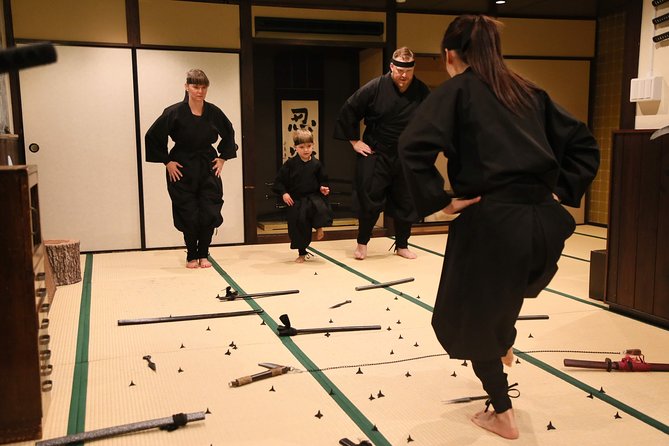
A dark floor section with spikes is also used to show the ninja walk. You are not simply sent across it. The instructor demonstrates how to avoid the hazard and guides you through the movement. This is one reason the class works for families: the activity feels like a small adventure, but the instructor controls the pace and explains what to do.
The trap features are theatrical, and you should expect some playfulness. They are not proof that you have entered a preserved historical ninja residence. That is an important distinction. The dojo presents ninja ideas in an accessible way, mixing demonstration, display, and safe practice.
Sword training with a Japanese sensei
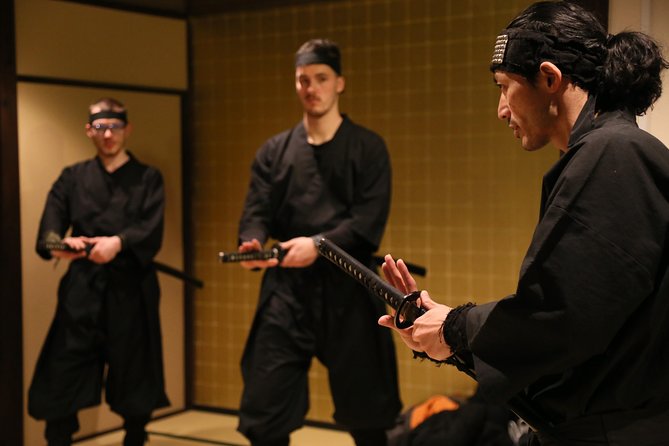
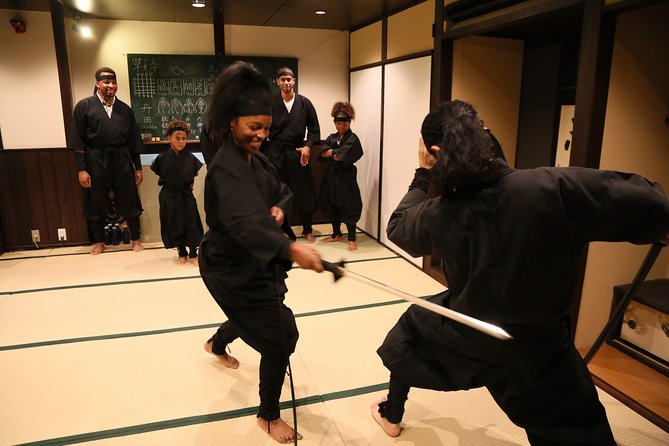
The sword portion begins with a demonstration. You then learn basic handling and practice the movements shown by the instructor.
The supplied information does not promise advanced sword work, sparring, or a long martial-arts course. Think of it as an introductory lesson in posture, grip, movement, and respect for the tool. You will be shown how to use a ninja sword, then given a chance to repeat the technique under supervision.
This part appeals to both children and adults because it feels like the activity most people picture when they hear ninja class. It also gives the instructor a chance to explain that weapons require control rather than wild swinging. Listen closely and follow the demonstration. The class is short, so you will gain more from careful practice than from rushing through the motions.
English communication is a useful feature here. Guides such as Sho and Jack have been praised for clear English, easy humor, and strong demonstrations. That matters when an activity involves body position and weapon handling. A vague explanation can make a sword lesson awkward. Clear instructions make it easier for parents to help younger children stay focused.
Same city, a completely different kind of day:
- PERFECT KYOTO 1-Day Bus Tour
★ 5.0 · 13,518 reviews - Kyoto: Fushimi Inari, Kinkakuji, Bamboo Grove 1 Day Bus Tour
★ 4.8 · 4,316 reviews - Kyoto: Tea Ceremony in a Traditional Tea House in Kiyomizu
★ 4.9 · 3,519 reviews - Kyoto: Tea Ceremony Ju-An at Jotokuji Temple
★ 4.9 · 3,207 reviews
Kunai, shuriken, and blowgun practice
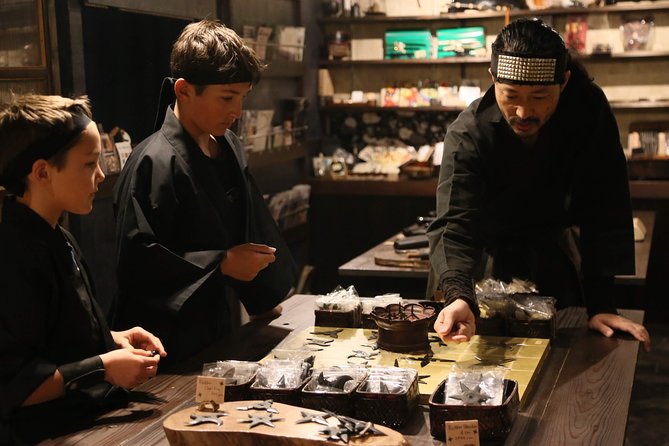
The hands-on weapons section covers several classic ninja tools. You practice with a kunai dagger, throw shuriken, and use a ninja blowgun with darts. The class also includes other ninja methods and tools, with the instructor explaining the purpose and technique behind them.
Shuriken throwing is often the most instantly satisfying part. You aim at wooden targets and learn how the throwing motion works. It is harder than it looks, which gives adults a reason to keep trying instead of letting the children have all the fun.
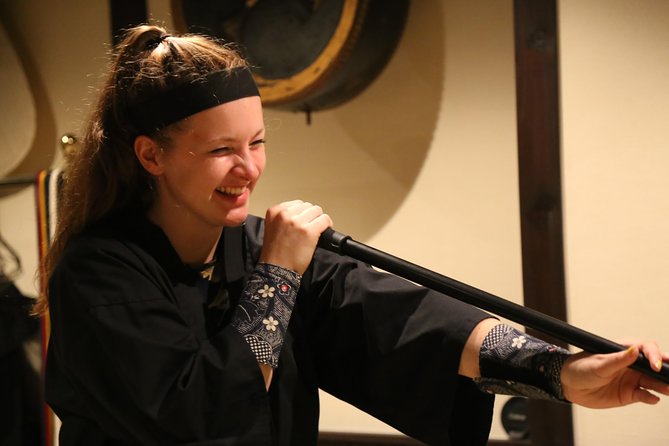
The blowgun is another highlight. You learn how to use the pipe and fire darts at a target under supervision. Some people discover they have a better aim with the blowgun than with the throwing stars. The activity is carefully managed, but you still need to listen to every safety instruction and wait your turn.
Kunai training adds another style of weapon practice. The lesson is not about sending dangerous objects around a room without control. It is a guided introduction, with the sensei showing the technique before you try it.
Because the group is capped at six, you should get more opportunities to practice than in a large demonstration. A small group also lets the instructor correct your stance or throwing motion. That does not turn the class into private coaching, but it makes the hour feel active rather than passive.
What the one-hour schedule really means
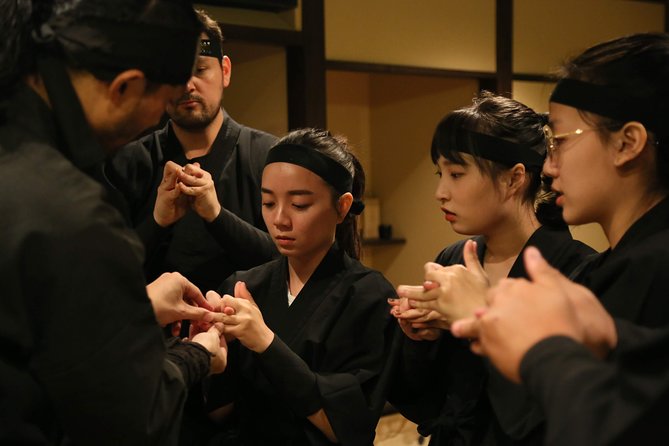
The advertised duration is approximately one hour. That is enough time for a brisk sequence of meditation, breathing, walking, trap-house demonstrations, sword work, kunai practice, shuriken throwing, and blowgun training.
The benefit is variety. You never spend too long on one exercise, and the hour moves quickly. Families like this pace because children have several new tasks before boredom arrives. It also works well for a Kyoto itinerary packed with temples, gardens, and food stops.
The tradeoff is depth. You will not become skilled with a sword or fully understand ninja history after one lesson. Some people may find the experience high-level and a little theatrical. If you want more practice and more time with the instructor, a two-hour version is worth considering if available when you book.
I would treat the one-hour class as a hands-on cultural activity, not professional training. Its value comes from the combination of movement, costume, stories, safe weapon practice, and a special setting. That is a fair use of an hour in Kyoto, especially for a family or a couple looking for something beyond shrine visits.
Is the $80.58 price good value?
At $80.58 per person, this is not a low-cost filler activity. The price covers admission, the English-speaking Japanese sensei, and ninja clothing rental. It also buys access to several different activities rather than one short photo opportunity.
The value is strongest when you are traveling with children or teenagers, since the class gives them a clear role and a chance to do something with their hands. Adults who enjoy Japanese history, martial arts, anime, or playful themed experiences will also get good use from it.
The value is weaker if you want an academically detailed look at ninja culture or serious martial-arts instruction. In that case, the class may feel too brief and light. You are paying for a carefully staged introduction with real instruction, not an intensive course.
The small group improves the calculation. A maximum of six means the lesson is not designed as a crowd spectacle. You have room to practice and ask simple questions. The fact that instructors share ninja history and explain the tools also gives the activity more substance than costume rental alone.
Who will enjoy this class most?
This is an easy choice for families with school-age children and teenagers. The activities are varied, the instructors speak English, and most people can participate. The supplied details also note that service animals are allowed and that the class is near public transportation.
A seven-year-old has taken part successfully, and older children often focus on the weapons and trap features. Parents should still decide what suits their child. The activity involves swords, darts, daggers, and throwing stars, so children need to follow instructions and wait for the instructor’s direction.
Couples and adult friends can enjoy it too. The class gives you something to laugh about and creates memorable photographs without requiring a full day. You do not need to be athletic or already familiar with martial arts. You simply need to take part and copy the demonstrations.
Ninja fans may get extra pleasure from the class. Familiarity with anime or Naruto can help you recognize the playful side of the experience, but it is not required. The instructors focus on ninja methods and tools rather than asking you to know a particular film or show.
Where the experience feels authentic, and where it feels staged
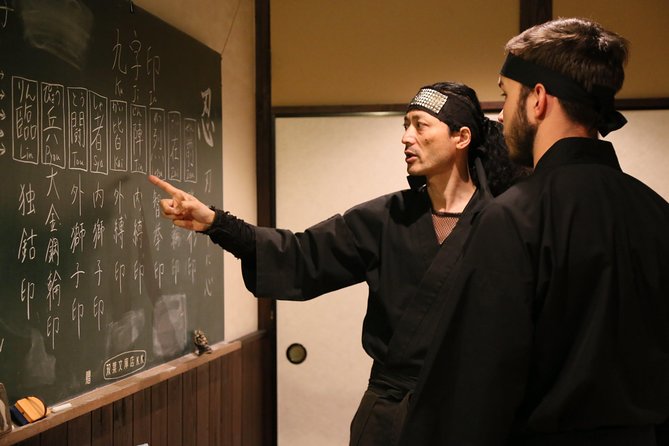
The use of a Japanese sensei, the English instruction, the meditation and breathing exercises, and the explanation of ninja tools give the class a cultural base. The setting includes Japanese-style features and ninja artifacts, and the instructor may share details that go beyond simply handing you a costume and a plastic prop.
At the same time, the activity is built for visitors. The secret doors, target throwing, costume change, and quick sequence of exercises are designed to be entertaining and safe. It is best to enjoy the class on those terms.
I would not book this expecting a private lesson in historical ninjutsu. I would book it if you want an accessible introduction that combines information with play. The difference matters, especially for adults comparing this with a serious martial-arts school.
The strongest instructors make that balance work. Sho is described as funny and well versed in ninja history, while Jack has been praised for making the class interesting and easy to follow. Instructor names may vary by session, but the activity is designed around an English-speaking Japanese master and an assistant.
Practical details before you book
Confirmation arrives at booking, and the experience uses a mobile ticket. The class begins and ends at NINJA DOJO and STORE KYOTO, with no hotel transfers included.
Wear something that allows comfortable movement under or with the rented ninja clothing. The supplied details do not list a dress code, so you do not need to plan a special outfit. Food and drinks are also not part of the price.
The activity has a maximum of six people, but it also requires a minimum number to operate. If that minimum is not met, the provider offers another date or experience, or a full refund. Poor weather can also lead to a new date or full refund, according to the stated policy.
You can cancel for a full refund up to 24 hours before the start time. Changes or cancellations inside that 24-hour window are not accepted and are not refunded. Use the local Kyoto time when calculating the deadline.
Should you book the Kyoto Ninja lesson?
Book it if you want an active, family-friendly hour that combines Japanese culture, costumes, secret dojo features, and supervised weapon practice. The small group, English instruction, and range of activities give it more substance than a quick dress-up stop.
I would especially recommend it for families with children, teenagers who need a break from temples, and adults who enjoy a little theatrical fun. The air-conditioned room can also be welcome during a hot Kyoto day.
Skip it if your priority is detailed ninja scholarship, an authentic long-form martial-arts course, or advanced sword training. The hour moves fast and covers many topics at an introductory level.
For most visitors, the best way to judge the $80.58 price is to ask what kind of memory you want. If you want to leave Kyoto having quietly meditated, walked like a ninja, thrown shuriken, fired a blowgun, and posed in ninja clothes, this class delivers a distinctive afternoon. If you want mastery, choose a longer or more serious training program instead.
FAQ
Where does the ninja lesson start and finish?
The lesson starts at NINJA DOJO and STORE KYOTO, 528 Hakurakutenchō, 2F, in Kyoto’s Shimogyo Ward. It ends back at the same meeting point.
How long does the ninja class last?
The entry-level lesson lasts approximately one hour.
What activities are included?
The lesson includes Kuji-In ninja meditation, ninja breathing, ninja walking, an introduction to ninja trick-house features, sword demonstration and training, kunai training, shuriken training, and ninja blowgun training.
Are ninja clothes included?
Yes. Ninja clothing rental during the training is included in the admission price.
Is the lesson taught in English?
Yes. A Japanese sensei who has trained in ninja arts teaches the class in English.
How many people can join the class?
The activity accepts a maximum of six travelers.
Can I cancel for a full refund?
Yes. You can cancel at least 24 hours before the experience start time for a full refund. Cancellations or changes made less than 24 hours before the start time are not accepted or refunded.
More 1-Hour Experiences in Kyoto
- 1 Hour Geisha Show in Kyoto
★ 5.0 · 452 reviews - One Hour Geisha Show in Kyoto
★ 5.0 · 64 reviews - Kyoto: Hands-on Takoyaki and Okonomiyaki Cooking (1 Hour)
★ 4.7 · 25 reviews - Ring making experience Completed in about 1 hour!
★ 5.0 · 141 reviews
More Workshops in Kyoto
- Kyoto: 45-Minute Tea Ceremony Lesson Experience
★ 4.3 · 2,378 reviews - Ramen Cooking Class at Ramen Factory in Kyoto
★ 5.0 · 1,937 reviews - Kyoto : Chopsticks Making Workshop in Gion with Engraving Option
★ 5.0 · 958 reviews - Kyoto: Samurai Sword Class by Experts in Traditional Arts
★ 4.9 · 657 reviews
Just added around Kyoto
- Taste of Nishiki Market Walking Food Tour with Local guide★ 5.0 · 17 reviews
- Kyoto: Sushi Making Class with Sushi Chef★ 4.8 · 64 reviews
- Kyoto: City Secrets eBike Tour★ 4.9 · 196 reviews
- Sacred Pathways: Discover the Philosopher’s Path of Kyoto★ 4.9 · 20 reviews
- Private Tour to Monkey Park and Arashiyama Highlights★ 5.0 · 22 reviews
- Private Nara Tour from Osaka – Meet at Your Hotel★ 5.0 · 22 reviews
- Private Sake Tasting in Central Kyoto with Sake Sommelier★ 5.0 · 13 reviews
- Kyoto : Private Custom Walking Tour With A Local Guide★ 4.6 · 144 reviews
Kimono & Culture Experiences, compared.
Kyoto Geisha Walking Tour: Gion District & Hidden Gems
Read our review →
Gion Magical Night Walking Tour with Geisha Trivia
Read our review →
Gion Geisha District Walking Tour – Stories of Geisha
Read our review →
Best of Kyoto: Gion, Geisha, Pagodas & Cobblestones
Read our review →
Kyoto Gion Geisha District Walking Tour – The Stories of Geisha
Read our review →
Browse the lists this tour appears in