
REVIEW · WALKING TOURS
Kyoto: Private 2.5 Hour Historical Walking Tour
Kyoto’s famous sights make more sense when someone explains what you’re seeing. This private walk links Yasaka Shrine, a Zen temple, a pagoda, and Kiyomizu-dera in one well-shaped route, with time for photos and questions along the way.
I like the personal scale and the guide’s visual teaching aids, especially the hand-drawn maps and illustrations used by guides such as Hisako and Hiroko. I also like the mix of major sights and quieter corners, including Entokuin’s calm dry gardens and the lanes around Nene-no-michi.
The main consideration is cost and timing. At $80 per group of up to five, it is good value for a full private group, but temple admission, transport, food, and drinks cost extra. The published timing also varies between two hours and two and a half hours, so confirm your exact start and finish time.
In This Review
- Key points to know before you book
- Starting at Yasaka Shrine with a map of Kyoto
- Maruyama Park and Nene-no-michi
- Entokuin’s dry gardens and traditional rooms
- Yasaka Koshin-do and the five-storied pagoda
- The walk toward Kiyomizu-dera
- Kiyomizu-dera and the wooden stage
- What the guide adds to the experience
- Price, pace, and practical value
- Who should book this Kyoto walk?
- Should you book it?
- FAQ
- Where does the Kyoto walking tour begin?
- Where does the tour finish?
- How long does the walking tour last?
- What language is the tour offered in?
- Is this a private tour?
- Are temple entrance fees included?
- What should I bring?
Key points to know before you book
- A useful Kyoto introduction: The walk begins with a map-based explanation of Kyoto, then puts that background to work at each shrine and temple.
- A private guide, not a set speech: Guides adjust the pace for photos, rest, and questions, with English explanations throughout.
- Entokuin is the quiet pause: This Zen temple offers dry gardens, traditional rooms, and sliding-door paintings away from the noise of the main streets.
- Kiyomizu-dera supplies the big finish: The wooden stage gives you broad views, including Koyasu Pagoda and the hills around the temple.
- The route is almost entirely on foot: Expect stone steps, temple paths, and about 45 minutes of walking between stops.
- Best value for a small group: Five people can share the $80 guide fee, though entrance tickets are not included.
Starting at Yasaka Shrine with a map of Kyoto
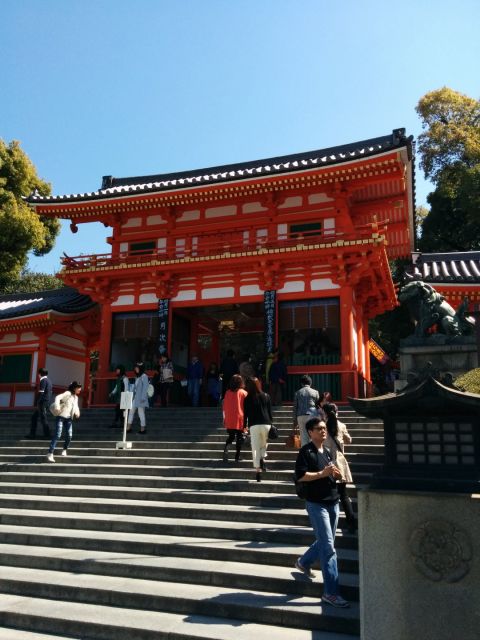
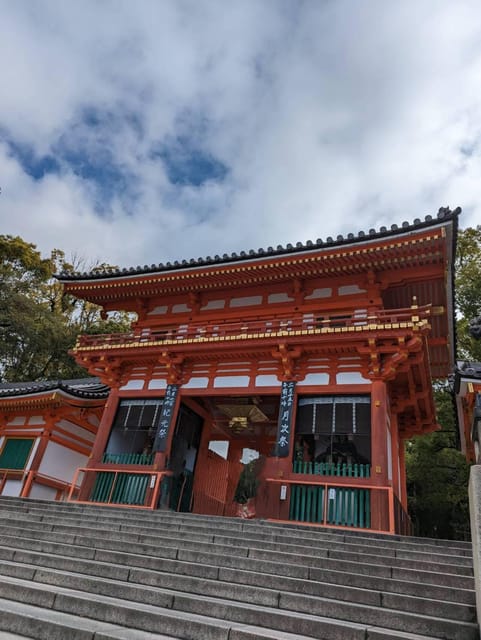
Meet your guide at the west gate, also called the red gate, of Yasaka Shrine. This is a practical starting point in eastern Kyoto, and the location is fairly easy to reach from Gion Shijo Station on the Keihan Line or Kawaramachi Station on the Hankyu Line.
From either station, walk east along Shijo Street toward the shrine. If you come by bus, get off at the Gion stop and look for the stone steps leading to the red gate. Give yourself a little extra time. Kyoto’s streets around Gion can be busy, and arriving flustered is no way to begin a walking tour.
The guide first uses a map to explain Kyoto’s layout and past. That short introduction matters. Instead of hearing disconnected facts at four separate sites, you get a basic sense of how the old capital developed and why this part of town holds such a dense group of religious buildings and historic lanes.
At Yasaka Shrine, you learn the basic steps for worship at a Shinto shrine. This is one of the most useful parts for first-time visitors to Japan. Shrine customs can seem mysterious when you are watching from the side, but a simple explanation helps you take part politely and with confidence.
Yasaka is also a good place to begin comparing Shinto and Buddhism. The tour later visits Buddhist temples, so the early shrine explanation gives you a reference point. You can begin to notice the difference between a shrine and a temple rather than treating every sacred site as the same.
More Walking Tours in Kyoto
- Kyoto Geisha Walking Tour: Gion District & Hidden Gems
★ 4.7 · 3,273 reviews - Kyoto: Gion Magical Night Walking Tour with Geisha Trivia
★ 4.9 · 2,393 reviews - Kyoto: Gion Geisha District Walking Tour – Stories of Geisha
★ 4.7 · 2,187 reviews
Maruyama Park and Nene-no-michi
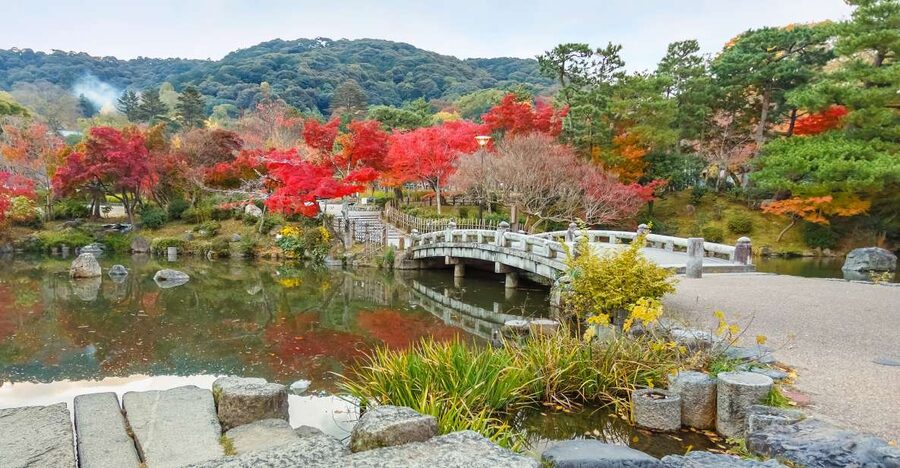
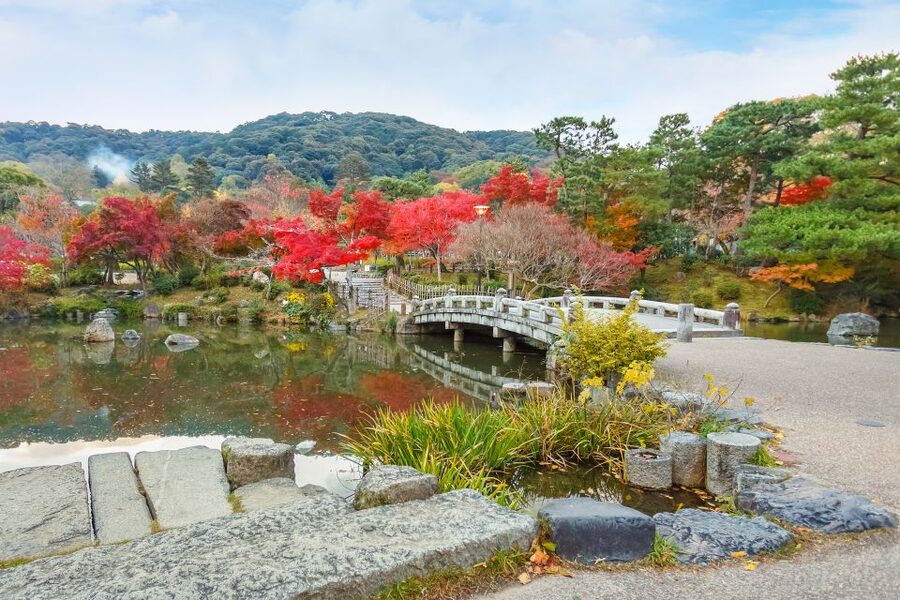
From Yasaka Shrine, the route continues through Maruyama Park. This green space sits right beside the shrine and provides a break from the hard stone streets around Gion. The walk then reaches Nene-no-michi, a historic lane named for Nene, the wife of Toyotomi Hideyoshi, a major political leader of late 16th-century Japan.
This is where the tour’s history becomes more personal. You are not only hearing about rulers and dates. You are following a street tied to a woman who played an important role in the political and religious world of the period.
The lane can be busy, and the old-style streets attract plenty of cameras. Your guide helps you look beyond the surface. Pay attention to the scale of the street, the traditional buildings, and the way Kyoto’s old districts connect temples, shrines, and former residences.
The route is short enough for most people who are comfortable walking, but it is not a flat city stroll. You will use stone steps and walk through areas with uneven paving. Comfortable shoes are the one item specifically recommended, and they are a sensible choice.
Entokuin’s dry gardens and traditional rooms
Entokuin is the first major temple visit and the tour’s quietest stop. Plan on about 40 minutes here. The temple is associated with Nene and is a Zen temple, so the focus shifts from shrine ritual and political history to Zen spaces, art, and contemplation.
The dry gardens are the main draw. These gardens use stones, gravel, and carefully arranged forms rather than ponds and large plantings. A guide can explain how to look at them, which is helpful if you are used to gardens designed mainly for walking through.
You also see traditional Japanese rooms and paintings on sliding doors. These details are easy to miss if you are moving quickly through a temple on your own. The rooms are not grand in the Western sense. Their appeal comes from proportion, materials, empty space, and the link between the interior and the garden.
Several guides have used their own drawings and prepared folders during this tour. Hisako, in particular, is often noted for hand-illustrated maps and pictures, while another guide, Hiroko, has used a folder with drawings and explanations. These visual aids can be especially useful when the guide is explaining architecture, religious figures, or a complicated stretch of Japanese history.
One past tour also included a calligraphy experience at the Zen temple, but that should not be treated as guaranteed. The confirmed description promises the temple, gardens, rooms, and paintings. Ask at booking if calligraphy matters to you.
The 40-minute visit gives you enough time to listen and look around without turning the temple into a rushed photo stop. Still, temple admission is not included, and the activity details do not state the exact ticket price. Budget for that separately.
Yasaka Koshin-do and the five-storied pagoda
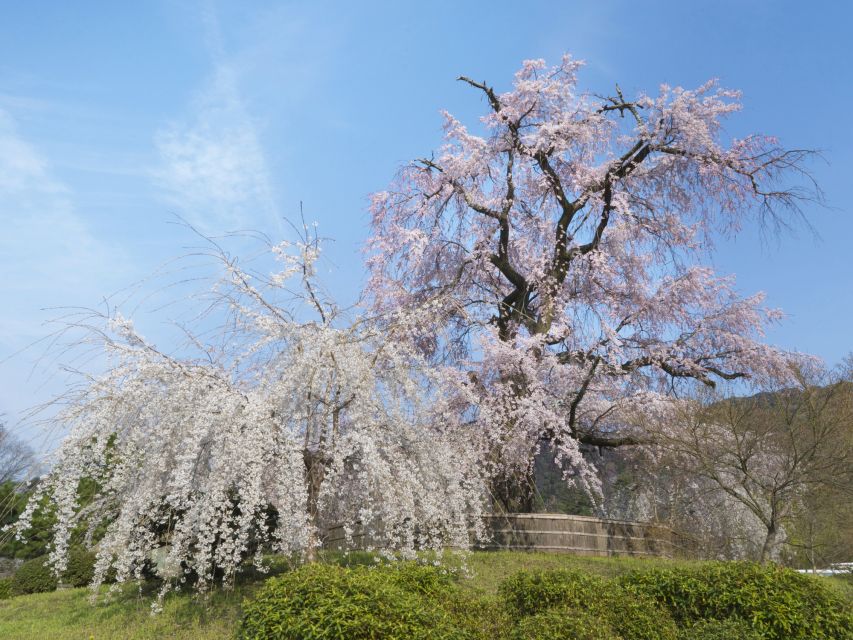
After Entokuin, you walk for about 10 minutes to Yasaka Koshin-do. The visit lasts about 15 minutes. This compact temple stop adds a different mood to the route and breaks up the larger, better-known sights.
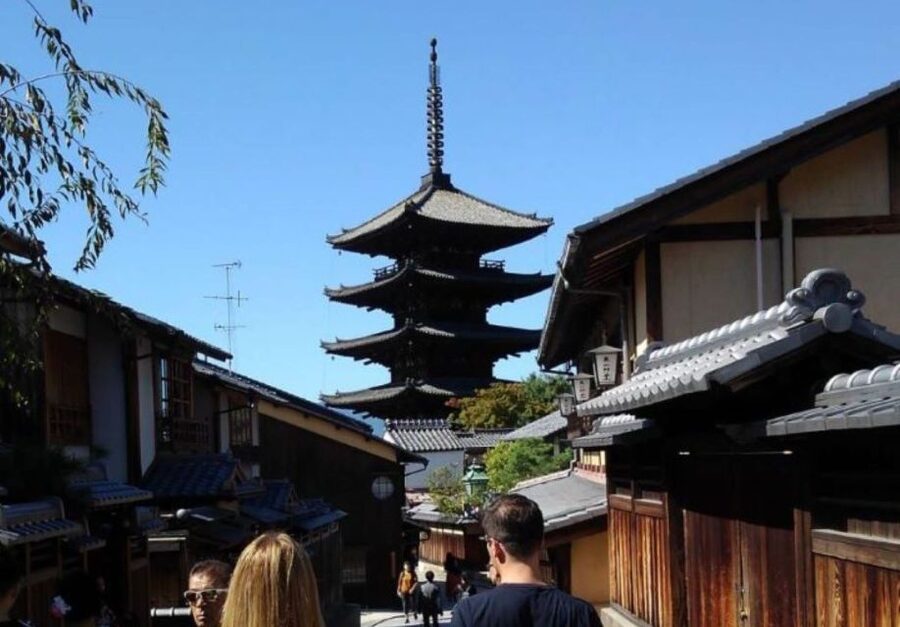
The nearby five-storied pagoda is commonly called Yasaka-no-to. You see it from outside rather than entering it. That distinction is worth knowing before you book. The pagoda is one of the route’s strongest photo subjects, but this is an exterior viewing stop, not an inside tour.
There is a well-known photo spot on a nearby street. Your guide can help you understand the setting and position yourself for a clear view, but the street may be crowded. Be courteous with people walking through the lane, and do not expect a private photo session in one of Kyoto’s most photographed areas.
The contrast works well: Entokuin offers a seated, quiet temple setting, while Yasaka-no-to gives you a strong visual reminder of Kyoto’s old skyline. You get both the inward-looking side of temple design and the postcard view that many people hope to see.
Same city, a completely different kind of day:
- PERFECT KYOTO 1-Day Bus Tour
★ 5.0 · 13,518 reviews - Kyoto: Fushimi Inari, Kinkakuji, Bamboo Grove 1 Day Bus Tour
★ 4.8 · 4,316 reviews - Kyoto: Tea Ceremony in a Traditional Tea House in Kiyomizu
★ 4.9 · 3,519 reviews - Kyoto: Tea Ceremony Ju-An at Jotokuji Temple
★ 4.9 · 3,207 reviews
The walk toward Kiyomizu-dera
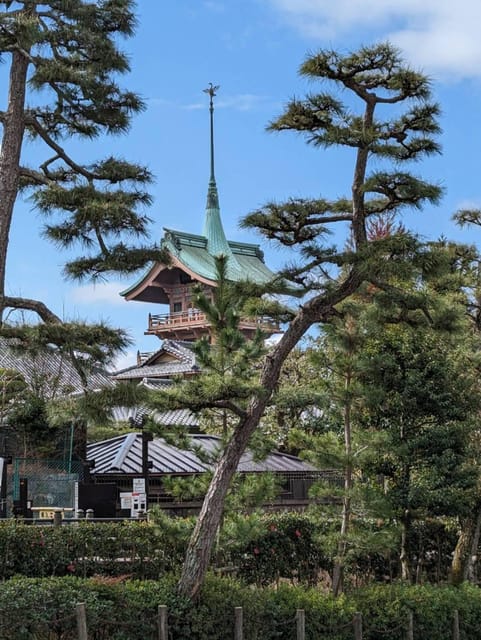
The itinerary includes another short viewing stop of about 10 minutes, followed by roughly 15 minutes on foot toward Kiyomizu-dera. This part of the route takes you through one of the most atmospheric sections of eastern Kyoto.
Expect a gradual build in activity as you approach Kiyomizu-dera. The streets leading to the temple are popular, and the route can feel much less peaceful than Entokuin. That is not a flaw in the tour, but it is part of the experience. You are moving from a calm Zen setting into one of Kyoto’s busiest landmark areas.
This is also a good point to ask questions. The strongest guides on this tour do not simply recite a script. Hisako and other guides are praised for explaining religion, imperial power, samurai government, language, philosophy, and Japanese customs in clear English. You can keep the conversation focused on the sites, or ask broader questions about Japan.
The private format makes this easier. You are not waiting for a large group to catch up, and the guide can spend more time on the topics that interest you. Families may appreciate the ability to pause, while history-minded visitors can ask about political and religious changes in more detail.
Kiyomizu-dera and the wooden stage
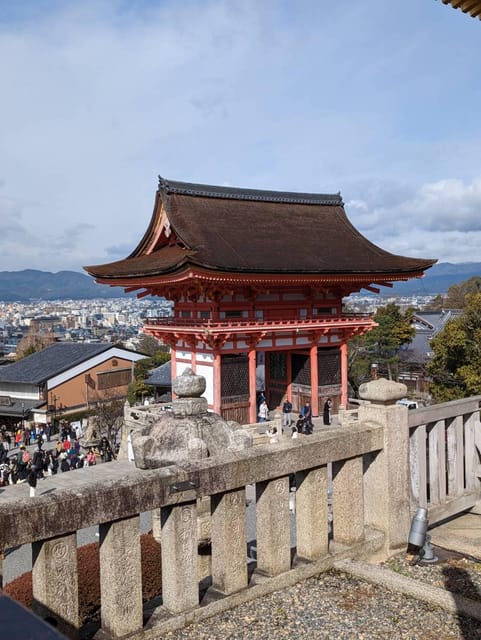
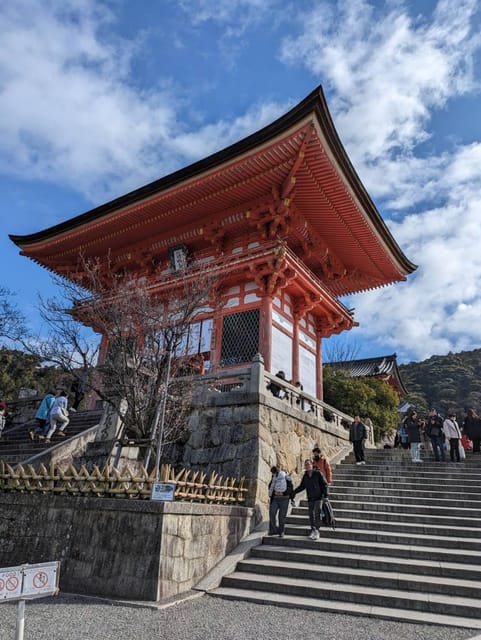
Kiyomizu-dera is the final destination, with about 35 minutes set aside for the visit. The temple was originally built in the eighth century and is dedicated to Kannon Bodhisattva. Inside the precincts, you can see Buddhist statues, including Kannon.
The main hall’s wooden stage is the visual high point. It is built without nails, and the platform looks out over the surrounding hills and temple grounds. From here, you can also see the three-storied Koyasu Pagoda, traditionally connected with prayers for an easy birth.
The view is impressive, but the stage can be crowded. Your guide’s value here is not only the explanation of the structure. You also get help understanding what you are looking at, why Kannon matters, and how the pagoda fits into the religious life of the temple.
Kiyomizu means pure water. A stream from the mountain behind the temple has continued running, and many people line up to drink from it. The water is divided into streams associated with different benefits, though the description of this tour does not promise a particular amount of time in line.
You can also see an iron stick and iron clogs donated to the temple. The stick is said to be very heavy, and the guide may invite you to try lifting it. It is a small, memorable detail that gives the temple a human touch after the grand views and formal architecture.
The tour ends after you leave the main hall. Before saying goodbye, the guide explains Jishu Shrine, associated with matchmaking. Since the tour does not return to Yasaka Shrine, plan your next stop from Kiyomizu-dera rather than from the starting point.
What the guide adds to the experience
The guide is the reason to choose this walk instead of simply following a map. Names assigned on different dates include Hisako, Hiroko, Hiroshita, and Takayuki Ishii, so you may not receive the same person each time. Hisako receives especially strong praise for her clear English, patience, personal drawings, and broad command of Japanese history.
The best feature is the way guides connect facts to visible details. A hand-drawn map can make Kyoto’s layout easier to grasp. A sketch of a pagoda or a religious figure can clarify an explanation that would otherwise disappear among unfamiliar names.
The guides also tend to leave room for conversation. You can ask about Shinto and Buddhism, the imperial family, nobility, shogunates, gender roles, philosophy, or modern Japan. One guide even offered suggestions for a later stop in Kanazawa, showing the kind of practical local help that can extend beyond the formal route.
This approach suits curious adults and older children more than people who only want quick photographs. One family found the history difficult for children aged 12 and 9, although the guide adjusted the language and switched between Japanese and English when needed. If your children are young, tell the guide in advance what level of detail will work best.
Price, pace, and practical value
The listed price is $80 for a private group of up to five. For one person, that is not a cheap walking tour. For a family or group of four or five, it becomes a strong value because the price is shared rather than charged per head.
The guide fee does not include temple admission, transport to or from Yasaka Shrine, meals, drinks, or insurance. The route itself is on foot, but one past booking needed a taxi to get around, with that cost paid separately. Do not assume every transfer connected with your Kyoto plans is covered.
The stated duration needs a careful look. The activity information gives both two hours and two and a half hours, while the listed stop and walking times add up to roughly two hours and 25 minutes. Most descriptions and guest experiences refer to a 2.5-hour walk, but confirm the actual start time and expected finish when you reserve.
Free cancellation is available up to 24 hours before the start for a full refund, and you can reserve now and pay later. These terms are useful if your Kyoto schedule is still shifting, but they do not remove the need to plan around temple opening hours and your own transport.
The route is best early in your Kyoto stay. Several guides explain customs that you can use later at other shrines and temples. You also gain a basic framework for the city, making later solo visits less confusing.
Who should book this Kyoto walk?
I would choose this for a first visit to Kyoto, especially if you want cultural context rather than a checklist of famous buildings. It is also a good match for couples, families of up to five, and small groups who prefer asking questions without a crowd around them.
History fans will get the most from the tour. The guides can move from Kyoto’s religious traditions to its political figures, imperial connections, samurai government, and ideas about art and philosophy. You can keep the conversation at a simpler level, but the tour has enough depth for serious questions.
This is less suitable if you want a completely quiet walk. Nene-no-michi and the streets near Kiyomizu-dera can be crowded, and the route includes stone steps. It is also not ideal if you need every major Kyoto sight in one day. This tour stays in one part of eastern Kyoto and finishes at Kiyomizu-dera.
Should you book it?
Book it if you want a patient English-speaking guide, a private pace, and real explanations of shrine and temple customs. The hand-drawn materials used by several guides are a memorable bonus, and the route gives you both calm interiors and classic Kyoto views.
Skip it if you already know Kyoto’s religious history, dislike walking on uneven streets, or want admission fees and transport bundled into one price. For most small groups, though, $80 is fair for a personal half-day introduction, especially when you take the walk near the start of your stay and use what you learn throughout the rest of your Japan trip.
FAQ
Where does the Kyoto walking tour begin?
It begins at the west gate, or red gate, of Yasaka Shrine.
Where does the tour finish?
The tour finishes at Kiyomizu-dera, after you leave the main hall.
How long does the walking tour last?
The activity information lists both two hours and two and a half hours. The detailed route adds up to about two hours and 25 minutes, so confirm the exact timing when booking.
What language is the tour offered in?
The live guide speaks English.
Is this a private tour?
Yes. It is for a private group of up to five people.
Are temple entrance fees included?
No. Admission fees to the temples are not included in the price.
What should I bring?
Bring comfortable shoes. The route includes walking between sites, stone steps, and temple paths.
More Historical Tours in Kyoto
- Kyoto Gion: 2-Hour Geisha Culture & History Walking Tour
★ 5.0 · 1,186 reviews - From Kyoto: Nara History Guided Half Day Bus Tour with Lunch
★ 4.8 · 114 reviews - Kyoto: Historic Higashiyama Walking Tour
★ 5.0 · 31 reviews - Kyoto/Osaka: Kobe & Himeji Journey Through Culture & History
★ 3.7 · 18 reviews
Just added around Kyoto
- Taste of Nishiki Market Walking Food Tour with Local guide★ 5.0 · 17 reviews
- Kyoto: Sushi Making Class with Sushi Chef★ 4.8 · 64 reviews
- Kyoto: City Secrets eBike Tour★ 4.9 · 196 reviews
- Sacred Pathways: Discover the Philosopher’s Path of Kyoto★ 4.9 · 20 reviews
- Private Tour to Monkey Park and Arashiyama Highlights★ 5.0 · 22 reviews
- Private Nara Tour from Osaka – Meet at Your Hotel★ 5.0 · 22 reviews
- Private Sake Tasting in Central Kyoto with Sake Sommelier★ 5.0 · 13 reviews
- Kyoto : Private Custom Walking Tour With A Local Guide★ 4.6 · 144 reviews
Walking Tours, compared.
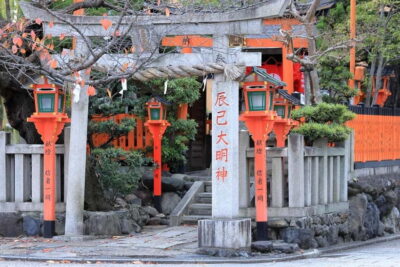
Kyoto Geisha Walking Tour: Gion District & Hidden Gems
Read our review →
Tokyo Tsukiji Fish Market Food and Culture Walking Tour
Read our review →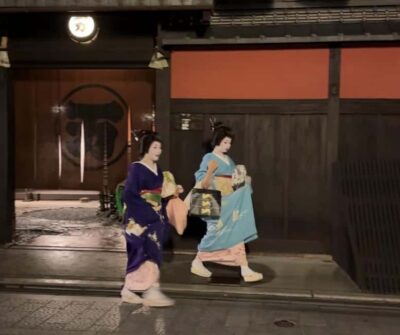
Gion Magical Night Walking Tour with Geisha Trivia
Read our review →
Imperial Palace and Shogun Historical Walking Tour
Read our review →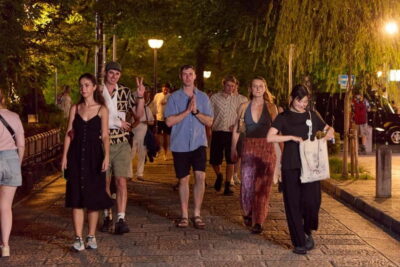
Gion Geisha District Walking Tour – Stories of Geisha
Read our review →
Asakusa Walking Tour with Sensoji Temple Visit
Read our review →
Kyoto Gion Geisha District Walking Tour – The Stories of Geisha
Read our review →Browse the lists this tour appears in