
REVIEW · TEA CEREMONY EXPERIENCES
Traditional Tea Ceremony with Matcha and Sweets in Kyoto
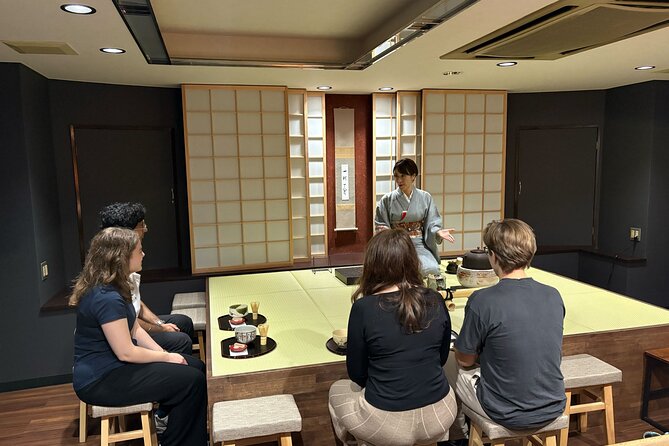
Kyoto’s tea ceremony can look formal and mysterious from the outside. This one-hour experience makes it friendly and clear: you sit on a chair, watch a tea master work up close, then whisk your own bowl of matcha in historic Gion. I like the hands-on preparation and the chance to taste sweets made by long-established artisans. I also like the short format, which gives you a real introduction without taking half a day.
The main consideration is that this is a compact introduction, not a full-length ceremonial training session. If you want a quiet, approachable taste of tea culture, it is a strong fit. If you expect an elaborate private ceremony with extended rituals, you may find the one-hour schedule too brief.
In This Review
- Key points at a glance
- A modern introduction to Kyoto tea culture
- What happens during the one-hour session
- Why chair seating changes the experience
- Understanding matcha beyond the bowl
- The value of a $22.86 Kyoto activity
- Gion location and practical planning
- Who will get the most from this ceremony
- What the strong ratings tell you
- Booking, cancellation, and final advice
- FAQ
- Where does the tea ceremony take place?
- How long does the experience last?
- Does the experience include matcha?
- Are traditional Japanese sweets included?
- Do I need to sit on the floor?
- How many people can join the activity?
- Is the meeting point near public transportation?
- Can I cancel for a full refund?
Key points at a glance
- Seated on chairs: You can take part without sitting on the floor, useful for anyone with limited mobility or little experience with Japanese-style seating.
- Tea masters Mitsune and Yuki: Instruction focuses on both the practical steps and the ideas behind chanoyu.
- Make your own matcha: You whisk a bowl yourself using premium tea sourced from a family-run farm.
- Traditional Kyoto sweets: Carefully selected sweets provide the classic sweet contrast to matcha’s bitter, grassy taste.
- Small maximum group: The experience accepts no more than 13 participants.
- Central Gion setting: The meeting point is at 1 Yamatocho, Higashiyama Ward, near public transportation.
A modern introduction to Kyoto tea culture
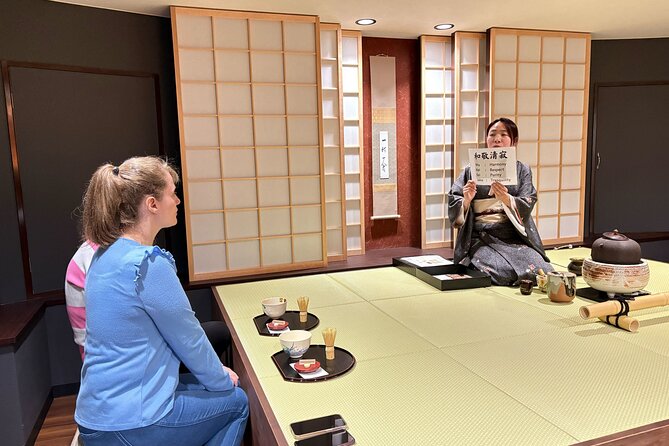
The appeal here is not simply drinking green tea. You get a guided look at chanoyu, the Japanese tea ceremony, as a blend of movement, hospitality, taste, and thought. The tea master explains how tea developed in Japan and how Zen philosophy helped shape the ceremony’s attention to calm, order, and presence.
That background matters. Without it, the careful handling of a bowl or whisk can seem like a series of rules. With it, you begin to see why each motion is restrained and why hospitality, known as omotenashi, carries such weight.
I appreciate that the experience does not treat tradition as something you must already understand. The tone is designed to be welcoming rather than stern. That makes it a good first cultural activity in Kyoto, especially if you want context before visiting tea shops, gardens, or historic temples.
The setting in Gion adds a useful sense of place. The meeting point is in Kyoto’s Higashiyama Ward, at the Gion Tanakaya Building on Yamatocho. The activity returns to the same location, so you do not need to arrange a separate finish point.
More Tea Ceremony Experiences in Kyoto
- Kyoto: Tea Ceremony in a Traditional Tea House in Kiyomizu
★ 4.9 · 3,519 reviews - Kyoto: Tea Ceremony Ju-An at Jotokuji Temple
★ 4.9 · 3,207 reviews - Kyoto: 45-Minute Tea Ceremony Lesson Experience
★ 4.3 · 2,378 reviews
What happens during the one-hour session
The session begins with an introduction to tea culture and the ceremony itself. You learn about the history of tea in Japan and the ideas that shaped its practice. The focus is not only on what the tea master does, but on why the movements and manners matter.
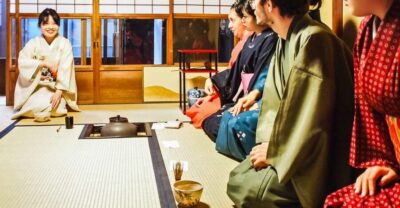
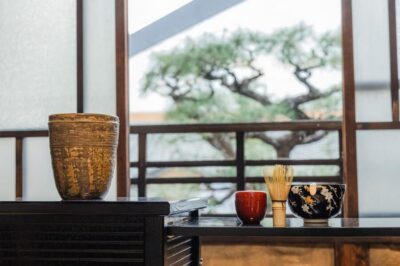
Next comes the demonstration. A tea master performs authentic techniques close enough for you to observe the details. The ceremony’s appeal lies in its restraint: the quiet preparation, deliberate gestures, and careful attention to the bowl, tea, and people present.
The demonstration is also where the guide’s personality matters most. Mitsune is praised for making the experience informative and welcoming. Yuki is noted for her insight into the ceremony and her clear connection to its philosophy. The available information does not guarantee which instructor will lead your session, but both names are associated with the teaching team.
In the second half, you taste traditional Japanese sweets selected from established confectioners. These are not just a snack added to the booking. Sweets are part of the balance of a tea gathering, offering sweetness before or alongside matcha’s sharper flavor.
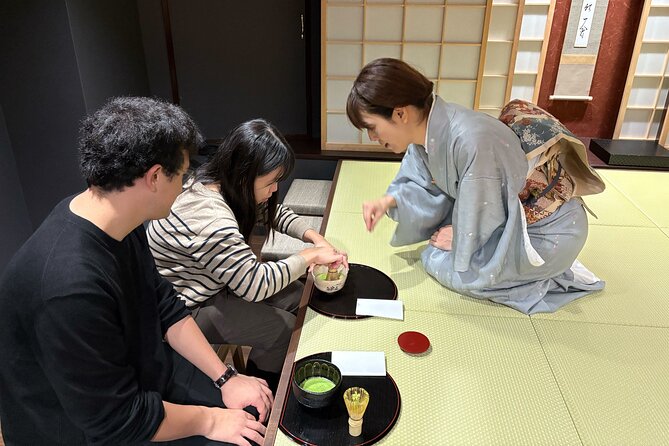
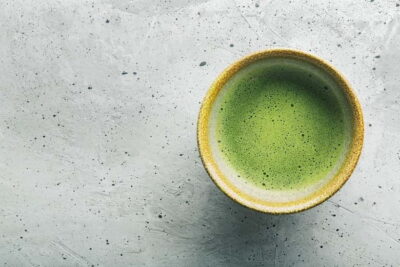
Then you prepare your own bowl. You use premium matcha sourced from a family-run farm and whisk it yourself. This is the moment that turns the experience from a demonstration into participation. You may not produce a perfect bowl on your first try, but you will understand the basic action and get a better sense of the skill involved.
The session ends with questions and answers. That final part is valuable because tea ceremony raises practical questions that a prepared speech may not cover. You can use the time to clarify customs, ingredients, philosophy, or the steps you have just practiced.
Why chair seating changes the experience
Traditional tea ceremony is often linked with sitting on the floor in a formal position. That can be uncomfortable or impossible for some people. Here, you sit on chairs, allowing you to focus on the ceremony instead of worrying about your knees, hips, or ability to get up.
This choice makes the activity more accessible to people with limited mobility and to anyone unfamiliar with floor seating. It also lowers the barrier for families, older visitors, and first-time participants who might avoid a more formal tea event.
There is a tradeoff. Chair seating may feel less traditional than kneeling on tatami mats. If physical setting is your main reason for booking, you should know that this experience presents Japanese tea culture in an adapted, modern format.
Still, the adaptation does not remove the central lessons. You see the techniques, learn the ideas, taste the tea and sweets, and prepare matcha yourself. For many people, being comfortable enough to pay attention is more useful than struggling to maintain a formal posture.
Understanding matcha beyond the bowl
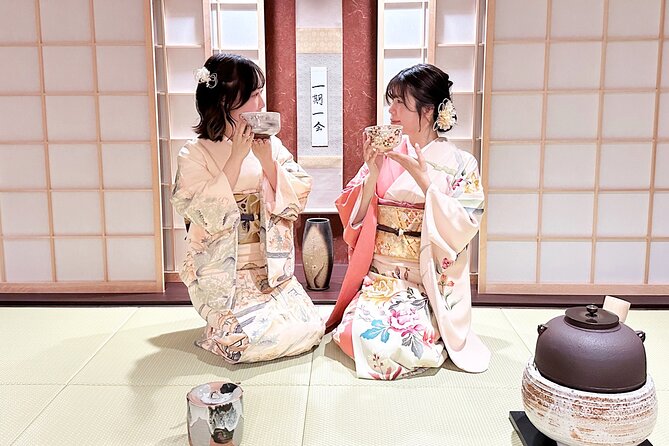
Matcha is powdered green tea whisked directly into water, rather than tea leaves being removed after steeping. Its taste can be unfamiliar if you usually drink black tea or mild green tea. The traditional sweets help balance its bitterness and astringency.
The hands-on part gives you a better sense of why preparation matters. The tea master can show the method, but whisking your own bowl lets you feel the movement and see how the powder changes as it mixes with water.
You also learn that the ceremony is not only about flavor. The experience connects tea with hospitality and Zen thought. The tea becomes a way to slow the pace and pay attention to a single moment. That may sound abstract before the session, but the quiet sequence of preparing and drinking makes the idea easier to understand.
The tea comes from a family-run farm, which adds a useful connection between the polished ceremony and the people who grow the ingredient. The information provided does not name the farm or describe its region, so you should not expect a detailed farm-to-cup presentation. The important point is that the matcha is presented as a premium product, not an afterthought.
Same city, a completely different kind of day:
- PERFECT KYOTO 1-Day Bus Tour
★ 5.0 · 13,518 reviews - Kyoto: Fushimi Inari, Kinkakuji, Bamboo Grove 1 Day Bus Tour
★ 4.8 · 4,316 reviews - Kyoto Geisha Walking Tour: Gion District & Hidden Gems
★ 4.7 · 3,273 reviews - Kyoto: Gion Magical Night Walking Tour with Geisha Trivia
★ 4.9 · 2,393 reviews
The value of a $22.86 Kyoto activity
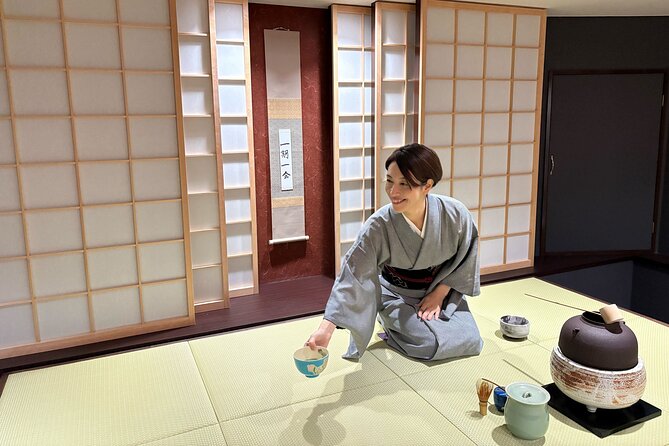
At $22.86 per person, this is priced as a short, accessible cultural activity rather than a luxury ceremony. The value comes from the combination of several elements in one hour: an explanation of tea history, a live demonstration, traditional sweets, your own matcha preparation, and a question period.
I consider that a fair price for visitors who want more than a tasting but do not want to commit to a long formal event. You receive instruction and participation, not just a cup of tea. The small maximum of 13 participants also matters. It is not a private lesson, but the group is limited enough for the demonstration and questions to remain manageable.
The one-hour length works well in a Kyoto day packed with temples, shrines, and walking. You can fit it between visits in Higashiyama without sacrificing an entire morning or afternoon. The short schedule also makes it useful for families or people who prefer cultural activities in clear, compact portions.
The limitation is depth. You will not become a tea practitioner in one hour, and the session cannot cover every school, utensil, regional style, or historical period. Think of it as a well-shaped first step. If it leaves you curious, you can pursue a longer tea gathering or study afterward.
Gion location and practical planning
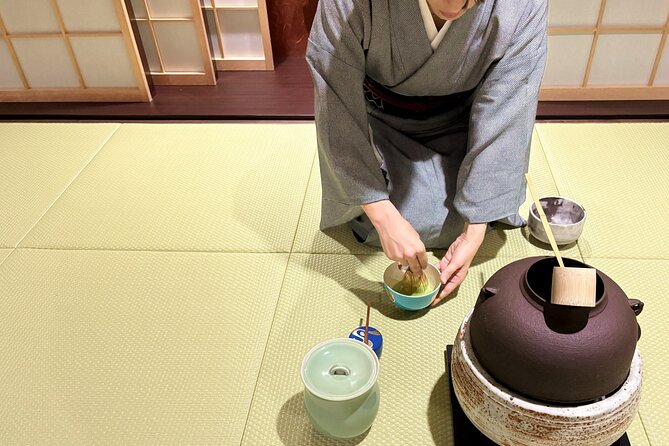
The meeting point is at Japan, 605-0802 Kyoto, Higashiyama Ward, Yamatocho, 1, Gion Tanakaya Building. The location is near public transportation, which makes it easier to reach without relying on a taxi.
Your activity ends at the same meeting point. That is handy if you want to continue exploring Gion afterward, though the supplied information does not specify exact walking times to nearby sights. Plan your route around the stated address and allow enough time to find the building.
A mobile ticket is included, and confirmation arrives when you book. Keep the ticket available on your phone. The operator is Japan Wonder Travel, and the activity accepts up to 13 people.
Because the ceremony is short and orderly, arriving with your attention switched on will improve it. This is not an activity to rush into while checking maps or planning lunch. The value comes from watching small movements and listening to the explanations.
The experience is offered in a part of Kyoto known for traditional architecture and tea culture. Even so, the ceremony itself is the main event. Do not book it only as a sightseeing stop in Gion. Book it because you want a guided introduction to the meaning and practice of matcha.
Who will get the most from this ceremony
This is especially suitable for a first visit to Japan. You get enough cultural background to understand what you are seeing, while the chair seating and friendly instruction keep the ceremony from feeling intimidating.
It also suits returning visitors who have walked through Gion before but want a more active connection to Kyoto’s traditions. The experience gives you something to do, not just another building to photograph.
I would recommend it for:
- People curious about matcha and Japanese sweets
- Visitors who want a cultural activity lasting about one hour
- Anyone who prefers chair seating to floor seating
- Families and mixed-age groups seeking an approachable introduction
- Participants who enjoy asking questions rather than simply watching
- Visitors staying near central Kyoto or exploring Gion
It may be less suitable if you want a highly formal, silent, or private ceremony. The welcoming format is part of its purpose, and the group can include as many as 13 people. That creates a shared learning atmosphere rather than a secluded ritual.
What the strong ratings tell you
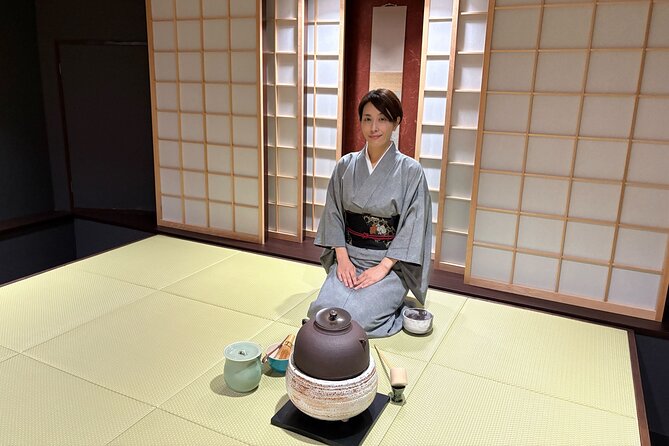
The experience has a 4.9 rating from 13 ratings, with 100 percent recommending it. The most consistent praise centers on the teaching, warmth, and clear cultural explanation.
The instruction is described as informative and interesting, with special attention to tea history, ceremony customs, and the hosts’ passion. That is important because tea ceremony activities can sometimes focus heavily on taking photographs or simply drinking tea. Here, the educational part appears to be central.
Mitsune receives specific praise for being friendly and informative. Yuki is singled out for her insight into the ceremony and philosophy. If your booking happens to include one of them, expect the guide’s interpretation to shape much of the session.
The matcha itself is also praised for its flavor. Taste is personal, and matcha is not sweet like many Western drinks, but the use of premium tea and traditional sweets gives you a proper introduction to the pairing.
The strongest descriptions call the experience harmonious, inspiring, and a fitting part of a Japan trip. I would read that as a sign that the activity succeeds at creating a calm pause in a busy sightseeing schedule. It is not merely a lesson in technique. It gives you a different way to look at hospitality and attention.
At the same time, the small number of ratings means you should keep the score in proportion. A 4.9 rating is encouraging, but it cannot answer every question about different instructors, group dynamics, or personal taste. The written details are more useful than the number alone.
Booking, cancellation, and final advice
The price is $22.86 per person, confirmation is provided at booking, and free cancellation is available until 24 hours before the start time. If you cancel less than 24 hours ahead, the payment is not refunded, and changes inside that period are not accepted. Cutoff times use Kyoto local time.
I would book this activity if you want a low-cost, focused introduction to one of Japan’s best-known cultural practices. The combination of explanation, demonstration, sweets, and hands-on matcha preparation gives you more substance than a basic tea tasting.
I would skip it only if you are specifically seeking a long, highly formal ceremony or a private session. For most visitors, especially first-timers, the chair seating, central Gion location, compact schedule, and patient teaching make this a sensible way to meet Kyoto’s tea culture without feeling lost in its rules.
FAQ
Where does the tea ceremony take place?
It takes place in Kyoto’s Gion district at 1 Yamatocho, Higashiyama Ward, Kyoto 605-0802, in the Gion Tanakaya Building.
How long does the experience last?
The activity lasts approximately one hour.
Does the experience include matcha?
Yes. You make your own bowl of matcha using premium tea sourced from a family-run farm.
Are traditional Japanese sweets included?
Yes. The session includes carefully selected traditional sweets from long-established artisans.
Do I need to sit on the floor?
No. Participants sit on chairs, making the experience easier for people unfamiliar with floor seating or with limited mobility.
How many people can join the activity?
The maximum group size is 13 participants.
Is the meeting point near public transportation?
Yes. The meeting point is near public transportation.
Can I cancel for a full refund?
Yes, if you cancel at least 24 hours before the experience start time. Cancellations made less than 24 hours in advance are not refunded, and changes during that period are not accepted.
More Dessert Tours in Kyoto
- Kyoto: Japanese Traditional Sweets Making and Tea Ceremony
★ 4.4 · 314 reviews - Kyoto Wagashi(Japanese sweets) Cooking Class near Fushimiinari
★ 5.0 · 60 reviews - Kyoto: Wagashi (Japanese sweets) Cooking near Fushimiinari
★ 5.0 · 40 reviews - Kyoto: Traditional Tea Ceremony with Matcha & Sweets in Gion
★ 4.9 · 27 reviews
Just added around Kyoto
- Private Guided Traditional Buddhist Cooking in Japan★ 5.0 · 16 reviews
- Kyoto: Gion Geisha District & Sake-in-Hand Walking Tour★ 5.0 · 37 reviews
- Your Private Vacation Photography Session In Kyoto★ 5.0 · 110 reviews
- Kyoto: Zen Meditation at a Private Temple with a Monk★ 5.0 · 25 reviews
- Traditional Japanese Washi Papermaking- Kyoto morning★ 5.0 · 77 reviews
- Kyoto Wagashi(Japanese sweets) Cooking Class near Fushimiinari★ 5.0 · 60 reviews
- Private Pewter Sake Cup Experience with a Kyoto Artisan★ 5.0 · 31 reviews
- Kyoto Private 6 hour Tour: English Speaking Driver Only, No Guide★ 5.0 · 88 reviews
Tea Ceremony Experiences, compared.
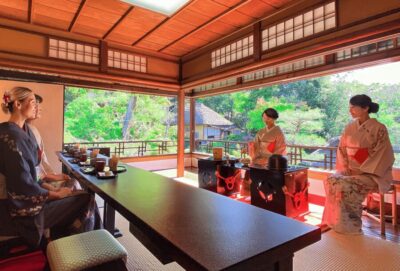
Tea Ceremony in a Traditional Tea House in Kiyomizu
Read our review →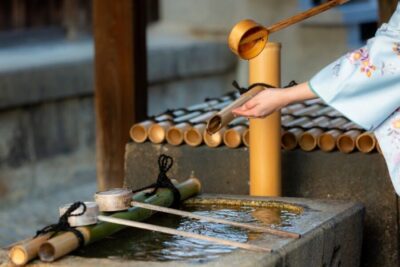
World Heritage Kyoto & Nara Uji Authentic Matcha Experience
Read our review →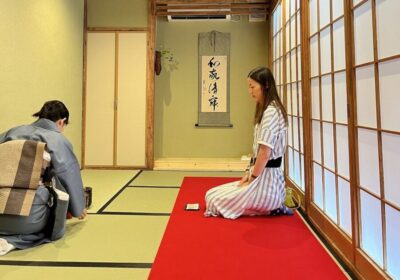
Browse the lists this tour appears in