
REVIEW · KIMONO & CULTURE EXPERIENCES
Kyoto Ninenzaka : Japanese Calligraphy Class in Townhouse
Kyoto’s Ninenzaka streets can feel busy, but step into this townhouse and the pace changes. In 50 minutes, you learn the quiet basics of Japanese calligraphy, from grinding ink and holding the brush to writing a simple kanji character of your own. You do not need Japanese language skills or drawing experience.
I like the authentic setting near Kiyomizu Temple, and I like that the lesson ends with something personal to take home rather than a quick photo and a handshake. The main drawback is the short class time. You will learn the foundations, but this is an introduction, not a full calligraphy course.
In This Review
- Key points to know before booking
- Entering a Kyoto townhouse near Ninenzaka
- The first minutes: shodō, tools, and tradition
- Learning to hold the brush correctly
- From simple strokes to basic kanji
- Seasonal themes give the writing meaning
- What you take home after 50 minutes
- Is $49 good value?
- Planning the class around Kiyomizu Temple
- Who will get the most from this experience?
- Booking, timing, and practical limits
- Should you book the Ninenzaka calligraphy class?
- FAQ
- Where does the calligraphy class take place?
- How long does the activity last?
- How much does the class cost?
- Is the class taught in English?
- Do I need Japanese or art experience?
- What will I learn during the class?
- Can I take my calligraphy home?
- What should I bring?
- Are children allowed to join?
Key points to know before booking
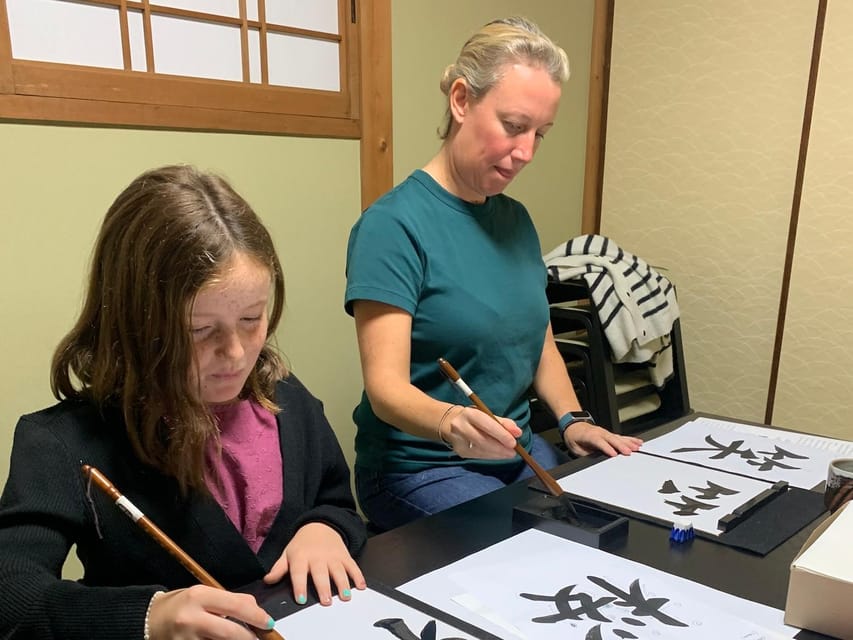
- A real shodō lesson: Learn brush pressure, line control, dots, sweeps, and basic kanji rather than simply copying a finished design.
- A calm break from Ninenzaka: The townhouse provides a quiet change of pace close to Kiyomizu Temple and the famous hillside lanes.
- Suitable for first-timers: English guidance covers the tools, posture, brush grip, paper, and simple characters.
- A useful 50-minute format: The class fits neatly into a morning or afternoon around sightseeing in eastern Kyoto.
- Bring socks and clothes that can get dirty: Shoes come off, and ink is part of the activity.
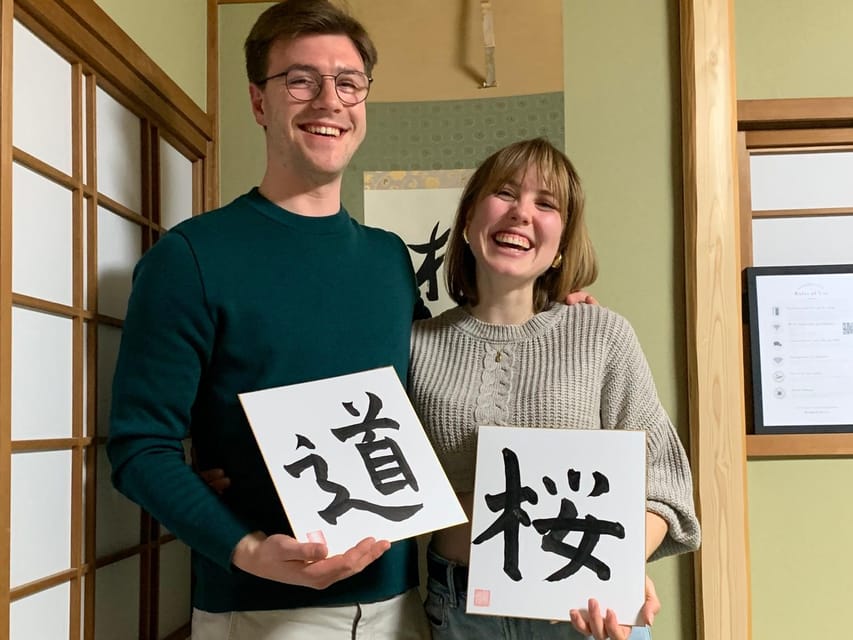
- Take home your own work: You keep the calligraphy you create during the lesson, along with an original booklet about the art.
Entering a Kyoto townhouse near Ninenzaka
The meeting point is at the end of the alley beside the Starbucks on Ninenzaka, near Kiyomizu Temple. That location matters. You can pair the class with a visit to the temple and a walk along Ninenzaka and Sannenzaka, without setting aside a separate trip across Kyoto.
Finding the venue should be manageable, but pay attention to the directions. The class is not described as taking place inside the Starbucks. It is at the end of the nearby alley. Give yourself enough time to reach the meeting point, especially when eastern Kyoto is crowded.
You will remove your shoes, so socks are required. If you arrive without them, socks can be provided for a fee. Wear clothing that can get dirty, since ink and paper are central to the lesson. Leave luggage and large bags behind, as they are not allowed inside.
The setting is part of the experience. A traditional townhouse gives the class a more fitting home than a modern meeting room would. You are not just completing a craft project in a generic studio. You are learning an art tied to Japanese writing, discipline, and seasonal customs in one of Kyoto’s oldest sightseeing areas.
More Kimono & Culture Experiences in Kyoto
- Kyoto Geisha Walking Tour: Gion District & Hidden Gems
★ 4.7 · 3,273 reviews - Kyoto: Gion Magical Night Walking Tour with Geisha Trivia
★ 4.9 · 2,393 reviews - Kyoto: Gion Geisha District Walking Tour – Stories of Geisha
★ 4.7 · 2,187 reviews
The first minutes: shodō, tools, and tradition
The class begins with an introduction to shodō and its place in Japanese culture. You learn basic background, the connection between calligraphy and Japanese traditions, and why the act of writing matters as much as the final character.
This context helps you understand why the lesson begins slowly. Japanese calligraphy is not simply handwriting with a large brush. The pressure, direction, speed, and ending of each stroke all affect the character. A short line can look heavy or light depending on how you place the brush.
You are also introduced to the main tools:
- Brush
- Ink stick
- Inkstone
- Calligraphy paper
- Paperweight
For a beginner, this is useful because the tools can seem unfamiliar at first. You will learn how they are used and cared for, rather than being handed a brush and told to copy a model.
The ink stick and inkstone also help set the mood. Preparing the materials asks you to slow down and pay attention. That quiet preparation is one of the class’s strongest features, especially if you have just spent the morning among shops, temple visitors, and narrow lanes.
Learning to hold the brush correctly
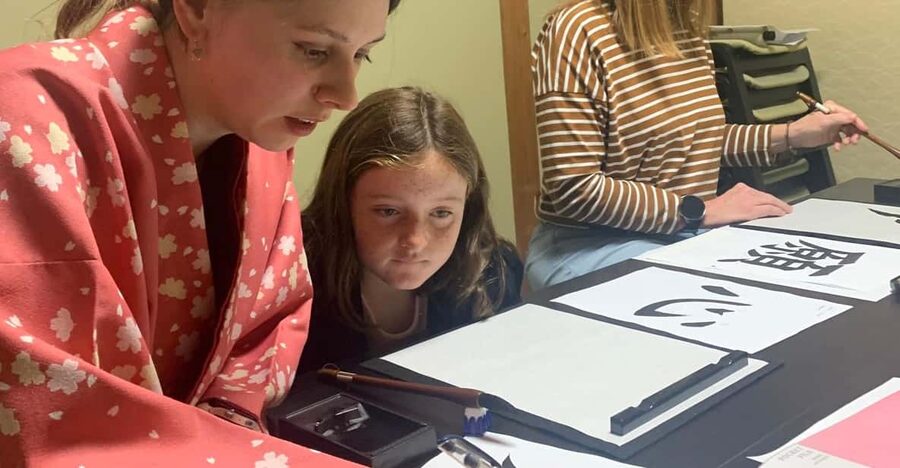
Brush handling is the technical heart of the lesson. You receive careful guidance on how to hold the brush and how to change pressure as you write. This is where the class becomes more than a souvenir activity.
A calligraphy brush does not behave like a ballpoint pen. You cannot press hard and drag it around casually. Your hand, wrist, and fingers need to work together, while the pressure on the tip changes the width and shape of the mark.
The instructor shows you the basic grip before asking you to write characters. That order is important. Beginners often focus on making a symbol look right and forget that the brush itself controls much of the result.
You will probably make uneven lines at first. That is normal. The point is to learn how a stroke begins, moves, and finishes. The instructor’s role is to correct your grip and pressure before bad habits settle in.
The English-speaking host makes the class accessible to international visitors. Last-minute and same-day bookings may be handled in English, even if another language was requested. English is the stated language for the activity, so you can book it without knowing Japanese.
From simple strokes to basic kanji
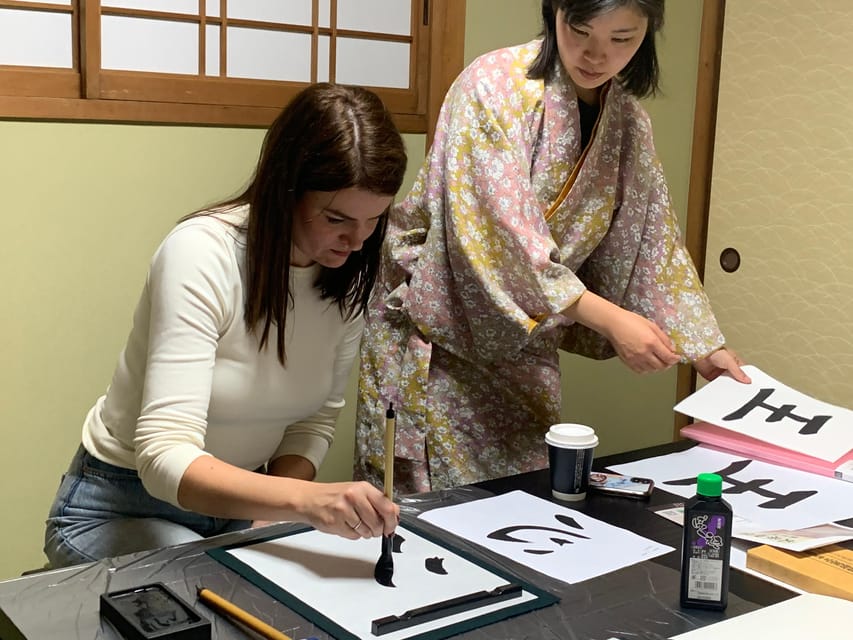
Before writing full characters, you practice individual marks. These include lines, dots, and sweeping strokes. This section may look basic, but it gives you control over the brush and teaches the balance needed for kanji.
You work on horizontal and vertical lines, then pay attention to placement on the paper. Japanese characters depend on proportion and spacing. A character can feel unstable if one side is too heavy or if the strokes are crowded.
The teacher also explains how to use the paper and paperweight. That practical detail is easy to overlook, but it makes a difference. Loose paper can shift, and a misplaced sheet can ruin a careful stroke. Preparing the surface is part of preparing your mind.
Once you have practiced the basic marks, you move to simple kanji characters. The lesson focuses on balance and position, not on producing a perfect work of art. You get a feel for the order and rhythm of the strokes, then try the character yourself.
A master and assistant guide the process, according to the experience format. When the class is small, you have more chances to ask questions and receive individual corrections. Group size is not specified as fixed, so do not book it expecting a private lesson. Still, the format is built around careful guidance rather than a large demonstration with little personal help.
Same city, a completely different kind of day:
- PERFECT KYOTO 1-Day Bus Tour
★ 5.0 · 13,518 reviews - Kyoto: Fushimi Inari, Kinkakuji, Bamboo Grove 1 Day Bus Tour
★ 4.8 · 4,316 reviews - Kyoto: Tea Ceremony in a Traditional Tea House in Kiyomizu
★ 4.9 · 3,519 reviews - Kyoto: Tea Ceremony Ju-An at Jotokuji Temple
★ 4.9 · 3,207 reviews
Seasonal themes give the writing meaning
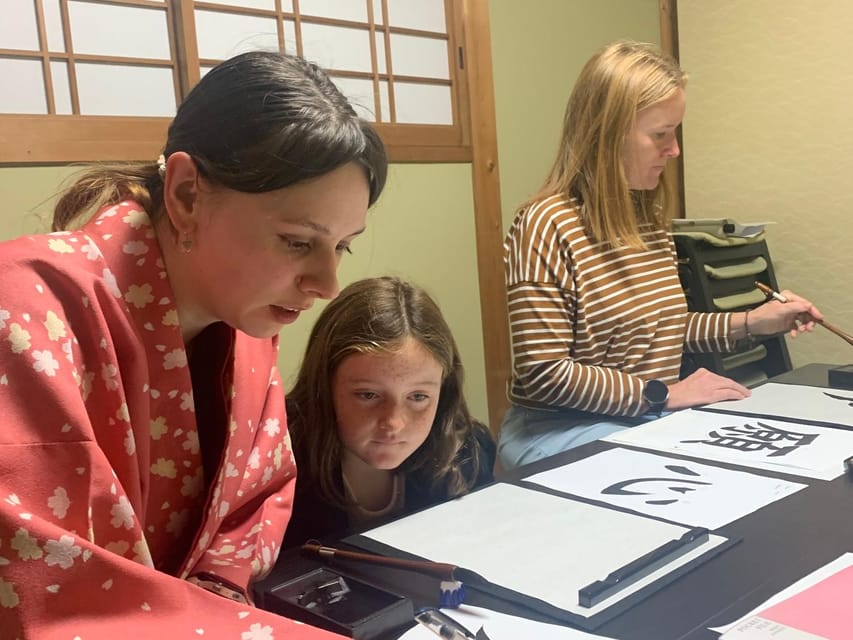
The lesson also connects calligraphy with seasonal themes and expressions. This gives the characters more meaning than a random decorative symbol.
Kyoto’s cultural traditions often link writing, nature, festivals, and the changing seasons. You may learn an expression that reflects the time of year or the mood of the culture around you. The exact character or phrase is not specified in advance, so the content may vary.
That uncertainty is worth accepting. It means you should not book this only to learn one particular kanji unless the provider confirms it beforehand. You are signing up for an introduction to the art and its cultural background, with a character selected as part of the lesson.
The seasonal focus also makes the souvenir more personal. A character connected to your visit can carry more meaning than a preprinted design. You leave with something you made through a process of practice, correction, and concentration.
What you take home after 50 minutes
You keep your own calligraphy as a souvenir. This is one of the best reasons to choose the class over a standard cultural demonstration. You are not only watching an instructor; you produce a finished piece with your own hand.
Set your expectations sensibly. Fifty minutes is enough to learn the basics, practice strokes, and write simple kanji. It is not long enough to develop polished brush control or study a large range of characters.
The included original booklet adds useful value. It gives you something to refer to after the class, particularly if you want to remember the names and uses of the tools or continue practicing later.
Your finished work may show the marks of a first lesson. That is part of its charm. The slightly uneven line or variation in pressure tells you that it was made during your time in Kyoto, not bought in a shop.
Is $49 good value?
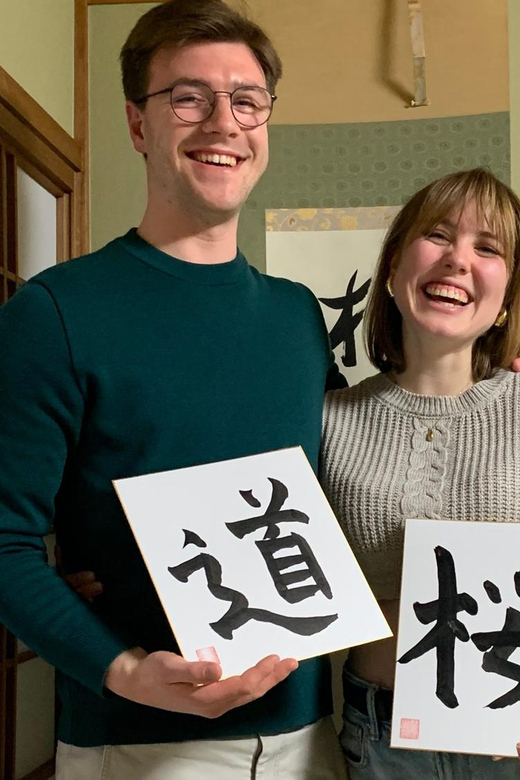
At $49 per person, the class costs more than a quick cultural craft stop, but the price includes instruction, materials, the townhouse setting, an original booklet, and your finished calligraphy. You are paying for direct guidance, not just access to a table and some ink.
I consider the price reasonable if you value a hands-on cultural activity and want a short experience close to Kiyomizu Temple. The location helps the value because you do not need separate transportation to reach an out-of-the-way studio.
The value is weaker if you want a long, technical course. The 50-minute length limits how much you can cover. You will learn the foundation of brush handling and basic characters, but serious practice would require more time and repeated lessons.
It also works well for a mixed-interest group. Someone who does not enjoy museums may appreciate making something. Someone who likes Japanese culture gets a closer look at tools, writing, and seasonal themes. The activity is compact enough that it does not consume half a day of sightseeing.
Planning the class around Kiyomizu Temple
The best plan is to place the calligraphy class before or after your visit to Kiyomizu Temple. The venue is near the temple and at the end of the Ninenzaka alley, so you can explore the area on foot around the scheduled time.
Allow time for the walk through Ninenzaka. The meeting point is easy to combine with the district, but eastern Kyoto can be crowded, and the venue is down an alley rather than directly on the main street. Arriving late could reduce an already short lesson.
Do not bring a large suitcase or bulky shopping bags. Luggage and large bags are not allowed. Selfie sticks, pets, baby strollers, wheelchairs that do not fold, and non-folding strollers are also not permitted.
Smoking, alcohol, drugs, and indoor noise are prohibited. These rules fit the quiet character of the class. You should expect a focused activity rather than a loud, casual workshop.
The experience is not suitable for children under 10. For older children, the brush practice may be engaging, but they need to be comfortable sitting quietly, following instructions, and handling ink with care.
Who will get the most from this experience?
I would recommend this class to you if you want a short cultural activity with a clear result. It suits first-time visitors who want more than temple photographs, couples looking for a shared project, and families with children aged 10 or older.
It is also a good choice for anyone curious about Japanese writing but worried about the language barrier. The instruction is in English, and no Japanese or previous art experience is required.
You may want to skip it if your schedule is already packed with timed sightseeing. The class is short, but it still requires you to reach the townhouse at a set time, remove your shoes, and settle into a quiet activity.
You should also think twice if you dislike activities where the final result depends on your own technique. The teacher guides you, but the finished piece is your work. It will not look like a professional master’s calligraphy, and that is not the aim.
Booking, timing, and practical limits
The activity lasts 50 minutes. Starting times vary, so you need to check availability for your date. The host or greeter speaks English, and the class can be booked with a reserve now and pay later option.
Free cancellation is available up to 24 hours before the activity for a full refund. That helps if your Kyoto schedule depends on weather or changing temple plans.
A kimono is not included. A two-piece kimono can be arranged for an extra charge, but you should treat that as an optional add-on rather than part of the standard class.
Transportation is also not included. The convenient location near Kiyomizu Temple means you can reach it as part of your eastern Kyoto sightseeing, but you still need to make your own way to the meeting point.
The overall rating is 5 from 59 reviews, and the strongest praise centers on the teachers’ patience, the small-class feel when available, and the chance to make a kanji symbol by hand. The most useful practical lesson is that the class can feel brief. You will have fun and leave with a souvenir, but the session moves quickly.
Should you book the Ninenzaka calligraphy class?
Book it if you want a beginner-friendly cultural activity in a prime Kyoto location, especially if you are already visiting Kiyomizu Temple. The patient instruction, calm townhouse, English guidance, and handmade souvenir make $49 a fair price for a compact experience.
Skip it if you need an advanced lesson, a guaranteed private session, or a full kimono experience included in the price. Bring socks, wear clothes that can handle ink, leave your luggage behind, and allow extra time to find the alley.
For most visitors, the appeal is simple: you spend less than an hour learning a traditional skill, then carry a piece of your own Kyoto experience home.
FAQ
Where does the calligraphy class take place?
It takes place in a townhouse near Kiyomizu Temple, at the end of the alley next to the Starbucks on Ninenzaka.
How long does the activity last?
The class lasts 50 minutes.
How much does the class cost?
The listed price is $49 per person.
Is the class taught in English?
Yes. English is the activity language, and the host or greeter speaks English.
Do I need Japanese or art experience?
No. The class is designed for beginners, and you do not need Japanese language or previous art experience.
What will I learn during the class?
You will learn about shodō and its cultural background, calligraphy tools, brush handling, paper preparation, basic brush techniques, and simple kanji characters.
Can I take my calligraphy home?
Yes. You can keep the calligraphy you create during the class. An original calligraphy booklet is also included.
What should I bring?
Bring socks and wear clothes that can get dirty. Socks can be provided for a fee if you arrive without them.
Are children allowed to join?
Children under 10 are not suitable for the activity. The supplied information does not set a maximum age.
More Workshops in Kyoto
- Kyoto: 45-Minute Tea Ceremony Lesson Experience
★ 4.3 · 2,378 reviews - Ramen Cooking Class at Ramen Factory in Kyoto
★ 5.0 · 1,937 reviews - Kyoto : Chopsticks Making Workshop in Gion with Engraving Option
★ 5.0 · 958 reviews - Kyoto: Samurai Sword Class by Experts in Traditional Arts
★ 4.9 · 657 reviews
Just added around Kyoto
- Taste of Nishiki Market Walking Food Tour with Local guide★ 5.0 · 17 reviews
- Kyoto: Sushi Making Class with Sushi Chef★ 4.8 · 64 reviews
- Kyoto: City Secrets eBike Tour★ 4.9 · 196 reviews
- Sacred Pathways: Discover the Philosopher’s Path of Kyoto★ 4.9 · 20 reviews
- Private Tour to Monkey Park and Arashiyama Highlights★ 5.0 · 22 reviews
- Private Nara Tour from Osaka – Meet at Your Hotel★ 5.0 · 22 reviews
- Private Sake Tasting in Central Kyoto with Sake Sommelier★ 5.0 · 13 reviews
- Kyoto : Private Custom Walking Tour With A Local Guide★ 4.6 · 144 reviews
Kimono & Culture Experiences, compared.
Kyoto Geisha Walking Tour: Gion District & Hidden Gems
Read our review →
Gion Magical Night Walking Tour with Geisha Trivia
Read our review →
Gion Geisha District Walking Tour – Stories of Geisha
Read our review →
Best of Kyoto: Gion, Geisha, Pagodas & Cobblestones
Read our review →
Kyoto Gion Geisha District Walking Tour – The Stories of Geisha
Read our review →
Browse the lists this tour appears in