
REVIEW · KIMONO & CULTURE EXPERIENCES
Kyoto: Local Home Visit and Japanese Calligraphy Class
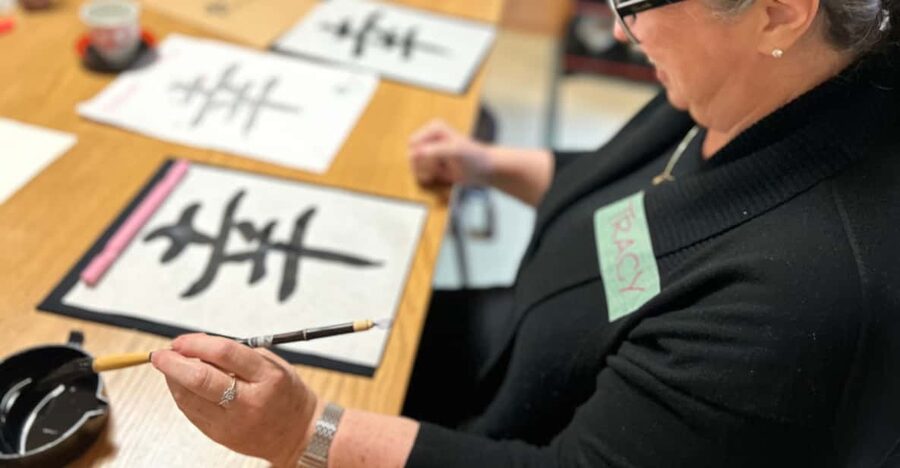
The best part of this Kyoto activity is its personal scale. Instead of watching a formal demonstration from a distance, you sit in a local home near Nijo Castle and learn how each brush movement shapes a kanji character. Aya explains the art, its story, and the proper order of strokes, then gives you time to practice.
I like the private-group format, which can mean patient, one-on-one help rather than a crowded classroom. I also like the finished souvenir: your own calligraphy on Japanese washi paper, with a chosen character such as peace, love, strength, or wisdom and your name written in Japanese. The main limitation is time. One hour is enough to learn the basics, not enough to become a calligraphy expert.
In This Review
- Key points at a glance
- A Kyoto home visit just west of Nijo Castle
- What happens during the one-hour lesson
- Choosing a kanji with personal meaning
- Why the brush movements are the real lesson
- Making and carrying home your washi artwork
- The value of $66 for one hour
- Practical rules that affect your visit
- Who will enjoy this most
- Should you book the calligraphy class?
- FAQ
- Where does the calligraphy class take place?
- How long does the activity last?
- Who teaches the class?
- What is included in the price?
- What should I bring?
- Can I cancel the booking?
Key points at a glance
- A local home near Nijo Castle: The meeting place is about 200 meters west of this UNESCO World Heritage Site.
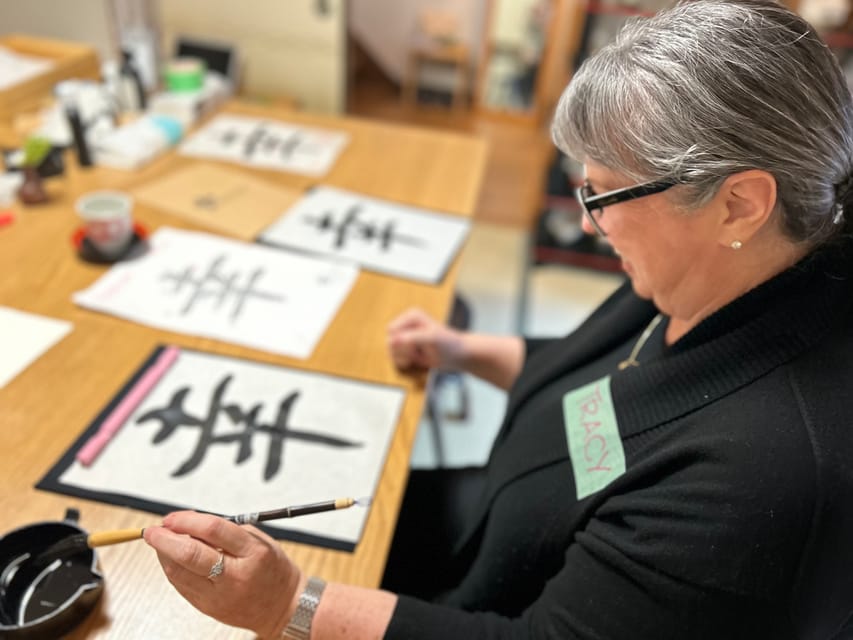
- Aya teaches the brush basics: You practice the correct stroke order, pressure, rhythm, and brush angle.
- Your choice of kanji: Select a character that has personal meaning, then create your own artwork.
- A calm private lesson: The group format allows direct help from the instructor and assistant.
- Useful Kyoto keepsake: Ink, tools, and washi paper are included, and you take your finished piece home.
- Plan around the strict timing: Arrive five minutes early, wear socks, and do not arrive more than 15 minutes late.
A Kyoto home visit just west of Nijo Castle
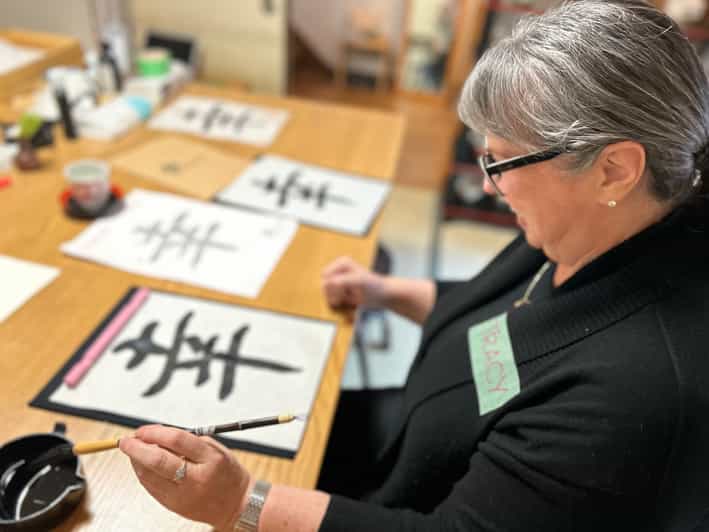
This is a small cultural lesson with a local setting, not a grand museum program. You visit a private home where real Kyoto residents live, near Nijo Castle and within easy reach of one of the city’s major sights. That setting gives the hour a friendly, everyday feel.
The location is on the north side of Ebisugawa Street, just west of Nishinotoin Street. On the opposite side of the road, look for the Lions Mansion building. The directions matter because Kyoto has multiple addresses with the same venue name. Enter the venue name in your map app, rather than relying on the street address alone.
If you take a taxi, give the driver the provided phone number. This is one of those small Kyoto details that can save you from arriving at the wrong building. You should also arrive about five minutes before your start time. There is no waiting area if you show up very early, so aim for a prompt arrival rather than getting there half an hour ahead.
The home visit adds something that a standard classroom cannot. You get a glimpse of a lived-in Kyoto setting and a chance to speak with your hosts. Julia from Canada found the conversation with the hosts one of the best parts, and that fits the character of the activity: it is as much a friendly cultural exchange as a craft lesson.
More Kimono & Culture Experiences in Kyoto
- Kyoto Geisha Walking Tour: Gion District & Hidden Gems
★ 4.7 · 3,273 reviews - Kyoto: Gion Magical Night Walking Tour with Geisha Trivia
★ 4.9 · 2,393 reviews - Kyoto: Gion Geisha District Walking Tour – Stories of Geisha
★ 4.7 · 2,187 reviews
What happens during the one-hour lesson
The session begins with instructions and an explanation of Japanese calligraphy. Aya has spoken about how she learned the art herself, and she explains why the strokes matter rather than simply handing you a brush and asking you to copy a finished character.
You first learn the basic movements. Calligraphy is not ordinary handwriting with a prettier pen. The direction of the stroke, the pressure on the paper, the speed of the brush, and the point where you lift it all affect the result.
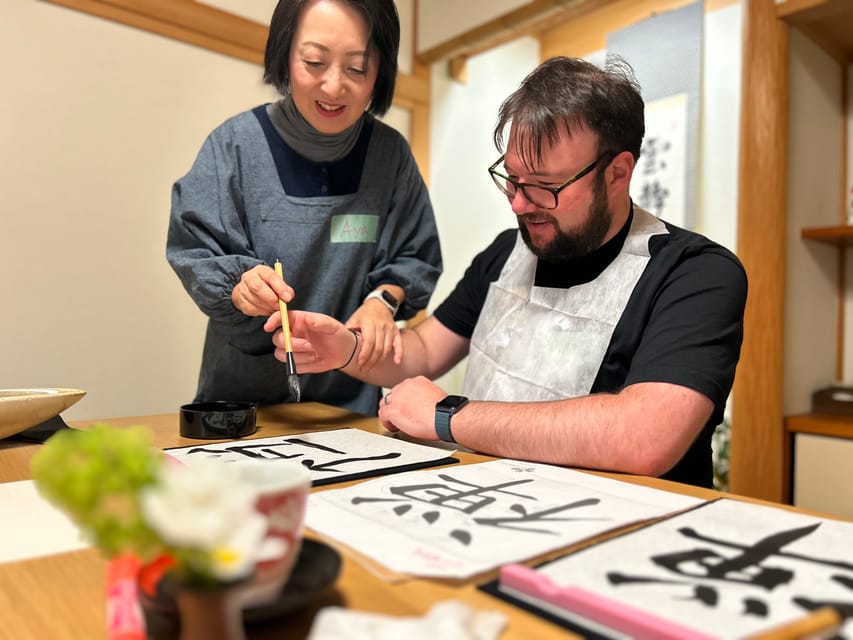
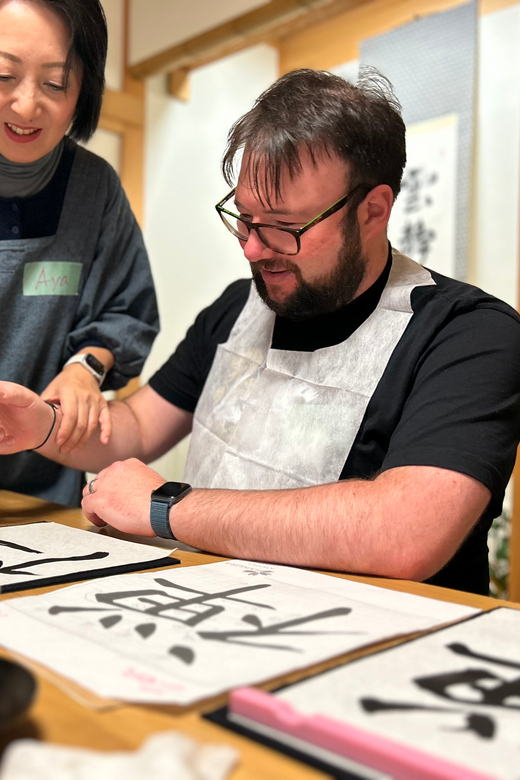
Expect to practice several times before making the final artwork. You might work on individual strokes or repeat a character while Aya corrects your hand position and movement. Her assistant can also offer help, which is especially useful when you are trying to control an unfamiliar brush.
The hour passes quickly because the lesson combines explanation with hands-on work. You are not sitting through a long lecture, but you are also not rushed straight into the final piece. The balance lets you understand the basic rules before making something you will want to keep.
A few people have described receiving nearly one-on-one instruction when they were the only participants booked. That level of attention is possible because the activity is offered as a private group, though the exact amount of individual guidance depends on your party and the session.
Choosing a kanji with personal meaning
Once you understand the basic brush work, you choose a kanji character for your artwork. The suggested themes include love, peace, strength, and wisdom. Picking a character gives the lesson a personal center, especially if you are marking a honeymoon, birthday, family trip, or a first visit to Japan.
You do not need to know Japanese to take part. The important choice is what idea you want your artwork to express. Aya can help you understand the character and guide you as you reproduce it.
Adding your name in Japanese makes the finished piece more personal. It turns a practice exercise into a small record of your time in Kyoto. The artwork does not need to look like a master’s work to have value. Its appeal is that you made it, with the marks and small irregularities that show a beginner learning a traditional art.
That distinction is worth keeping in mind. Calligraphy takes years of training, and a one-hour class cannot cover its full range. ARIK from the United States put it plainly: you learn the basics, but you will not become an expert in an hour. The sensible goal is not perfection. It is to understand the discipline and produce a piece that feels like your own.
Why the brush movements are the real lesson
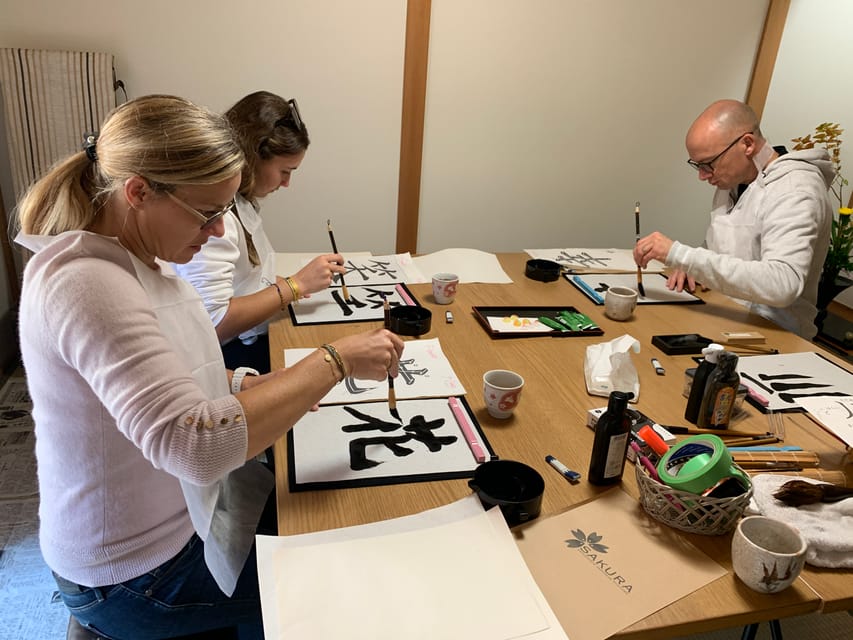
Japanese calligraphy can look simple when you see a finished character. The black lines may be bold and spare, but getting those lines onto paper requires control. The class helps you notice the small decisions hidden inside each stroke.
You learn to slow down and follow a sequence. That makes the activity calming, but it also demands focus. Jonas from Germany found that even as beginners, he and his companion could feel the relaxing effect of the practice. For many people, that quiet concentration is more memorable than the finished paper.
Aya’s teaching style is another important part of the value. Several people praised her patience, kindness, and clear instruction. Ellen from the United Kingdom described her explanations of calligraphy’s past and her constructive advice after practice strokes. Andrea from Austria enjoyed hearing how Aya herself learned the art.
This personal teaching matters because beginners can easily feel clumsy with the brush. You may produce a crooked line or apply too much ink. A calm instructor turns those mistakes into useful corrections instead of making the lesson feel like a test.
The class also gives you a short introduction to an art form that is both visual and physical. You are not simply learning what a kanji means. You are learning how movement, pressure, and space give it character.
Same city, a completely different kind of day:
- PERFECT KYOTO 1-Day Bus Tour
★ 5.0 · 13,518 reviews - Kyoto: Fushimi Inari, Kinkakuji, Bamboo Grove 1 Day Bus Tour
★ 4.8 · 4,316 reviews - Kyoto: Tea Ceremony in a Traditional Tea House in Kiyomizu
★ 4.9 · 3,519 reviews - Kyoto: Tea Ceremony Ju-An at Jotokuji Temple
★ 4.9 · 3,207 reviews
Making and carrying home your washi artwork
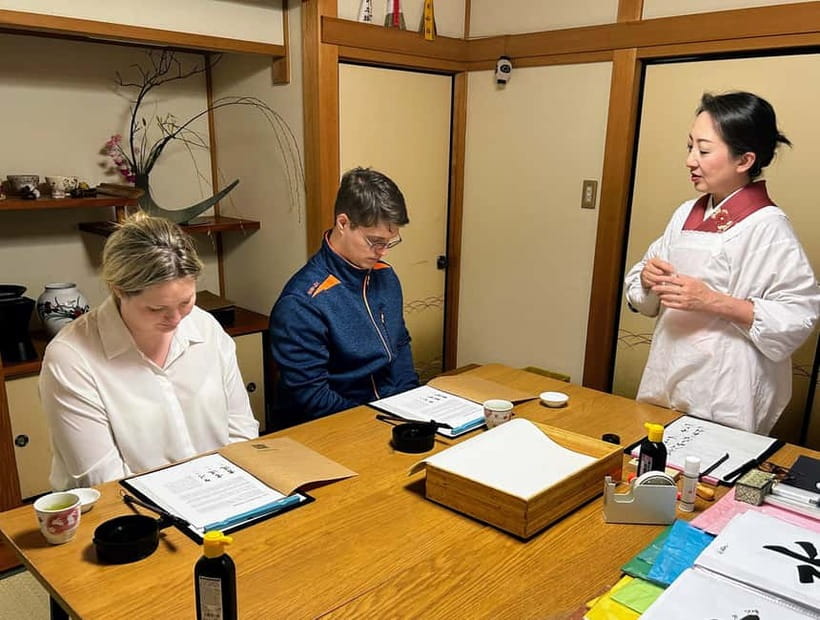
The final piece is created on Japanese paper, or washi. Ink, brushes, and other calligraphy tools are included, so you do not need to bring supplies. Your job is to focus on the technique and the composition.
Alicia from the United States appreciated leaving with calligraphy suitable for display at home. Harriet and George, who were visiting Japan on their honeymoon, valued the finished work as a personal reminder of their trip. That is where this activity makes good sense as a souvenir: it is light, distinctive, and connected to something you actively did.
Do not expect a factory-perfect item. Your artwork will show that you are learning. That is the point. A shop-bought print may look more polished, but it will not carry the same memory of choosing the character, practicing the strokes, and making the final attempt under Aya’s guidance.
Photos can add to the keepsake. One couple noted that the instructor’s husband took photos and video during their experience. Photo arrangements can vary, so do not book the class solely for a promised photo package, but the home setting and hands-on work naturally provide good moments to record.
The value of $66 for one hour
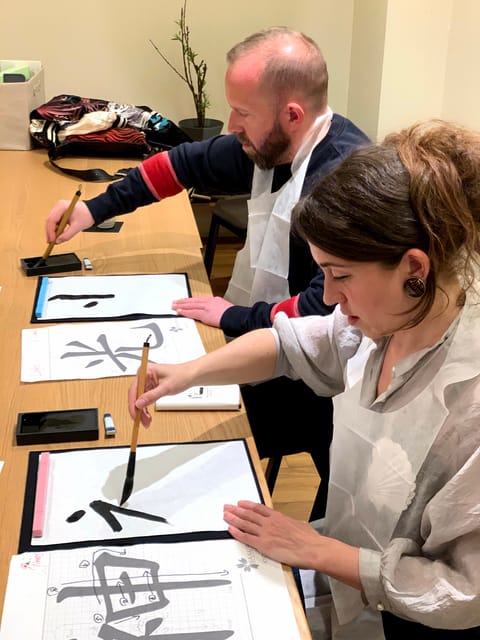
At $66 per person, this is not the cheapest one-hour activity in Kyoto. You are paying for more than access to ink and paper, though. The price includes instruction, tool rental, ink, washi, and a private-group setting with an English- or Japanese-speaking instructor.
The value improves if you want direct help rather than a self-guided craft. A larger workshop might offer more time or lower cost, but it may not give you the same personal attention. Here, the instructor can watch how you hold the brush, correct your strokes, discuss your chosen kanji, and help you finish a piece to take home.
The cost also covers a local connection near a major sightseeing stop. You can schedule the class around a visit to Nijo Castle, though the lesson itself lasts only one hour. If your Kyoto plans are packed with temples and gardens, this gives you a change of pace without taking half a day.
For a family, the price adds up quickly, and children under 13 cannot join. Couples, solo visitors, honeymooners, and small private groups are likely to get the most from it. If you only want a cheap souvenir, buying a calligraphy print will cost less. If you want to make your own and receive patient instruction, $66 is easier to justify.
Practical rules that affect your visit
Wear socks. Shoes are not allowed indoors, and bare feet are not accepted. If you forget, socks may be available for purchase, but bringing your own is the simpler and cheaper choice.
Strong fragrances are not allowed, along with smoking, vaping, alcohol, and drugs. These rules are typical for a private home and help keep the space comfortable for everyone.
Punctuality is important. Arriving late shortens your lesson, and the class cannot be offered if you are more than 15 minutes late. Since there is no early waiting space, plan to arrive five minutes before the start time, not much earlier.
The activity is wheelchair accessible, but you should still follow the venue directions carefully. The exact starting time depends on availability, so check the schedule when booking.
Free cancellation is available up to 24 hours before the activity for a full refund. You can also reserve now and pay later, which helps if you are still arranging a Kyoto schedule.
Who will enjoy this most
I would choose this for anyone who wants a quiet, hands-on cultural activity rather than another sightseeing stop. It works particularly well for couples because the finished pieces can mark a shared trip, and the private format keeps the lesson relaxed.
It also suits solo visitors. You can choose a kanji that reflects your own interests and receive direct feedback without feeling lost in a large workshop. The instructor speaks English and Japanese, so language should not prevent you from learning the main steps.
This is a good choice for people who enjoy crafts, stationery, design, Japanese culture, or mindful activities. It is also useful on a hot Kyoto afternoon, when sitting indoors for an hour can be a welcome break. Martina from Austria enjoyed using the class as an escape from summer heat while trying to reproduce traditional words with a brush.
I would not choose it for children under 13, anyone who refuses to remove shoes indoors, or anyone expecting advanced training. You will learn the foundation and make a keepsake, but mastery takes much longer.
Should you book the calligraphy class?
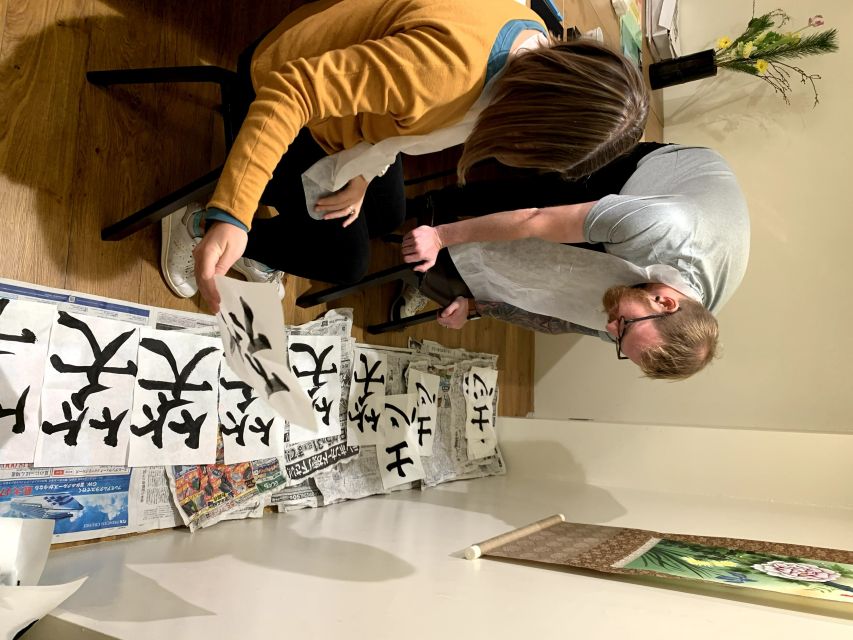
Book it if you want a personal Kyoto activity that combines a local home visit, direct instruction, and a souvenir you make yourself. The strongest reasons are Aya’s patient teaching, the private-group setting, and the chance to choose a meaningful kanji rather than copying a random design.
Skip it if your schedule allows no room for a fixed one-hour appointment, or if $66 feels high for a short class. The time is brief, and calligraphy is an art that rewards years of practice.
For most visitors who want something beyond temples and shopping, I think the class earns its place. Arrive on time, bring socks, use the venue name in your map app, and treat the final piece as a record of your effort rather than a test of artistic skill.
FAQ
Where does the calligraphy class take place?
The class takes place at a local home about 200 meters west of Nijo Castle in Kyoto. It is on the north side of Ebisugawa Street, just west of Nishinotoin Street. The Lions Mansion building is across the street.
How long does the activity last?
The activity lasts one hour. If you arrive late, your lesson time is shortened, and the class cannot be offered if you are more than 15 minutes late.
Who teaches the class?
Aya is the calligraphy instructor, and an assistant may also help during the lesson. Instruction is available in English and Japanese.
What is included in the price?
The price includes calligraphy instruction and explanations, rental of the calligraphy tools, ink, and Japanese washi paper.
What should I bring?
Bring socks, since shoes are not allowed indoors and bare feet are not accepted. Socks may be available for purchase if you forget them.
Can I cancel the booking?
You can cancel up to 24 hours in advance for a full refund. The activity also offers a reserve-now-and-pay-later option.
More Workshops in Kyoto
- Kyoto: 45-Minute Tea Ceremony Lesson Experience
★ 4.3 · 2,378 reviews - Ramen Cooking Class at Ramen Factory in Kyoto
★ 5.0 · 1,937 reviews - Kyoto : Chopsticks Making Workshop in Gion with Engraving Option
★ 5.0 · 958 reviews - Kyoto: Samurai Sword Class by Experts in Traditional Arts
★ 4.9 · 657 reviews
Just added around Kyoto
- Taste of Nishiki Market Walking Food Tour with Local guide★ 5.0 · 17 reviews
- Kyoto: Sushi Making Class with Sushi Chef★ 4.8 · 64 reviews
- Kyoto: City Secrets eBike Tour★ 4.9 · 196 reviews
- Sacred Pathways: Discover the Philosopher’s Path of Kyoto★ 4.9 · 20 reviews
- Private Tour to Monkey Park and Arashiyama Highlights★ 5.0 · 22 reviews
- Private Nara Tour from Osaka – Meet at Your Hotel★ 5.0 · 22 reviews
- Private Sake Tasting in Central Kyoto with Sake Sommelier★ 5.0 · 13 reviews
- Kyoto : Private Custom Walking Tour With A Local Guide★ 4.6 · 144 reviews
Kimono & Culture Experiences, compared.
Kyoto Geisha Walking Tour: Gion District & Hidden Gems
Read our review →
Gion Magical Night Walking Tour with Geisha Trivia
Read our review →
Gion Geisha District Walking Tour – Stories of Geisha
Read our review →
Best of Kyoto: Gion, Geisha, Pagodas & Cobblestones
Read our review →
Kyoto Gion Geisha District Walking Tour – The Stories of Geisha
Read our review →
Browse the lists this tour appears in