
REVIEW · WALKING TOURS
Kyoto Gion Early Morning Walking Tour
Kyoto’s famous sights are far more enjoyable before the afternoon rush. This early-morning Gion walk takes you from willow-lined Shirakawa to Kiyomizu-dera, old stone lanes, Yasaka Pagoda, and Yasaka Shrine while the city is still waking up.
I like the maximum group size of 12, which gives you a fair chance to ask questions. I also like the guides’ personal styles: Hiro connects Japanese history to the wider world, Caleb brings a strong interest in history, and Vincent is happy to answer questions as you go.
The trade-off is simple: you must get up early, and the timing may not always beat the crowds at Kiyomizu-dera. One visitor found the temple already very busy and wished the tour had started an hour earlier. You should also expect a steady amount of walking and stairs, with the ¥500 Kiyomizu-dera admission fee added to the tour price.
In This Review
- Key points before you book
- Why an early Gion walk works so well
- Gion Shirakawa begins the morning quietly
- Hanamikoji Street and Kyoto’s geisha district
- Kiyomizu-dera brings the biggest payoff
- Sannenzaka and Ninenzaka feel like old Kyoto
- Yasaka Pagoda offers a classic photo stop
- Yasaka Shrine closes the circuit
- The guides are a major part of the value
- What the walking and timing are really like
- Is $49.42 a fair price?
- Who should book this Kyoto walk?
- Should you book it?
- FAQ
- How long is the Kyoto Gion Early Morning Walking Tour?
- What sights are included on the route?
- Is the Kiyomizu-dera admission fee included?
- How much does the tour cost?
- Is hotel pickup included?
- Where does the tour end?
- How large is the group?
- Is the tour conducted in English?
- Can I cancel for a full refund?
Key points before you book
- Early access to Gion: See the Shirakawa River, Hanamikoji Street, and nearby traditional streets before the busiest part of the day.
- Six worthwhile Kyoto stops: The route covers Gion Shirakawa, Hanamikoji Street, Kiyomizu-dera, Sannenzaka and Ninenzaka, Yasaka Pagoda, and Yasaka Shrine.
- A compact group: With no more than 12 people, you can stay close to the English-speaking guide and ask questions.
- A strong guide makes the difference: Hiro, Caleb, and Vincent are praised for history, humor, clear English, and their willingness to explain more than the bare basics.
- Budget for one extra fee: The tour costs $49.42 per person, but Kiyomizu-dera admission costs another ¥500 per person.
- A useful first look at eastern Kyoto: The tour ends back at its starting point, giving you a guided introduction before you explore more on your own.
Why an early Gion walk works so well
Gion is often pictured as a quiet Kyoto district of wooden townhouses, narrow lanes, shrine gates, and soft morning light. By afternoon, the same places can feel packed. The point of this tour is not to show you obscure corners far from the center. It is to bring you to Kyoto’s best-known sights at a more favorable hour.
That timing matters most for photography and atmosphere. You have a better chance of seeing the old streets without a wall of people around you, though you should not expect every stop to be empty. Kiyomizu-dera is one of Kyoto’s major attractions, and the schedule may still bring you there after crowds have begun to gather.
The tour lasts about three hours and is conducted in English. You move through several districts and landmark areas rather than staying in one small part of Gion. I would treat it as a brisk orientation walk, not a slow morning of sitting in one shrine or temple.
The meeting point is the Statue of Izumo-no-Okuni in Kawabatacho, in Kyoto’s Higashiyama Ward. The activity ends back at that same meeting point. Hotel pickup is not included, so you need to make your own way there, but the meeting point is near public transportation.
More Walking Tours in Kyoto
- Kyoto Geisha Walking Tour: Gion District & Hidden Gems
★ 4.7 · 3,273 reviews - Kyoto: Gion Magical Night Walking Tour with Geisha Trivia
★ 4.9 · 2,393 reviews - Kyoto: Gion Geisha District Walking Tour – Stories of Geisha
★ 4.7 · 2,187 reviews
Gion Shirakawa begins the morning quietly
The first stop is Gion Shirakawa, where the Shirakawa River runs beside traditional machiya houses and weeping willows. You have about 15 minutes here, enough to get your bearings and take in the setting before moving on.
This is a good opening because it introduces the older character of Gion without demanding much walking right away. The river, wooden facades, and narrow street create the kind of Kyoto scene many people hope to find, but the early hour gives it a calmer feel.
Your guide can also help you understand why this area matters within Gion. The value here is not a long formal visit. It is the chance to begin with a clear sense of place and to hear context before the route becomes more crowded and physically demanding.
Keep your expectations practical. Fifteen minutes is a short stop, so you will not have time to explore every side street or linger at length. If you want extensive independent photography, you may wish to return later on your own.
Hanamikoji Street and Kyoto’s geisha district
From Shirakawa, the walk continues to Hanamikoji Street for about 20 minutes. This is one of Kyoto’s best-known streets in the geisha district, lined with historic wooden machiya and traditional teahouses called ochaya.
The guide-led setting is especially useful here. Gion is not just a backdrop for photographs. It is a working neighborhood with customs and private spaces, and a guide can help you understand the difference between seeing a historic street and treating it like a stage set.
You may hear about geisha and maiko, the traditional performers associated with Kyoto’s entertainment districts. The supplied tour details do not promise a sighting, so do not book this walk expecting to see one. Book it for the architecture, atmosphere, and explanation of how this part of Kyoto fits into local culture.
Hanamikoji is also a place where considerate behavior matters. Stay with the group, follow your guide’s instructions, and remember that the wooden buildings and teahouses are part of a living district, not simply a photo prop.
Kiyomizu-dera brings the biggest payoff
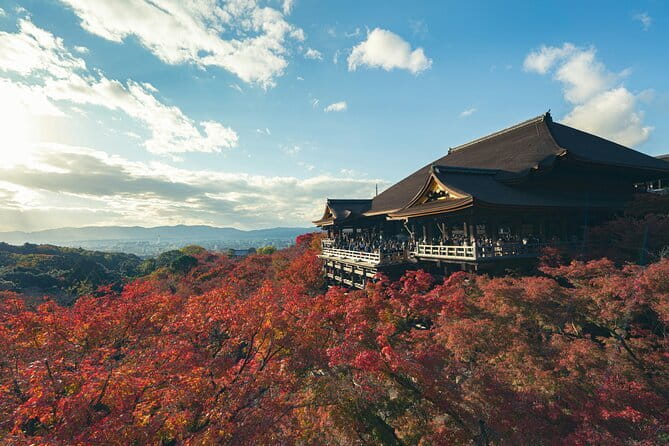
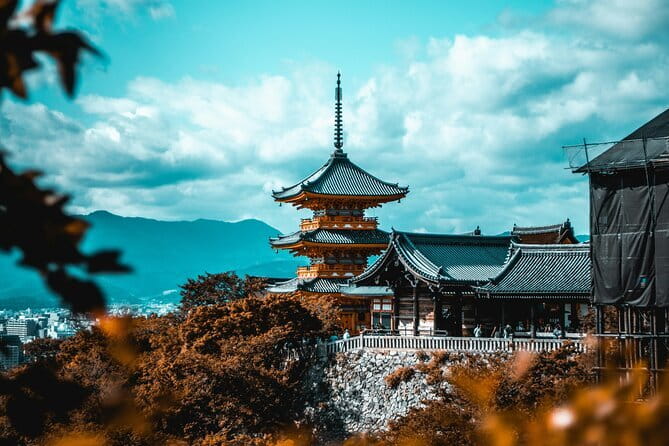
The tour allows one hour at Kiyomizu-dera, the longest stop of the morning. That gives you time to appreciate the temple’s famous wooden stage and its outlook over Kyoto, with seasonal color around the grounds.
Kiyomizu-dera is likely to be the main reason many people book this experience. The temple combines a major architectural landmark with broad city views and a strong sense of Kyoto’s spiritual tradition. A guide adds value by explaining what you are seeing instead of leaving you to decode the site from signs alone.
The admission fee is not included. You should add ¥500 per person to your budget. At $49.42, the tour price is reasonable for three hours with an English-speaking guide and a route through several major sites, but the separate temple fee is worth noting before you book.
This is also where the early start faces its biggest test. The tour is designed to reach the landmarks before the crowds, yet one reported experience found Kiyomizu-dera already swarming by the time the group arrived. If avoiding crowds is your top priority, choose the earliest available departure and understand that the tour’s advertised early timing does not guarantee an empty temple.
The hour at Kiyomizu-dera may include more walking and standing than the opening stops. Wear shoes that are comfortable on slopes and stone-paved streets. The tour information says most people can participate, but it does not promise a step-free route or a pace tailored to individual mobility needs.
Same city, a completely different kind of day:
- PERFECT KYOTO 1-Day Bus Tour
★ 5.0 · 13,518 reviews - Kyoto: Fushimi Inari, Kinkakuji, Bamboo Grove 1 Day Bus Tour
★ 4.8 · 4,316 reviews - Kyoto: Tea Ceremony in a Traditional Tea House in Kiyomizu
★ 4.9 · 3,519 reviews - Kyoto: Tea Ceremony Ju-An at Jotokuji Temple
★ 4.9 · 3,207 reviews
Sannenzaka and Ninenzaka feel like old Kyoto
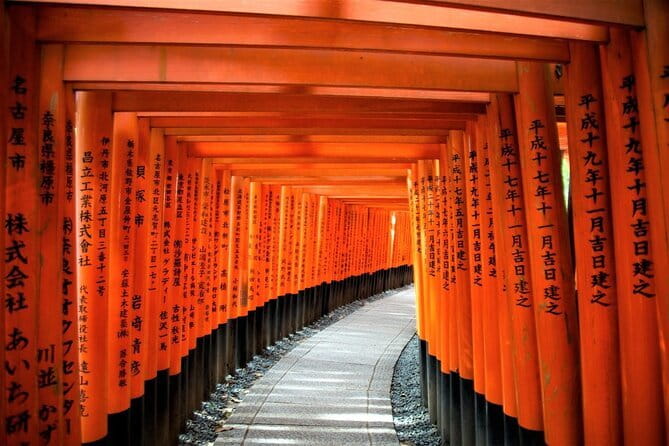
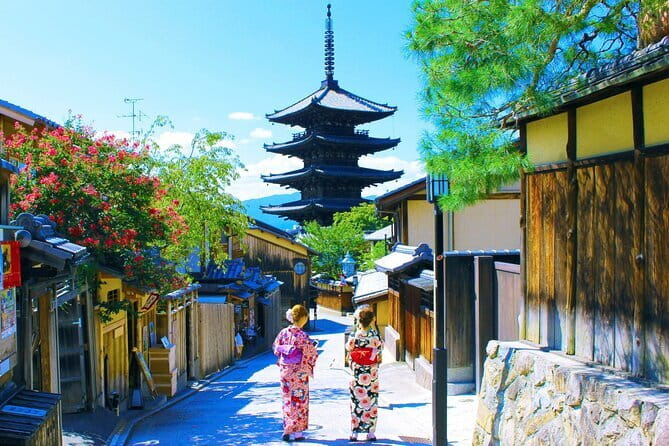
After Kiyomizu-dera, you spend about 30 minutes on Sannenzaka and Ninenzaka. These historic lanes are known for stone paving, traditional wooden townhouses, and small local shops. They lead toward the Kiyomizu-dera area and are among the most recognizable old streets in Kyoto.
This section helps connect the temple to the neighborhood around it. You are not simply moving from one ticketed attraction to another. You see how streets, shops, houses, and religious sites fit together in the same part of the city.
The lanes are attractive, but their popularity brings a practical problem. They can become crowded, and the stone paving can make the walk feel slower than a flat city sidewalk. The early timing helps, yet you should still expect other people, especially near Kiyomizu-dera.
The 30-minute stop is enough for an introduction and some photographs. It is not long enough for a leisurely shopping session. If you see a shop you want to revisit, note its location and come back after the tour, since the group needs to keep moving.
Yasaka Pagoda offers a classic photo stop
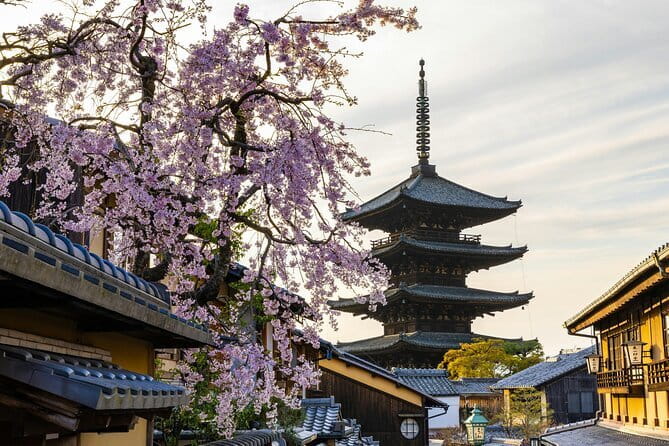
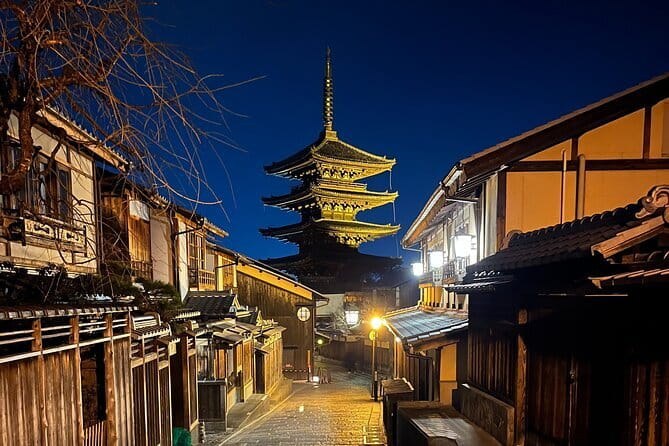
Yasaka-no-To, usually called Yasaka Pagoda, receives about 10 minutes. The pagoda rises among Kyoto’s historic streets and offers one of the area’s most familiar views.
This is a short but well-chosen stop. After the temple grounds and sloping lanes, the pagoda gives you a strong visual landmark and a chance to pause for photographs. Morning light can also make the surrounding streets feel less hectic.
Ten minutes goes quickly, so be ready when the group arrives. You will not have time for a long visit inside or around the pagoda, and the supplied details do not state that interior admission is part of the tour. Think of this as a focused exterior viewing point within a larger walking route.
Yasaka Shrine closes the circuit
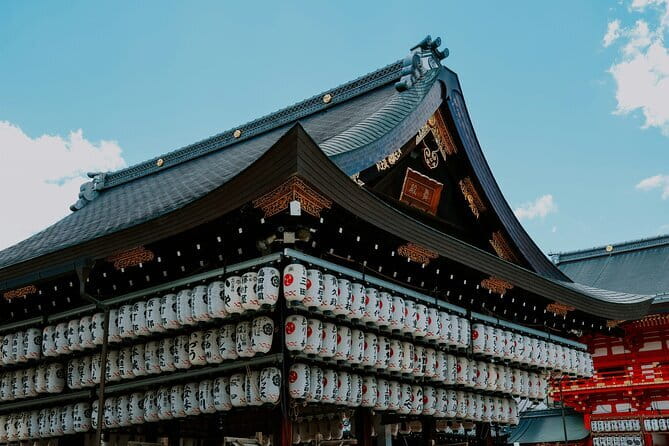
The final stop is Yasaka Shrine, with about 30 minutes. This is one of Kyoto’s best-known Shinto shrines, recognized for its vermilion gate and lantern-lit dance stage.
The shrine provides a useful contrast with Kiyomizu-dera. Instead of ending at another Buddhist temple, the tour closes with a major Shinto site and a chance to consider different parts of Japanese religious life. Your guide can help put the buildings, rituals, and traditions into context.
Because the tour ends back at the original meeting point, Yasaka Shrine is not the final point of a one-way transfer. You return to where you began after the three-hour walk. That is useful if you have plans elsewhere, though it means the tour does not function as transportation to your next Kyoto sight.
You may want to spend more time at the shrine on your own afterward if your schedule allows. The tour gives you 30 minutes, which is enough for a guided visit but not necessarily enough for an unhurried look at every corner.
The guides are a major part of the value

The route is strong, but the guide can determine how much you get from it. Hiro is praised for explaining Japanese history in a broader global context, and for adding humor to the walk. Caleb is described as friendly and deeply interested in history. Vincent is noted for taking time with explanations and answering questions, including questions beyond the immediate route.
Those details matter because this tour covers a lot in three hours. You pass through a river district, a geisha quarter, a major temple, historic lanes, a pagoda, and a shrine. Without a good guide, that can become a string of names and photo stops. With a strong guide, the walk can give you a framework for understanding eastern Kyoto.
The group limit of 12 supports that style. You are not guaranteed a private tour, but a smaller group usually makes it easier to hear, keep up, and ask questions. One experience was described as feeling private, though the formal maximum remains 12 people, so you should not count on having the guide to yourself.
Several guides have been praised for clear English and a willingness to explain. That is useful if you want more than quick facts. I would ask questions as they come up rather than saving everything for the end, since the route moves through each stop on a set schedule.
What the walking and timing are really like
The tour is approximately three hours, but the stop times alone add up to about three hours and 15 minutes. That difference is small and may reflect approximate timing, walking between locations, or a flexible schedule. You should allow a little extra time rather than booking something immediately afterward.
The route includes traditional streets, temple and shrine grounds, and the approach to Kiyomizu-dera. Expect to be on your feet for most of the experience. The tour information says most people can participate, but it does not give a detailed accessibility description, so ask the provider if you need specific mobility arrangements.
The early hour is central to the experience. You trade sleep for quieter streets, cooler conditions, and better odds of seeing the most famous places before the day fills in. If you dislike early starts, the benefit may not outweigh the inconvenience. If your Kyoto schedule is tight, though, finishing in the morning leaves much of the day open.
No meals are listed as included. One guide-led morning included an enjoyable coffee stop at Here, but you should not assume that coffee is part of every departure or included in the price. Eat beforehand or plan your own coffee afterward unless your guide says otherwise.
Is $49.42 a fair price?
At $49.42 per person, this is not the cheapest way to walk through Gion. You can visit the streets, shrine exteriors, Yasaka Pagoda area, and much of the surrounding neighborhood without paying a tour fee.
The price makes more sense if you want orientation and explanation. You are paying for an English-speaking guide, a planned route, crowd-conscious timing, and the convenience of not having to navigate between six different stops. The group maximum of 12 also gives the experience more personal attention than a large coach-style outing.
Kiyomizu-dera admission costs an additional ¥500 per person. Hotel pickup is not included, and the tour returns to its original meeting point. Those are modest limitations, but they affect your total cost and schedule.
I think the price is fair for a first morning in Kyoto, especially if you value history and want to ask questions. It is less compelling for confident independent walkers who already know Gion and prefer to set their own pace.
Who should book this Kyoto walk?
I would recommend it to you if this is your first visit to Kyoto, you want the major Gion-area sights explained in English, and you are willing to start early. It also suits people who want a useful introduction before returning to favorite areas alone.
It is a good match for anyone who likes history, architecture, photography, and local customs. Hiro, Caleb, and Vincent each bring a slightly different tone, but the common thread is careful explanation and a willingness to engage with questions.
You may want another option if you need a slow pace, a fully accessible route, hotel pickup, or a guaranteed crowd-free Kiyomizu-dera. You should also skip it if three hours of walking sounds tiring or if you would rather spend your morning shopping and exploring independently.
The tour receives a five-star rating from 24 reviews, with 100 percent recommending it. That is a small sample, but it fits the practical strengths of the experience: strong guides, a sensible route, and a worthwhile attempt to see Kyoto’s most popular sights before the busiest hours.
Should you book it?
Book this tour if you want a guided introduction to Gion and eastern Kyoto, especially if you appreciate historical context and do not want to lose time finding the next shrine or temple. The early start is the main reason to choose it, not a minor detail.
I would book the earliest departure available, wear comfortable shoes, bring money for the ¥500 Kiyomizu-dera fee, and leave room in your schedule after the tour in case the morning runs a little long. If you can accept that Kiyomizu-dera may still be crowded, the route offers a solid mix of famous sights, old streets, and useful local context for a fair price.
FAQ
How long is the Kyoto Gion Early Morning Walking Tour?
The tour lasts approximately three hours.
What sights are included on the route?
The route includes Gion Shirakawa, Hanamikoji Street, Kiyomizu-dera Temple, Sannenzaka and Ninenzaka, Yasaka-no-To or Yasaka Pagoda, and Yasaka Shrine.
Is the Kiyomizu-dera admission fee included?
No. Kiyomizu-dera admission costs ¥500 per person and is paid separately.
How much does the tour cost?
The listed price is $49.42 per person.
Is hotel pickup included?
No. Hotel pickup is not included. You meet at the Statue of Izumo-no-Okuni in Kawabatacho, Kyoto.
Where does the tour end?
The activity ends back at the meeting point.
How large is the group?
The tour has a maximum of 12 people.
Is the tour conducted in English?
Yes. An English-speaking guide is included.
Can I cancel for a full refund?
Yes. You can cancel at least 24 hours before the start time for a full refund. Cancellations or changes made less than 24 hours before the start time are not accepted for a refund.
More Morning in Kyoto
- Kyoto Early Morning Tour with English-Speaking Guide
★ 5.0 · 1,427 reviews - Kyoto: Early Morning Tour with English-Speaking Guide
★ 4.9 · 1,128 reviews - From Kyoto: Nara Guided Morning Tour
★ 4.6 · 335 reviews - Kyoto Morning Tour from Kyoto or Osaka
★ 4.0 · 281 reviews
Just added around Kyoto
- Private Guided Traditional Buddhist Cooking in Japan★ 5.0 · 16 reviews
- Kyoto: Gion Geisha District & Sake-in-Hand Walking Tour★ 5.0 · 37 reviews
- Your Private Vacation Photography Session In Kyoto★ 5.0 · 110 reviews
- Kyoto: Zen Meditation at a Private Temple with a Monk★ 5.0 · 25 reviews
- Traditional Japanese Washi Papermaking- Kyoto morning★ 5.0 · 77 reviews
- Kyoto Wagashi(Japanese sweets) Cooking Class near Fushimiinari★ 5.0 · 60 reviews
- Private Pewter Sake Cup Experience with a Kyoto Artisan★ 5.0 · 31 reviews
- Kyoto Private 6 hour Tour: English Speaking Driver Only, No Guide★ 5.0 · 88 reviews
Walking Tours, compared.

Kyoto Geisha Walking Tour: Gion District & Hidden Gems
Read our review →
Tokyo Tsukiji Fish Market Food and Culture Walking Tour
Read our review →
Gion Magical Night Walking Tour with Geisha Trivia
Read our review →
Imperial Palace and Shogun Historical Walking Tour
Read our review →
Gion Geisha District Walking Tour – Stories of Geisha
Read our review →
Asakusa Walking Tour with Sensoji Temple Visit
Read our review →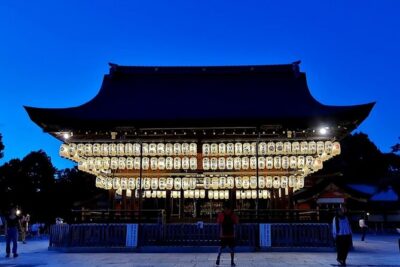
Kyoto Gion Geisha District Walking Tour – The Stories of Geisha
Read our review →Browse the lists this tour appears in