
REVIEW · KIMONO & CULTURE EXPERIENCES
The Art of Geisha: Exclusive Show & Gion Walking Tour
Kyoto’s geisha world is usually glimpsed from a distance, if at all. This experience brings you into Gion for a maiko performance, tea, snacks, conversation, and a traditional Japanese game you can play with her. It is a rare chance to meet an apprentice geisha in a setting built for questions rather than quick street photographs.
I like two things right away: the maximum six-person group keeps the meeting personal, and the English-speaking guide gives you a way to understand what you are seeing. Guides named Ai and Yoshino have been especially praised for their warm explanations of Gion and maiko culture.
The main consideration is time. The listed duration is about one to two hours, while the stated itinerary is one hour, so this is a focused introduction, not a full afternoon of Kyoto sightseeing. Children aged six and under cannot join.
In This Review
- Key points to know before booking
- Why meeting a maiko in Gion feels different
- Starting at the Statue of Izumo-no-Okuni
- A small Gion group keeps the meeting personal
- Watching the maiko perform traditional arts
- Tea, snacks, and a traditional Japanese game
- Asking questions without the usual Gion distance
- What $124.21 buys you
- Timing, age limits, and what to expect
- Who will get the most from this experience
- Should you book the Gion maiko experience?
- FAQ
- Where does the tour start?
- Where does the tour finish?
- How long does the experience last?
- What is included in the price?
- How many people can join?
- Can children join the tour?
Key points to know before booking
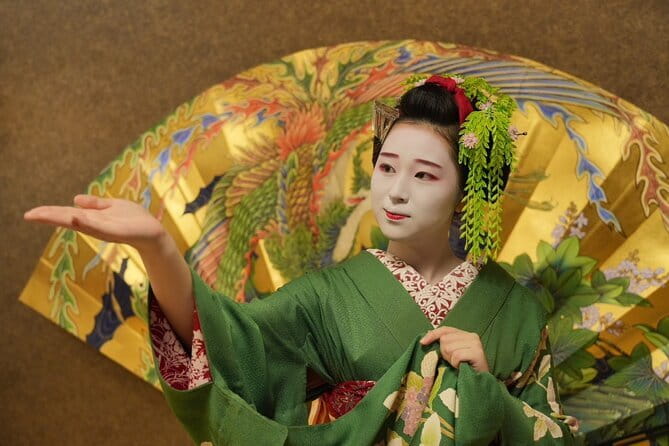
- A maiko performs traditional arts: You see an apprentice geisha dance and take part in a Japanese game.
- Small groups matter here: The experience accepts no more than six people, allowing time for questions and conversation.
- Tea and snacks are included: They add a calm, traditional setting to the performance.
- Gion is part of the experience: The guide introduces the district and explains how maiko and geiko fit into Kyoto culture.
- The meeting time is 3 p.m.: Start at the Statue of Izumo-no-Okuni and finish in Higashiyama.
- The price is $124.21 per person: That is a serious sum for a short activity, but it includes the show, refreshments, guide, and a rare personal encounter.
Why meeting a maiko in Gion feels different
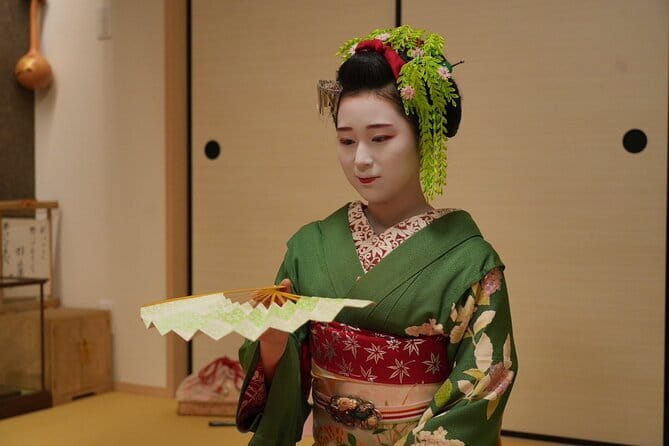
It is easy to walk through Gion and hope to spot a maiko in the evening. It is much harder to understand what you are seeing from the pavement. A painted face, elaborate hair, and bright kimono tell you very little about the years of training, formal arts, and strict customs behind the appearance.
This experience gives you context before the performance. Your guide leads you through Gion and explains the district’s connection to maiko and geiko culture. That short introduction matters because it turns the performance from a pretty spectacle into a cultural meeting with meaning.
The word maiko refers to an apprentice geisha. The presentation focuses on her training and artistic work, rather than treating her as a costumed photo prop. You can ask questions, hear explanations through the guide, and see how much skill goes into the arts she presents.
I especially like the chance to speak with the maiko. A stage show can be polished but distant. Here, the conversation and game create a more relaxed exchange. The experience remains structured, yet you have room to ask about the subjects that interest you most.
More Kimono & Culture Experiences in Kyoto
- Kyoto Geisha Walking Tour: Gion District & Hidden Gems
★ 4.7 · 3,273 reviews - Kyoto: Gion Magical Night Walking Tour with Geisha Trivia
★ 4.9 · 2,393 reviews - Kyoto: Gion Geisha District Walking Tour – Stories of Geisha
★ 4.7 · 2,187 reviews
Starting at the Statue of Izumo-no-Okuni
The meeting point is the Statue of Izumo-no-Okuni in Kawabatacho, Higashiyama Ward. The start time is 3 p.m., so check your route before setting out and allow enough time to find the exact statue.
The tour begins with Gion rather than rushing straight indoors. This gives you a useful sense of place. Your guide helps explain the neighborhood and points out its connection to traditional entertainment districts. The walk is not presented as a long historical tour, so keep your expectations focused: this is an introduction designed to lead into the maiko meeting.
That format suits an afternoon in Kyoto. You can visit a temple or market earlier, then make your way to Gion for the 3 p.m. start. The experience finishes at Hangesho, at 535 Morishitacho in Higashiyama Ward, so it does not return you to the starting statue.
The area is near public transportation, which makes the activity fairly easy to fit into a Kyoto day. Still, the start and end points differ, so do not assume you will finish exactly where you began.
A small Gion group keeps the meeting personal
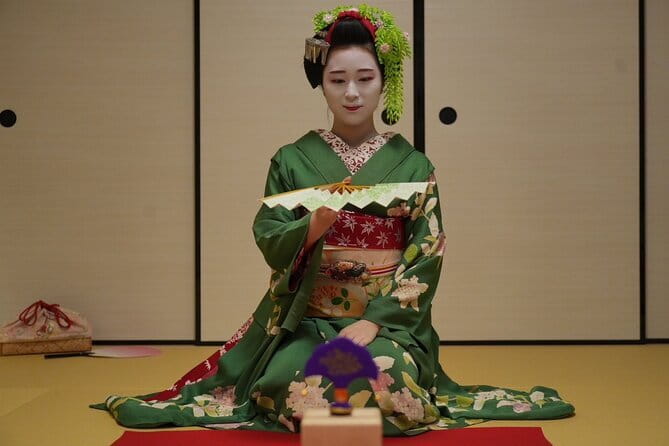
The group limit is six people. That is one of the strongest features of the experience because the value depends on being able to see, hear, and speak during the presentation.
In a large room, a maiko demonstration could feel like a distant stage show. With only a handful of people, you have a better chance of following the movements closely and asking a question without turning the meeting into a formal interview. Several group sizes described in the feedback were even smaller, including a meeting with one maiko and four participants.
A small group also makes the guide’s role more useful. Ai and Yoshino are named as guides who explained Gion, Kyoto culture, and the maiko tradition in a friendly way. The exact guide may vary, but the service includes an English-speaking guide who interprets and adds background.
The group limit does not guarantee that every question will receive a long answer. The session is short, and the maiko’s time is shared with the rest of the group. If you have questions, it helps to think of two or three in advance.
Watching the maiko perform traditional arts
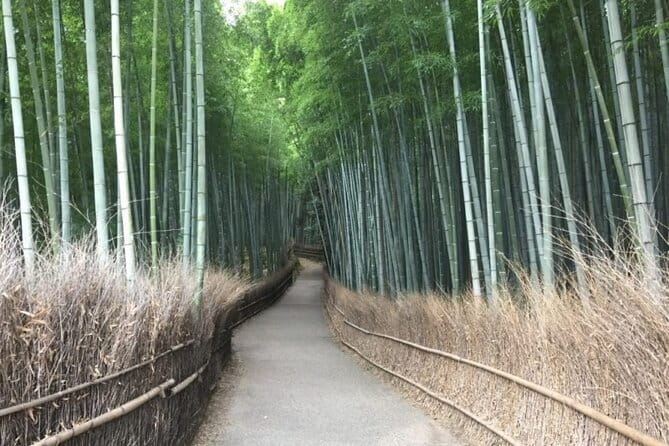
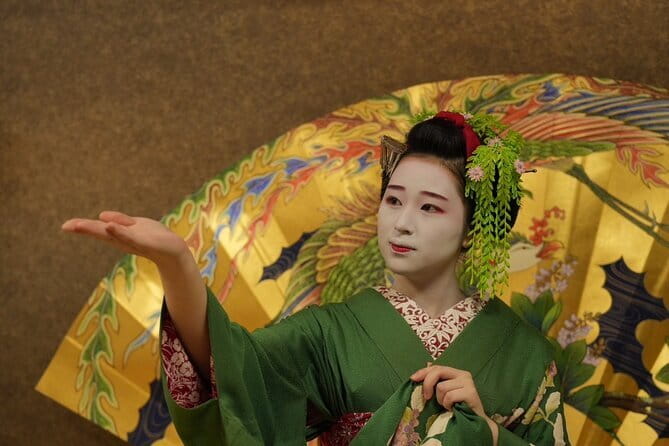
The central event is the maiko show. You watch an apprentice geisha perform traditional arts, including dance. This is the moment to slow down and pay attention to the details: posture, controlled movement, costume, music if used, and the careful presentation of each gesture.
The performance is not described as a long theater production. It is a personal cultural demonstration within a compact tour. That makes it a good choice for someone who wants a meaningful introduction without committing to an entire evening of formal entertainment.
The setting also matters. You enjoy Japanese tea and snacks while watching, which gives the event a quieter rhythm. Rather than arriving, taking a photograph, and leaving, you have a chance to sit, observe, and let the guide explain what is happening.
The supplied details do not specify the exact menu, performance length, or number of dances. I would not book this expecting a complete catalog of geisha arts. Book it for a close look at one maiko’s performance and for the chance to understand the person and tradition behind it.
More Walking Tours in Kyoto
- Private Kyoto Tour with a Local, Highlights & Hidden Gems, Personalised
★ 5.0 · 1,543 reviews - Kyoto Gion Geisha District Walking Tour – The Stories of Geisha
★ 5.0 · 1,441 reviews - Nishiki Market Brunch Walking Tour (7 Tastings + Brunch)
★ 5.0 · 1,355 reviews - Kyoto Arashiyama Walking Tour: Bamboo, Monkeys, Gardens & Secrets
★ 5.0 · 1,216 reviews
Tea, snacks, and a traditional Japanese game
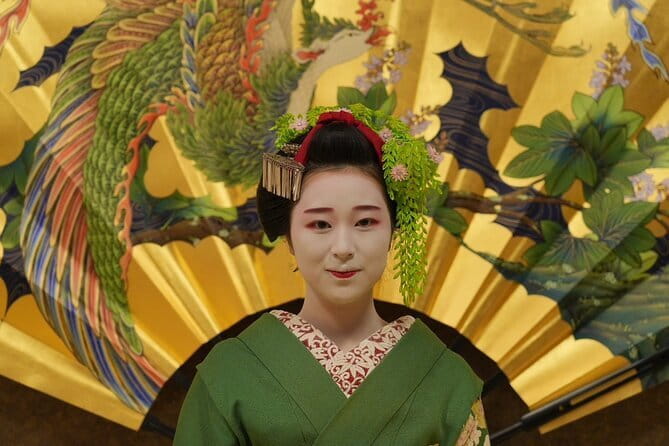
Tea and snacks are included in the price. They are a modest but useful part of the experience, since they make the meeting feel like a cultural visit rather than a stand-alone stage presentation.
The most playful part comes after the performance, when you can challenge the maiko in a traditional Japanese game. This gives you an active role. You are not simply watching from your seat, and the game can loosen the formality of the meeting.
One participant even described beating the maiko. That detail captures the tone well: the activity is respectful, but it is not meant to be stiff. You may get a chance to play, though the exact order and amount of participation will depend on the group.
If you are shy about joining in, do not assume you must perform in front of everyone. The provided details say you have the chance to challenge your skill, not that every person must take a turn. The guide can help explain the game and keep the exchange comfortable.
Asking questions without the usual Gion distance
For many people, the conversation is more valuable than the dance. Kyoto’s geisha culture is surrounded by mystery, and it is easy to rely on guesses or romantic ideas. A direct question and a clear translation can replace much of that fog.
You can ask the maiko questions through the English-speaking guide. The discussion may cover her training, the difference between maiko and geiko, the arts she studies, or daily life within the profession. Only the general opportunity to ask questions is promised, so the precise subjects will depend on the maiko and the group.
This is where guide quality matters. Ai and Yoshino are specifically praised for making the background clear and approachable. A good guide does more than translate words. The guide helps you understand what is appropriate to ask, explains cultural references, and keeps the conversation moving.
The experience is especially useful if you have tried to spot maiko in Gion and come away empty-handed. Street sightings are uncertain and brief. Here, the encounter is arranged in a respectful setting, with time to watch, listen, and ask.
What $124.21 buys you
At $124.21 per person, this is not a bargain-priced walking tour. You are paying for a short activity, a specialist cultural encounter, a performance, tea and snacks, and an English-speaking guide. The small group limit is important to the value because a six-person maximum offers a more direct experience than a standard bus or large walking group.
I would compare the price with what you actually want from Kyoto. If your goal is to cover several neighborhoods or major sights in an afternoon, this tour will seem expensive for its one to two-hour duration. If meeting a maiko is a major personal goal, the price becomes easier to justify because the encounter is difficult to arrange independently.
The experience has received a five-star rating from 129 reviews, with 99 percent recommending it. Those figures suggest a strong record, but they should not erase the practical limits. You still get a compact presentation rather than a full evening of geisha entertainment, and the exact guide and group size can vary up to the six-person maximum.
For a special occasion, a first visit to Kyoto, or a trip built around traditional arts, I think the cost can make sense. For budget travelers focused on temples, food, and free neighborhood walks, you may prefer to spend the money elsewhere.
Timing, age limits, and what to expect
The advertised duration is approximately one to two hours, while the itinerary gives one hour in Gion. Treat it as a short afternoon activity and leave space before and after it rather than scheduling a major timed attraction immediately afterward.
The start time is fixed at 3 p.m. Confirmation is sent when you book, and the tour uses a mobile ticket. Bring the ticket on your phone and make sure it is easy to open before you arrive.
Children aged six and under cannot join. The activity is near public transportation, and the provided information says most people can participate. No further accessibility details are given, so if you have specific mobility, hearing, or seating needs, ask the operator before booking.
The tour ends at Hangesho, 535 Morishitacho, Higashiyama Ward. Since the finish is different from the meeting point, plan your next stop from there. Free cancellation is available if you cancel at least 24 hours before the 3 p.m. start time. Cancellations or changes made less than 24 hours ahead are not accepted for a refund.
Who will get the most from this experience
I would recommend this to you if the geisha tradition is high on your Kyoto wish list, especially if you want conversation rather than a distant sighting. The small group, English-speaking guide, tea, snacks, and game give the activity more substance than a quick performance alone.
It also suits first-time visitors who want help understanding Gion. The walk is brief, but it gives the show a neighborhood setting and helps explain why the district matters.
The experience may be less suitable if you want a long walking tour, a large-scale theater performance, or a full evening of entertainment. It is also not a good fit for children aged six and under, who cannot participate.
Photography rules, the exact tea and snacks, the length of the dance, and the identity of the maiko are not specified. I would respect the guide’s instructions and treat the meeting as a cultural exchange first, not a photo opportunity.
Should you book the Gion maiko experience?
Book it if you want a close, respectful introduction to maiko culture and value the chance to ask questions. The six-person maximum, guide interpretation, traditional performance, tea, snacks, and Japanese game give you several ways to connect with the subject.
Think twice if the $124.21 price feels high for a one-hour itinerary or if you prefer to spend your afternoon moving among several Kyoto sights. This is a focused experience, not a general Gion tour.
For most people who have dreamed of seeing a maiko up close, I think it is worth serious consideration. The meeting is personal, the guides add useful context, and the conversation helps replace the mystery with a clearer understanding of the work and training involved.
FAQ
Where does the tour start?
It starts at the Statue of Izumo-no-Okuni in Kawabatacho, Higashiyama Ward, Kyoto. The start time is 3 p.m.
Where does the tour finish?
The tour ends at Hangesho, 535 Morishitacho, Higashiyama Ward, Kyoto. The ending point is different from the starting point.
How long does the experience last?
The approximate duration is one to two hours. The stated itinerary describes one hour in Gion.
What is included in the price?
The price includes a geisha show, Japanese tea and snacks, and an English-speaking tour guide.
How many people can join?
The activity has a maximum of six participants.
Can children join the tour?
Children aged six and under cannot join. The provided information says most other participants can take part.
More Show in Kyoto
- Kyoto Gion Cultural Walk & Geisha Show with Dining Options
★ 5.0 · 518 reviews - Kyoto Gion Cultural Walk & Geisha Show with Dining Options
★ 5.0 · 483 reviews - 1 Hour Geisha Show in Kyoto
★ 5.0 · 452 reviews - Kyoto: Samurai Kenbu Traditional Sword Dancing Show
★ 4.5 · 426 reviews
Just added around Kyoto
- Private Guided Traditional Buddhist Cooking in Japan★ 5.0 · 16 reviews
- Kyoto: Gion Geisha District & Sake-in-Hand Walking Tour★ 5.0 · 37 reviews
- Your Private Vacation Photography Session In Kyoto★ 5.0 · 110 reviews
- Kyoto: Zen Meditation at a Private Temple with a Monk★ 5.0 · 25 reviews
- Traditional Japanese Washi Papermaking- Kyoto morning★ 5.0 · 77 reviews
- Kyoto Wagashi(Japanese sweets) Cooking Class near Fushimiinari★ 5.0 · 60 reviews
- Private Pewter Sake Cup Experience with a Kyoto Artisan★ 5.0 · 31 reviews
- Kyoto Private 6 hour Tour: English Speaking Driver Only, No Guide★ 5.0 · 88 reviews
Kimono & Culture Experiences, compared.

Kyoto Geisha Walking Tour: Gion District & Hidden Gems
Read our review →
Gion Magical Night Walking Tour with Geisha Trivia
Read our review →
Gion Geisha District Walking Tour – Stories of Geisha
Read our review →
Best of Kyoto: Gion, Geisha, Pagodas & Cobblestones
Read our review →
Kyoto Gion Geisha District Walking Tour – The Stories of Geisha
Read our review →
Browse the lists this tour appears in