
REVIEW · WALKING TOURS
Kyoto: Gion Magical Night Walking Tour
Gion looks very different after dark, when lanterns glow, temple grounds grow quiet, and the famous geisha district becomes easier to appreciate without daytime crowds. This small-group walk takes you beyond the best-known lanes and adds the cultural context that is hard to get from a map alone.
I like the maximum group size, listed as eight in the tour highlights, because it keeps the walk polite and makes it easy to ask questions. I also like the mix of geisha culture, shrine customs, pagodas, and nighttime photography rather than a tour focused on only one theme.
The main thing to consider is the walking. The route includes slopes and stairs, and some people find the roughly 100-minute outing longer or more strenuous than expected. The booking details also mention a maximum of 10 people, so confirm the group size if that matters to you.
In This Review
- Key points to know before you book
- Why Gion works so well at night
- Meeting at Minamiza Theater and entering Gion
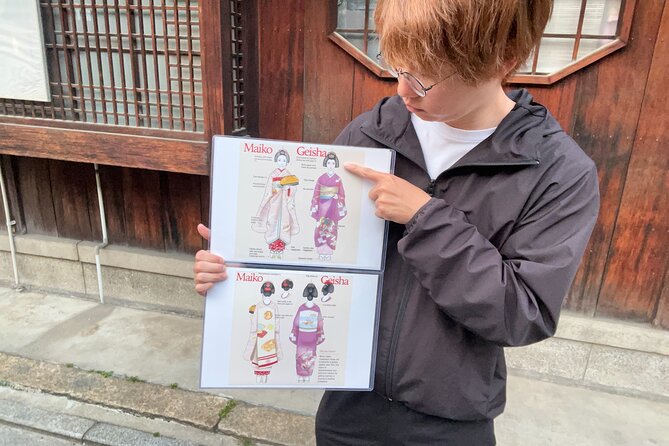
- Gionmachi Minamigawa and the world of maiko and geiko
- Yasui-Konpiragu and Kyoto’s relationship shrines
- Sannenzaka, Ninenzaka, and the view toward Yasaka Pagoda
- The Kannon statue and the temple garden stops
- Yasaka Shrine and the final stretch
- The guides make the difference
- Price, pace, and who gets the most value
- Small-group manners and photography advice
- Should you book the Gion Magical Night Walking Tour?
- FAQ
- How long does the Gion Magical Night Walking Tour last?
- What is the price of the tour?
- Where does the tour start?
- Where does the tour end?
- How large is the group?
- What sights are included?
- Will I definitely see a maiko or geiko?
- Is the tour suitable for people who do not like hills or stairs?
- Can I cancel for a full refund?
Key points to know before you book
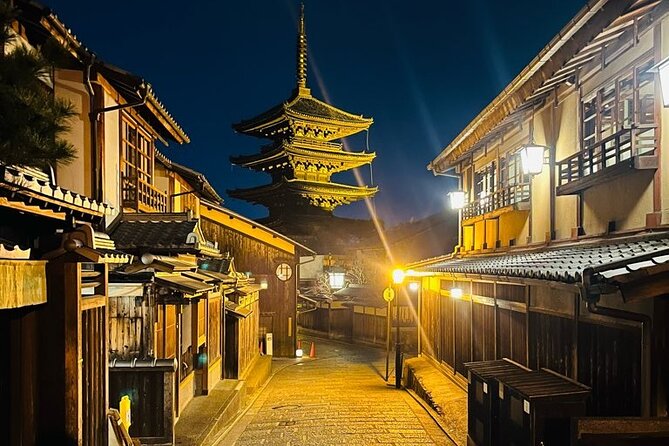
- Gion after dark: Lantern-lit streets and quieter lanes give the district a calmer mood than daytime sightseeing.
- A useful geisha introduction: Guides explain the difference between maiko and geiko, their place in Kyoto society, and proper etiquette around them.
- More than the famous lanes: The route includes Yasui-Konpiragu, Ninenzaka, Sannenzaka, Yasaka Pagoda views, and Yasaka Shrine.
- Small-group format: The advertised group limit keeps the walk easier to follow and less intrusive in residential streets.
- Strong guide feedback: Karen, Ricky, Hina, May, Pam, and Sho are among the guides praised for friendly storytelling and local insight.
- Bring comfortable shoes: Slopes, stairs, and a fair amount of walking are part of the experience.
Why Gion works so well at night
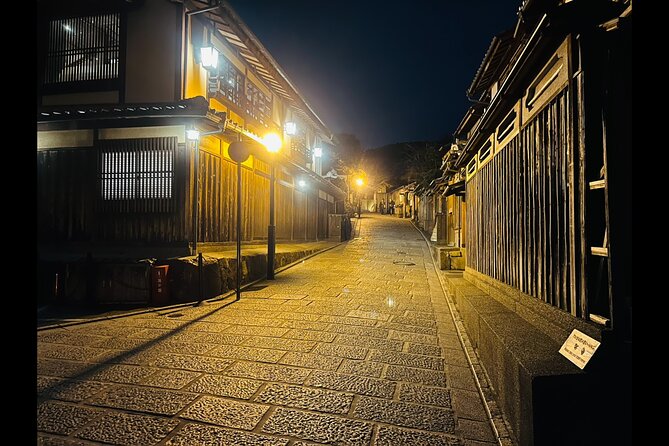
Gion is famous for its teahouses, traditional wooden buildings, and geisha heritage. By day, the area can feel crowded enough to distract from its details. At night, the mood changes. Streetlights and shrine lanterns pick out doorways, tiled roofs, pagodas, and narrow lanes, while the main streets often feel less pressured.
That quieter setting is the chief reason to choose this tour instead of simply wandering Gion on your own. You can see the same district, but a guide helps explain what you are looking at and how to behave around a working neighborhood.
You may be lucky enough to see a maiko or geiko. The sensible approach is simple: smile, greet her with Konnichiwa, and do not block her path or treat her like a stage performer. The tour’s emphasis on etiquette matters because Gion is not a theme park. It is a real neighborhood where traditional entertainers are going to work.
The nighttime schedule also suits anyone who has spent the day at Kyoto’s major temples. A walk of about one hour and 40 minutes gives you a cultural outing without taking up an entire day. Several people found the length just right after a long day, though one person expected only an hour and felt the walking added up.
More Walking Tours in Kyoto
- Kyoto Geisha Walking Tour: Gion District & Hidden Gems
★ 4.7 · 3,273 reviews - Kyoto: Gion Magical Night Walking Tour with Geisha Trivia
★ 4.9 · 2,393 reviews - Kyoto: Gion Geisha District Walking Tour – Stories of Geisha
★ 4.7 · 2,187 reviews
Meeting at Minamiza Theater and entering Gion
The meeting point is outside or near the Minamiza Theater at the eastern end of Shijo Bridge, in Kyoto’s Higashiyama Ward. The listed address places the start at the theater’s second-floor west lobby area, so give yourself enough time to identify the correct spot rather than arriving at the last minute.
This is a practical starting point. Minamiza is a well-known landmark, and from here you are close to the streets that lead into Gion. The tour ends at 625 Gionmachi Kitagawa, so it is not a circular walk back to the theater. Plan your evening with that in mind.
One poor experience came from a missed meeting point and failed communication with the operator. The operator said the tour ran as scheduled and that the notification for a message had not arrived. I would treat this as a reason to save the meeting details offline, arrive early, and contact the provider well before the start time if you need clarification.
Gionmachi Minamigawa and the world of maiko and geiko
The first listed stop is Gionmachi Minamigawa, one of Kyoto’s most famous streets. You get about 10 minutes here, enough to take in the traditional facades and learn why this part of Gion is linked so closely with geisha culture.
A good guide can make this stop much more useful than a quick photo stop. Guides such as Karen and Ricky have been praised for explaining the lives of maiko and geiko, including how their work fits into Kyoto society in the past and today. One guide shared family connections to geisha culture and photographs from her great-great-grandmother, which shows the kind of personal detail that can make the subject feel less abstract.
You should keep expectations realistic. Seeing a maiko or geiko is possible, not promised. If one appears, the best part of the experience is observing respectfully for a moment, not chasing her down the street.
This stop is also where the small group helps. Eight people can listen without forming a large wall across a narrow lane. The listing elsewhere gives a maximum of 10, so the exact cap may vary, but it remains a compact format compared with large city walking tours.
Yasui-Konpiragu and Kyoto’s relationship shrines
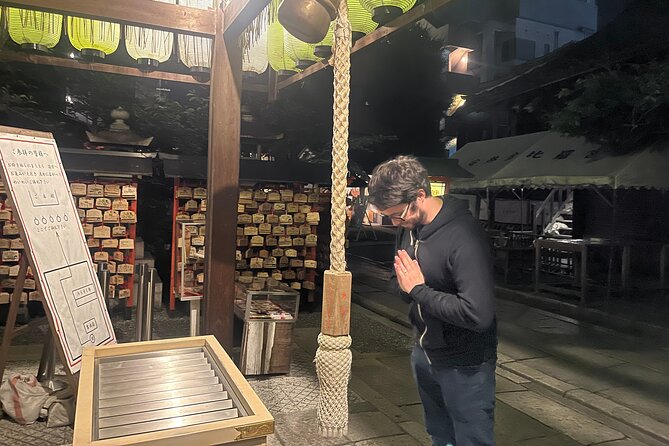
The walk continues to Yasui-Konpiragu, a shrine associated with relationships. Its unusual appeal is that it is said to help people meet a good partner or cut off harmful relationships. For couples, the shrine is also connected with strengthening an existing bond.
You spend about 10 minutes here. That is enough time for an explanation of the shrine’s purpose and a look at the site, but not enough for a long private visit. I like this inclusion because it gives you a glimpse of everyday religious practice rather than only the grandest monuments.
This is also a useful reminder that Kyoto’s shrines are not simply old buildings for photographs. People visit them with personal hopes, worries, and rituals. A guide can explain that local meaning in a way a signboard may not.
The stop is free, as are the other listed locations. That keeps the $29.60 price focused on the guide and the route rather than admission charges.
Same city, a completely different kind of day:
- PERFECT KYOTO 1-Day Bus Tour
★ 5.0 · 13,518 reviews - Kyoto: Fushimi Inari, Kinkakuji, Bamboo Grove 1 Day Bus Tour
★ 4.8 · 4,316 reviews - Kyoto: Tea Ceremony in a Traditional Tea House in Kiyomizu
★ 4.9 · 3,519 reviews - Kyoto: Tea Ceremony Ju-An at Jotokuji Temple
★ 4.9 · 3,207 reviews
Sannenzaka, Ninenzaka, and the view toward Yasaka Pagoda
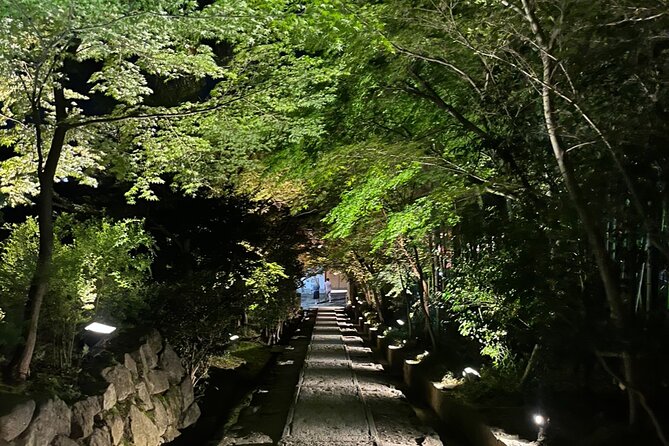
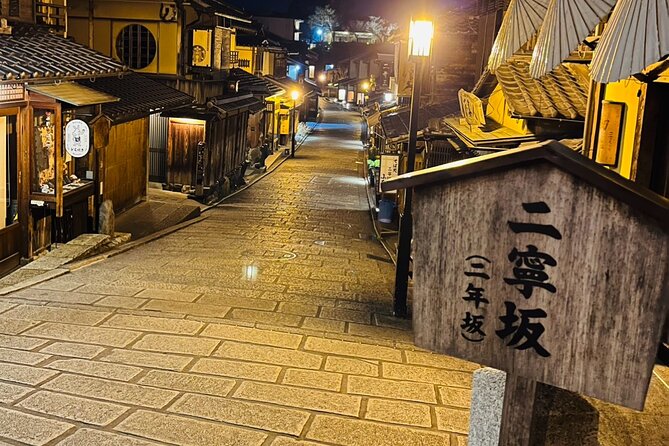
The Sannenzaka and Ninenzaka lanes lead toward Kiyomizu-dera and preserve one of Kyoto’s best-known traditional townscapes. The walk here lasts about 20 minutes, making it the longest clearly timed stop.
You will see sloping lanes, old-style buildings, and the well-known Yasaka Pagoda, also called Hokanji Pagoda. At night, this stretch can be especially good for photographs because the streetlights bring out the shape of the buildings while reducing the harsh glare of daytime crowds.
There is a tradeoff. These lanes are attractive precisely because they slope, and the route includes stairs. Smooth, comfortable shoes are a must. Anyone uncomfortable with hills should think carefully before booking, since this is not a flat stroll along a riverside path.
A guide adds value here by pointing out details you might otherwise pass without noticing. The route is designed to connect famous sights with less obvious corners, so you get orientation as well as pictures. If you have already walked this area alone, the explanations can give the streets and buildings more meaning. If it is your first visit, the tour helps you cover several key areas without constantly checking a map.
The Kannon statue and the temple garden stops
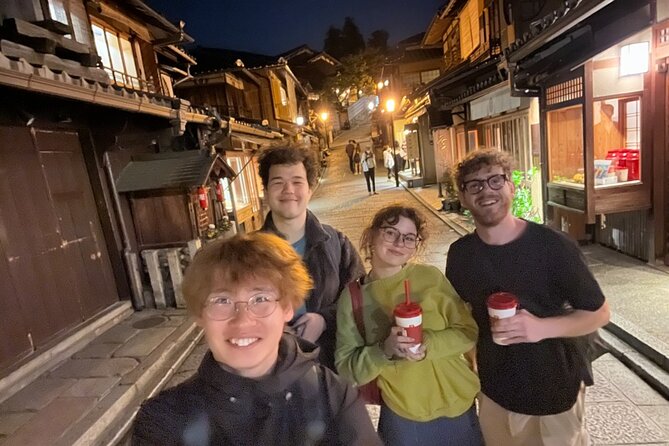
The schedule also refers to two additional locations between the Sannenzaka and Yasaka Shrine portions of the route, though the supplied details do not name them clearly. One was built in 1955 to honor the souls of World War II victims and includes a very large Kannon statue.
The other was built roughly 400 years ago by a shogun’s wife to mourn her husband. Its attractions include a garden, a 400-year-old tea ceremony house, and a bamboo grove. These descriptions suggest that the walk includes more than a quick pass through Gion’s main entertainment streets.
Because the exact names, admission arrangements, and time spent at these two places are not specified, you should not book expecting a full temple visit or a long garden tour. Think of them as cultural and visual additions to the walking route. Ask your guide for the names and current access details at the start if these sites are especially important to you.
Yasaka Shrine and the final stretch
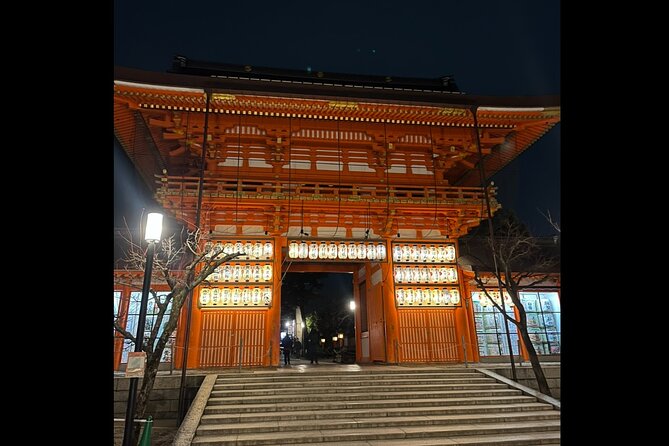
The listed route finishes at Yasaka Shrine, one of Kyoto’s major Shinto sites. It is the head shrine of about 2,300 related shrines across Japan and is widely known as Gion-san.
Yasaka Shrine is associated with protection from bad luck, good fortune, and beauty. At night, its lanterns and open grounds can feel more serene than they do during the day. The shrine gives the walk a strong finish because it connects the entertainment district with a major center of local worship.
The final stop is listed as about 10 minutes. That is enough for a concise explanation, a few photographs, and a chance to absorb the setting, but you should not expect an extended ceremony or guided religious service.
The end point is in Gionmachi Kitagawa, not at the starting theater. That makes it easy to continue exploring the district or find a meal nearby, but you will need to arrange your own way onward. The experience includes a mobile ticket, and confirmation is provided at booking.
The guides make the difference
The strongest part of this experience is the guide. Names attached to particularly positive experiences include Karen, Ricky, Hina, May, Pam, and Sho. The best descriptions focus on clear explanations, a friendly manner, patience with questions, and stories that bring the district to life.
Karen is praised for answering questions, handling family groups well, and explaining Gion and geisha culture with humor. Ricky is described as strong on Kyoto’s past and present, especially the relationship between maiko, geiko, and local society. Hina is noted for personal family insight, while May and Pam are praised for warmth and enthusiasm.
Sho receives strong praise as well, with one note that English explanations could sometimes be difficult to follow while he was still learning. That is a fair reminder that guide quality can vary by individual and language comfort. The overall score is 4.8 from 136 ratings, with 96 percent recommending the experience, but no tour has perfect communication every time.
I would choose this walk for the chance to ask questions in a small group. A large group can deliver facts, but it rarely allows much conversation. Here, you have a better chance to ask about geisha etiquette, shrine customs, family traditions, or the meaning of a particular building.
Price, pace, and who gets the most value
At $29.60 per person, this is a reasonable price for a guided Kyoto walk lasting around 100 minutes. You are not paying for temple admissions, transportation, or a meal. You are paying for local explanation, route planning, and the chance to see several important areas without wasting time finding them yourself.
I think the value is best for a first visit to Kyoto, especially if you want cultural context but do not want to commit to a full-day tour. It also works well after visiting temples during daylight, since the night setting changes the feel of familiar streets.
You may find less value if you have already spent several evenings walking Gion and have researched its shrines and geisha traditions in detail. The tour moves at a group pace, and the stops are short. Independent walkers who prefer long temple visits or extended photography sessions may want more freedom.
The route suits most people who are comfortable walking, but slopes and stairs are specifically noted. Service animals are allowed, public transportation is nearby, and most people can participate. Poor weather can lead to a date change or full refund, and the tour may also be canceled if the minimum number of participants is not met.
Free cancellation is available up to 24 hours before the start time. Within 24 hours, changes and refunds are not accepted, so keep the local cut-off time in mind.
Small-group manners and photography advice
Gion rewards quiet observation. Keep your group together, avoid blocking doorways, and give anyone heading to work plenty of space. If your guide points out a maiko or geiko, follow the advice to greet politely and resist the urge to crowd around.
The tour is particularly useful for nighttime photography, with illuminated streets, shrines, pagodas, and temple grounds along the way. You will have time for pictures at many stops, but this is still a walking tour, not a dedicated photography workshop. Bring a phone or camera that handles low light well, and listen for the guide’s instructions before stopping in a narrow lane.
Rain does not automatically ruin the mood. One outing took place in gentle rain with umbrellas, and the wet streets helped keep the area quieter. Still, the experience requires good weather, so cancellations are possible when conditions are poor.
Should you book the Gion Magical Night Walking Tour?
Book it if you want a compact introduction to Gion, prefer a guide to wandering alone, and value a small group over a set of entrance tickets. The best reasons are the nighttime atmosphere, the range of shrines and traditional streets, and the chance to ask direct questions about maiko, geiko, and Kyoto etiquette.
Think twice if hills and stairs are a problem, if you need a fully flat route, or if your main goal is an unhurried temple visit. Also confirm the meeting instructions and group-size limit before setting out, since the details list both eight and 10 as the maximum.
For most first-time visitors, $29.60 is a fair price for a focused evening walk that helps Gion make sense. Wear good shoes, arrive early at Minamiza Theater, and treat the neighborhood as a living part of Kyoto rather than a backdrop for photographs.
FAQ
How long does the Gion Magical Night Walking Tour last?
The experience lasts approximately one hour and 40 minutes. One description refers to it as roughly 90 minutes, so allow about 100 minutes in your evening plans.
What is the price of the tour?
The listed price is $29.60 per person.
Where does the tour start?
It starts at Minamiza Theater in Kyoto’s Higashiyama Ward, near the eastern end of Shijo Bridge. The supplied address places the meeting point at the theater’s second-floor west lobby area.
Where does the tour end?
The tour ends at 625 Gionmachi Kitagawa in Kyoto’s Higashiyama Ward.
How large is the group?
The highlights describe a maximum of eight people. The additional information gives a maximum of 10 travelers, so confirm the exact limit for your chosen date.
What sights are included?
The route includes Gionmachi Minamigawa, Yasui-Konpiragu, the Sannenzaka and Ninenzaka area, Yasaka Shrine, and additional stops featuring a large Kannon statue and a historic temple garden, tea house, and bamboo grove.
Will I definitely see a maiko or geiko?
No. You may see a maiko or geiko if you are lucky, but sightings are not guaranteed.
Is the tour suitable for people who do not like hills or stairs?
The tour is not recommended for anyone who is uncomfortable with walking, slopes, or stairs. Comfortable shoes are advised.
Can I cancel for a full refund?
Yes. You can cancel at least 24 hours before the start time for a full refund. Cancellations or changes made within 24 hours are not accepted for a refund. If poor weather or an insufficient number of participants causes the operator to cancel, you will be offered another date or experience, or a full refund.
More Evening Experiences in Kyoto
- Night Walk in Gion: Kyoto’s Geisha District
★ 4.5 · 2,003 reviews - Kyoto Night Foodie Tour in Gion (9+ dishes + 6 Sake tastings)
★ 5.0 · 1,762 reviews - Kyoto Gion Night Walk & Geisha District Guided Tour
★ 5.0 · 786 reviews - Kyoto Ghost Tour: Dark Tales, Urban Legends, Bamboo Forest Night
★ 5.0 · 625 reviews
Just added around Kyoto
- Private Guided Traditional Buddhist Cooking in Japan★ 5.0 · 16 reviews
- Kyoto: Gion Geisha District & Sake-in-Hand Walking Tour★ 5.0 · 37 reviews
- Your Private Vacation Photography Session In Kyoto★ 5.0 · 110 reviews
- Kyoto: Zen Meditation at a Private Temple with a Monk★ 5.0 · 25 reviews
- Private Pewter Sake Cup Experience with a Kyoto Artisan★ 5.0 · 31 reviews
- Traditional Japanese Washi Papermaking- Kyoto morning★ 5.0 · 77 reviews
- Kyoto Wagashi(Japanese sweets) Cooking Class near Fushimiinari★ 5.0 · 60 reviews
- Kyoto Private 6 hour Tour: English Speaking Driver Only, No Guide★ 5.0 · 88 reviews
Walking Tours, compared.

Kyoto Geisha Walking Tour: Gion District & Hidden Gems
Read our review →
Tokyo Tsukiji Fish Market Food and Culture Walking Tour
Read our review →
Gion Magical Night Walking Tour with Geisha Trivia
Read our review →
Imperial Palace and Shogun Historical Walking Tour
Read our review →
Gion Geisha District Walking Tour – Stories of Geisha
Read our review →
Asakusa Walking Tour with Sensoji Temple Visit
Read our review →
Kyoto Gion Geisha District Walking Tour – The Stories of Geisha
Read our review →Browse the lists this tour appears in