
REVIEW · KIMONO & CULTURE EXPERIENCES
Samurai Performance and Casual Experience: Kyoto Ticket
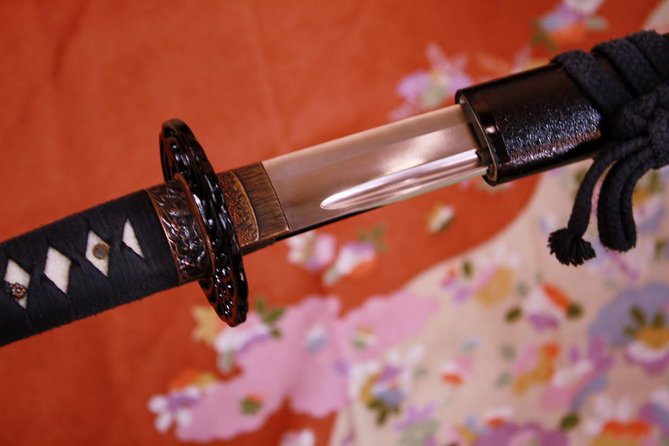
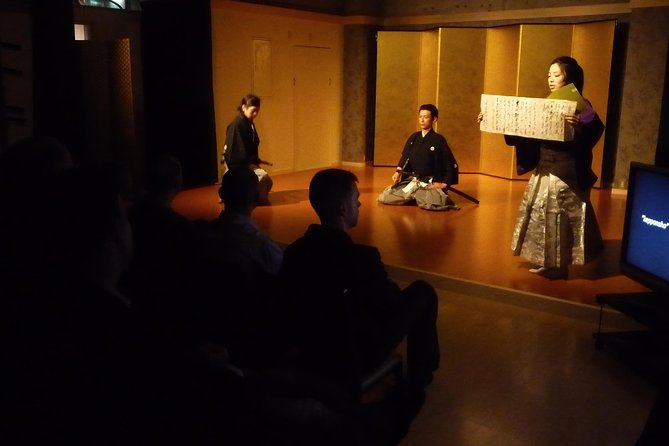
Kembu is not a sword-fighting stunt show. It is a theatrical art built from controlled sword movement, samurai poems, and ritual gestures, presented in an intimate Kyoto theater. The evening includes an English introduction, short history lessons, traditional and new-style performances, then a chance to hold a sword and fan for photos.
I like the clear cultural context and the friendly humor, which make the show easy to follow even if you know little about samurai customs. I also like the tidy one-hour length and the hands-on finale, a useful break from Kyoto’s temples and shrines.
The main consideration is expectation. About 40 minutes is stage performance, and some of that time is narration, so this is not a serious battle reenactment or a full sword-fighting class. English is provided, though some visitors may find the pronunciation difficult to follow.
In This Review
- Key points to know before booking
- What Kembu actually is
- Inside the Samurai Kembu Theater
- The opening talk makes the show easier to follow
- Sword demonstrations with poetry and precision
- The final 20 minutes put you in the picture
- What the $33.03 price gets you
- Who will enjoy this Kyoto performance most
- Timing, access, and small practical details
- How this compares with a full samurai lesson
- Should you book Samurai Performance and Casual Experience?
- FAQ
- How long does the Samurai Performance and Casual Experience last?
- What time does the experience start?
- Where does the performance take place?
- Do I need to remove my shoes?
- Are regular chairs available?
- Is the activity suitable for children?
- What happens after the performance?
Key points to know before booking
- Traditional Kembu with a theatrical touch: Watch sword movements, fan work, and recited samurai poems rather than staged combat.
- A useful English introduction: Learn why Kembu was linked with courage, concentration, and preparation for battle.
- Hands-on finale: Hold a sword and fan, try a few movements, and take photos with the performers.
- Easy evening timing: The listed start time is 4:15 pm, with another showtime available when booking.
- Shoes come off at the door: Seating includes low-to-the-ground chairs and regular chairs.
- Good value for a short cultural stop: At $33.03 per person, the price covers a performance, interpretation, and a brief activity in central Kyoto.
What Kembu actually is
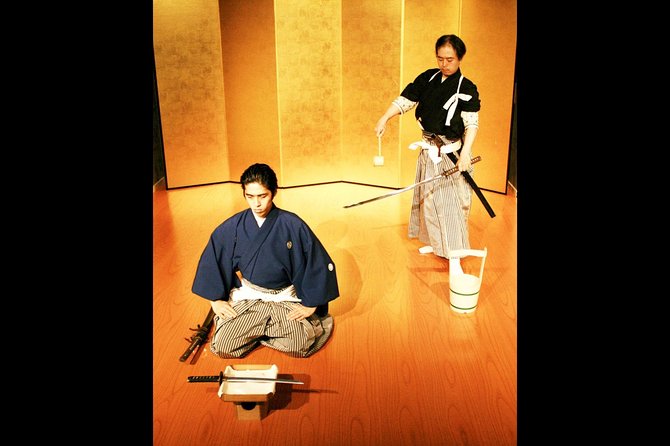
Kembu, also written as Kenbu in some tour details, is a traditional Japanese sword performance linked with the samurai class. It combines sword handling, fan movements, formal gestures, and the recitation of short poems associated with warriors preparing for battle.
That distinction matters. You are not watching two actors hack at each other with metal blades. The power comes from timing, posture, pauses, and the way a performer turns a sword movement into a visual expression of courage, grief, resolve, or ceremony.
The art is described as a way for samurai to build courage and focus the mind before the hardships of battle. The show uses that idea as a doorway into samurai culture. Before each section, a performer or narrator explains what you are about to see and how it relates to Japanese history or warrior practice.
I find this format more useful than a performance that simply throws costumes and swords at you. You get enough explanation to understand why the performers move as they do, then you can watch the physical skill with better eyes.
More Kimono & Culture Experiences in Kyoto
- Kyoto Geisha Walking Tour: Gion District & Hidden Gems
★ 4.7 · 3,273 reviews - Kyoto: Gion Magical Night Walking Tour with Geisha Trivia
★ 4.9 · 2,393 reviews - Kyoto: Gion Geisha District Walking Tour – Stories of Geisha
★ 4.7 · 2,187 reviews
Inside the Samurai Kembu Theater
The theater is in downtown Kyoto, near public transportation and within reach of the Gion area. The entrance instruction is specific: go down the stairs on the right side toward the GOZAN building and continue to the reception desk.
Allow extra time to find the entrance. You should arrive 15 to 5 minutes before the start, with 15 minutes being the safer choice if you do not know the building. The listed start time is 4:15 pm, and another showtime lets you fit the performance around a day of sightseeing.
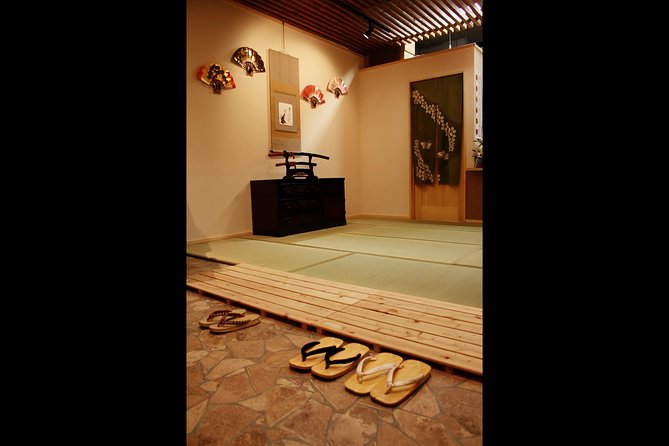
At reception, you remove your shoes in the Japanese style before taking your seat. Seating includes low chairs close to the floor as well as normal chairs, so you do not necessarily have to sit directly on the floor. The room is described as small and intimate, which helps the gestures and sword work feel close rather than distant.
That small setting also shapes the experience. This is not a grand theater production with a huge cast and elaborate scenery. The focus stays on the performers, their costumes, their weapons, and the words that explain each scene.
The opening talk makes the show easier to follow
The performance begins with narration about the origins and methods of Kembu. The introduction covers the samurai class, which ruled Japan from roughly the 12th through the 19th century, and explains the connection between the art and mental preparation.
The show is presented in English, including explanations before the different demonstrations. One English-speaking presenter has been praised for making the opening clear and engaging. Still, the quality of spoken English can vary, and some people may find the pronunciation or delivery hard to understand.
My practical advice is to sit where you can clearly watch the stage and listen without distraction. If you miss a sentence, do not worry too much. The demonstrations are visual, and the main ideas are repeated in short sections before each routine.
The introduction also helps prevent a common misunderstanding. Samurai culture is not reduced to sword blows. The program touches on discipline, poetry, ceremony, the folding fan, and the meaning of seppuku, also known as hara-kiri. That subject is serious, but it is presented as part of the cultural explanation rather than as a sensational shock.
Sword demonstrations with poetry and precision
The central part of the experience is a series of short Kembu demonstrations. Performers wield their swords through precise, stylized movements while reciting brief poems linked to samurai going into battle.
The appeal is visual. A raised sword, a sudden turn, a pause, and a precise cut can communicate more than a long fight scene. The performers use their whole bodies, not just their arms, and the costumes add shape and ceremony to each movement.
You also see traditional and newer forms of Kembu. This gives the program some range, though it remains a compact introduction rather than a complete study of the art. The performance includes both sword and hand movements, and the folding fan appears as another tool for expressing character and emotion.
The show has a light theatrical style. There are funny exchanges and moments designed to keep the mood relaxed. That works well for families and for people who want a cultural evening without a solemn lecture. If you expect a dark, serious account of samurai warfare, the humor may feel like a surprise.
A few people may also wish for more action or a deeper look at fighting methods. That is a fair criticism. The program spends meaningful time talking, and the demonstrations are short. Its strength is explanation and presentation, not combat instruction.
Same city, a completely different kind of day:
- PERFECT KYOTO 1-Day Bus Tour
★ 5.0 · 13,518 reviews - Kyoto: Fushimi Inari, Kinkakuji, Bamboo Grove 1 Day Bus Tour
★ 4.8 · 4,316 reviews - Kyoto: Tea Ceremony in a Traditional Tea House in Kiyomizu
★ 4.9 · 3,519 reviews - Kyoto: Tea Ceremony Ju-An at Jotokuji Temple
★ 4.9 · 3,207 reviews
The final 20 minutes put you in the picture
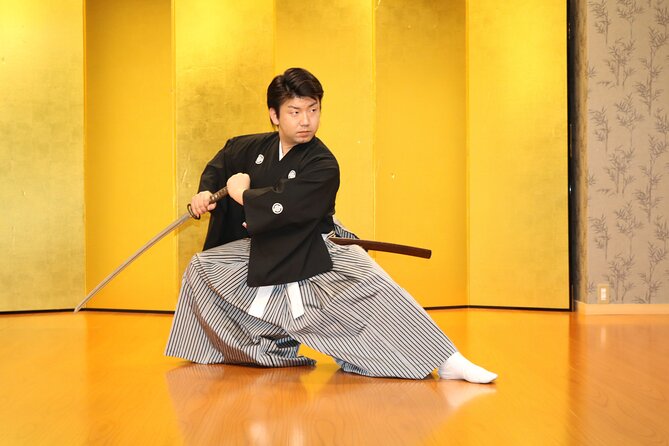
The advertised hour is divided into roughly 40 minutes of performance and a mini experience afterward. During the finale, you can practice simple sword and fan movements, then pose with the performers.
This is not a full samurai lesson. You are getting a short introduction to the gestures, followed by a photo opportunity. Still, it changes the mood of the evening. Instead of only watching from your chair, you get to hold a sword and fan and make a few movements yourself.
The photo session is especially useful for families and groups of friends. The performers help arrange the pose, and the result gives you a personal souvenir rather than just another stage photograph. Some people have wished they had known in advance that they could dress up for the practice, so it is worth asking staff about any available costume option when you arrive. The provided information does not promise costumes, so do not book on that expectation.
Some bookings have also included a small samurai-themed gift, such as socks, but this is not listed as a standard inclusion. Treat it as a possible extra, not part of the price calculation.
What the $33.03 price gets you
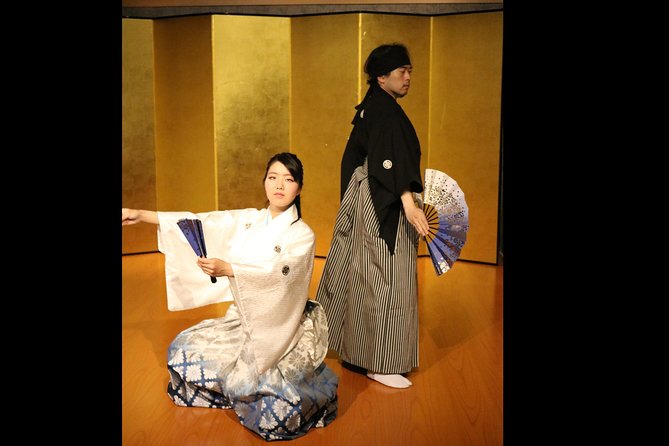
At $33.03 per person, this is priced like a short evening attraction rather than a major theater production. You receive admission, the Kembu performance, the spoken cultural introduction, and the post-show mini activity with sword and fan photos.
I think the value is strongest if you want a compact cultural experience that fills an hour between sightseeing and dinner. The theater setting, live performers, English explanation, and photo session give the price more substance than a simple staged demonstration.
The value is weaker if you want technical martial-arts training or a long performance. The show contains narration and short routines, and the hands-on part is brief. You are paying for an introduction to an art form and its cultural setting, not for a workshop that will teach you to fight with a sword.
The 91 percent recommendation rate and 4.6 rating from 115 ratings point to a generally strong experience, but the mixed expectations are worth keeping in mind. The most consistent strengths are the performers’ energy, the helpful explanations, the small theater, and the fun photo session. The most common reservations concern the amount of talking, the limited action, and the difficulty of understanding some English delivery.
Who will enjoy this Kyoto performance most
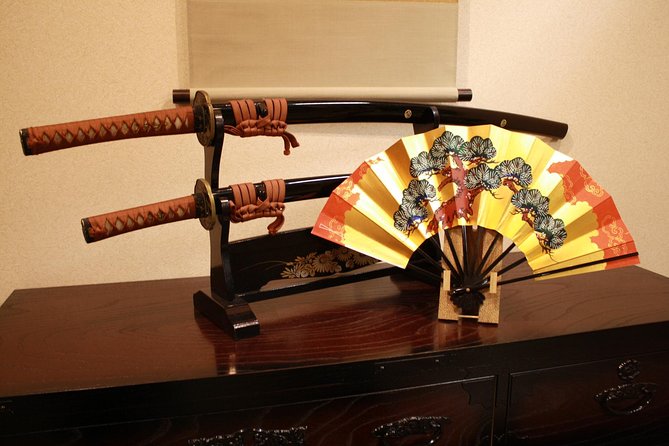
This suits families particularly well. Children can follow the costumes, swords, dramatic poses, and photo session, while the short running time prevents the program from becoming tiring. The light comedy also helps younger viewers stay engaged.
It is a good pick for adults who want something beyond temples and gardens. You get a different view of Kyoto, centered on a traditional performance art rather than architecture or food.
First-time visitors to Japan may find it especially useful because the narrator explains basic samurai customs instead of assuming prior knowledge. You do not need to know Japanese history before arriving.
Fans of Japanese history, theater, martial arts, and traditional arts will have the most to gain. The program offers a glimpse of Bushido through performance, poetry, and ritual. If you already have expert knowledge of samurai culture, the material may feel introductory.
I would be cautious about booking if your main goal is realistic combat. The sword movements are carefully performed, but this is art and theater. It is not a battle show, and the short interactive section will not replace a proper training session.
Timing, access, and small practical details
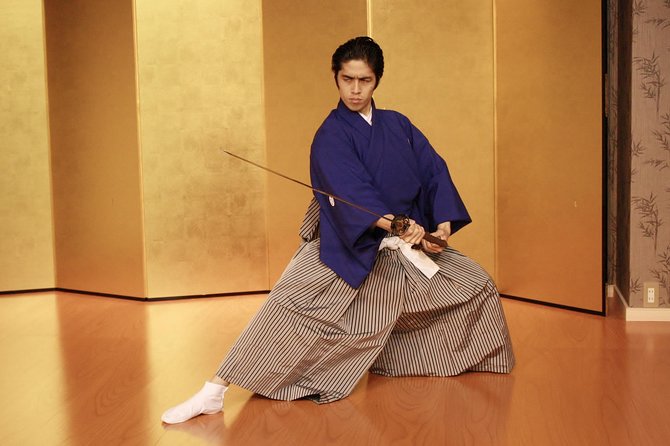
The experience lasts about one hour, making it easy to pair with a late afternoon in central Kyoto. You might visit nearby sights earlier, then attend the 4:15 pm show before dinner and an evening walk around Gion.
The venue is near public transportation, but the entrance requires stairs down to the reception desk. You also remove your shoes, so wear socks you are comfortable showing. The theater offers both low and regular chairs, which gives you some choice in seating.
Hotel pickup, hotel drop-off, food, and drinks are not included. Plan your route and meal separately. Confirmation is provided when you book, and the ticket is mobile, so you can keep it on your phone rather than carry a printed voucher.
The activity is listed as suitable for most people. No special skill is required for the performance or mini experience, and the staff guide you through the photo session. If stairs or low seating are a concern, contact the provider before booking, since the available details do not give a fuller accessibility breakdown.
Free cancellation is available up to 24 hours before the start time for a full refund. Changes or cancellations made inside that 24-hour window are not accepted for a refund, and cancellation must be completed by you through Viator.
How this compares with a full samurai lesson
The performance and the lesson are related but not the same product. Here, the stage show comes first, followed by a short practice and photo session. The emphasis is on watching, listening, and getting a taste of the movements.
A full lesson would naturally put more weight on instruction and participation. If you want to spend most of your time learning techniques, look for that separate format rather than assuming this ticket is a complete class.
One useful detail is that a person who had already taken an afternoon lesson was able to switch to the afternoon performance instead. That suggests it may be worth asking the theater directly about schedule changes, but you should not count on a switch unless the provider confirms it.
Should you book Samurai Performance and Casual Experience?
Book it if you want a short, friendly introduction to samurai culture with live sword work, clear historical framing, and a playful photo session. It is a smart choice for families, first-time visitors, and anyone looking for an indoor evening activity near central Kyoto.
Skip it if you are seeking hard-edged combat choreography, detailed martial-arts training, or a long stage production. The talking is part of the value, but it also takes up a large share of the hour.
For most people, the deciding question is simple: do you want to understand a traditional performance art, then try a few movements yourself? If yes, the $33.03 ticket is a reasonable Kyoto add-on. If you want a fight show, choose something else.
FAQ
How long does the Samurai Performance and Casual Experience last?
The experience lasts approximately one hour. About 40 minutes is the Kembu performance, followed by the mini sword-and-fan activity and photo session.
What time does the experience start?
The listed start time is 4:15 pm. Another showtime is available when booking, subject to the option shown for your chosen date.
Where does the performance take place?
It takes place at the Samurai Kembu Theater in downtown Kyoto. Go down the stairs on the right side toward the GOZAN building to reach the reception desk.
Do I need to remove my shoes?
Yes. You remove your shoes before entering the theater and taking your seat.
Are regular chairs available?
Yes. Seating includes both low-to-the-ground chairs and normal chairs.
Is the activity suitable for children?
Most people can participate, and the performance and short interactive section can suit families. The experience includes demonstrations, explanations, simple movements, and photos.
What happens after the performance?
After the show, you can take part in a mini experience with a sword and fan, then pose for photos with the performers. Food, drinks, and hotel transportation are not included.
Just added around Kyoto
- Private Guided Traditional Buddhist Cooking in Japan★ 5.0 · 16 reviews
- Kyoto: Gion Geisha District & Sake-in-Hand Walking Tour★ 5.0 · 37 reviews
- Your Private Vacation Photography Session In Kyoto★ 5.0 · 110 reviews
- Kyoto: Zen Meditation at a Private Temple with a Monk★ 5.0 · 25 reviews
- Traditional Japanese Washi Papermaking- Kyoto morning★ 5.0 · 77 reviews
- Kyoto Wagashi(Japanese sweets) Cooking Class near Fushimiinari★ 5.0 · 60 reviews
- Private Pewter Sake Cup Experience with a Kyoto Artisan★ 5.0 · 31 reviews
- Kyoto Private 6 hour Tour: English Speaking Driver Only, No Guide★ 5.0 · 88 reviews
Kimono & Culture Experiences, compared.

Kyoto Geisha Walking Tour: Gion District & Hidden Gems
Read our review →
Gion Magical Night Walking Tour with Geisha Trivia
Read our review →
Gion Geisha District Walking Tour – Stories of Geisha
Read our review →
Best of Kyoto: Gion, Geisha, Pagodas & Cobblestones
Read our review →
Kyoto Gion Geisha District Walking Tour – The Stories of Geisha
Read our review →
Browse the lists this tour appears in