
REVIEW · TEA CEREMONY EXPERIENCES
Kyoto: Tea Ceremony with Maiko Premium
Kyoto’s maiko culture can feel distant if you only see a glimpse of it on a Gion street. This 90-minute Premium program brings a maiko close enough for conversation, questions, photographs, and two traditional dances. You also prepare your own matcha and take part in a lively game.
I like the direct contact most: the Q&A gives you a window into training, daily routines, kimono, hairstyles, and the path from maiko to geiko. I also like the balance of quiet and playful moments, from tea and sweets to dance and a game that gets the room clapping. The main drawback is the setting. This takes place in a modern building with tables, stools, and branded advertising, not an ochaya or tatami-lined tea house.
In This Review
- Quick points before you book
- Meeting a maiko near Gojo Station
- What the Premium ticket adds
- Making matcha with the maiko
- The Q&A reveals the daily life behind the makeup
- Two dances show why the Premium option matters
- A playful game breaks the formal mood
- The photo setting is practical, not historic
- Timing, language, and practical details
- Who will get the most from this Kyoto experience
- Should you book it?
- FAQ
- Where is the tea ceremony held?
- How long does the experience last?
- How much does the experience cost?
- Is the venue a traditional tea house?
- Will I meet a maiko?
- Can I take a photo with the maiko?
- Is matcha included?
- Is the program available in English?
- Can children attend?
- Can I cancel for a refund?
Quick points before you book
- Two dances are included: The Premium option adds traditional dance performances that express seasonal scenes, love stories, and daily life.
- You make your own matcha: A maiko demonstrates the process, then guides you as you prepare your tea.
- The Q&A is the heart of the visit: You can ask about maiko training, customs, work, and everyday life.
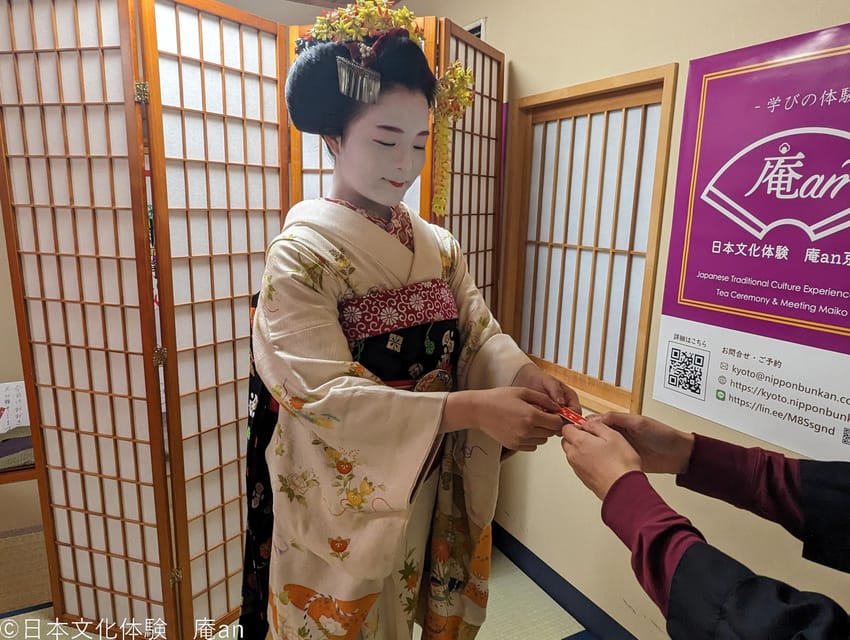
- Photos are part of the program: You receive a commemorative photo opportunity beside the maiko and a Senjafuda lucky charm.
- The mood is friendly rather than formal: Traditional elements are present, but this is a group activity in a modern room.
- Geiko may appear instead: The performer can be a geiko, depending on the day.
Meeting a maiko near Gojo Station
The venue is one minute from Exit 1 of Gojo Station on Kyoto’s Subway Karasuma Line. The entrance faces Gojo-dori, so you do not need to wander through a side street or search deep inside a traditional district.
That easy access matters. You can fit this activity between central Kyoto sights without spending much time on transport. Still, arrive early. The organizers do not hold the program for late arrivals, and one participant found that arriving about 15 minutes ahead offered a chance to see the maiko arrive by taxi.
The building has no elevator. You will need to use stairs to reach the venue, so this is important for anyone with mobility concerns or a stroller. Participants who have not booked the experience cannot enter, and the organizers cannot cover your transport costs if you miss the start.
The room itself sets the tone. You sit at tables and stools in a building rather than on tatami in a traditional Japanese house. Some seats have extra charges: first-row SS seats cost 3,300 yen, second-row S2 seats cost 2,200 yen, and third-row S3 seats cost 1,100 yen. The standard price is about $50 per person, before any seat upgrade.
More Tea Ceremony Experiences in Kyoto
- Kyoto: Tea Ceremony in a Traditional Tea House in Kiyomizu
★ 4.9 · 3,519 reviews - Kyoto: Tea Ceremony Ju-An at Jotokuji Temple
★ 4.9 · 3,207 reviews - Kyoto: 45-Minute Tea Ceremony Lesson Experience
★ 4.3 · 2,378 reviews
What the Premium ticket adds
The Premium version makes sense if you want the full program rather than a brief introduction to tea. It combines the tea lesson with the maiko’s Q&A, two dances, a photo opportunity, a Senjafuda gift, and an interactive game.
The price is fair for the amount packed into 90 minutes. A private meeting with a maiko would be a very different and far more costly proposition, while this program lets you see several parts of the tradition in one sitting. You also receive matcha, two dried Japanese sweets, snacks, and a drink.
You should set your expectations correctly. This is not a formal tea ceremony with a long sequence of precise rituals in a historic house. It is an accessible cultural presentation designed for an international audience. For many people, that is the point. You get more conversation and personal contact than you would in a silent ceremonial setting.
Some sessions may finish closer to 70 or 75 minutes, even though the scheduled duration is 90 minutes. The formal program ends around the 75-minute mark, when the maiko leaves the room, followed by chat time before departure. If you have another booking afterward, allow the full 90 minutes.
Making matcha with the maiko
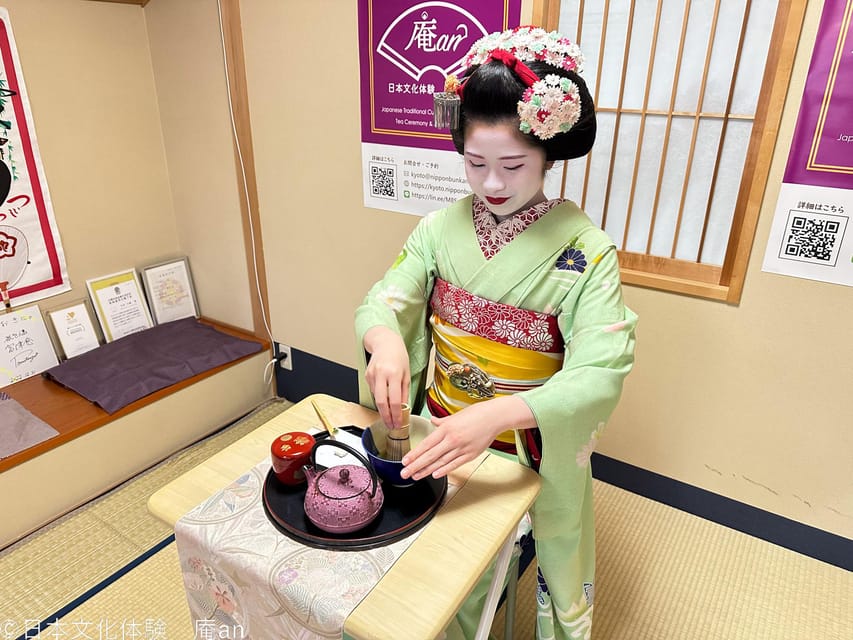
The tea portion begins with a greeting and an explanation from the maiko. She shows you how to prepare matcha, then you make your own bowl under her guidance.
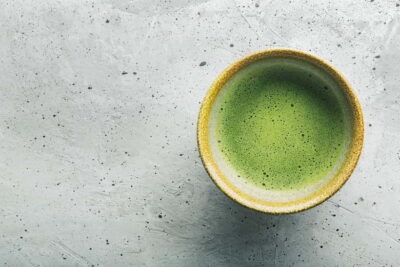
This is a simple activity, but it gives you something to do instead of simply watching a presentation. You handle the whisk, prepare the tea, and taste it with two Japanese sweets. The sweets help soften matcha’s bitter edge and give you a small taste of the customs that surround Japanese tea.
The lesson is basic. If you already know the mechanics of matcha preparation, you may find it familiar. If this is your first hands-on experience, it offers a clear and manageable introduction without requiring special preparation, clothing, or prior knowledge.
The tea also provides a useful way to see the maiko’s manner and training up close. Her movements, posture, and way of serving are part of the cultural lesson. The appeal is not only the drink itself, but the chance to observe a living performance tradition while taking part.
The host handles the explanation, and English translation is provided as much as possible if you request it. The official operating language is Japanese, so you should contact the organizer in advance if English support matters to you. Some sessions have had a host who spoke both Japanese and English, but that should not be assumed for every date.
The Q&A reveals the daily life behind the makeup
After the tea, the program turns conversational. This is where the experience becomes more personal than a standard stage show.
You can ask the maiko about her life, training, traditions, clothing, and daily routine. The discussion gives context to the polished appearance. The kimono, elaborate hairstyle, makeup, and graceful movements are not costumes thrown on for a quick photo. They reflect a demanding traditional career and a carefully maintained way of life.
One useful detail discussed during a session is that training can take about five years. That helps explain why the maiko’s presentation feels so practiced. You are not simply looking at an attractive outfit. You are seeing the public side of a long period of discipline and study.
The questions are not limited to experts. The format welcomes ordinary curiosity, and the maiko answers directly through the host or translation. Families can take part as well. Children have enjoyed asking questions and joining the games, although very young children may need to remain on a parent’s lap.
The group setting has both strengths and limits. You hear a range of questions, which can make the discussion lively and useful. On the other hand, this is not an intimate private conversation. Noise from other participants can affect the atmosphere, and the quality of the session depends partly on how considerate the room is.
Same city, a completely different kind of day:
- PERFECT KYOTO 1-Day Bus Tour
★ 5.0 · 13,518 reviews - Kyoto: Fushimi Inari, Kinkakuji, Bamboo Grove 1 Day Bus Tour
★ 4.8 · 4,316 reviews - Kyoto Geisha Walking Tour: Gion District & Hidden Gems
★ 4.7 · 3,273 reviews - Kyoto: Gion Magical Night Walking Tour with Geisha Trivia
★ 4.9 · 2,393 reviews
Two dances show why the Premium option matters
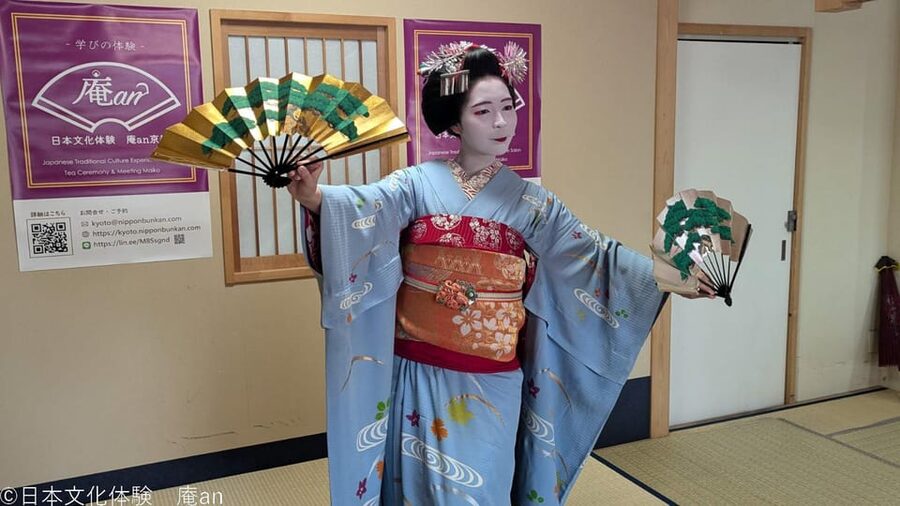
The maiko performs two traditional dances. The movements are controlled and economical, with meaning expressed through posture, hand gestures, turns, and the pace of the performance.
The dances can reflect the seasons, love stories, or scenes from daily life. You do not need to understand every detail to appreciate the precision. The quiet concentration of the performance provides a sharp contrast to the laughter and clapping during the game later.
This is the part I would not cut if you are deciding between ticket types. The basic tea lesson gives you participation, but the dances show the artistic side of the maiko tradition. Several people have found the performances moving enough to produce goosebumps, while others simply valued the chance to watch from close range.
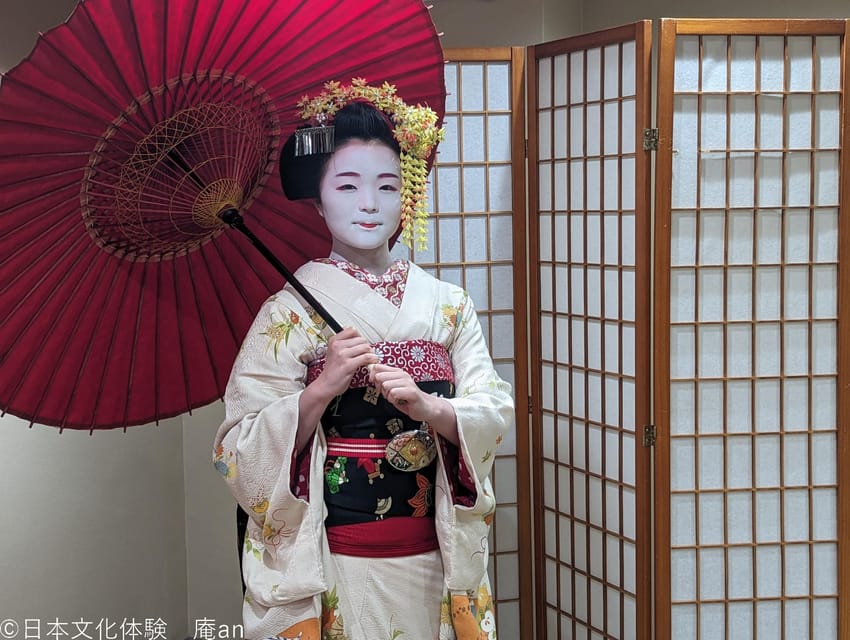
Photography is permitted during the presentation, and you can take a commemorative photo beside the maiko. You also receive a Senjafuda, a small paper charm associated with good fortune. Check your camera angle before the dance begins, since the backdrop is a practical concern. The wall may include large company advertisements, a name, or a QR code, which can appear in your photos.
If the appearance is a geiko rather than a maiko, the program still follows the same general pattern. The distinction matters if you booked specifically to meet a maiko, but the performance and conversation remain central parts of the experience.
A playful game breaks the formal mood
The interactive game is one of the cleverest parts of the program. Maiko often use simple games as part of their hospitality, and volunteers can join while everyone else claps and cheers.
You do not need Japanese language skills or specialist knowledge to enjoy this section. The rules are explained, participants compete, and the rest of the room becomes a small cheering section. It is a welcome change after the more composed tea and dance segments.
The game also shows a social side of maiko culture that a museum display cannot provide. Hospitality here is not only about serving tea politely. It includes reading the room, encouraging participation, and making people laugh.
Families tend to get good value from this portion. Children as young as four have enjoyed taking part, and adults do not need to sit quietly for the whole session. If you prefer observation, you can simply watch and support the players.
The photo setting is practical, not historic
The biggest compromise is the room. The activity is not held in an ochaya, a traditional teahouse, or an old Japanese residence. It is in a building with a relaxed atmosphere, friendly staff, tables, and stools.
That choice keeps the experience approachable and likely helps fit more people into a convenient location. It also means the visual setting does not match the elegance of the kimono and dances. A plain wall and vendor advertising can weaken the atmosphere and spoil an otherwise special photograph.
I would treat this as a meeting and performance program, not an architectural experience. If you want polished photos, ask where the cleanest background is before the photo session and sit as close to the front as your budget allows. The paid seat upgrades may be worthwhile if viewing and photography are priorities, though the standard seat still provides access to the full program.
Noise is another variable. The experience can be enjoyable with a full room, but one disruptive group has the power to affect the quiet dance portion. You cannot control the behavior of other participants, so book this for the cultural contact and performance rather than expecting a private atmosphere.
Timing, language, and practical details
The activity operates between 10:00 and 17:00, with reservations received after 17:00 processed the next day. Starting times vary, so check availability for your chosen date.
The scheduled order is straightforward:
- Greeting from the maiko
- Matcha preparation with two Japanese sweets
- Q&A session
- Photo with the maiko
- Senjafuda gift
- Two traditional dances
- Interactive game
- Departure of the maiko
- Chatting time before leaving
The program lasts 90 minutes, though the structured portion may end around 75 minutes. Do not arrive late. The event will not be held while you make your way to the building, even for a delay caused by transport.
No special preparation is required. Wear whatever is comfortable for sitting and using stairs. Children under two are free when seated on a parent’s lap, but a seat or meal requires the full one-person fee. Everyone entering must participate in the experience.
The cancellation rule is worth noting before you commit. You can cancel up to eight days in advance for a full refund. After that point, a fee applies, and changing the date after a fee has been incurred can bring another specified charge.
Who will get the most from this Kyoto experience
I would recommend this to you if you want a focused introduction to maiko culture without committing to an expensive meal or a long evening. It works especially well for first-time visitors, families, and anyone who wants both cultural explanation and entertainment.
It is also a good fit if you value conversation. The chance to ask questions directly is more revealing than simply watching a dance from a distance. You leave with a better sense of the training, etiquette, and working life behind the appearance.
You may want to choose something else if your main goal is a traditional room, a quiet ceremonial setting, or a private encounter. The modern venue and group format are clear limitations. The experience gives you access, not seclusion.
At around $50, the Premium ticket offers good value because it includes the hands-on tea lesson, sweets, drinks, Q&A, two dances, a photo, a charm, and the game. The paid seating upgrades are optional. I would consider one only if front-row views and cleaner photos matter to you.
Should you book it?
Book this Kyoto maiko tea ceremony if you want a friendly, time-efficient way to meet a maiko or possibly a geiko, ask real questions, prepare matcha, and see traditional dance at close range. The Q&A, game, and photo make it more engaging than a performance alone.
Skip it if the building’s modern setting would disappoint you or if you need a fully formal tea ceremony. For everyone else, the Premium option is the sensible choice. It gives you the complete experience, and the combination of conversation, dance, tea, and play creates a memorable look at a tradition that still exists in present-day Kyoto.
FAQ
Where is the tea ceremony held?
It is held one minute from Exit 1 of Gojo Station on Kyoto’s Subway Karasuma Line. The entrance faces Gojo-dori.
How long does the experience last?
The scheduled duration is 90 minutes. The main program ends at about 75 minutes, followed by chatting time before you leave.
How much does the experience cost?
The listed price is $50 per person. Optional seat upgrades cost 3,300 yen for SS, 2,200 yen for S2, and 1,100 yen for S3 seating.
Is the venue a traditional tea house?
No. The venue is in a building, not an ochaya or traditional Japanese house. It has tables and stools and offers a relaxed atmosphere.
Will I meet a maiko?
The program is designed around meeting a maiko, but a geiko may be invited instead depending on the situation.
Can I take a photo with the maiko?
Yes. The program includes a commemorative photo opportunity beside the maiko. You also receive a Senjafuda charm.
Is matcha included?
Yes. You make matcha during the tea portion, and two dried Japanese sweets are included. Snacks and a drink are also included.
Is the program available in English?
The operating language is Japanese. English translation is provided as much as possible if you request it, and you should contact the organizer if you would like language support.
Can children attend?
Yes. Children under two are free when sitting on a parent’s lap. If a child under two requires a seat or meal, the one-person fee applies.
Can I cancel for a refund?
You can cancel up to eight days in advance for a full refund. Cancellation fees apply after that point, and changing a reservation after a fee has been incurred may also involve a specified charge.
Just added around Kyoto
- Taste of Nishiki Market Walking Food Tour with Local guide★ 5.0 · 17 reviews
- Kyoto: Sushi Making Class with Sushi Chef★ 4.8 · 64 reviews
- Kyoto: City Secrets eBike Tour★ 4.9 · 196 reviews
- Sacred Pathways: Discover the Philosopher’s Path of Kyoto★ 4.9 · 20 reviews
- Private Tour to Monkey Park and Arashiyama Highlights★ 5.0 · 22 reviews
- Private Nara Tour from Osaka – Meet at Your Hotel★ 5.0 · 22 reviews
- Private Sake Tasting in Central Kyoto with Sake Sommelier★ 5.0 · 13 reviews
- Kyoto : Private Custom Walking Tour With A Local Guide★ 4.6 · 144 reviews
Tea Ceremony Experiences, compared.
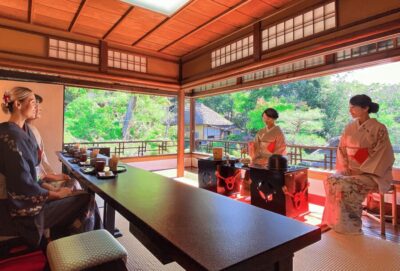
Tea Ceremony in a Traditional Tea House in Kiyomizu
Read our review →
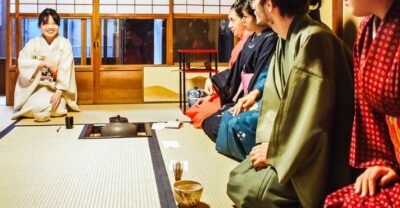
World Heritage Kyoto & Nara Uji Authentic Matcha Experience
Read our review →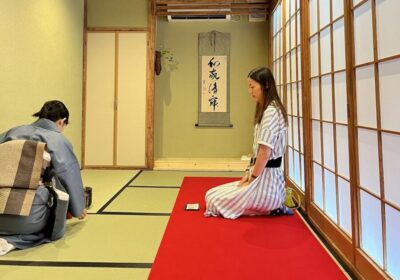
Browse the lists this tour appears in