
REVIEW · GARDEN & PALACE TOURS
Kyoto: Nijo-jo Castle and Ninomaru Palace Guided Tour
Nijo Castle is not just an old fortress. It is a carefully staged show of shogun power, where painted tigers, creaking floors, grand gates, and formal rooms told visitors who ruled Japan. This one-hour English tour helps you read those details instead of simply walking past them.
I like the small-group feel reported by many participants, and I like the extra access to rooms normally closed to regular visitors. Guides including Ai, Miki, Kaoru, and Don have been praised for clear English, humor, and good answers to questions. The main drawback is simple: the $16 tour fee does not include castle admission, and the palace can feel hot in summer because there is no air conditioning.
In This Review
- Key points to know before you go
- Why Nijo Castle feels different from a typical Japanese castle
- Entering through the East Main Gate
- Karamon Gate: a grand entrance with a message
- Ninomaru Palace, where architecture becomes social control
- The restricted areas are the tour’s strongest extra
- Ninomaru Garden gives the palace room to breathe
- What makes the English guiding effective
- Is $16 good value when admission costs extra?
- Timing, closures, and practical comfort
- Who should book this Nijo Castle tour?
- Should you book it?
- FAQ
- Is castle admission included in the $16 tour price?
- How long does the guided tour last?
- What language is the tour conducted in?
- Where do I meet the guide?
- Can children join the tour for free?
- When is Ninomaru Palace closed?
Key points to know before you go
- Hear the political meaning behind the palace: Learn why Nijo Castle was a seat of power, not only a military stronghold.
- See Ninomaru Palace room by room: The guide explains the shogun’s work areas, reception rooms, private quarters, artwork, and court customs.
- Enter through the East Main Gate: The meeting point is beside the General Reception area, not outside the castle grounds.
- Look for details you might miss alone: Guides point out symbols, murals, fire risks, food preparation customs, and design features.
- Get limited access beyond the usual route: The tour can include two additional areas normally unavailable to ordinary visitors.
- Plan around the weather and closures: The palace has no air conditioning, and Ninomaru Goten closes on listed dates in summer and winter.
Why Nijo Castle feels different from a typical Japanese castle
Nijo Castle was built in 1603 as the Kyoto residence of Tokugawa Ieyasu, the first shogun of the Edo Period. That date matters. This was not simply a defensive building placed on a hill. It was a political headquarters in the emperor’s city, designed to display authority and control access.
The Tokugawa Shogunate fell in 1867, after which the castle became an imperial palace. It was later given to Kyoto City and opened as a historic site. In 1994, Nijo Castle received UNESCO World Heritage status.
You can visit on your own, but the setting is full of signals that are easy to miss. The arrangement of gates, the order of the rooms, the placement of paintings, and even the floorboards reflect rank and security. A guide gives you the key to these choices.
I especially like the contrast between the castle’s name and its actual role. You may expect towering stone walls and a central keep to dominate the visit. Instead, the most important stop is Ninomaru Palace, a low wooden complex where the shogun conducted business, received officials, and maintained a strict social order.
More Garden & Palace Tours in Kyoto
- Kyoto: Nijo Castle, Kiyomizu & Fushimi Inari Guided Tour
★ 4.7 · 700 reviews - Kyoto: Imperial Palace & Nijo Castle Guided Walking Tour
★ 4.7 · 453 reviews - Kyoto Zen Meditation & Garden Tour at a Zen Temple with Lunch
★ 5.0 · 441 reviews
Entering through the East Main Gate
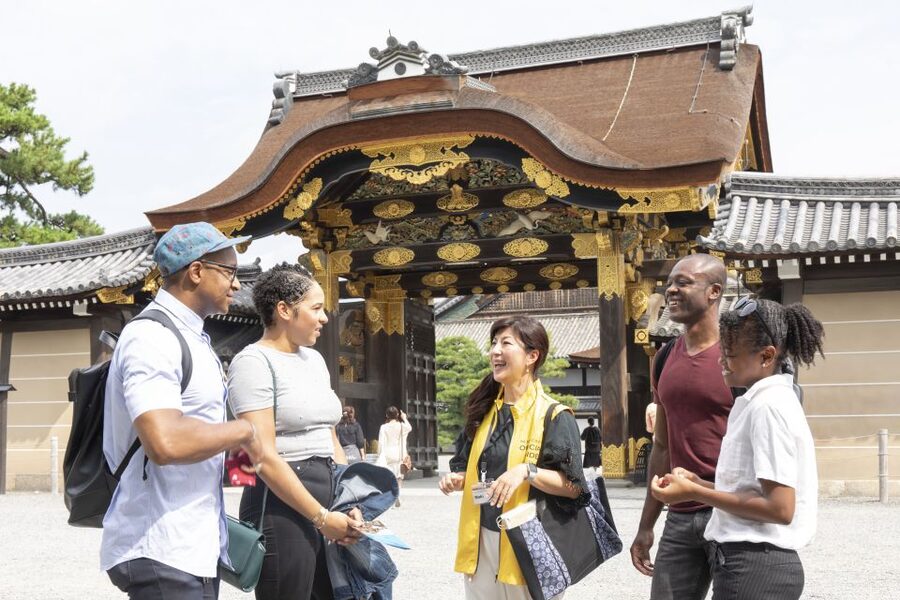
Your tour begins at the East Main Gate. Enter the castle grounds first, then go to the reception area beside the General Reception desk, on the left after you pass through the gate. The meeting point is the Nijo Castle Tour Ticket Booth, with exact details supplied at booking.
This is worth taking seriously. You cannot join after the tour begins, so arrive well ahead of time. You also need to pay the separate castle admission fee in cash on site. The tour itself costs $16 per person, while a recent price note put the admission at 1,300 yen. Since admission charges can change, check the current amount before you go.
The first part of the walk takes in the Higashi Ote-mon Gate. Your guide may use this area to explain the castle’s defensive layout and the difference between the main defensive circle, called the Honmaru, and the secondary circle, the Ninomaru.
You do not need a long military lecture to appreciate the plan. The castle is divided into the Honmaru, the Ninomaru, and the gardens surrounding both. That layout shows how movement was controlled, from the outside gate to the most private spaces.
Karamon Gate: a grand entrance with a message
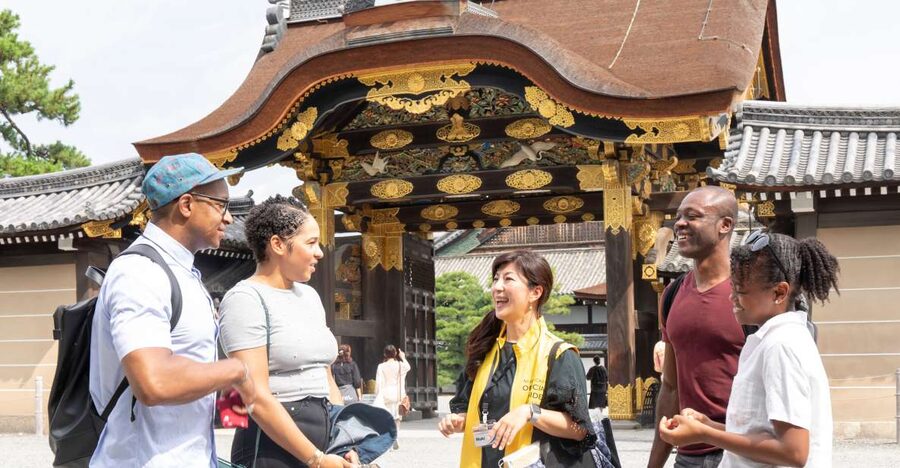
The Karamon Gate leads toward Ninomaru Palace and is one of the most decorative points on the route. Its carved and painted details announce that you are approaching an official residence, not a plain barracks.
This is a good place to slow down. A quick photograph cannot show why the gate looks so elaborate or what its decorative subjects meant in the setting of a shogun’s palace. Guides use the carvings and design to explain the visual language of status and authority.
Some tour participants have connected the castle’s animal carvings with familiar modern Japanese characters, including Dragon Ball references and Pokemon inspiration. Those connections are best treated as an entertaining observation rather than the central lesson, but they can help younger visitors look more closely at the artwork.
The gate also prepares you for the palace interior. Everything becomes more formal as you move inward. The route is not simply from one attractive building to another. It is a progression through spaces where access, appearance, and behavior were carefully managed.
Ninomaru Palace, where architecture becomes social control
Ninomaru Palace is the heart of the tour. It once served as the shogun’s residence and office during visits to Kyoto, and it remains remarkably intact.
You remove your shoes before entering and follow the established path through the wooden rooms. Photography is not allowed inside, and water is not available within the palace. These rules protect the building, but they also mean you should drink before entering and keep your camera ready only for the exterior grounds.
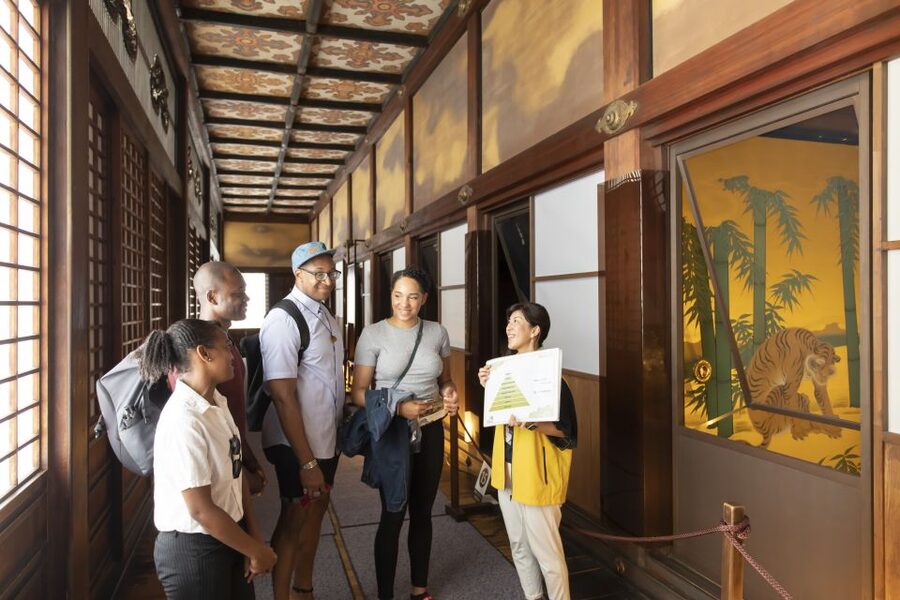
The palace rooms are not presented as empty chambers. Your guide explains what each room was used for and who could enter it. You might hear about the shogun’s working rooms, formal receiving areas, private quarters, and the daily routines that supported court life.
The painted panels are a major part of the experience. The artwork includes tigers, plants, birds, and other motifs, and their placement helped communicate rank and purpose. A good guide will point out details that a casual walk-through leaves behind, such as the symbolism of the animals and the reason particular paintings suited particular rooms.
The floors are famous for their nightingale squeaks. These boards make a chirping sound when stepped on, providing a built-in warning system against unwanted movement. The tour is a chance to understand this feature as practical security rather than a charming oddity.
You also get a clearer idea of how fragile palace life could be. Guides have discussed fire risks, food preparation, and the danger of poisoning at meals. These details turn the elegant rooms into working spaces shaped by fear, ceremony, and strict procedure.
Same city, a completely different kind of day:
- PERFECT KYOTO 1-Day Bus Tour
★ 5.0 · 13,518 reviews - Kyoto: Fushimi Inari, Kinkakuji, Bamboo Grove 1 Day Bus Tour
★ 4.8 · 4,316 reviews - Kyoto: Tea Ceremony in a Traditional Tea House in Kiyomizu
★ 4.9 · 3,519 reviews - Kyoto Geisha Walking Tour: Gion District & Hidden Gems
★ 4.7 · 3,273 reviews
The restricted areas are the tour’s strongest extra
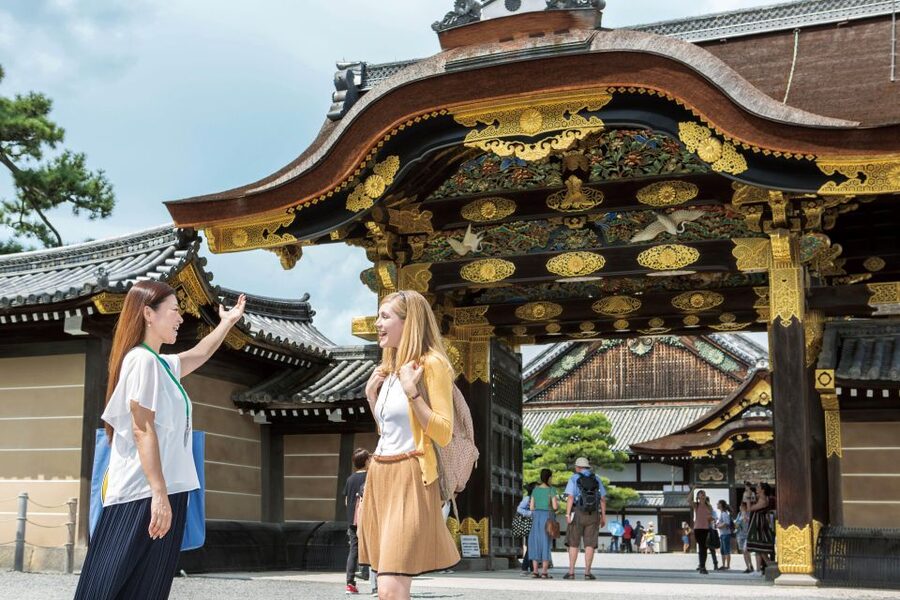
The biggest reason to choose the guided option is the possibility of entering areas that regular visitors cannot access. The experience includes exclusive access to part of the castle normally closed to the public, and several participants specifically described seeing two additional spaces linked to the shogun’s private quarters.
The exact rooms available can depend on current operating conditions, so I would not book this expecting one guaranteed secret chamber. Still, the extra access gives the tour a clear advantage over simply buying admission and following the standard path.
This portion is especially useful if you have already visited major Japanese castles and want something beyond the usual exterior views. You are not just looking at a famous building from the same corridor as everyone else. You may see features that help explain how the shogun lived and how palace space was divided by rank.
Ask questions here. Guides have been praised for taking time with visitors rather than racing through the rooms. If you are curious about private quarters, samurai customs, court intrigue, or the difference between political and military power, this is the moment to speak up.
Ninomaru Garden gives the palace room to breathe
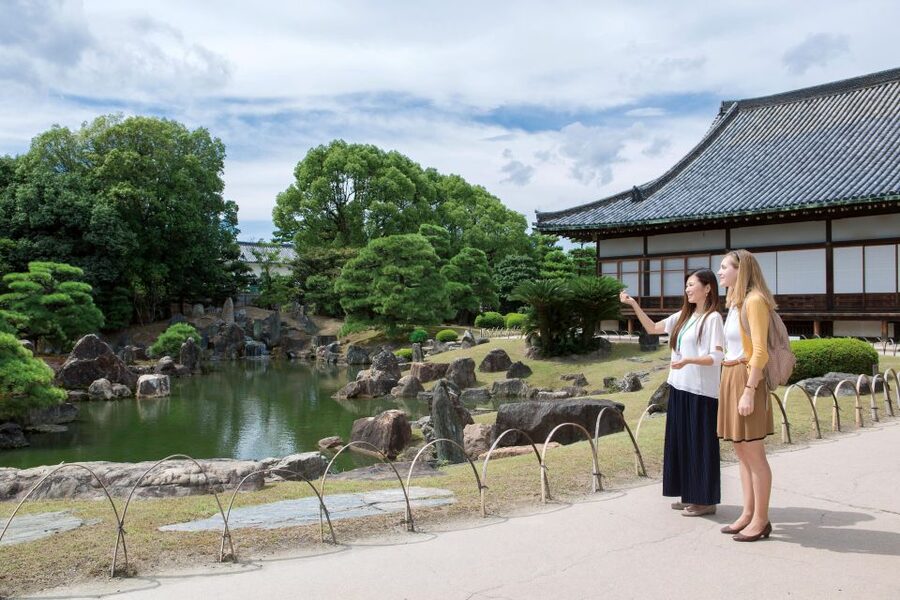
After the palace, the route includes Ninomaru Garden. The garden provides a useful change of pace after the dark wooden corridors and tightly controlled interior spaces.
Here you can consider the castle as a complete design. The palace, gate, walls, and garden were meant to work together. The garden was not a separate decoration added for tourists. It helped create a setting suitable for formal residence and political display.
The guided portion lasts one hour, so you should expect highlights rather than a full exploration of every path. Afterward, you can continue on your own through the grounds, including areas around the Honmaru and Ninomaru. That combination works well: the guide supplies context, then you have freedom to linger, take exterior photographs, and set your own pace.
If you are visiting in hot weather, bring water for the outdoor portion. Summer conditions in Kyoto can be severe, and there is no air conditioning inside Ninomaru Palace. One August visit took place in temperatures above 95 degrees Fahrenheit, and even a strong guide cannot make that kind of heat disappear.
What makes the English guiding effective
The tour is conducted only in English. The strongest guides use plain explanations, historical context, and a bit of humor rather than turning the walk into a list of dates.
Ai has been praised for detailed explanations and for keeping the group comfortable during very hot weather. Miki has been described as energetic, kind, and able to explain the castle’s history in clear English. Kaoru has been noted for humor, expressive delivery, and strong answers about samurai customs and the period’s political structure.
Other guides, including Don, Ayu, Kiku, Michiko, and Kingo, have been singled out for different strengths. Don has kept the tour both educational and fun. Kiku has focused on court intrigue and power struggles. Michiko has guided visitors calmly through crowded areas and helped solo participants with photographs.
These names do not mean you can request a particular person or that one guide will lead every departure. They do show the range of the guiding style you can expect: history, room functions, artwork, political context, and practical care during hot weather.
The use of earphones is another useful detail. They are supplied to paid participants, which helps you hear in crowded palace spaces. A child aged 0 to 12 can join free with each paid adult, but that child will not receive an earphone unless you buy an adult ticket for them. Children must stay with an adult, and each additional child beyond the first needs an adult ticket.
Is $16 good value when admission costs extra?
The price deserves a close look. At $16, the guided portion is not expensive compared with many private cultural tours, but it is not the full cost of entering Nijo Castle. You pay the admission fee separately, in cash, at the site.
That separate charge may feel less convenient, especially since one participant suggested that including admission would make the package better value. Still, the guide provides something you cannot get from the entrance ticket alone: a structured explanation of the palace and possible access to restricted areas.
I think the price works best for three kinds of visitors:
- First-time visitors to Kyoto: You get a clear introduction to the Tokugawa period and the relationship between the shogun and emperor.
- History and architecture fans: The guide explains why the building looks and functions as it does.
- Visitors with limited time: One hour covers the main route, and you can explore the gardens afterward.
If you mainly want to wander quietly, take photographs, or spend half a day in the gardens, you may prefer to visit without a guide. The palace has rules against indoor photography, and the one-hour format does not cover every corner of the grounds.
Timing, closures, and practical comfort
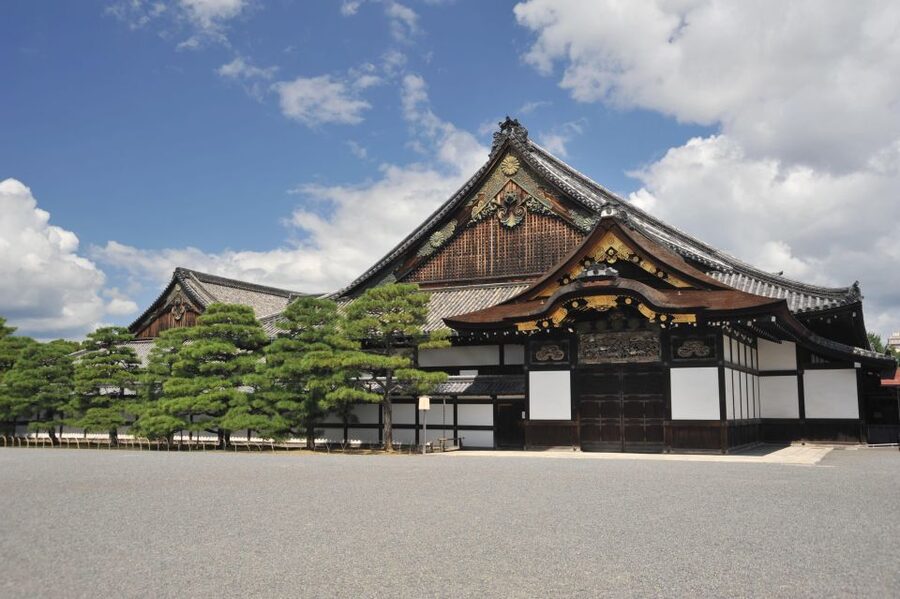
Check starting times when booking because the tour runs for 60 minutes and availability changes by date. Arrive early at the East Main Gate, not just at the general castle neighborhood. Missing the start means you cannot join later.
Ninomaru Goten is closed every Tuesday in July, August, December, and January. It is also closed from December 26 through January 3. Since the palace is the central attraction, check the date carefully before paying for the tour.
Wear shoes that are easy to remove and put back on. The interior visit requires you to leave footwear outside, and you will spend time walking between the gate, palace, and garden.
Bring water, especially from June through August. The palace has no air conditioning, and you cannot take water inside. A light drizzle does not prevent the tour, but comfortable shoes and a small umbrella can make the outdoor sections easier.
Free cancellation is available up to 24 hours before the start time. Transportation is not included, so you arrange your own way to the castle.
Who should book this Nijo Castle tour?
I would book it if you want to understand what you are seeing. Nijo Castle can look beautiful without explanation, but the rooms become far more interesting when you know who was allowed to enter, how the shogun received officials, why certain paintings were chosen, and how the floors helped guard the palace.
It is also a smart choice for solo visitors. The guide keeps the route organized, explains details in manageable sections, and may help with photographs. Families can benefit from the free child place, though you should consider buying an adult ticket for a child who needs an earphone.
I would hesitate only if your priority is complete independence or indoor photography. You also need to budget for the admission fee, arrive early, and accept that summer heat can make the palace uncomfortable.
Should you book it?
Yes, if you are interested in Japan’s feudal government, palace design, samurai customs, or the symbolism in traditional artwork. The strongest value comes from the guide’s explanations and the chance to see restricted areas, not from saving time or avoiding the entrance fee.
You can walk around Nijo Castle on your own, but you may miss the political meaning behind its rooms and gates. For $16 plus admission, this short tour gives the castle a human and practical dimension. Book it when you want the building to explain itself, not merely pose for photographs.
FAQ
Is castle admission included in the $16 tour price?
No. Nijo Castle admission is separate and must be paid in cash on site. A recent price note listed the admission at 1,300 yen, but you should check the current charge before visiting.
How long does the guided tour last?
The guided tour lasts 60 minutes. Afterward, you can continue exploring the castle grounds independently.
What language is the tour conducted in?
The tour is conducted only in English and includes a live English-speaking guide.
Where do I meet the guide?
Enter through Nijo Castle’s East Main Gate. After entering, go to the reception area next to the General Reception, on the left side. The meeting point is the Nijo Castle Tour Ticket Booth.
Can children join the tour for free?
Each paid participant can bring one child aged 0 to 12 free of charge. The child must stay with an adult. Earphones are provided only to paid participants, so a child who needs an earphone requires an adult ticket.
When is Ninomaru Palace closed?
Ninomaru Goten is closed every Tuesday in July, August, December, and January. It is also closed from December 26 through January 3.
Just added around Kyoto
- Taste of Nishiki Market Walking Food Tour with Local guide★ 5.0 · 17 reviews
- Kyoto: Sushi Making Class with Sushi Chef★ 4.8 · 64 reviews
- Kyoto: City Secrets eBike Tour★ 4.9 · 196 reviews
- Sacred Pathways: Discover the Philosopher’s Path of Kyoto★ 4.9 · 20 reviews
- Private Tour to Monkey Park and Arashiyama Highlights★ 5.0 · 22 reviews
- Private Nara Tour from Osaka – Meet at Your Hotel★ 5.0 · 22 reviews
- Private Sake Tasting in Central Kyoto with Sake Sommelier★ 5.0 · 13 reviews
- Kyoto : Private Custom Walking Tour With A Local Guide★ 4.6 · 144 reviews
Garden & Palace Tours, compared.

Imperial Palace and Shogun Historical Walking Tour
Read our review →
Tokyo Castle & Imperial PalaceーShogun Walking Tour
Read our review →

Ultimate Osaka Walking Tour: Castle, Dotonbori & Hidden Gems
Read our review →Tokyo Castle & Imperial PalaceーShogun Walking Tour
Read our review →
Nijo Castle, Kiyomizu & Fushimi Inari Guided Tour
Read our review →Browse the lists this tour appears in