
REVIEW · DINNER EXPERIENCES
Kyoto: Lunch or Dinner with Maiko
A Maiko afternoon or evening gives you something a stage show cannot: direct contact with a young woman carrying on a demanding Kyoto tradition. You’ll watch a tea ceremony, enjoy two graceful dances, ask questions about daily life, and take a photo together. The personal Q&A and the interactive game are the parts I like most because they turn a formal performance into a real meeting.
I also like the meal’s connection to old Kyoto cooking, especially the use of dashi and the shidashi style of delivered cuisine. The main thing to keep in mind is the setting: this is not an ochaya or an old Japanese townhouse. It takes place in a plain building, and some sessions may feel more like a functional event room than a richly decorated cultural salon.
In This Review
- Key Points Before You Book
- Meeting a Maiko Without Entering an Ochaya
- Tea Ceremony Movements You Can Watch Closely
- A Kyoto Meal Built Around Dashi and Shidashi
- Questions That Turn a Performance Into a Conversation
- Two Dances That Show Maiko Technique
- A Game Where You Can Play Against the Maiko
- Photos, Senjafuda, and the Final Ten Minutes
- What $63 Includes, and What Costs Extra
- Gojo Station Access and Practical Limits
- Who Will Enjoy This Kyoto Experience Most
- Should You Book the Maiko Program?
- FAQ
- Where is the Maiko experience held?
- How long does the program last?
- Is dinner included in the price?
- Can I make my own tea?
- Are English translations available?
- Will I see a Maiko or a Geiko?
- Can I take a photo with the Maiko?
- Is the venue an ochaya or traditional Japanese house?
- Can children under two attend for free?
Key Points Before You Book
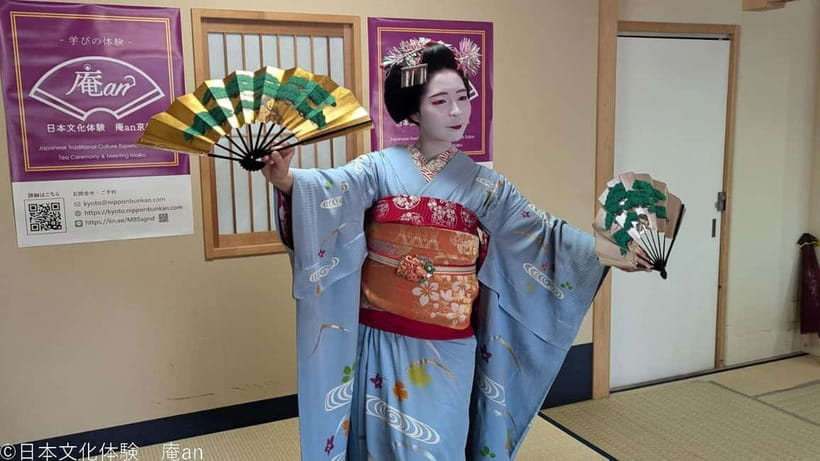
- Two traditional dances: You’ll see dances linked to seasonal beauty, love stories, or ordinary life in Japan.
- A real question-and-answer session: Ask the Maiko directly about her work and daily routine.
- Tea ceremony first: You can watch the demonstration, or add your own tea-making experience for 1,600 JPY.
- A Kyoto-style meal: The food comes from a long-established restaurant and uses classic ingredients such as dashi.
- Photo and Senjafuda gift: You’ll pose beside the Maiko and receive a small lucky charm.
- Simple, practical venue: The building is one minute from Gojo Station, but there is no elevator and the room is not an ochaya.
Meeting a Maiko Without Entering an Ochaya
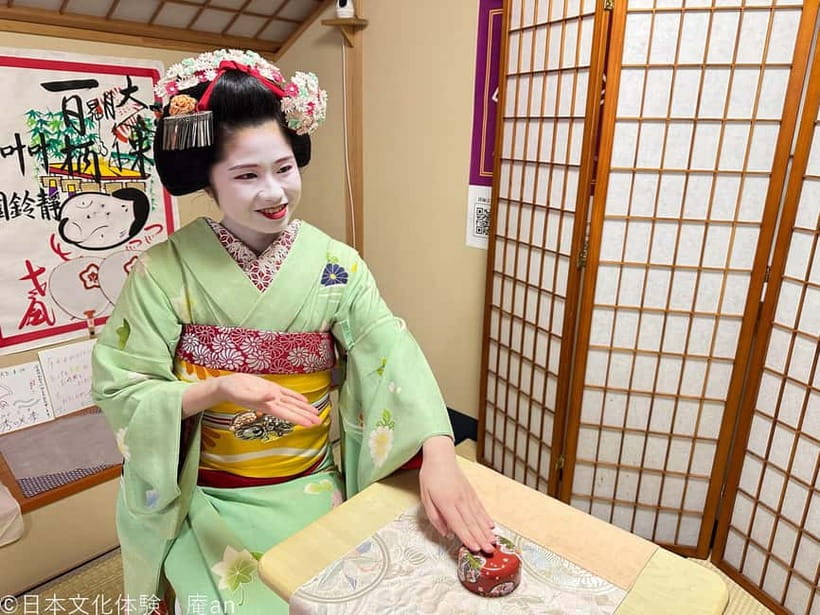
Kyoto’s Maiko are apprentice entertainers trained in traditional dance, music, manners, clothing, and hospitality. Their kimono, hair ornaments, makeup, and controlled movements are not costumes for a one-night show. They belong to a demanding way of life that still exists in Kyoto’s entertainment districts.
That context matters. Many visitors see Maiko only at a distance, perhaps hurrying through Gion or appearing briefly at a public performance. Here, you sit in the same room, watch her work, and have time to ask questions. The format is friendly rather than mysterious, which makes it a useful introduction if you want to understand more than the outward appearance.
The program is hosted by B.B.Advisors Inc. AN KYOTO. No individual guide name is provided, so you should not expect a named historian or specialist lecturer. The working language is Japanese, with English translation offered as much as possible if you request it in advance.
The setting needs realistic expectations. You are not entering an ochaya, the exclusive traditional teahouse associated with Kyoto’s geiko and Maiko culture. You’ll meet in a building near Gojo Station, with a relaxed atmosphere and staff who help keep the program moving. The room may lack the screens, woodwork, and old-world decoration you might imagine from photographs of Kyoto.
That plain setting has one advantage: the Maiko and the activities remain the focus. It also means this is not the best choice if your main goal is a beautifully preserved historic interior.
A few more Kyoto trips to weigh up
- Bike Tour Exploring North Kyoto plus Lunch
★ 5.0 · 1,087 reviews - Osaka/Kyoto: Arashiyama, Nara & Fushimi Inari Shrine w/Lunch
★ 4.4 · 754 reviews - Kyoto Zen Meditation & Garden Tour at a Zen Temple with Lunch
★ 5.0 · 441 reviews
Tea Ceremony Movements You Can Watch Closely
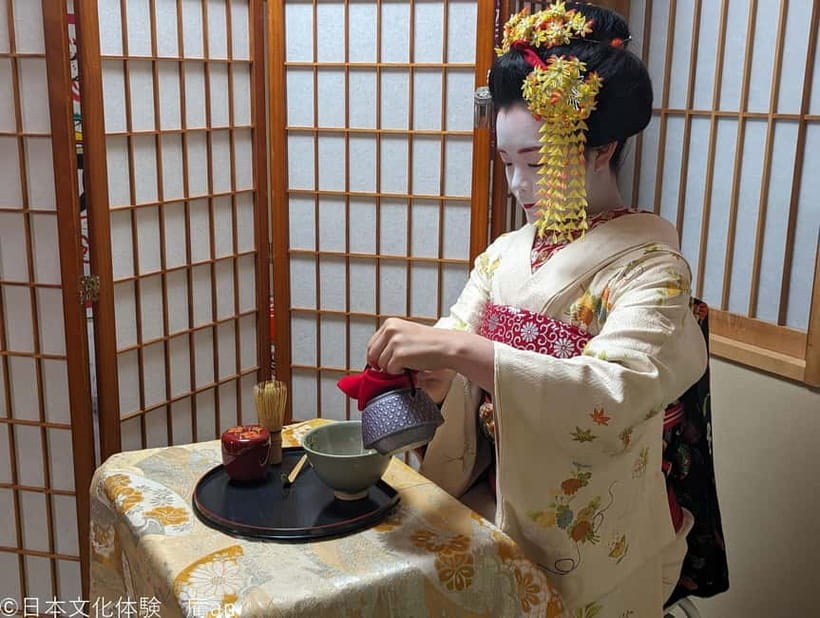
The program begins with a tea ceremony demonstration. Watch the Maiko handle the bowl, utensils, and motions with care. Tea ceremony is not simply about making a drink. The pace, posture, sequence, and attention given to the person receiving the tea all carry meaning.
You can choose to watch, which is included, or add a hands-on tea-making option for 1,600 JPY. The extra option is worth considering if you want a small physical connection to the custom rather than only observing it. Since the tea option may run alongside the meal and other parts of the program, ask about the exact format when booking.
The tea demonstration also sets the tone for the rest of the meeting. At first, the Maiko’s movements may feel formal and carefully controlled. Later, the questions and game show a more relaxed side of her hospitality. That change from ceremony to conversation is one of the program’s better features.
Keep in mind that more than one group may share the room. Some people may be eating while others are taking part in the tea option. This can make the event feel less private and less carefully staged, but it also reflects the practical group format.
A Kyoto Meal Built Around Dashi and Shidashi
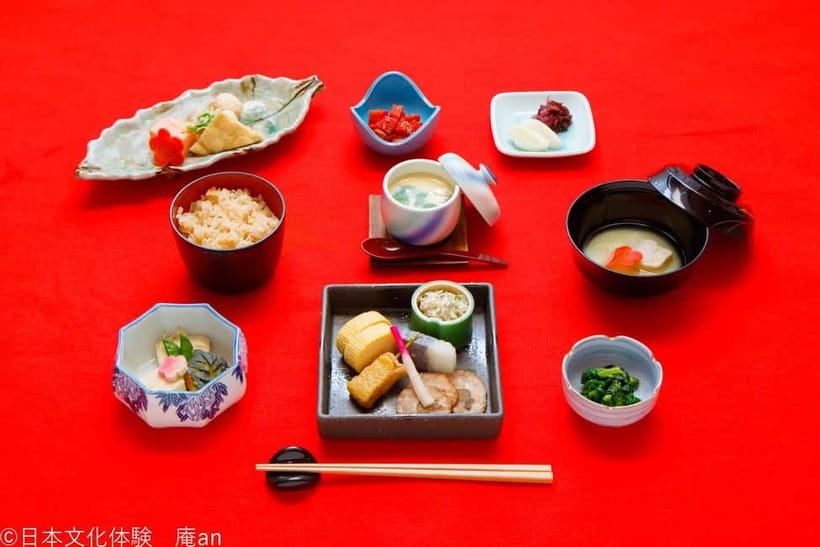
Food is included in the $63 price, which gives this experience more value than a short performance alone. The meal comes from a long-established Kyoto restaurant and features traditional dishes. Kyoto cooking often depends on dashi, the soup stock that gives many dishes their gentle depth without heavy seasoning.
You may also encounter shidashi, the Kyoto practice of having prepared food delivered in a formal arrangement. The meal is part of the cultural setting, not merely a plate added to fill the schedule. It lets you taste the style of food associated with the city while watching and talking with the Maiko.
Still, I would keep your expectations moderate. Traditional Kyoto food can be subtle, and not everyone enjoys its restrained seasoning. Some meals may also be served in prepared trays. A recent session was described as barely thawed and difficult to eat, while another found the meal typical but mild in smell and flavor. That points to an uneven food experience, even though the cultural program itself can be worthwhile.
If food quality is your main reason for booking, this is not a safe substitute for a carefully chosen Kyoto restaurant. If your priority is meeting a Maiko and the meal is a useful extra, the balance is better.
The title allows for lunch or dinner, but the supplied program describes a traditional Kyoto dinner. Check the available start time and meal format for your chosen date rather than assuming an evening schedule.
Questions That Turn a Performance Into a Conversation
The Q&A session is where the experience becomes more than a demonstration. You can ask the Maiko about her daily routine, training, clothing, hairstyle, or the customs that shape her working life. The exact questions depend on the group, so prepare one or two of your own if you want to make good use of the time.
This is also the part that helps explain why Maiko are special. The elegant appearance is only the visible layer. Their work requires discipline and repeated practice, and the Q&A gives you a chance to hear about that world in a direct, approachable way.
English interpretation is provided as much as possible, but Japanese is the stated operating language. Do not assume every answer will receive a full, word-for-word translation. If language access matters to you, contact the operator before booking and request English support.
You may be sharing the session with people who selected different meal or tea arrangements. That can affect how personal the conversation feels. It is still a useful chance to ask questions, but it is not presented as a private one-on-one meeting.
Same city, a completely different kind of day:
- PERFECT KYOTO 1-Day Bus Tour
★ 5.0 · 13,518 reviews - Kyoto: Fushimi Inari, Kinkakuji, Bamboo Grove 1 Day Bus Tour
★ 4.8 · 4,316 reviews - Kyoto: Tea Ceremony in a Traditional Tea House in Kiyomizu
★ 4.9 · 3,519 reviews - Kyoto Geisha Walking Tour: Gion District & Hidden Gems
★ 4.7 · 3,273 reviews
Two Dances That Show Maiko Technique
The Maiko performs two traditional dances. Their subjects may express the seasons, a love story, or a scene from everyday Japanese life. Watch the small details: the angle of a sleeve, the turn of the head, the position of a fan, and the careful timing of each step.
The dances are short enough to fit into a compact program, but two pieces give you more range than a single number. You can compare the mood and movement of each performance instead of seeing only one example.
The dance portion has earned the strongest praise in the available feedback. One session also included a Geiko instead of a Maiko, which can happen depending on circumstances. A Geiko is a senior performer in the same traditional entertainment world. If that substitution occurs, it changes the experience but does not remove the central cultural focus.
Do not expect a large theatrical production. There may be no elaborate backdrop or traditional screen behind the performer. The room’s plain lighting and furniture can make the presentation feel less polished than the dance itself deserves. Even so, the close distance lets you see details that would disappear on a large stage.
A Game Where You Can Play Against the Maiko
After the formal dance, the mood loosens with a simple interactive game. Volunteers can take part, while everyone else claps and watches. The activity is designed as light entertainment rather than a serious lesson, and the fun comes from seeing whether anyone can beat a professional at a game she knows well.
This is a good feature for families and for people who find a formal cultural performance intimidating. You are not required to volunteer, and you can still enjoy the energy from your seat. The game also gives the Maiko a chance to show the hospitality skills that have long been part of this type of entertainment.
The program’s tone is generally warm and social, but remember that you may be grouped with people who booked different options. If you prefer a quiet, private cultural lesson, the shared format may disappoint. If you like a little harmless competition and audience participation, it adds welcome variety.
Photos, Senjafuda, and the Final Ten Minutes
You’ll have a chance to take a commemorative photo beside the Maiko. This is a close-up opportunity, not simply a distant picture from the audience, so have your camera ready and follow the staff’s directions.
You also receive a Senjafuda, a small paper charm traditionally associated with a performer’s name or mark. Here it is presented as a lucky charm and a tangible reminder of the meeting. It is a modest gift, but it gives the final photo and conversation a personal finish.
The main program ends at about 75 minutes, when the Maiko leaves the room. You then have roughly 15 minutes of chatting time before leaving at the 90-minute mark. That final period can be useful if you have one last question or want a calmer moment after the performance.
You should not expect the Maiko to remain available indefinitely. The schedule is tight, so arrive ready and avoid saving every question for the final minutes.
What $63 Includes, and What Costs Extra
At $63 per person, the price covers the Maiko program and dinner. You are paying for a combined cultural experience: food, demonstration, conversation, dance, game, photo, and charm. Compared with booking separate entertainment and a traditional meal, the package can be good value if you want several elements in one short session.
Three upgrades cost extra:
- Tea ceremony experience: 1,600 JPY
- SS seat, first row: 3,300 JPY
- S2 seat, second row: 2,200 JPY
- S3 seat, third row: 1,100 JPY
The seat options matter because the dances and tea movements are detailed. If seeing the Maiko clearly is important to you, a closer seat may be a sensible addition. The base price does not specify a front-row position, so do not assume you’ll be directly in front of the performer.
Children under two can attend free when sitting on a parent’s lap. If a child under two needs a seat or meal, the full one-person fee applies. Children who do not participate cannot enter the event, so do not book a space only for an accompanying nonparticipant.
Gojo Station Access and Practical Limits
The meeting point is one minute from Exit 1 of Gojo Station on the Subway Karasuma Line. The entrance faces Gojo-dori, the main street, which makes the location relatively easy to find. Use the exact street-facing entrance rather than assuming the event is inside a traditional-looking house.
There is no elevator in the building. You’ll need to use stairs to reach the venue, so this experience is not suitable for anyone who cannot manage the stairs. The supplied information does not give a detailed accessibility plan, so contact the operator before booking if you need specific assistance.
Arrive early. The event will not be held for delayed participants, regardless of the reason. The operator also does not reimburse transportation costs if you miss the program or cancel, so build in extra time for finding the entrance.
Reservations are processed from 10:00 to 17:00. Requests received after 17:00 are handled the next day. Cancellation is free up to eight days before the scheduled date, with a full refund. After that point, fees apply, and changing the date or time after a fee has been incurred can bring another specified charge.
Who Will Enjoy This Kyoto Experience Most
I would recommend this for you if you want a direct cultural meeting rather than a distant performance. It suits first-time Kyoto visitors who want an easy introduction to Maiko customs, families with older children who enjoy games, and anyone who likes combining food with a short cultural show.
It is also a good fit if your schedule is tight. Ninety minutes is long enough for several distinct activities without taking over half a day. The Gojo Station location makes it easy to place before or after other sightseeing, provided you allow time for the fixed start.
I would be more cautious if you are booking mainly for a refined meal, an old Japanese interior, or a private encounter. The food may be mild and the presentation can be plain. Shared groups, Japanese-language hosting, and possible schedule substitutions also mean the event has a practical group-tour feel.
Should You Book the Maiko Program?
Book it if you want a friendly, compact introduction to Kyoto’s living Maiko tradition, with real interaction rather than only watching a dance. The Q&A, two dances, photo, Senjafuda charm, and game give you a lot to do in 90 minutes.
Skip it if your ideal evening requires an elegant ochaya setting or a guaranteed high-end dinner. For the best chance of enjoying it, request English help ahead of time, consider a closer seat, arrive early at Gojo Station, and treat the meal as part of the cultural package rather than the main culinary event.
FAQ
Where is the Maiko experience held?
It is held one minute from Exit 1 of Gojo Station on Kyoto’s Subway Karasuma Line. The entrance faces Gojo-dori, the main street.
How long does the program last?
The full experience lasts 90 minutes. The main program ends at about 75 minutes, followed by chatting time before you leave.
Is dinner included in the price?
Yes. Dinner with the Maiko is included in the $63 per-person price. The meal features traditional Kyoto dishes from a long-established restaurant.
Can I make my own tea?
Yes, but the tea-making experience is an optional add-on costing 1,600 JPY. The tea ceremony demonstration is part of the main program.
Are English translations available?
English translation is provided as much as possible if requested. The operating language is Japanese, so contact the operator before booking if you need English assistance.
Will I see a Maiko or a Geiko?
The program is designed around a Maiko, but a Geiko may be invited instead depending on the situation.
Can I take a photo with the Maiko?
Yes. The program includes a commemorative photo opportunity beside the Maiko. You also receive a Senjafuda lucky charm.
Is the venue an ochaya or traditional Japanese house?
No. The event takes place in a building with a relaxed atmosphere and friendly staff. It is not an ochaya or a traditional Japanese house.
Can children under two attend for free?
Children under two are free when sitting on a parent’s lap. If a seat or meal is required, the child is charged the same fee as one person.
More Dining Experiences in Kyoto
- Kyoto Gion Cultural Walk & Geisha Show with Dining Options
★ 5.0 · 518 reviews - Kyoto Gion Cultural Walk & Geisha Show with Dining Options
★ 5.0 · 483 reviews - Kyoto: Geisha Dinner & Gion Cultural Walk
★ 5.0 · 73 reviews - Kyoto: Maiko Dinner in Traditional Restaurant and Tour
★ 4.8 · 55 reviews
Just added around Kyoto
- Taste of Nishiki Market Walking Food Tour with Local guide★ 5.0 · 17 reviews
- Kyoto: Sushi Making Class with Sushi Chef★ 4.8 · 64 reviews
- Kyoto: City Secrets eBike Tour★ 4.9 · 196 reviews
- Sacred Pathways: Discover the Philosopher’s Path of Kyoto★ 4.9 · 20 reviews
- Private Tour to Monkey Park and Arashiyama Highlights★ 5.0 · 22 reviews
- Private Nara Tour from Osaka – Meet at Your Hotel★ 5.0 · 22 reviews
- Private Sake Tasting in Central Kyoto with Sake Sommelier★ 5.0 · 13 reviews
- Kyoto : Private Custom Walking Tour With A Local Guide★ 4.6 · 144 reviews
Dinner Experiences, compared.
Tokyo Bar Hopping Tour in Shinjuku (All-You-Can-Drink + Dinner)
Read our review →

Deep Backstreet Osaka Tours (Option to add Dinner)
Read our review →
Deep Backstreets Walking Tour with Dinner Option
Read our review →
Sumida River: Japanese Traditional Yakatabune Dinner Cruise
Read our review →
Kyoto Gion Cultural Walk & Geisha Show with Dining Options
Read our review →Kyoto Gion Cultural Walk & Geisha Show with Dining Options
Read our review →
Tokyo Bay Yakatabune Dinner/Day Cruise with Japan Show and Drinks
Read our review →Browse the lists this tour appears in