
REVIEW · CYCLING TOURS
Bike Tour Exploring North Kyoto plus Lunch
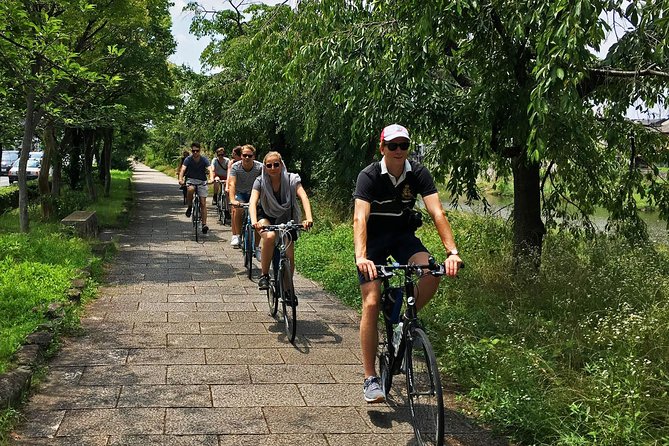
Kyoto makes more sense from a bicycle seat. You can slip through quiet back streets, reach famous temples without spending the day on crowded buses, and cover a surprising stretch of the city in one outing. This small-group ride visits Nishi Honganji, Kitano Tenmangu, Kinkakuji, former imperial grounds, and Gion.
I like the small maximum of eight people, which gives guides such as Mayko, Julian, Indra, Quinn, and Jay room to answer questions and adjust the pace. I also like the practical package: a quality Cannondale bike, water, temple admission, and lunch are included. The main drawback is simple: six hours and roughly 13 miles, or 24 kilometers, still requires steady effort, especially in Kyoto’s heat.
In This Review
- Key points to know before you book
- Why Kyoto works so well by bicycle
- Starting near Kyoto Station with a proper bike fitting
- Nishi Honganji and the scale of Kyoto’s wooden architecture
- Kitano Tenmangu, a shrine with a local feel
- Kinkakuji and the famous Golden Pavilion
- Former imperial grounds and the ride between districts
- Gion closes the day with Kyoto’s most famous geisha district
- Lunch is more than a break
- The $106.12 price and what you receive
- Fitness, weather, and the small details that matter
- Who will like this North Kyoto ride
- Should you book it?
- FAQ
- Where does the bike tour begin?
- What time does the tour start?
- Where does the tour finish?
- How long does the experience last?
- How far do you ride?
- Is lunch included?
- Are temple entrance fees included?
- What equipment is provided?
- Are dietary requirements accepted?
- What is the cancellation policy?
Key points to know before you book
- The ride covers about 13 miles: Expect roughly 2.5 hours actually cycling, spread across a six-hour sightseeing day.
- Kinkakuji is the headline stop: The Golden Pavilion is one of Japan’s most visited sights, and admission is included.
- Lunch is part of the experience: You receive a Japanese meal, with noodle and sushi restaurants used on different days.
- The route mixes famous and quieter Kyoto: Nishi Honganji, Kitano Tenmangu, back streets, imperial grounds, and Gion all appear.
- The pace is moderate, not athletic: The route has few hills, though there is a slight climb toward Kinkakuji.
- The group stays small: A maximum of eight riders makes the guide’s safety advice and historical explanations easier to follow.
Why Kyoto works so well by bicycle
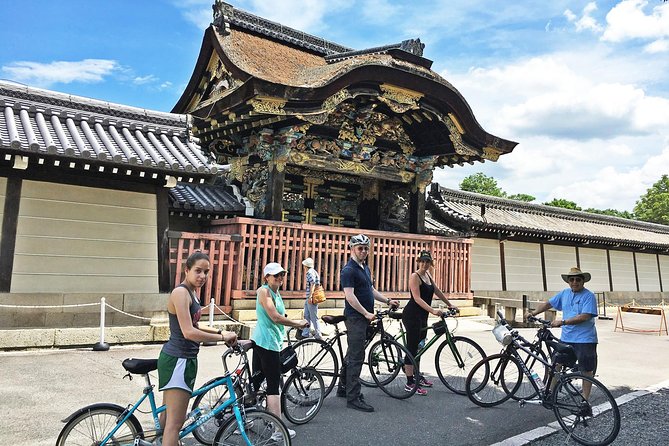
Kyoto’s major sights are spread across the city, and public transport does not always connect them neatly. A bus can take you from one famous stop to another, but it cannot show you the narrow lanes, local streets, and small transitions between old neighborhoods.
This tour uses those in-between spaces well. You ride from the shop near Kyoto Station toward the city’s northern sights, stopping often enough that the day feels like sightseeing rather than a cycling workout. The route has about 2.5 hours of riding, but those hours are broken up by temple visits, explanations, photographs, lunch, and short pauses.
I would not book this as a fast city cycling challenge. The point is to move at a steady pace, listen to your guide, and notice how Kyoto changes from one district to the next. The route is generally manageable for someone with moderate fitness, and the relatively few hills help. Still, you need to be comfortable riding a bicycle and able to stay in the saddle for much of the day.
The group size matters here. With no more than eight riders, the guide can keep an eye on the group and adapt the speed. Guides have also adjusted routes and timing for the group’s ability, which helps less confident riders. You should still expect a full active day, not a gentle ten-minute spin.
A few more Kyoto trips to weigh up
- Hidden Kyoto E-Biking tour
★ 5.0 · 1,843 reviews - Arashiyama Bamboo Forest & Hidden Gems Bike Tour (Early Bird)
★ 5.0 · 613 reviews - 5 Top Highlights of Kyoto Full Day Bike Tour (E-bike option)
★ 5.0 · 511 reviews
Starting near Kyoto Station with a proper bike fitting
The day begins at Cycle Kyoto, at 7 Higashikujō Nishisannōchō in Minami Ward. The start time is 10:00 am, and the tour returns to this same meeting point.
The first 15 minutes are used to meet the guide and group, choose a bike, and get ready. The included bike is a high-quality Cannondale, and the equipment setup is one of the tour’s practical strengths. Bikes are matched to rider height, and padded seats have been used to make a long day more comfortable. Helmet use is available, which is useful if you prefer extra protection.
This is the moment to speak up about fit. Tell the guide if the saddle feels wrong, the handlebars are uncomfortable, or the bike does not feel easy to control. A small adjustment at the beginning can make a big difference by the afternoon.
Bottled water is included, but Kyoto can become very hot. Guides have made a point of keeping the group hydrated during hot weather. You should still arrive ready for sun and heat, since the tour requires regular outdoor riding.
Nishi Honganji and the scale of Kyoto’s wooden architecture
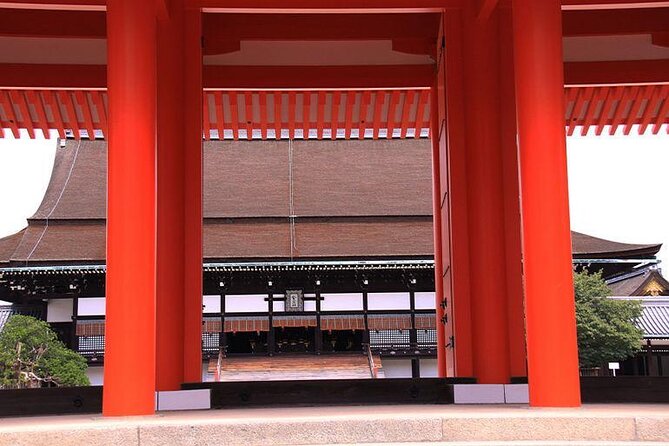
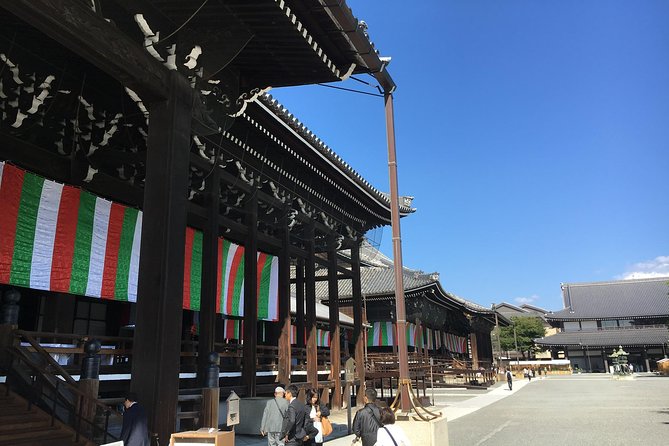
The first major stop is Nishi Honganji, a Buddhist temple complex that often receives less attention than Kyoto’s headline sights. Its large wooden buildings give you a strong sense of the scale and craftsmanship of traditional Japanese religious architecture.
You spend about 15 minutes here. That is not enough for a long, quiet temple visit, but it works well as an introduction to the city’s religious traditions. A good guide can explain what you are looking at instead of leaving you to admire the woodwork without context.
One detail that can make this stop memorable is the visible repair work on the historic buildings. Rather than making the site feel less authentic, careful repairs show how Kyoto preserves old structures for continued use. I find this more revealing than a perfectly polished monument because it connects the past with the work required to protect it.
Nishi Honganji is also a useful early stop because it eases you into the day. You are not immediately thrown into the largest crowds. You begin with an important site, learn how the tour works, and then continue north.
Kitano Tenmangu, a shrine with a local feel
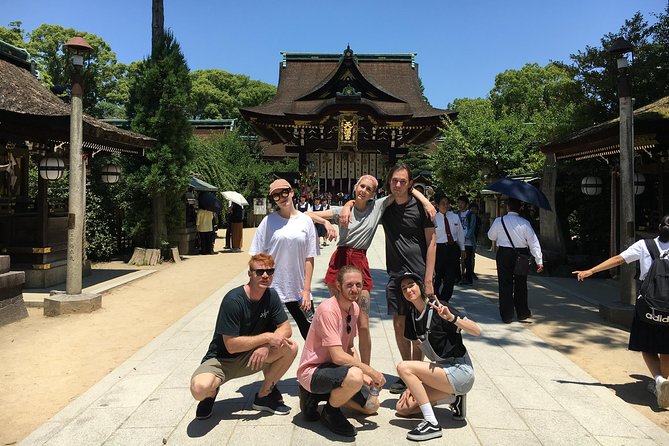
Kitano Tenmangu Shrine gives the route a different religious setting. The stop lasts about 20 minutes, and you can join local worshippers while taking in the shrine’s calm atmosphere.
The contrast with Nishi Honganji is part of the value. You are not seeing a string of temples that blur together. The guide can explain differences between Buddhism and Shinto, along with the role these traditions play in Japanese culture today.
This is one of the places where a guide adds real value. Shrine customs can seem simple from the outside, but small actions and symbols have meaning. Indra, Quinn, Mayko, and other guides have been praised for explaining religious traditions in a clear, engaging way, including the relationship between Shinto practice and Buddhist history.
You have about 20 minutes, so do not expect to inspect every corner. Instead, use the time to absorb the setting, ask questions, and watch how local worshippers use the shrine. The stop feels less like checking off a monument and more like seeing a living place of worship.
Same city, a completely different kind of day:
- PERFECT KYOTO 1-Day Bus Tour
★ 5.0 · 13,518 reviews - Kyoto: Fushimi Inari, Kinkakuji, Bamboo Grove 1 Day Bus Tour
★ 4.8 · 4,316 reviews - Kyoto: Tea Ceremony in a Traditional Tea House in Kiyomizu
★ 4.9 · 3,519 reviews - Kyoto Geisha Walking Tour: Gion District & Hidden Gems
★ 4.7 · 3,273 reviews
Kinkakuji and the famous Golden Pavilion
Kinkakuji is the tour’s biggest attraction. The Golden Pavilion is one of Japan’s most visited sights, and the entrance fee is included in the tour price.
You spend about 30 minutes at the temple. That gives you enough time to walk through the designated grounds, view the pavilion, take photographs, and hear your guide’s explanation. You might also have time for an ice cream, a small but welcome pause after the ride.
Kinkakuji can be crowded, and no guided bike tour can remove that reality. You will be sharing the approach and viewing areas with other visitors. The advantage here is that you arrive with context and a plan instead of losing time figuring out where to go.
There is a slight incline on the way to the Golden Pavilion. It is not described as a major climb, but it may be the toughest part of the route for occasional riders. After this point, much of the ride feels easier, with a downhill stretch noted by riders familiar with the route.
The pavilion is spectacular, but do not judge the entire tour by this single stop. Kinkakuji is the most famous sight, not necessarily the most personal one. The quieter streets, smaller stops, and explanations between temples are what make the day feel distinct from a standard sightseeing circuit.
Former imperial grounds and the ride between districts
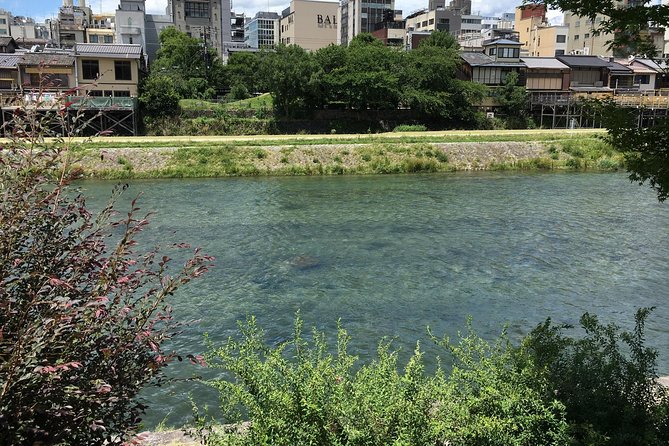
The route also passes through the grounds of the former seat of Japan’s imperial family. The supplied schedule does not give this stop a formal name or fixed visit length, so the exact timing may vary.
This part of the route helps you understand Kyoto as a former imperial capital rather than just a collection of temples. You ride through a large historic area, hear about its past, and get a break from the concentrated crowds around Kinkakuji.
I appreciate stops like this because they create breathing room. A full day of temples can become repetitive, especially in hot weather. Riding through open grounds and then continuing along city streets gives the day a better rhythm.
The guide’s local knowledge is especially useful on these transitions. The strongest guides, including Julian, Karl, Quinn, Jay, and Indra, have been praised for connecting different periods of Japanese history and explaining how religious and political life shaped Kyoto. You are not just being led from one pin on a map to another.
Gion closes the day with Kyoto’s most famous geisha district
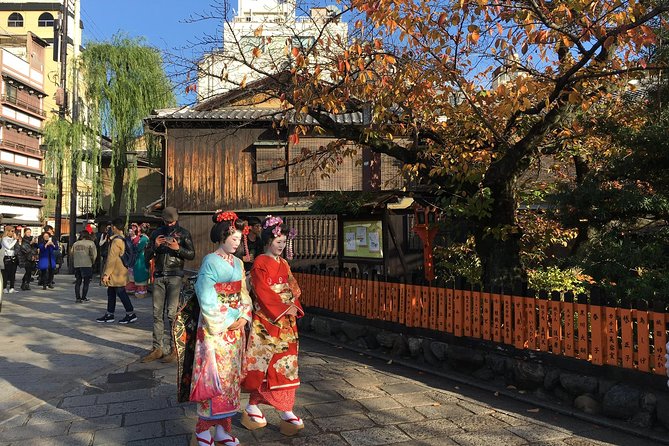
The final named stop is Gion, Kyoto’s best-known geisha district. You spend about 10 minutes here, learning about the area and the performers who work within its traditional entertainment world.
A short stop is appropriate. Gion is not a stage show, and you should not treat it like one. You might catch a glimpse of a geisha or maiko, but there is no promise of that. The useful part is learning how the district operates and how to behave respectfully in a place where people live and work.
The brief visit also avoids turning the end of the day into a long walk through crowded lanes. After several hours on a bicycle, ten minutes provides a focused introduction before the ride back to the meeting point.
Gion adds a different side of Kyoto to the itinerary. Nishi Honganji and Kitano Tenmangu show religious life, Kinkakuji brings grand architecture, and Gion introduces traditional arts and entertainment. The route has a clear range without trying to include every major sight in the city.
Lunch is more than a break
Lunch is included, but the exact restaurant can change. Stops have included a traditional noodle house, including one described as about 400 years old, as well as a sushi restaurant and a sushi train venue.
That flexibility is worth noting. If the planned noodle restaurant is closed, the guide may use a sushi venue instead. This is not a weakness if you want a fixed menu, but it is useful to know that the lunch setting is not guaranteed in advance.
The meal is one of the tour’s strongest features because it gives you a proper refueling stop within the sightseeing plan. You are not left to search for food while the group waits. Vegetarian options have also been arranged when requested, but dietary requirements need to be provided ahead of time.
Extra drinks are not included. Lunch and bottled water are covered, but you should budget for any additional beverages. Optional gratuities are also outside the stated price.
The $106.12 price and what you receive
At $106.12 per person, this is not the cheapest way to see Kyoto. It is also more than a simple bike rental because the price covers a guided route, a Cannondale bicycle, cycling equipment, bottled water, lunch, and temple admission.
The value depends on how you use the day. If you already know Kyoto well and prefer to set your own pace, renting a bike may suit you better. You will save money and can stop wherever you wish, though you will also handle navigation, route planning, traffic decisions, and explanations on your own.
For a first full day in Kyoto, the price is easier to justify. You can cover a wide area, learn how the main districts fit together, and gather ideas for the rest of your visit. Several guides also give practical suggestions for what to see after the tour, which can make the experience useful beyond the six-hour schedule.
A maximum of eight people adds value as well. This is not a large coach outing where questions get lost. The guide can learn names, watch the group, and adapt the pace. That personal attention is a major reason to choose this over a cheaper self-guided ride.
Fitness, weather, and the small details that matter
The activity requires moderate physical fitness. Riders must be at least 13 years old and comfortable riding a bike. Families have used the tour with teenagers, including groups with children aged 12 to 17, but the stated minimum age is 13, so confirm the age requirement before booking.
The route is described as about 13 miles, or 24 kilometers, over roughly six hours. Riding time makes up about 2.5 hours, with sightseeing breaks spread through the day. The pace is generally easy to moderate, and there are not many hills, but heat, humidity, and saddle time can make the day feel harder than the distance suggests.
Good weather is required. If poor weather cancels the tour, you can choose another date or receive a full refund. If you are visiting Kyoto for only a short time, booking early in your stay gives you more room to reschedule.
You can cancel for a full refund up to 24 hours before the start time. Changes or cancellations inside that window are not accepted for a refund. The tour also requires a minimum number of people, so a cancellation for that reason comes with a choice of another date or experience, or a full refund.
Who will like this North Kyoto ride
I would choose this tour if you want a clear introduction to Kyoto and prefer active sightseeing to sitting on buses. It suits first-time visitors, couples, solo riders, families with older children, and anyone who wants a local guide to explain temples and shrines rather than simply point them out.
It is also a good choice for people who enjoy small groups. Guides such as Julian, Indra, Quinn, Karl, Mayko, and Jay have been praised for warmth, humor, history, safety, and the ability to tailor the pace. The guide can make a major difference, and the exact personality will vary by date.
I would hesitate if you dislike cycling in city traffic, have not ridden for years, or want a slow day with no physical demands. The pace is not extreme, but the route is long enough to leave you tired. I would also choose another type of tour if Kinkakuji is your only priority, since you may prefer a shorter temple visit without six hours of riding.
Should you book it?
Book it if you want to see several sides of Kyoto in one well-paced day, especially if this is near the beginning of your visit. You will get famous sights, quieter streets, religious and imperial history, Gion, lunch, and a guide who can help you understand what you are seeing.
Skip it if you want total independence, dislike bicycles, or need a guaranteed restaurant and fixed route. For most reasonably fit visitors aged 13 and older, though, the combination of small-group guiding, included equipment, lunch, water, and admission makes the $106.12 cost fair. Bring a willingness to pedal, ask questions, and accept that Kyoto is best understood between the big sights as much as at them.
FAQ
Where does the bike tour begin?
It begins at Cycle Kyoto, 7 Higashikujō Nishisannōchō, Minami Ward, Kyoto, 601-8003, Japan.
What time does the tour start?
The scheduled start time is 10:00 am.
Where does the tour finish?
The activity ends back at the original meeting point.
How long does the experience last?
The tour lasts approximately 5 to 6 hours.
How far do you ride?
The route is about 13 miles, or approximately 24 kilometers. About 2.5 hours are spent cycling, with sightseeing breaks during the day.
Is lunch included?
Yes. Lunch is included, though the restaurant can vary. Noodle and sushi restaurants have been used.
Are temple entrance fees included?
Yes. Admission to Kinkakuji Temple is included.
What equipment is provided?
The tour provides a high-quality Cannondale bike, cycling equipment, guidance, and bottled water.
Are dietary requirements accepted?
Yes, but you need to provide dietary requirements ahead of time.
What is the cancellation policy?
You can cancel at least 24 hours before the start time for a full refund. Poor weather or failure to meet the minimum number of participants can result in another date or experience, or a full refund.
Just added around Kyoto
- Taste of Nishiki Market Walking Food Tour with Local guide★ 5.0 · 17 reviews
- Kyoto: Sushi Making Class with Sushi Chef★ 4.8 · 64 reviews
- Kyoto: City Secrets eBike Tour★ 4.9 · 196 reviews
- Sacred Pathways: Discover the Philosopher’s Path of Kyoto★ 4.9 · 20 reviews
- Private Tour to Monkey Park and Arashiyama Highlights★ 5.0 · 22 reviews
- Private Nara Tour from Osaka – Meet at Your Hotel★ 5.0 · 22 reviews
- Private Sake Tasting in Central Kyoto with Sake Sommelier★ 5.0 · 13 reviews
- Kyoto : Private Custom Walking Tour With A Local Guide★ 4.6 · 144 reviews
Cycling Tours, compared.
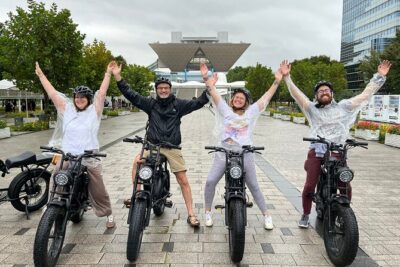

3h Tokyo E-Bike Tour: Hidden Gems, and Local Life with guide
Read our review →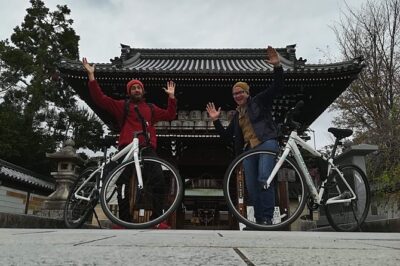
Arashiyama Bamboo Forest & Hidden Gems Bike Tour (Early Bird)
Read our review →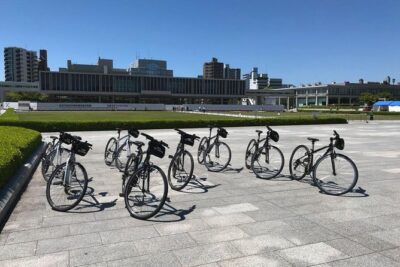
Hiroshima in a Nutshell: Morning Bike Adventure
Read our review →
5 Top Highlights of Kyoto Full Day Bike Tour (E-bike option)
Read our review →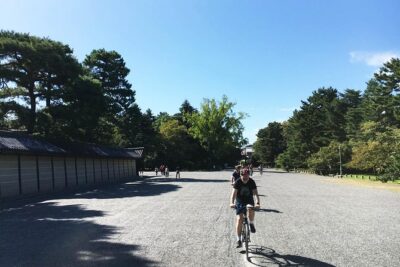
Full Day Biking Tour Exploring the Best of Kyoto
Read our review →Browse the lists this tour appears in