
REVIEW · DINNER EXPERIENCES
Dinner with Maiko in a Traditional Kyoto Style Restaurant Tour
Kyoto’s most unusual dinner experience is not just about eating. It gives you a close look at Gion’s geisha culture, then places you in a private dining room with a maiko, an apprentice geisha, for conversation, games, and a dance performance. Guides such as Hikari, Josh, and Peco have been praised for making the customs easy to understand.
I like the small maximum of seven, which keeps the evening personal, and I like that the guide translates your questions instead of leaving you to watch from a distance. The meal includes many small Kyoto-style dishes, with drinks such as sake, plum wine, beer, tea, and wine available according to the experience details.
The main caution is the seating. One customer found that people at the far end had only a partial view of the dance, and this matters even more if someone in your party needs a clear line of sight. At $299.95 per person, this is a special-occasion splurge rather than a casual night out.
In This Review
- Key points at a glance
- Why this Gion evening feels different
- The 40-minute walk through historic Gion
- Dinner in a private Kyoto-style restaurant
- Meeting a maiko, not just watching one
- The performance, games, and etiquette
- Is $299.95 a fair price?
- Who should book this experience
- Dietary needs, weather, and timing
- What to expect from the full three-and-a-half hours
- My recommendation
- FAQ
- How long does the Dinner with Maiko tour last?
- Where does the tour begin?
- Where does the tour end?
- What is the maximum group size?
- What is the minimum age?
- Can I request a special meal or report an allergy?
- Can I cancel for a full refund?
Key points at a glance
- A 40-minute Gion walk comes first: Learn about wooden machiya houses, local traditions, and small details you could easily miss on your own.
- The group never exceeds seven people: That gives you a better chance to ask questions and hear the guide’s explanations.
- The maiko performs dances and traditional games: The evening is participatory, not simply a stage show.
- Your guide translates the conversation: Guides including Hikari, Josh, and Peco have helped make questions about work and daily life feel comfortable.
- Dinner is a multi-course Kyoto meal: One account describes nine small traditional dishes, while the food quality is generally praised, though one person found it only okay.
- Plan for a long evening on foot: The tour lasts about three and a half hours and is not recommended if walking is difficult.
Why this Gion evening feels different
Many Kyoto cultural activities give you a performance and little else. This one builds context first. You begin at the Statue of Izumo-no-Okuni near Kawabatacho, then walk through Gion before settling into a traditional restaurant.
That order matters. You get to see the streets where geisha and maiko work before learning about their arts over dinner. A guide can explain the difference between a maiko and a geiko, describe the role of the entertainment districts, and point out features that would otherwise look like ordinary buildings.
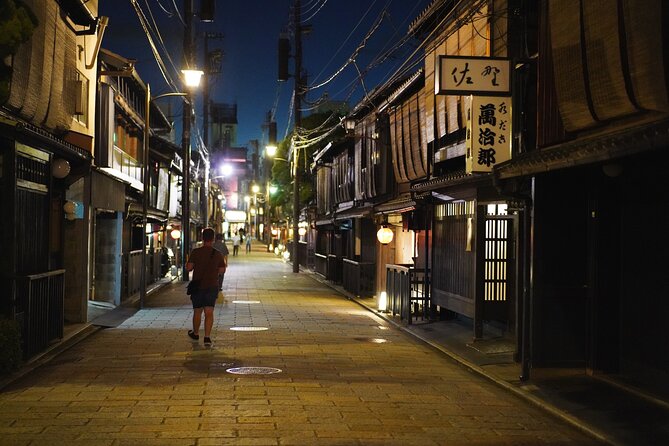
The walking portion lasts about 40 minutes. Expect a gentle orientation rather than a major sightseeing walk. The route passes traditional wooden machiya houses and preserved streets, and guides have pointed out small local details, including a school timetable that most visitors would simply walk past.
I like this introduction because Gion can be confusing. The district is famous, but it is also a working neighborhood with private homes, restaurants, schools, and businesses. A guide helps you look without treating the area like a film set. That is important in a place where respectful behavior matters.
The meeting point is central and close to public transportation, but arrive early. The tour starts on time, and a late arrival could mean missing part of the walk or holding up a small group.
A few more Kyoto trips to weigh up
- Kyoto Gion Cultural Walk & Geisha Show with Dining Options
★ 5.0 · 518 reviews - Kyoto Gion Cultural Walk & Geisha Show with Dining Options
★ 5.0 · 483 reviews - Kyoto: Geisha Dinner & Gion Cultural Walk
★ 5.0 · 73 reviews
The 40-minute walk through historic Gion
Gion is at its best when you slow down. Its narrow streets and wooden facades create the atmosphere most people hope to find in Kyoto, but the charm is easy to flatten into a few photographs. The guide adds useful meaning to what you are seeing.
You may learn why the machiya style matters, how the district developed its connection to geisha arts, and how to tell the difference between a public entertainment venue and a private space. The provided details do not give a fixed list of every sight, so the exact route may vary.
The walk is not designed for strenuous sightseeing. Still, you should be comfortable standing and walking for 40 minutes before dinner, followed by more movement at the end of the evening. The tour is specifically not recommended for people with mobility issues.
If you have trouble walking, the operator recommends a private tour instead. That may give you more control over the pace, but it is a separate booking choice, not an included feature of this small-group outing.
Dinner in a private Kyoto-style restaurant
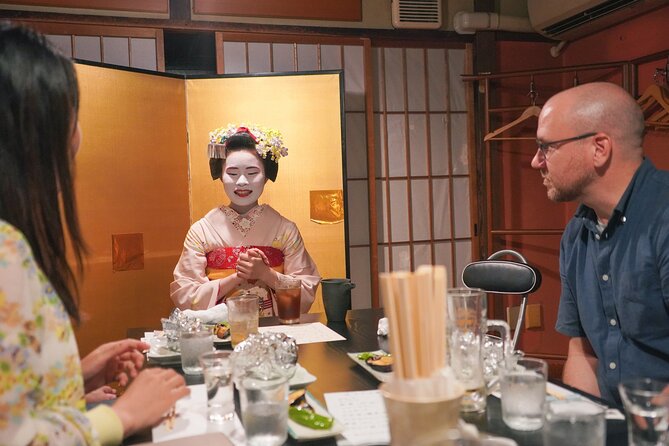
After the walk, the group heads to the restaurant, where the main part of the experience lasts about two hours and 40 minutes. The setting is private and intimate, with dinner served in a traditional restaurant or small teahouse-style room.
The food is a major part of the appeal. One description mentions nine small typical dishes, which gives you a chance to sample several flavors and textures rather than order one large plate. The meal is not simply fuel between sightseeing stops. It is part of the cultural setting.
The food receives strong praise overall, with several people describing it as delicious or top notch. One person found it just okay, so I would not book this solely as a gourmet meal. The stronger reason to go is the combination of the food, the room, the guide, and the maiko encounter.
Drinks may include alcoholic and nonalcoholic choices such as wine, sake, plum wine, tea, and beer. One account describes free-flowing drinks, but the exact drinks policy should be checked when booking because the supplied tour details do not spell out the full inclusion list.
The room’s layout deserves attention. One customer could not see the dance well from the far end because other people were seated between them and the maiko. If you have hearing loss or rely on visual access, contact the operator before booking and ask how seating is arranged.
Meeting a maiko, not just watching one
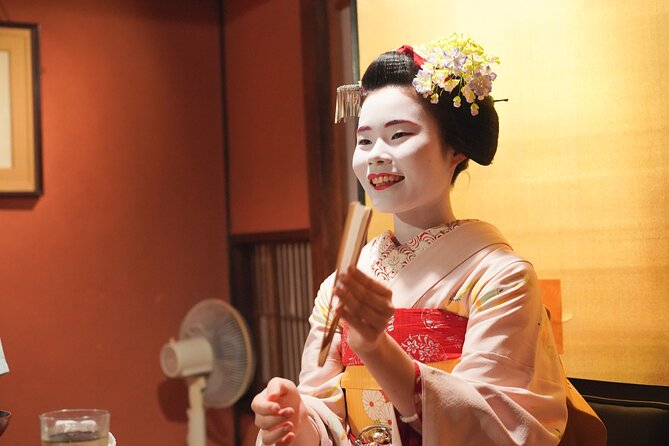
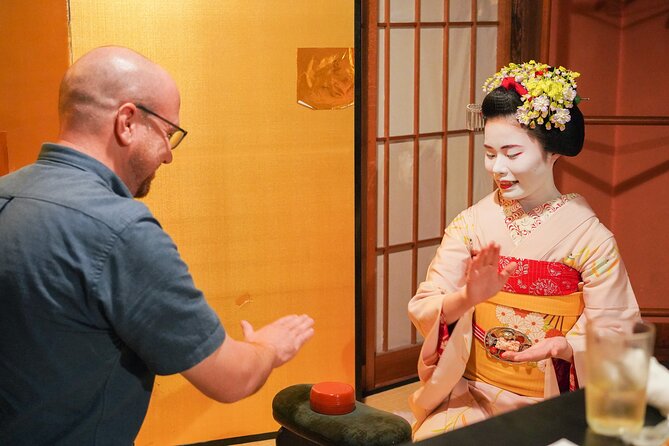
The maiko is the heart of the evening. She joins the group in the private setting, performs traditional dances, and takes part in games. You also have time to ask about her life, work, and decision to enter this demanding cultural path.
Your guide translates the conversation. That makes a big difference. Instead of trying to guess what is happening, you can ask direct questions and follow the answers. Guides Hikari, Josh, and Peco have each been singled out for warmth, energy, and clear explanations.
Hikari, in particular, has been praised for knowing a great deal about the arts and for helping people feel comfortable asking questions. Peco has been described as energetic and enthusiastic, even during heavy rain. Josh has also guided the Gion walk and dinner for a highly praised evening.
Do not expect a long private interview with unlimited one-to-one time. The activity is built around group conversation, performance, and traditional games. One person felt the exchange was less conversational than expected and thought the maiko was very young.
That point is worth taking seriously. A maiko is an apprentice, often young, and the interaction follows traditional entertainment customs. If your ideal experience is a lengthy discussion about modern Japanese society, this may feel too structured. If you want a respectful introduction to her training, performance, and daily work, the format should suit you better.
A geiko may attend instead of a maiko, as happened for one couple. That would be a pleasant surprise, but you should book with the understanding that the advertised experience centers on a maiko and that the exact performer is not guaranteed.
Same city, a completely different kind of day:
- PERFECT KYOTO 1-Day Bus Tour
★ 5.0 · 13,518 reviews - Kyoto: Fushimi Inari, Kinkakuji, Bamboo Grove 1 Day Bus Tour
★ 4.8 · 4,316 reviews - Kyoto: Tea Ceremony in a Traditional Tea House in Kiyomizu
★ 4.9 · 3,519 reviews - Kyoto Geisha Walking Tour: Gion District & Hidden Gems
★ 4.7 · 3,273 reviews
The performance, games, and etiquette
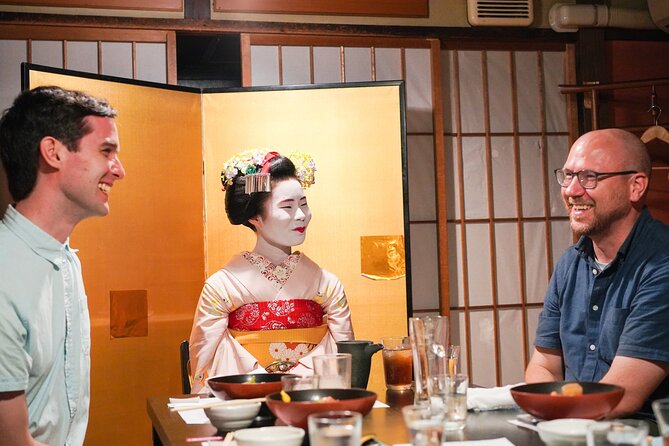
The performance gives the evening its ceremony. The dance is described as elegant, and watching it in a small room feels different from seeing a large theater show. You are close enough to notice the costume, posture, controlled movements, and formal presentation.
The traditional games make the event less passive. You may have a chance to join in, though the supplied information does not specify the exact games or how much participation each person receives. The guide helps explain what is happening and keeps the tone relaxed.
This is also where etiquette matters. The walk and dinner introduce you to a world that has its own customs. Listen to the guide, follow instructions, and let the maiko set the pace of the interaction. The best questions are likely to be curious and respectful rather than intrusive.
Photography rules are not provided, so ask the guide before taking pictures. Do not assume that every moment can be photographed simply because it takes place in a private room.
Is $299.95 a fair price?
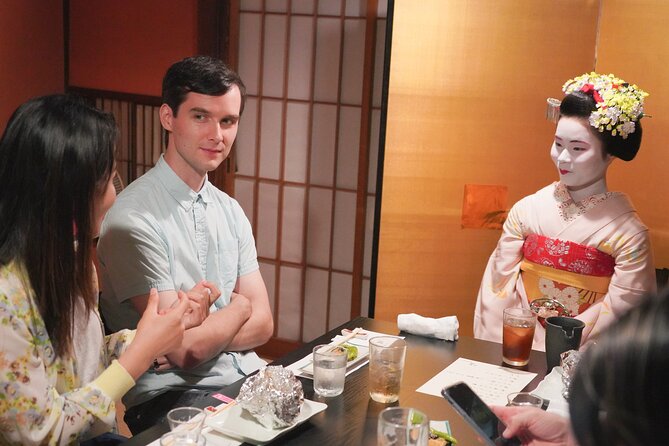
At $299.95 per person, the tour is expensive by Kyoto dinner standards. You are not paying only for the meal. The price covers a small-group guide, a Gion orientation, a private restaurant setting, translation, and access to a cultural performance that is not easy to arrange independently.
The group limit of seven is important to the value. A larger group might offer a similar performance, but you would have less time to ask questions and a greater chance of sitting far from the action. Here, the small size gives the guide more room to explain and helps the evening feel personal.
I would compare the price with your overall Kyoto budget and interests. If you already plan to attend several tea ceremonies, dance performances, and cultural talks, this may duplicate part of your schedule. If you want one concentrated evening focused on Gion’s traditional arts, the combination is more efficient than booking several separate activities.
The cost is easier to justify for a first visit to Kyoto when you want guidance. It is harder to justify if your priority is simply a high-end meal or a formal stage performance. The meal is well regarded, but the experience is not sold as a fine-dining tasting menu.
Who should book this experience
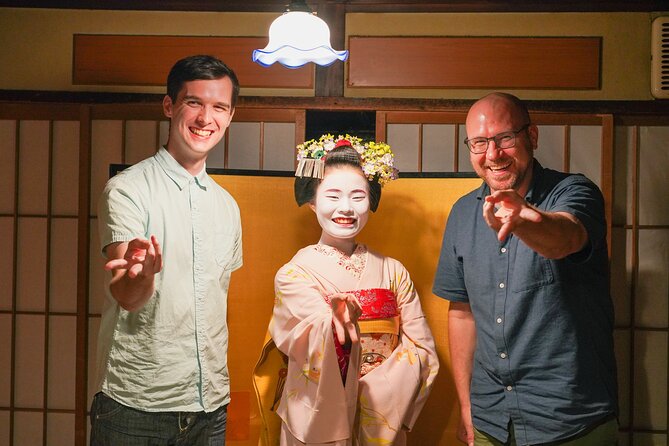
This tour suits adults and older teenagers who are curious about Japanese performance traditions and want to ask questions. The minimum age is 15, and small children and babies are not allowed. Families with younger children must book a private tour if they want to bring them.
It also suits you if you prefer a guide to explain social customs. Gion is easy to photograph and hard to understand from the outside. The walking tour provides context, while the translated conversation gives you a more direct connection to the people who carry on these arts.
Couples, friends, and solo visitors can all fit the format, though solo visitors should be comfortable sharing a table or private room with a small group. The tour has a maximum of seven people, not a private booking for your party alone.
I would hesitate to recommend it to anyone with serious mobility problems. The operator says a private tour is better in that situation. I would also think twice if you dislike set cultural performances, group dining, or food where the menu may not be fully customized.
Dietary needs, weather, and timing

Tell the operator about allergies or dietary requests at least one day before the tour. Requests made on the day cannot be accommodated, and allergy-free meals or substitutions cannot be guaranteed because the food is prepared in kitchens the operator does not control.
That warning is practical, not a footnote to ignore. If you have a serious allergy, ask specific questions before paying. A general request may not be enough.
Kyoto weather can be severe. Summer temperatures may reach 40°C, while winter temperatures can fall to -5°C. You will spend time outdoors during the Gion walk, so dress for the season and wear shoes suitable for walking.
The tour may be canceled for unsafe weather. If rain is possible, bring suitable protection and allow time to reach the meeting point without rushing. The start is at the Statue of Izumo-no-Okuni, and the evening ends at the restaurant in Gion rather than returning you to the original meeting point.
Cancellation information should be checked carefully before purchase. The supplied terms mention free cancellation up to 24 hours before the start, while another part says free cancellation or rescheduling is available up to seven days before. Since those limits conflict, confirm the current rule at checkout.
What to expect from the full three-and-a-half hours
The evening breaks down into three parts:
- About 40 minutes walking through Gion
- About 2 hours and 40 minutes at the restaurant with dinner and the maiko
- About 10 minutes walking through Kyoto after the evening
The final walk is short. It gives you a quiet end to the night as you leave the restaurant, but it is not a return transfer. The listed endpoint is the restaurant in Gion.
The long restaurant portion means the experience is not rushed. You have time for the meal, explanations, questions, performance, and games. It also means you should not schedule another evening activity immediately afterward.
I like this pacing. The first walk helps you get your bearings, the dinner provides a calm setting, and the short final stroll lets the evening wind down. The only weak point is that the experience depends heavily on the room layout and the quality of communication between guide and group.
My recommendation
I recommend this tour if you want one memorable Kyoto evening centered on Gion, traditional food, and direct contact with maiko culture. The best parts are the small group, the translated questions, and the chance to see a dance and join traditional games in a private setting.
Book it when the $299.95 price fits your budget and you value access over a cheap dinner. Ask about seating if clear sightlines matter, disclose dietary needs early, and confirm the cancellation deadline because the stated policies do not match.
Skip it if you want a quiet restaurant meal, a fully private encounter, or a long unstructured conversation with a performer. For the right person, though, this is one of Kyoto’s strongest cultural evenings, especially when a guide such as Hikari, Josh, or Peco helps turn a beautiful but unfamiliar tradition into something you can understand.
FAQ
How long does the Dinner with Maiko tour last?
The experience lasts approximately three hours and 30 minutes. It includes about 40 minutes walking in Gion, about two hours and 40 minutes at the restaurant, and a final 10-minute walk.
Where does the tour begin?
The meeting point is the Statue of Izumo-no-Okuni at Kawabatacho in Kyoto’s Higashiyama Ward. The location is near public transportation.
Where does the tour end?
The tour ends at the restaurant in Gion. It does not return you to the starting statue.
What is the maximum group size?
The tour has a maximum of seven travelers. It is designed as a small-group experience rather than a private tour.
What is the minimum age?
Participants must be at least 15 years old. Small children and babies are not allowed, even when accompanied by parents. Families with younger children should book a private tour.
Can I request a special meal or report an allergy?
Yes, but you must provide dietary requests or allergy information at least one day before the tour. Same-day requests cannot be accommodated, and allergy-free meals or substitutions cannot be guaranteed.
Can I cancel for a full refund?
The cancellation terms provided state that you can cancel at least 24 hours before the start for a full refund. Another section mentions seven days for free cancellation or rescheduling, so confirm the applicable deadline when booking.
Just added around Kyoto
- Private Guided Traditional Buddhist Cooking in Japan★ 5.0 · 16 reviews
- Kyoto: Gion Geisha District & Sake-in-Hand Walking Tour★ 5.0 · 37 reviews
- Kyoto: Zen Meditation at a Private Temple with a Monk★ 5.0 · 25 reviews
- Your Private Vacation Photography Session In Kyoto★ 5.0 · 110 reviews
- Traditional Japanese Washi Papermaking- Kyoto morning★ 5.0 · 77 reviews
- Kyoto Wagashi(Japanese sweets) Cooking Class near Fushimiinari★ 5.0 · 60 reviews
- Private Pewter Sake Cup Experience with a Kyoto Artisan★ 5.0 · 31 reviews
- Kyoto Private 6 hour Tour: English Speaking Driver Only, No Guide★ 5.0 · 88 reviews
Dinner Experiences, compared.
Tokyo Bar Hopping Tour in Shinjuku (All-You-Can-Drink + Dinner)
Read our review →
Deep Backstreet Osaka Tours (Option to add Dinner)
Read our review →
Deep Backstreets Walking Tour with Dinner Option
Read our review →
Sumida River: Japanese Traditional Yakatabune Dinner Cruise
Read our review →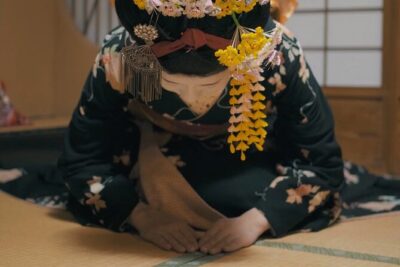
Kyoto Gion Cultural Walk & Geisha Show with Dining Options
Read our review →Kyoto Gion Cultural Walk & Geisha Show with Dining Options
Read our review →
Tokyo Bay Yakatabune Dinner/Day Cruise with Japan Show and Drinks
Read our review →Browse the lists this tour appears in