
REVIEW · KIMONO & CULTURE EXPERIENCES
Kyoto: Gion Geisha District Walking Tour and Hidden Gems
Kyoto’s Gion district is best understood on foot, one narrow lane at a time. This three-hour walk takes you from Ben’s Cookies near Shijo through Gion and northern Higashiyama, finishing at Kiyomizu-dera. Along the way, guides such as Ben and J, also called Jay, explain geisha training, religious customs, samurai-era Japan, and modern Kyoto.
I like the route’s strong sense of place and its unusually broad sweep of sights. I also like the way the guides leave room for ordinary questions about Japanese life, rather than delivering only a memorized list of temple facts. The drawback is physical: there are many steps, uphill sections, and crowded lanes, so this is not a good match for anyone with low fitness.
In This Review
- Key points
- Starting in Gion, where Kyoto’s old streets still work
- Tatsumi Bridge and the quiet side of Gion
- Chion-in, a major temple with a serious climb
- Maruyama Park, a breathing space between temples
- Hōkan-ji and the famous Yasaka-no-Tō view
- Ninen-zaka and Sannenzaka, Kyoto’s picture-book lanes
- Finishing at Kiyomizu-dera’s Niomon Gate
- What the guides add to the walk
- Three hours and $25: a useful Kyoto value
- Practical advice before you go
- Who will enjoy this Kyoto walk
- Should you book the Gion and hidden-corners walk?
- FAQ
- How long does the Kyoto Gion walking tour last?
- How much does the tour cost?
- Where does the tour begin?
- Where does the tour finish?
- What language is the tour conducted in?
- Does the tour include a guide?
- Which places are included on the route?
- What will I learn about geisha culture?
- What should I bring?
- Is the tour suitable for people with low fitness?
Key points
- A point-to-point route: You start near Shijo and finish at Kiyomizu-dera, so the walk gives you a useful tour of eastern Kyoto rather than circling back.
- Gion beyond the postcard view: You’ll learn how maiko and geisha train and work while walking past traditional wooden townhouses and teahouses.
- A guide-led history lesson: Ben, J, and Jay have been praised for connecting Kyoto’s sites with Japanese history, samurai culture, the Shinkansen, and daily life.
- Northern Higashiyama in one outing: Chion-in, Maruyama Park, Hōkan-ji, Ninen-zaka, and Sannenzaka fit into a busy three-hour route.
- Good for mixed ages: The explanations are designed to be accessible, and the route has worked well for families with children and an older grandparent.
- Bring water and expect stairs: The route is active, with frequent walking and many steps.
Starting in Gion, where Kyoto’s old streets still work

Meet your guide in front of Ben’s Cookies Kyoto Shijo, where the guide will hold a sign. This is a practical starting point near the Shijo area, and it puts you close to the historic side of Kyoto from the first few minutes.
The opening portion lasts about 10 minutes. Do not expect a long stop at the meeting point. The useful part is getting oriented, meeting the guide, and beginning to connect modern Shijo with the older streets ahead.
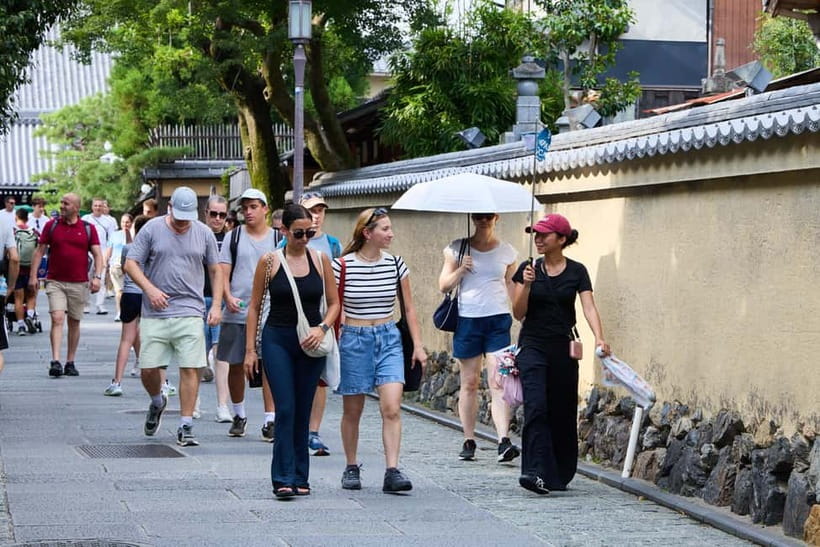
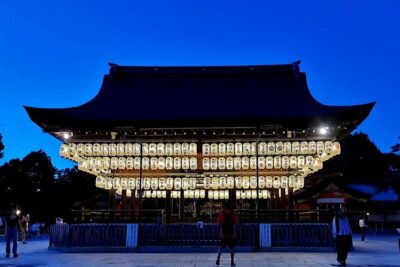
Gion is famous for its wooden townhouses, teahouses, lantern-lit lanes, and geisha culture. It is also a working district, not a stage set built only for sightseeing. Your guide can help you understand the difference between a maiko, a geisha, and the businesses that support their training and performances.
That explanation matters because Gion can be easy to misread. A quick walk through the district may give you pretty doors and atmospheric alleys, but not much sense of what happens behind them. A guide adds the social context, including the discipline, customs, and daily work associated with geisha life.
More Kimono & Culture Experiences in Kyoto
- Kyoto Geisha Walking Tour: Gion District & Hidden Gems
★ 4.7 · 3,273 reviews - Kyoto: Gion Magical Night Walking Tour with Geisha Trivia
★ 4.9 · 2,393 reviews - Kyoto: Gion Geisha District Walking Tour – Stories of Geisha
★ 4.7 · 2,187 reviews
Tatsumi Bridge and the quiet side of Gion
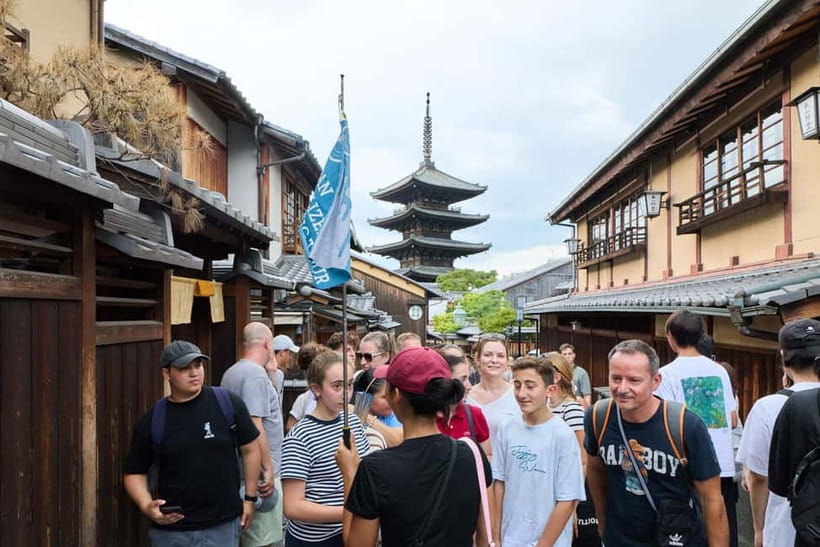
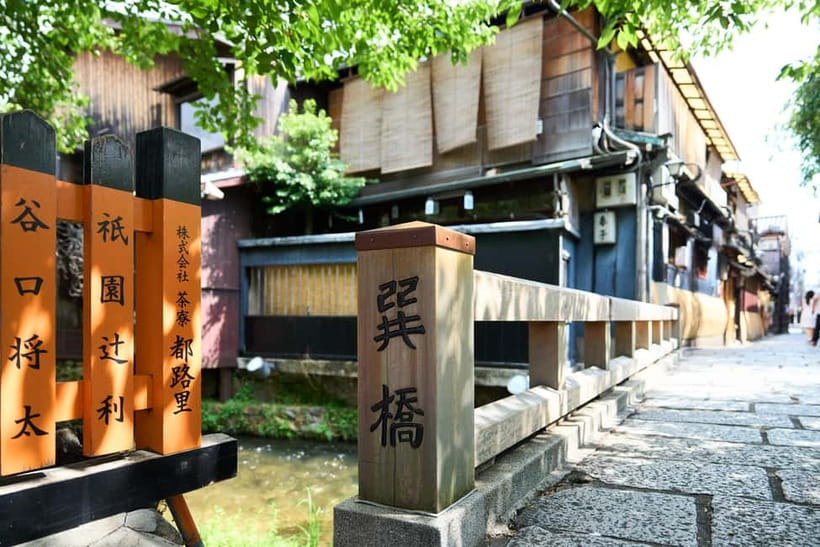
Gion Tatsumi Bridge is the first substantial stop, with about 20 minutes for a guided visit. The bridge and nearby lanes offer the kind of classic Kyoto setting many people hope to see: water, traditional architecture, carefully maintained streets, and a calmer mood than the larger shopping roads.
This is a good place to listen rather than hurry. Your guide may use the surroundings to explain how Kyoto’s old neighborhoods developed and how the city changed from imperial capital to modern cultural center. The experience is strongest when you ask questions. The guides have been praised for handling broad topics, including ordinary life in Japan and the differences between Japanese and Western history.
Photography is an obvious pleasure here, but keep your attention on the street as well. Gion’s charm comes from small details: the shape of a wooden façade, a narrow passage, or a shrine tucked into an otherwise ordinary block. You are not simply moving from one famous address to another. You are learning how the district fits together.
Chion-in, a major temple with a serious climb
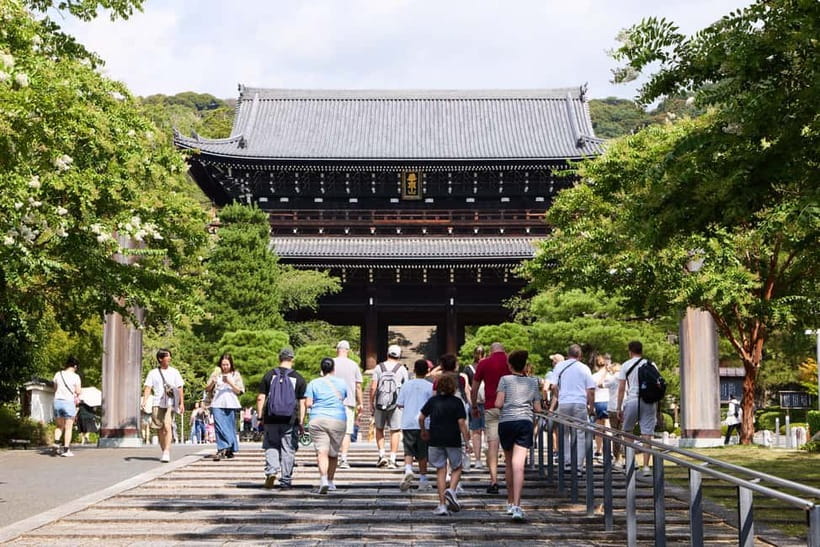
The route then reaches Chion-in for about 30 minutes. This is one of the longest stops and one of the places where the guide’s historical background becomes especially useful.
Chion-in is a major religious site, and the approach gives the tour a clear change of pace. Gion’s intimate lanes give way to a larger temple setting with broad approaches, steps, and formal spaces. Your guide explains Kyoto’s religious traditions and the role such places have played in the city’s past.
The stairs are not a minor detail. The tour information specifically warns that there are many steps, and this stop helps explain why you should wear comfortable shoes and carry water. The walk is manageable for people who are used to active sightseeing, but it is not a relaxed, flat stroll.
I like that Chion-in gives the route more weight than a purely scenic Gion walk. You get architecture and atmosphere, but you also get a chance to discuss belief, ceremony, and the way religion shaped Kyoto. Since the guide can adapt explanations to questions, you can ask for more detail about the temple or keep the conversation at a general level.
Maruyama Park, a breathing space between temples
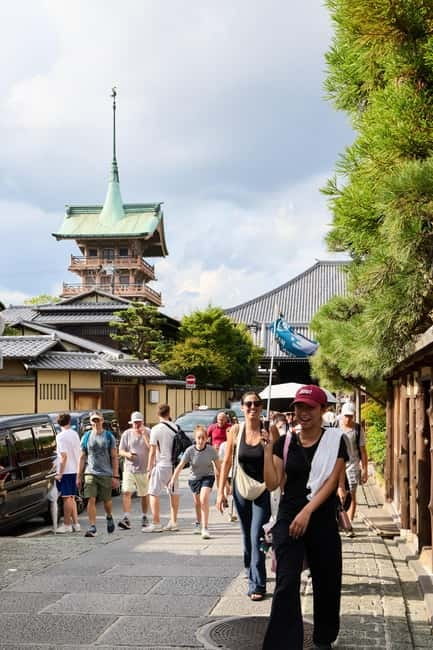
After Chion-in, the walk continues to Maruyama Park for roughly 20 minutes. This section gives you a break from enclosed lanes and temple approaches.
Parks are useful on a walking tour because they let you absorb what you have just seen. The guide can connect the religious sites and old neighborhoods with Kyoto’s present-day public life. You may find the park especially welcome after the steps at Chion-in.
This is also one of the better places to pause, refill your attention, and ask questions. One guide has been noted for allowing rest when possible during the three-hour route. That makes a real difference. A long walking tour can feel rushed if every stop is treated like a timed photo opportunity.
The park stop is not the main attraction of the outing, but it helps the route breathe. It also keeps the experience from becoming a nonstop march through temples and narrow streets.
More Walking Tours in Kyoto
- Private Kyoto Tour with a Local, Highlights & Hidden Gems, Personalised
★ 5.0 · 1,543 reviews - Kyoto Gion Geisha District Walking Tour – The Stories of Geisha
★ 5.0 · 1,441 reviews - Nishiki Market Brunch Walking Tour (7 Tastings + Brunch)
★ 5.0 · 1,355 reviews - Kyoto Arashiyama Walking Tour: Bamboo, Monkeys, Gardens & Secrets
★ 5.0 · 1,216 reviews
Hōkan-ji and the famous Yasaka-no-Tō view
The next stop is Hōkan-ji, with about 10 minutes of guided time. The temple is widely associated with its tall pagoda, often called Yasaka-no-Tō, and it is one of the most recognizable sights in this part of Kyoto.
Ten minutes is enough for an introduction and photographs, but not for a long temple visit. That is worth understanding before booking. This tour is designed to show you a large part of the district and explain what you are seeing. It is not a slow, detailed study of every temple interior.
The short stop works because Hōkan-ji fits naturally into the walk toward the preserved streets of Ninen-zaka and Sannenzaka. The guide can point out how the pagoda, sloping lanes, and wooden buildings form one of Kyoto’s most familiar scenes.
This is also where the route may feel most crowded. The old streets are popular, and the charm comes with uneven paving, steps, and limited room. Stay close enough to hear the guide, especially if the group is larger than the small group some people have experienced.
Ninen-zaka and Sannenzaka, Kyoto’s picture-book lanes
Ninen-zaka and Sannenzaka each receive about five minutes of guided attention. That may sound brief, but the walking itself continues through these historic streets, so the total time in the area is longer than the formal stop suggests.
The lanes are lined with preserved wooden buildings, shops, food outlets, and traditional-style façades. They are among Kyoto’s most recognizable walking areas, and they offer plenty of photo opportunities. The guide’s role is to help you look past the surface and understand why the streets feel different from a modern commercial district.
The slopes are part of the experience. Sannenzaka means a three-year slope, and Ninen-zaka means a two-year slope, names that are tied to local tradition. The provided tour information does not promise a detailed explanation of those names, so ask your guide if that question interests you.
What you can count on is a short, active passage through one of eastern Kyoto’s most atmospheric areas. You may want to return later on your own, especially if you prefer to browse at a slow pace. During the tour, the group needs to keep moving toward the final stop.
Finishing at Kiyomizu-dera’s Niomon Gate
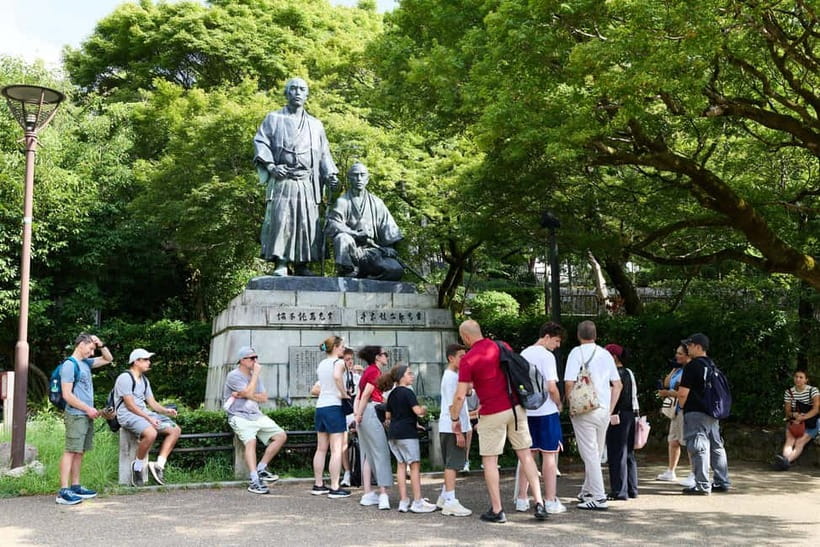
The tour ends at the Niomon Gate of Kiyomizu-dera. This point-to-point design is one of the route’s practical strengths. You do not walk all the way through eastern Kyoto and then retrace your steps to Gion.
The ending also feels well chosen. After Gion, Chion-in, Maruyama Park, Hōkan-ji, Ninen-zaka, and Sannenzaka, you arrive at one of Kyoto’s major temple entrances with a clearer sense of how the district connects.
The gate makes a memorable finale, but the tour does not include a separate visit inside Kiyomizu-dera beyond ending at the Niomon Gate. If you want to explore the temple grounds, you can continue on your own after the walk. Plan your energy accordingly, since the final approach comes after several hours on foot.
The finish is especially useful for first-time visitors. You have covered a broad section of Kyoto’s cultural center, and you can decide from there if you want to enter Kiyomizu-dera, shop along the nearby lanes, or make your way elsewhere.
What the guides add to the walk
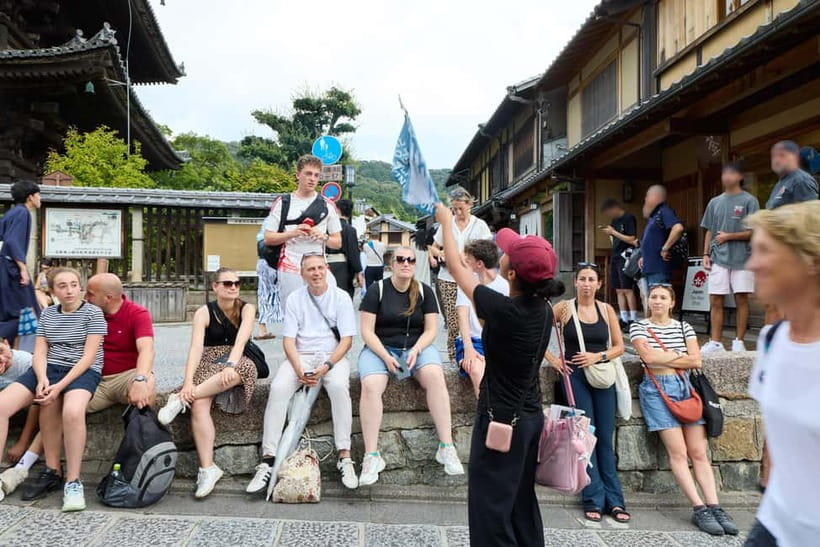
The main reason to book this experience is the guide. Ben has been described as patient, accommodating, and strong on Kyoto’s history. J, also called Jay in the tour comments, has been praised for lively explanations, a history degree, and the ability to answer questions in depth.
Those details suggest a tour that works best as a conversation, not as a silent march behind a flag. You can ask about geisha customs, Japanese history, daily life, samurai, the Shinkansen, or even cultural subjects such as tanuki. The guide’s range is useful because Kyoto’s sights are connected to more than one period or tradition.
The style also suits families. A group with children aged 11 and 15, a parent, and a 79-year-old grandparent found the explanations easy to follow and the pace enjoyable. That does not remove the physical demands, but it suggests the material is not written only for history specialists.
A small group can make the experience feel almost personal, though group size may vary. With more people, hearing every explanation in narrow lanes can be harder. Stay near the guide and speak up if you miss a point.
Three hours and $25: a useful Kyoto value
At $25 per person, this is a strong-value way to cover several major areas of eastern Kyoto with a live English-speaking guide. You are paying for interpretation and route planning, not admission to a paid attraction.
The value is highest if you are new to Kyoto or have limited time. In three hours, you see Gion, Chion-in, Maruyama Park, Hōkan-ji, Ninen-zaka, Sannenzaka, and the entrance to Kiyomizu-dera. Doing that independently is possible, but you would need to research the route and find your own explanations.
The tradeoff is pace. Six named stops in three hours means the tour keeps moving. You will not have unlimited time for shopping, lingering photographs, or detailed temple visits. I would treat this as an orientation walk, then return independently to the places that catch your interest.
The high rating of 4.9 from 14 reviews supports the idea that the guide quality is the tour’s strongest feature. Still, the limited number of ratings means you should judge the experience mainly by the route, walking demands, and guide-led format.
Practical advice before you go
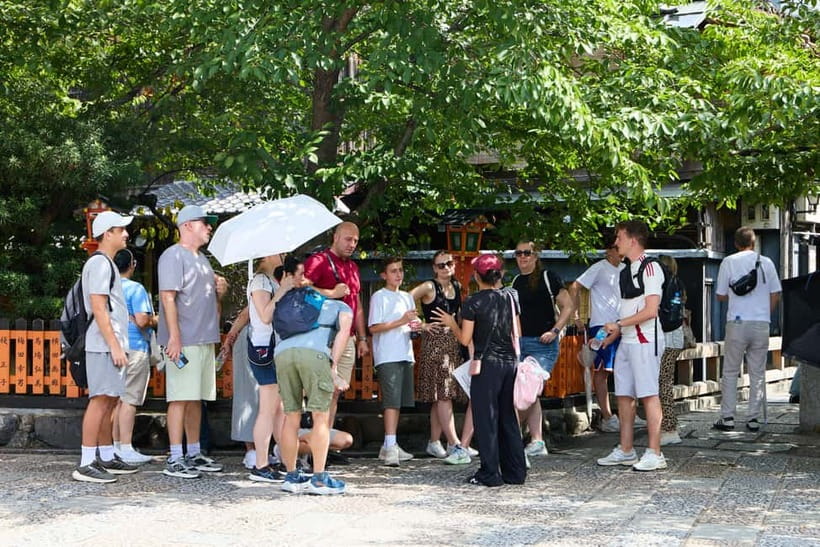
Bring water. That simple instruction matters because of the steps, hills, and three-hour duration.
Wear shoes suited to uneven streets and stairs. The route includes temple approaches and sloping historic lanes, so fashion footwear that is uncomfortable after an hour will become a problem.
Arrive at Ben’s Cookies Kyoto Shijo with enough time to spot the guide’s sign. The activity is in English, and the guide will be holding a sign in front of the shop.
Keep your expectations clear. You are not booking a private geisha encounter or a formal performance. You are walking through the district and learning about geisha culture, training, traditions, and work from a local guide.
The tour is not suitable for people with a low level of fitness. Alcohol and drugs are not allowed. If your plans may change, free cancellation is available up to 24 hours before the start, and you can reserve now while paying later.
Who will enjoy this Kyoto walk
I would recommend it to first-time Kyoto visitors who want context before exploring on their own. It is also a good fit if you want to cover the Gion and northern Higashiyama area without spending hours planning a route.
Families can benefit from the clear storytelling, especially if children are old enough to walk for three hours and manage stairs. The tour can also suit older adults who are active, but the route should not be confused with an easy stroll.
History-minded people will get the most from guides such as Ben and J, who connect the sights with larger questions about Japanese history and modern life. You should also book it if you enjoy asking questions rather than simply taking photographs.
I would choose another option if you want a slow food walk, a private experience, extensive shopping time, or a temple tour focused on interiors and ritual detail. This outing covers ground. Its strength is range, explanation, and local orientation.
Should you book the Gion and hidden-corners walk?
Book it if you want an affordable, active introduction to Kyoto’s most atmospheric eastern districts. The route is well chosen, the finish at Kiyomizu-dera is useful, and the guides bring personality and historical context to places that can otherwise blur together.
Skip it if stairs are difficult or if you prefer to explore at your own pace. For everyone else, $25 buys three hours of focused sightseeing and a much better understanding of what you are looking at. Bring water, wear good shoes, and stay ready to ask questions. That is where this tour earns its price.
FAQ
How long does the Kyoto Gion walking tour last?
The tour lasts three hours.
How much does the tour cost?
The listed price is $25 per person.
Where does the tour begin?
The meeting point is in front of Ben’s Cookies Kyoto Shijo, where the guide will hold a sign.
Where does the tour finish?
The tour finishes at the Niomon Gate of Kiyomizu-dera.
What language is the tour conducted in?
The live guided tour is conducted in English.
Does the tour include a guide?
Yes. A live English-speaking guide leads the walking tour.
Which places are included on the route?
The route includes Gion Tatsumi Bridge, Chion-in, Maruyama Park, Hōkan-ji Temple, Ninen-zaka, Sannenzaka, and the Niomon Gate of Kiyomizu-dera.
What will I learn about geisha culture?
You will learn about geisha traditions, training, work, and daily life as you walk through Gion and its surrounding streets.
What should I bring?
Bring water. Comfortable footwear is also a sensible choice because the tour includes many steps.
Is the tour suitable for people with low fitness?
No. The activity information says it is not suitable for people with a low level of fitness because there are many steps during the tour.
Just added around Kyoto
- Taste of Nishiki Market Walking Food Tour with Local guide★ 5.0 · 17 reviews
- Kyoto: Sushi Making Class with Sushi Chef★ 4.8 · 64 reviews
- Kyoto: City Secrets eBike Tour★ 4.9 · 196 reviews
- Sacred Pathways: Discover the Philosopher’s Path of Kyoto★ 4.9 · 20 reviews
- Private Tour to Monkey Park and Arashiyama Highlights★ 5.0 · 22 reviews
- Private Nara Tour from Osaka – Meet at Your Hotel★ 5.0 · 22 reviews
- Private Sake Tasting in Central Kyoto with Sake Sommelier★ 5.0 · 13 reviews
- Kyoto : Private Custom Walking Tour With A Local Guide★ 4.6 · 144 reviews
Kimono & Culture Experiences, compared.
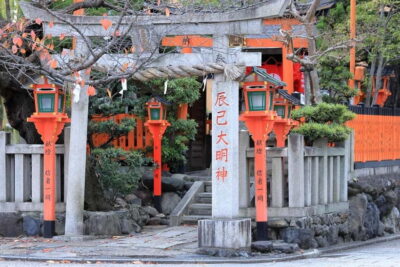
Kyoto Geisha Walking Tour: Gion District & Hidden Gems
Read our review →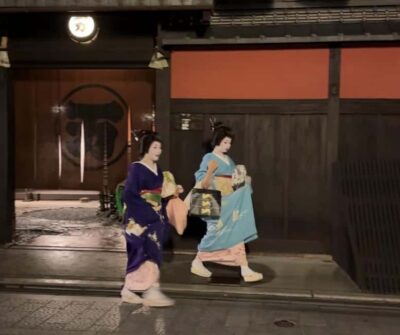
Gion Magical Night Walking Tour with Geisha Trivia
Read our review →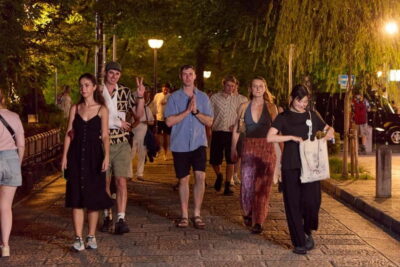
Gion Geisha District Walking Tour – Stories of Geisha
Read our review →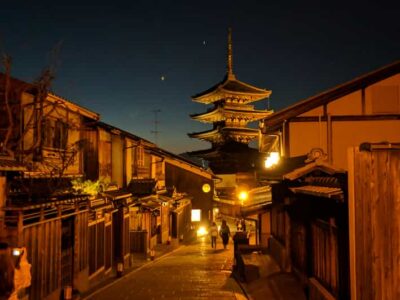
Best of Kyoto: Gion, Geisha, Pagodas & Cobblestones
Read our review →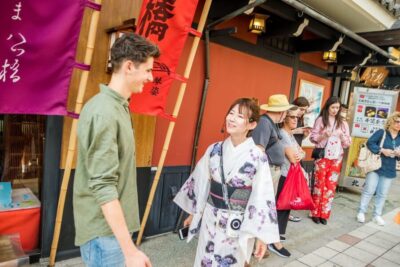
Kyoto Gion Geisha District Walking Tour – The Stories of Geisha
Read our review →
Browse the lists this tour appears in