
REVIEW · WALKING TOURS
Kyoto Early Bird Walking Tour
Kyoto’s famous sights are at their best before the day gets going. This private early-morning tour takes you through Fushimi Inari’s torii gates, to Kinkaku-ji as it opens, and into Arashiyama’s bamboo grove before the crowds fill the paths. I like the smart timing and the fact that a guide handles the public transportation between sites. The main drawback is simple: you must be ready for a very early start and quite a bit of walking.
I also like that the tour finishes around noon, leaving your afternoon open for Gion, Nishiki Market, or a quiet temple visit. Guides such as Akiko, Sumiko, Kaz, and Miho are praised for clear explanations, route-finding, family-friendly help, and even taking photos. Just remember that Kinkaku-ji admission and ¥1,220 in transportation costs are not included in the tour price.
In This Review
- Key points to know before booking
- Why the early start matters in Kyoto
- Meeting at Kyoto Station and finding your way
- Fushimi Inari’s vermilion torii gates
- Kinkaku-ji in the morning light
- Arashiyama’s bamboo forest before noon
- What a private guide adds
- The pace, walking, and physical demands
- Price and what you still need to budget
- Who should book this Kyoto morning tour
- Should you book the Kyoto Early Bird Walking Tour?
- FAQ
- Where does the Kyoto Early Bird Walking Tour start?
- Where does the tour end?
- How long does the tour last?
- Which attractions are included?
- Is Kinkaku-ji admission included?
- Is public transportation included?
- Is this a private tour?
- Can I cancel for a full refund?
Key points to know before booking
- Three major sights in one morning: Fushimi Inari, Kinkaku-ji, and Arashiyama’s bamboo forest are spread across Kyoto, yet the tour connects them in about five hours and fifteen minutes.
- The early start is the real advantage: You reach the torii gates and Golden Pavilion before the worst crowds build.
- Private touring keeps the pace flexible: Only your group participates, and guides have adjusted the order or timing when needed.
- Public transit is part of the experience: Your guide leads you through the trains and buses, a useful service when the destinations sit far apart.
- Plan for walking and weather: Comfortable shoes, water, and sun protection matter, especially in summer.
- The afternoon remains free: Ending by noon makes this a useful first-day orientation to Kyoto.
Why the early start matters in Kyoto
The strongest reason to choose this tour is not the number of sights. It is the hour.
Kyoto’s most photographed places can change character quickly. Fushimi Inari is more peaceful when you can move through the first stretch of vermilion gates without a wall of tour groups around you. Kinkaku-ji is at its most striking when the gilded pavilion reflects in the pond and the grounds are still relatively quiet. Arashiyama’s bamboo grove also feels cooler and calmer before the midday rush.
That does not mean you will have every path to yourself. These are popular places, and the early morning advantage is one of degree, not magic. Still, starting early gives you a much better chance of seeing the sites clearly and taking photographs without constant interruptions.
The schedule also suits Kyoto’s weather. The bamboo grove offers shade and cooler air, but walking between three major locations takes effort. By finishing around noon, you do much of the outdoor sightseeing before the day becomes hotter.
More Walking Tours in Kyoto
- Kyoto Geisha Walking Tour: Gion District & Hidden Gems
★ 4.7 · 3,273 reviews - Kyoto: Gion Magical Night Walking Tour with Geisha Trivia
★ 4.9 · 2,393 reviews - Kyoto: Gion Geisha District Walking Tour – Stories of Geisha
★ 4.7 · 2,187 reviews
Meeting at Kyoto Station and finding your way
The tour begins at the Kyoto Station Building at 901 Higashishiokōjichō, in Shimogyo Ward. This is a practical meeting point because Kyoto Station is the city’s main transportation hub, but the building is large and can feel confusing when you are tired or arriving for the first time.
A useful detail from the experience is the guide’s role before and during the trip. Makoto, for example, sent a photograph of the meeting point ahead of time and explained the rain forecast. Other guides have provided printed schedules or helped groups understand which train and bus to take next.
You pay ¥1,220 per person for public transportation separately. That cost covers the necessary train and bus travel listed for the route, but you should treat it as part of the tour budget, not an unexpected add-on. If you already use an IC card such as Suica, having it charged can make boarding quicker. One family specifically found a smartphone Suica useful for trains, buses, and vending machines.
The guide does more than point toward a platform. You can follow someone who knows the route, instead of stopping to decode station signs or second-guessing the transfer. That is especially valuable because the three stops sit in different parts of Kyoto. The transportation is not private, so you still ride with the public, but your guide keeps the morning moving.
Fushimi Inari’s vermilion torii gates
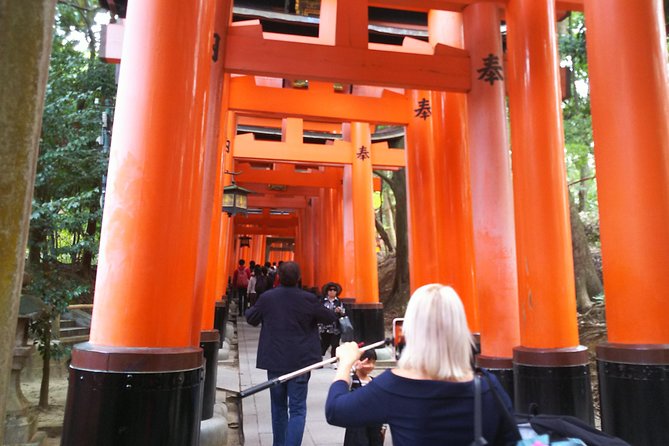
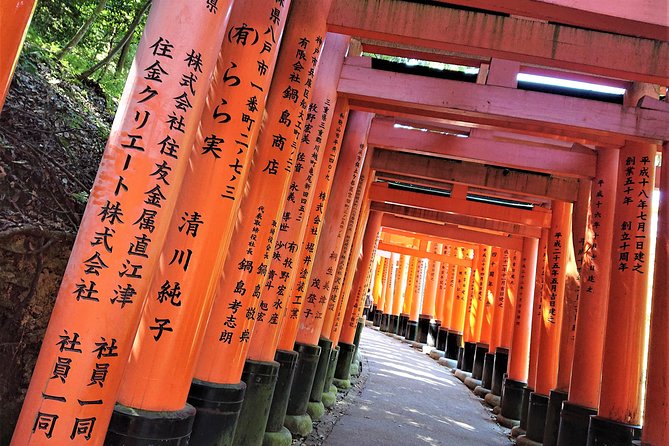
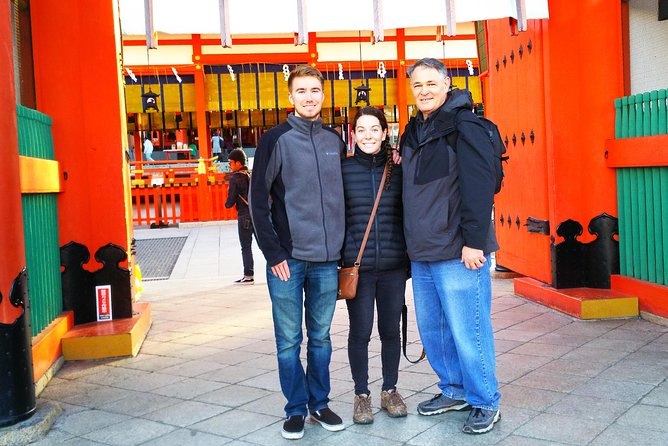
The first stop is Fushimi Inari-taisha Shrine, with about an hour to explore. Admission is free.
The shrine is famous for its long tunnel of orange-red torii gates. Each gate was offered by a worshipper, business, or organization in thanks for good fortune connected with the deity honored here. As you walk beneath them, the repeating pattern creates one of Kyoto’s most memorable scenes.
The tour does not promise a full climb to the mountain summit. The listed visit lasts about an hour, so you should expect a focused walk through the shrine area and the most recognizable gates rather than an exhaustive hike. Your guide can explain the Shinto customs and the meaning of what you are seeing, which adds much more than simply arriving at a photo spot.
The timing is crucial. Fushimi Inari is open early, so it makes sense as the first stop. The paths can become crowded later in the morning, especially near the lower gates and the main photographic sections. An early arrival gives you room to walk at a reasonable pace and listen without repeatedly stepping aside.
Wear shoes with good support. Even the lower part of the shrine involves walking, slopes, and steps. If you have limited mobility, the tour is listed as accessible, but you should still consider how much walking your own group can comfortably manage.
Kinkaku-ji in the morning light
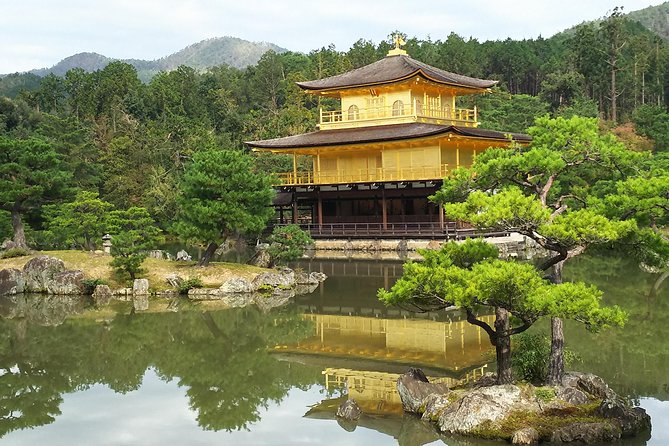
Next comes Kinkaku-ji, better known as the Golden Pavilion. The visit lasts about an hour, and the ¥500 admission fee is extra.
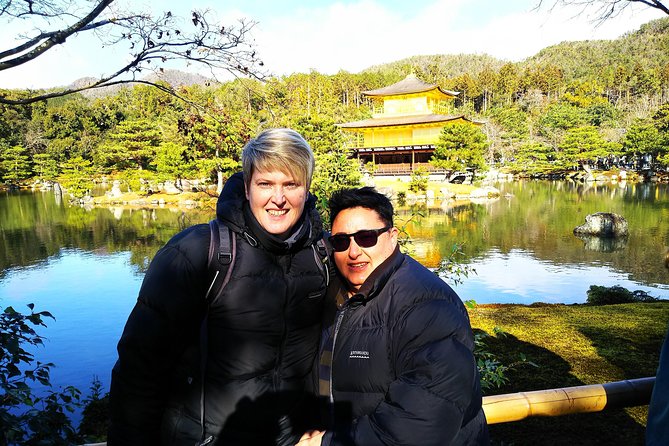
This Zen temple is one of Kyoto’s visual icons. The upper levels are covered in gold leaf, and the building sits beside a pond where the reflection can be as important as the structure itself. Morning light can make the pavilion look especially crisp, and entering soon after opening helps you see it before the grounds become crowded.
Kinkaku-ji is not a place where you wander freely through the pavilion’s interior. The pleasure comes from the approach, the pond, the surrounding garden, and the changing views as you follow the prescribed route. A guide can give the building context, including its connection to Zen practice and Samurai-era culture, so the stop feels less like a quick photograph.
The one-hour visit is enough for the principal view and garden walk, but not for a slow, detailed examination of every corner. That is part of the trade-off in this itinerary. You cover three major sights in one morning, so each stop receives a strong introduction rather than an extended study.
For many first visits to Kyoto, that balance works well. You see the Golden Pavilion at a favorable time, learn why it matters, and still have time for Arashiyama. If Kinkaku-ji is your main priority and you prefer to linger, a separate visit would give you more control.
Same city, a completely different kind of day:
- PERFECT KYOTO 1-Day Bus Tour
★ 5.0 · 13,518 reviews - Kyoto: Fushimi Inari, Kinkakuji, Bamboo Grove 1 Day Bus Tour
★ 4.8 · 4,316 reviews - Kyoto: Tea Ceremony in a Traditional Tea House in Kiyomizu
★ 4.9 · 3,519 reviews - Kyoto: Tea Ceremony Ju-An at Jotokuji Temple
★ 4.9 · 3,207 reviews
Arashiyama’s bamboo forest before noon
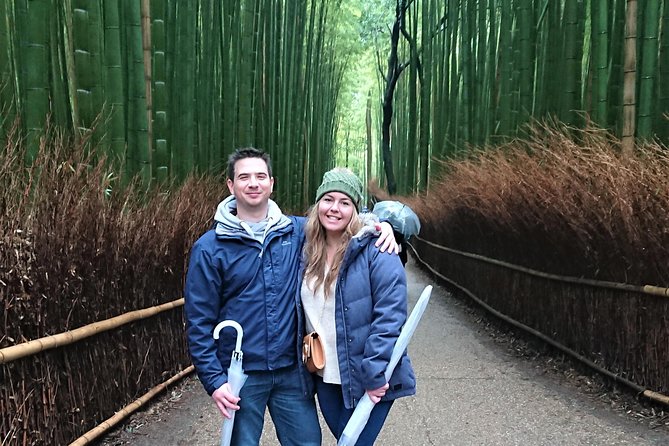
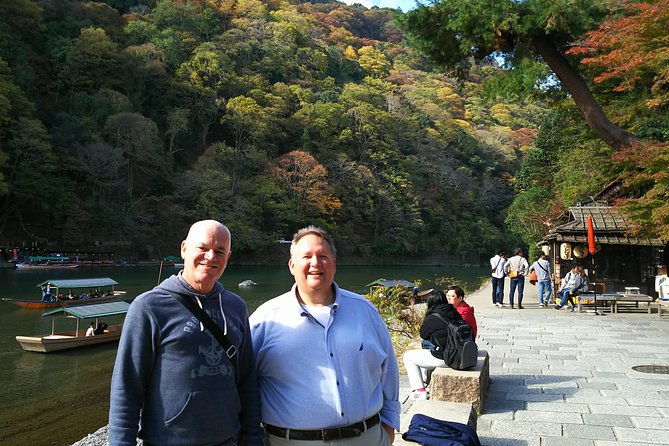
The final main stop is Arashiyama, also scheduled for about an hour. The bamboo forest is free to enter.
The grove is famous for its tall bamboo stalks, narrow paths, and soft green light. In the early morning, the air can feel cool, and the sound of wind moving through the bamboo gives the place a quality that photographs do not fully capture. Your guide may invite you to pause, close your eyes, and listen, a small moment that helps you experience the grove rather than rush through it.
Again, the timing does the heavy lifting. Arashiyama can become crowded later in the day, and the narrow paths offer limited room for stopping. The early visit gives you a better chance to walk through at a steady pace and find clear angles for photographs.
An hour is enough for the main bamboo path, but Arashiyama is a larger district with temples, gardens, river views, and other sights. This tour focuses on the bamboo forest. If you want to spend much of the day in Arashiyama, you will need to return or continue exploring after the guided portion ends.
That can be an advantage. The tour brings you to the area early, and you can decide later if you want to stay longer. Since the official end is back at the Kyoto Station meeting point, you should ask your guide about the precise timing if you hope to remain in Arashiyama independently.
What a private guide adds
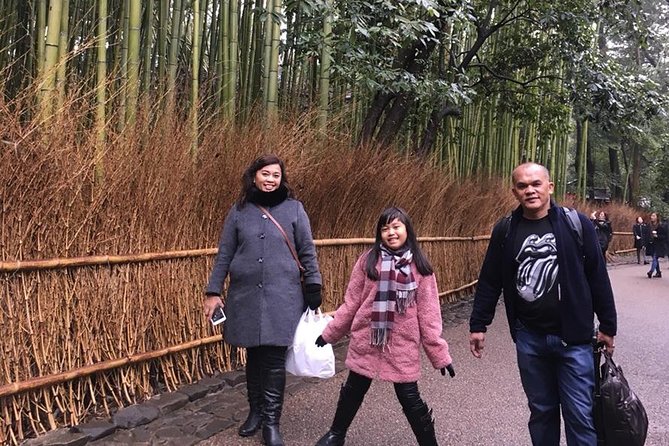
This is a private activity, meaning only your group takes part. That is a meaningful difference from a large group walk. Your guide can explain customs at a pace that suits your family, answer questions, and notice when someone needs water or a restroom.
The guides have different personalities, but the recurring strengths are clear. Akiko is praised for being friendly, helpful with children, and willing to take photographs. Sumiko has supplied printed agendas, found good photo spots, and offered detailed explanations of Japanese history and culture. Kaz has adjusted the order when asked and connected with children through topics such as Studio Ghibli films.
Miho and Mihu have helped groups move through the train and bus system with little wasted time. Hiro has explained Buddhist and Shinto ceremonies and even helped a participant locate a pharmacy. These details matter because a good guide is not only a source of facts. The guide also serves as your practical partner for the morning.
You cannot select a specific guide with certainty unless the operator confirms it. Names associated with this experience include Akiko, Megumi, Kaz, Tomoko, Hiro, Sumiko, Emiko, Kazuo, Mihu, Makoto, Makiko, Naoko, Miho, Miko, and Toshi. The consistently high rating, 4.9 from 377 ratings with 99 percent recommending it, suggests a strong level of satisfaction, but individual guide assignment may vary.
The pace, walking, and physical demands
Five hours and fifteen minutes sounds manageable until you add three sites, several transfers, stairs, shrine paths, temple grounds, and the movement required in a busy city. This is an active half-day, not a gentle stroll with long café breaks.
The tour information calls for moderate physical fitness and recommends comfortable shoes. Bring water, especially in summer. One practical tip is to carry a sun umbrella or other sun protection during hot weather. The early start helps with heat, but it does not remove the need to walk.
The tour is listed as accessible for people with limited eyesight and limited mobility. Even so, accessibility in practice depends on your personal needs and comfort with public transportation, uneven surfaces, and the amount of walking. If stairs or long walks are difficult, contact KAMNAVI Tours before booking and explain your situation.
Animals and pets are allowed according to the stated conditions. The experience is not recommended for people with heart conditions. Those points are easy to overlook, but they are important when deciding if this fast-moving route suits your group.
Price and what you still need to budget
The tour costs $105.45 per person. That is a substantial price for a five-hour morning, but the value depends on what you want help with.
You are paying for a private guide, route planning, cultural explanation, and the ability to cover three far-flung Kyoto sights without managing the connections alone. For a family or small group, group discounts may improve the price. The private format also means the guide can answer your questions and adjust the pace more easily than a standard shared tour.
You still pay ¥1,220 per person for public transportation and ¥500 per person for Kinkaku-ji admission. Food and drinks are not included. The two stated extras are modest beside the tour fee, but you should add them before comparing this experience with a self-guided morning.
A self-guided visit costs less and gives you more time at each site. The trade-off is planning the route, finding the right trains and buses, learning the background on your own, and managing the clock. I see the tour as better value for a first morning in Kyoto, a family group, or anyone who wants to reduce navigation stress.
Who should book this Kyoto morning tour
I would recommend it most strongly for first-time Kyoto visitors with limited time. The route gives you three major reference points in one morning and helps you understand how the city fits together.
It also works well for families. Guides have been praised for helping children, taking family photos, and responding to small needs along the way. The private setting means you do not have to worry about slowing a large group or keeping strangers waiting.
This is a good match for early risers and people dealing with jet lag. One family found it especially useful on a first day in Kyoto, when being awake early was easy and having help with transport made the city less stressful.
I would be more cautious if you dislike fixed schedules, want long visits at each temple, or have difficulty walking. The itinerary is efficient by design. You see a lot, but you do not have unlimited time to linger.
Free cancellation is available up to 24 hours before the start time for a full refund. The experience requires good weather, and if poor weather causes cancellation, you are offered another date or a full refund.
Should you book the Kyoto Early Bird Walking Tour?
Book this tour if your priority is seeing Kyoto’s three headline sights before the crowds, with a private guide handling the trains, buses, explanations, and timing. The early start is not a minor feature. It is the reason the route works so well.
I would choose it for a first full day, a short Kyoto stay, or a family group that wants a clear introduction without spending hours navigating. Bring comfortable shoes, water, sun protection in warm months, and money for ¥1,220 in transit plus ¥500 for Kinkaku-ji.
Skip it if you want a slow temple morning or plan to spend the whole day in one district. For everyone else, this is a smart, active way to meet Kyoto early, see its most famous sights in better conditions, and keep the rest of the day for your own plans.
FAQ
Where does the Kyoto Early Bird Walking Tour start?
The tour starts at the Kyoto Station Building, at 901 Higashishiokōjichō, Shimogyo Ward, Kyoto, 600-8216, Japan.
Where does the tour end?
The activity ends back at the meeting point at Kyoto Station.
How long does the tour last?
The tour lasts approximately 5 hours and 15 minutes and finishes around noon.
Which attractions are included?
The route includes Fushimi Inari-taisha Shrine, Kinkaku-ji Temple, and Arashiyama’s bamboo forest.
Is Kinkaku-ji admission included?
No. Kinkaku-ji admission costs ¥500 per person and is paid separately.
Is public transportation included?
No. Public transportation costs ¥1,220 per person and are not included in the tour price.
Is this a private tour?
Yes. Only your group participates in the activity.
Can I cancel for a full refund?
Yes, you can cancel at least 24 hours before the start time for a full refund. Cancellations or changes made less than 24 hours before the start time are not refunded or accepted.
Just added around Kyoto
- Taste of Nishiki Market Walking Food Tour with Local guide★ 5.0 · 17 reviews
- Kyoto: Sushi Making Class with Sushi Chef★ 4.8 · 64 reviews
- Kyoto: City Secrets eBike Tour★ 4.9 · 196 reviews
- Sacred Pathways: Discover the Philosopher’s Path of Kyoto★ 4.9 · 20 reviews
- Private Tour to Monkey Park and Arashiyama Highlights★ 5.0 · 22 reviews
- Private Nara Tour from Osaka – Meet at Your Hotel★ 5.0 · 22 reviews
- Private Sake Tasting in Central Kyoto with Sake Sommelier★ 5.0 · 13 reviews
- Kyoto : Private Custom Walking Tour With A Local Guide★ 4.6 · 144 reviews
Walking Tours, compared.
Kyoto Geisha Walking Tour: Gion District & Hidden Gems
Read our review →
Tokyo Tsukiji Fish Market Food and Culture Walking Tour
Read our review →
Gion Magical Night Walking Tour with Geisha Trivia
Read our review →
Imperial Palace and Shogun Historical Walking Tour
Read our review →
Gion Geisha District Walking Tour – Stories of Geisha
Read our review →
Asakusa Walking Tour with Sensoji Temple Visit
Read our review →
Kyoto Gion Geisha District Walking Tour – The Stories of Geisha
Read our review →Browse the lists this tour appears in