
REVIEW · CYCLING TOURS
Start from Kyoto Station: Early Morning E-Bike Tour with Kyotoite
Kyoto is at its best before the tour buses arrive, and this early-morning e-bike ride uses that quiet window well. You pedal from near Kyoto Station to Fushimi Inari, Gion, Nanzen-ji, and Heian Shrine, with backstreets and riverside stretches filling the gaps between the headline sights.
I like the small maximum group of six, which makes it easier to hear your guide and stay together. I also like the local feel: guides such as Aki, Sato, and Ryuto have been praised for clear English, Kyoto insight, route planning, and family photos. The main consideration is physical: the ride is not hard for most active people, but it does include hills, city traffic, and several hours in the saddle.
In This Review
- Key points at a glance
- Why an early e-bike ride works in Kyoto
- Starting at Kyoto Station’s east side
- Fushimi Inari and its famous torii gates
- Sanjusangendo and the 1,001 Kannon figures
- Gion by the Shirakawa River
- Nanzen-ji, a quieter Zen pause
- Heian Shrine and the old capital
- Following the Kamogawa River back
- How much value do you get for $84.92?
- Fitness, weather, and daily timing
- Who should book this Kyoto e-bike tour?
- Should you book it?
- FAQ
- Where does the Kyoto e-bike tour begin?
- How long does the experience last?
- What sights are included?
- What is included in the price?
- How large is the group?
- What are the operating hours?
Key points at a glance
- Start near Kyoto Station: Meet at Kyoto ECO Trip Flagship, a practical location for anyone staying near the station.
- See four major Kyoto areas by bike: Fushimi Inari, Gion, Nanzen-ji, and Heian Shrine form the backbone of the route.
- Ride beyond the usual tourist path: Quiet backstreets, the Shirakawa River, Miyagawa-cho, Tatsumi Bridge, and the Kamogawa River add local texture.
- Small group, maximum six people: You get more access to the guide and less chance of being separated from the group.
- Equipment is supplied: The fee includes an e-bike, helmet, bottled water, raincoat, and liability insurance.
- Allow three and a half hours: The stated duration includes riding time, so you should plan the rest of your morning around a late return.
Why an early e-bike ride works in Kyoto
Kyoto’s main sights can become crowded soon after breakfast. Starting early lets you move through famous districts before the heaviest foot traffic, while the bicycle carries you between areas that are too far apart for a comfortable walk and awkward to link by subway.
The tour begins at 7:30 a.m. from March through June, and at 8:30 a.m. from January through February. The seasonal schedule matters. A winter start is still early, but the later departure gives you a little more daylight and warmth. From March onward, you are on the road while much of the city is still getting going.
The route is not a race. It combines riding with short visits and explanations, and the listed duration is about three hours and 30 minutes. One guide-led outing has run longer than scheduled, so keep some flexibility afterward if you have a train, lunch reservation, or timed entry.
The e-bikes help with Kyoto’s long east-west distances and modest hills. Still, electric assistance does not turn this into a motorized sightseeing vehicle. You need to pedal, follow city cycling rules, and remain comfortable riding in an urban setting.
A few more Kyoto trips to weigh up
- Hidden Kyoto E-Biking tour
★ 5.0 · 1,843 reviews - Bike Tour Exploring North Kyoto plus Lunch
★ 5.0 · 1,087 reviews - Arashiyama Bamboo Forest & Hidden Gems Bike Tour (Early Bird)
★ 5.0 · 613 reviews
Starting at Kyoto Station’s east side
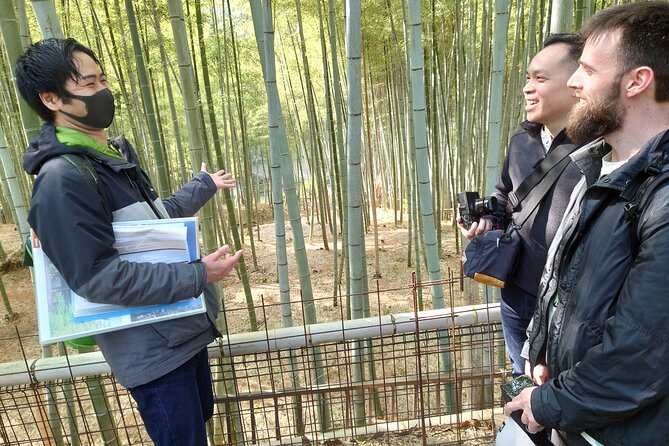
The meeting point is Rental Bicycle Kyoto ECO Trip Flagship shop at 58 Higashikujo Muromachi, in Minami Ward. It is close to Kyoto Station, making the tour especially convenient if you are staying nearby or arriving by train.
You receive the bicycle, helmet, bottled water, raincoat, and liability insurance as part of the booking. Snacks are not included, so eat beforehand. An early departure leaves little time for a relaxed breakfast after meeting the group.
With only six people maximum, the guide can keep a close eye on the pace and route. That is useful in Kyoto, where a group can quickly become scattered at a busy junction or shrine entrance. Families have also found the format workable, including a group with teenagers aged 13, 17, and 19.
Ask about the bicycle setup before you set off. One detailed account described the bikes as traditional in style and not overly bulky, a useful advantage when you are handling them around narrow streets and temple approaches.
Fushimi Inari and its famous torii gates
The first ride takes about 20 minutes. Fushimi Inari-taisha is one of Kyoto’s essential stops, best known for its thousands of orange torii gates climbing the wooded slopes behind the shrine.
The tour gives you about 50 minutes here, enough to see the lower shrine area and walk into the torii corridor without trying to cover the entire mountain. That is a sensible choice. Fushimi Inari can occupy half a day if you hike all the way to the summit, but this bicycle route has several more districts to reach.
The lower shrine grounds can fill quickly later in the morning. Arriving early gives you a better chance to appreciate the gates as a passage rather than simply a backdrop for photographs. Your guide can also explain the connection between the shrine, the fox statues, and the Shinto tradition, depending on the questions you ask.
There is a practical tradeoff here. You will not have unlimited time for a full mountain climb, and you should not expect to explore every side trail. If Fushimi Inari is your single top priority, plan a separate return visit.
Sanjusangendo and the 1,001 Kannon figures
After Fushimi Inari, you ride about 15 minutes to Sanjusangendo Temple. The stop is known for its interior display of 1,001 statues of Kannon, the Buddhist goddess of mercy.
The provided schedule does not specify a visit length or admission arrangement for this stop, so confirm on the day how much time is available and whether the tour enters the hall. That point matters because Sanjusangendo’s main attraction is indoors, unlike the torii gates and river routes that you see from the bicycle.
Even a short visit adds variety to the morning. Fushimi Inari presents Shinto worship through gates, fox imagery, and mountain paths. Sanjusangendo shifts the focus to Buddhist sculpture and a striking indoor arrangement. The two stops together give you a useful introduction to Kyoto’s overlapping religious traditions.
Same city, a completely different kind of day:
- PERFECT KYOTO 1-Day Bus Tour
★ 5.0 · 13,518 reviews - Kyoto: Fushimi Inari, Kinkakuji, Bamboo Grove 1 Day Bus Tour
★ 4.8 · 4,316 reviews - Kyoto: Tea Ceremony in a Traditional Tea House in Kiyomizu
★ 4.9 · 3,519 reviews - Kyoto Geisha Walking Tour: Gion District & Hidden Gems
★ 4.7 · 3,273 reviews
Gion by the Shirakawa River
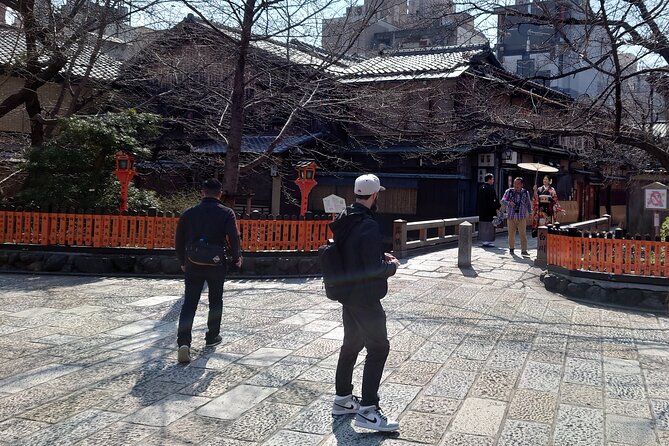
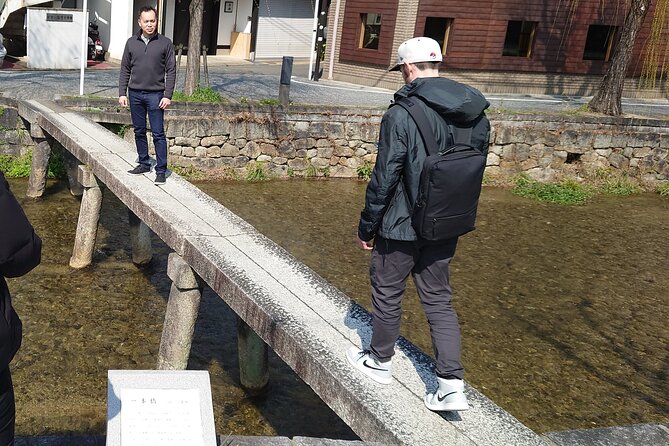
A roughly 10-minute ride leads toward the Shirakawa River and the old streets around Miyagawa-cho and Tatsumi Bridge. This is one of the more appealing parts of the route because you are not simply ticking off a major monument. You are moving through the lanes and waterways that give Gion its distinctive character.
Gion is famous as Kyoto’s geisha district, but it is also a working neighborhood. Ride quietly, keep your distance from people and private entrances, and follow your guide’s lead. The narrow streets are better suited to slow cycling and observation than to stopping wherever you like.
Tatsumi Bridge and the Shirakawa area are particularly photogenic, and the guide may help you frame family or group pictures. Aki has been praised for taking photos at several stops, which is handy when nobody wants to be left out of every group shot.
The route also includes Miyagawa-cho, another historic entertainment district. The value here is the connection between places. You see how rivers, lanes, bridges, and small neighborhoods fit together rather than jumping from one isolated temple to another by vehicle.
Nanzen-ji, a quieter Zen pause
From Gion, the ride to Nanzen-ji takes about 15 minutes. This major Zen temple gives the morning a calmer, more spacious stop after the narrow streets of the geisha district.
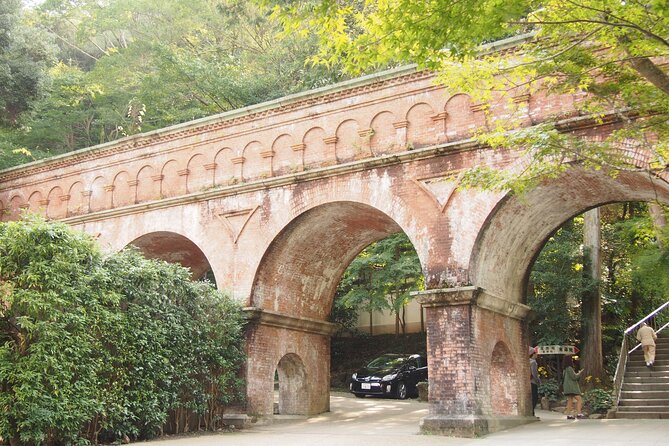
You spend about 20 minutes at Nanzen-ji, with no admission fee listed for the tour. The temple complex is known for its Zen setting and its large brick aqueduct, an unusual piece of Meiji-era infrastructure within a historic religious site. The supplied tour details do not promise a particular building or sub-area, so your guide will determine the exact stopping point and explanation.
Twenty minutes is enough to get a feel for the grounds, but not enough for a slow inspection of every gate, garden, and subtemple. Think of this as a well-chosen introduction. You can return later if Nanzen-ji becomes a favorite.
This stop also gives your legs a break. The route has several riding segments, but the short temple visits prevent the morning from feeling like nonstop cycling.
Heian Shrine and the old capital
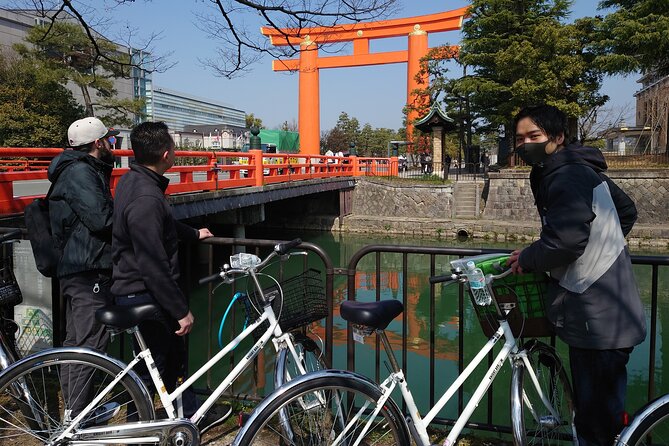
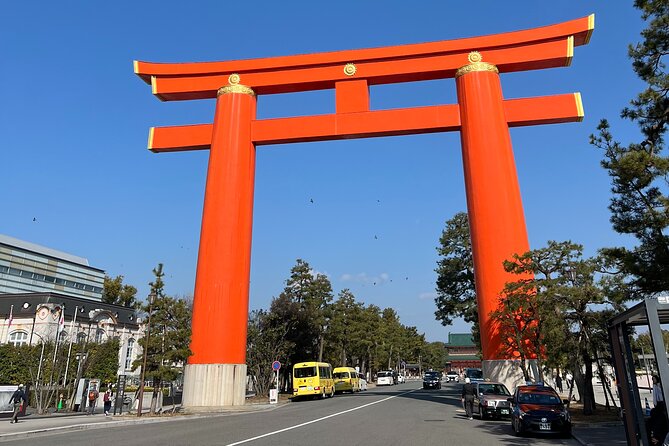
A 10-minute ride brings you to Heian Shrine, the final main stop. The shrine is associated with Kyoto’s role as Japan’s imperial capital, which began more than 1,000 years ago, although the supplied tour description presents it as a symbol of the capital from about 800 years ago.
You have around 20 minutes here. The broad approach and large vermilion structures make Heian Shrine feel very different from the intimate lanes of Gion and the dense torii passage at Fushimi Inari.
The contrast is part of the route’s strength. In a single morning, you move from a mountain shrine to Buddhist sculpture, a traditional entertainment district, a Zen temple, and a major Shinto shrine. The guide’s explanations are important because the visual differences are obvious, while the cultural connections may not be.
Some guides, including Ryuto and Riuto in the tour’s recorded experiences, have been praised for explaining Shinto, Buddhism, and Kyoto’s past in clear English. Names and guide assignments can change, but the small group gives you a good chance to ask questions rather than simply listen to a fixed speech.
Following the Kamogawa River back
The final ride follows the Kamogawa River for about 20 minutes back to the Flagship shop. This is a pleasant way to finish because the river route offers a change from temples, lanes, and city intersections.
You return to the same meeting point, rather than being dropped at a different neighborhood. That simplifies the rest of your day, especially if you are staying near Kyoto Station. It also means you should collect anything you need for the morning before departure.
The return is not just dead time. Riverside riding helps connect the northern and southern parts of the route, and it gives you a less crowded view of Kyoto’s daily rhythm. Keep in mind that the total time includes all riding, so the actual stops are relatively brief.
How much value do you get for $84.92?
At $84.92 per person, this is not the cheapest way to rent a bicycle for a morning. You are paying for more than the machine: a prepared route, a guide, helmets, water, rain protection, liability insurance, and a small group limited to six.
The price makes more sense if you want to cover several scattered sights without planning the route yourself. Fushimi Inari, Gion, Nanzen-ji, and Heian Shrine are not all next door to one another. A self-guided rider must work out the safest connections, parking, timing, and order of stops.
You also get local interpretation. Guides such as Aki, Sato, and Ryuto have been praised for route navigation, good English, historical explanations, patience, and food suggestions for after the ride. That last detail can be useful when the tour ends before lunch and you want a nearby recommendation.
The value is weaker if you dislike bicycles, want long unhurried temple visits, or already know Kyoto’s cycling routes. This is a moving overview, not a full guided study of each site.
Fitness, weather, and daily timing
Most people can participate, according to the supplied tour information, but you should be comfortable riding for several hours. One account specifically noted that the ride was not too strenuous but included some hills. The e-bike assistance helps, yet you still need balance, awareness, and enough stamina for repeated starts and stops.
Urban riding requires attention. Kyoto’s backstreets can be narrow, and famous districts may have pedestrians. The route is designed to avoid as much foot traffic as possible, but conditions change. Follow the guide closely and slow down near crossings, bridges, and temple entrances.
Rain does not automatically cancel the experience because a raincoat is included. Still, wet streets can make cycling less pleasant, and one outing ended with rain. Wear clothes you can move in and shoes suited to riding and walking.
The early start is both the attraction and the challenge. You get quieter streets and cooler conditions, but you must be ready at the meeting point soon after breakfast time. From March through June, the 7:30 a.m. opening is particularly useful for fitting more sightseeing into the day. From January through February, the 8:30 a.m. start is later, but winter weather may still affect comfort.
Who should book this Kyoto e-bike tour?
I would recommend it most strongly to first-time Kyoto visitors who want an efficient orientation without spending the whole morning underground or in taxis. It also suits families with older children and teenagers, couples, and small groups who value conversation with a guide.
The tour works well if you enjoy seeing famous places from several angles. You ride along rivers, pass through older neighborhoods, and stop at major religious sites. That mix feels more connected than a string of isolated taxi rides.
It is less suitable for anyone seeking a slow temple morning. The 20-minute stops at Nanzen-ji and Heian Shrine are introductions, and Fushimi Inari receives about 50 minutes rather than a full mountain expedition.
You should also think carefully if hills or city cycling are a concern. The e-bikes reduce effort, but they do not remove the need to ride. Ask yourself if you would be comfortable staying with a group on urban streets for three and a half hours.
Should you book it?
Book this tour if you want to see a broad slice of Kyoto before the crowds build, and if you value a human guide more than unlimited time at each temple. The route is smart, the group is genuinely small, and the included equipment removes the usual bicycle-rental hassle.
I especially like it for a first or second day in Kyoto. It helps you understand the city’s geography, points out areas worth revisiting, and leaves you with much of the day still available.
Skip it if your priority is a deep visit to Fushimi Inari, Nanzen-ji, or Sanjusangendo, or if you would rather walk slowly and linger. At $84.92, the tour earns its price through route planning, equipment, and local guidance, not through lengthy time inside every sight.
FAQ
Where does the Kyoto e-bike tour begin?
It begins at Rental Bicycle Kyoto ECO Trip Flagship shop, 58 Higashikujo Muromachi, Minami Ward, Kyoto, 601-8001, Japan. The shop is near Kyoto Station.
How long does the experience last?
The approximate duration is three hours and 30 minutes, including riding time. The activity ends back at the original meeting point.
What sights are included?
The route includes Fushimi Inari-taisha Shrine, Sanjusangendo Temple, the Shirakawa River, Miyagawa-cho, Tatsumi Bridge, Gion, Nanzen-ji Temple, Heian Shrine, and the Kamogawa River.
What is included in the price?
The price includes use of an e-bike, a helmet, bottled water, a raincoat, and liability insurance. Snacks are not included.
How large is the group?
The tour has a maximum of six participants. This allows closer access to the guide and makes it easier to stay together while riding.
What are the operating hours?
From January 1 through February 28, 2026, the tour operates on Mondays from 8:30 a.m. to noon. From March 1 through June 30, 2026, it operates Monday through Sunday from 7:30 a.m. to 11 a.m. Free cancellation is available up to 24 hours before the start time.
More Morning in Kyoto
- Kyoto Early Morning Tour with English-Speaking Guide
★ 5.0 · 1,427 reviews - Kyoto: Early Morning Tour with English-Speaking Guide
★ 4.9 · 1,128 reviews - From Kyoto: Nara Guided Morning Tour
★ 4.6 · 335 reviews - Kyoto Morning Tour from Kyoto or Osaka
★ 4.0 · 281 reviews
Just added around Kyoto
- Kyoto: Gion Geisha District & Sake-in-Hand Walking Tour★ 5.0 · 37 reviews
- Private Guided Traditional Buddhist Cooking in Japan★ 5.0 · 16 reviews
- Your Private Vacation Photography Session In Kyoto★ 5.0 · 110 reviews
- Kyoto: Zen Meditation at a Private Temple with a Monk★ 5.0 · 25 reviews
- Traditional Japanese Washi Papermaking- Kyoto morning★ 5.0 · 77 reviews
- Kyoto Wagashi(Japanese sweets) Cooking Class near Fushimiinari★ 5.0 · 60 reviews
- Private Pewter Sake Cup Experience with a Kyoto Artisan★ 5.0 · 31 reviews
- Kyoto Private 6 hour Tour: English Speaking Driver Only, No Guide★ 5.0 · 88 reviews
Cycling Tours, compared.
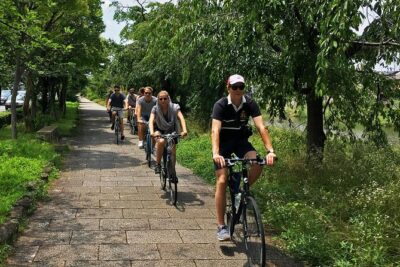
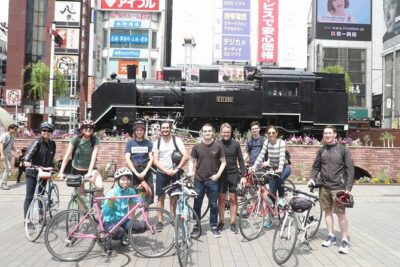


3h Tokyo E-Bike Tour: Hidden Gems, and Local Life with guide
Read our review →
Arashiyama Bamboo Forest & Hidden Gems Bike Tour (Early Bird)
Read our review →
Hiroshima in a Nutshell: Morning Bike Adventure
Read our review →
5 Top Highlights of Kyoto Full Day Bike Tour (E-bike option)
Read our review →Browse the lists this tour appears in