

REVIEW · JAPANESE COOKING CLASSES
Ramen Making from Scratch +Akihabara Tour –Tokyo Cooking Class
Making ramen is the main event here, but the experience starts in a useful place: Akihabara’s supermarket shelves. You’ll walk through Tokyo’s famous electric town, learn about Japanese ingredients, then head to a kitchen studio to make fresh noodles, broth, chashu pork, and toppings for a Jiro-style bowl.
I like the way the class connects food with everyday Tokyo life, rather than dropping you straight into a cooking room. I also like the small maximum of 12 people and the digital photos, which give you a keepsake beyond a full stomach. The main consideration is dietary: vegan and vegetarian options are not available, so this is best for people happy to work with pork and traditional ramen ingredients.
In This Review
- Key points before you book
- Why this Tokyo ramen class is more than a meal
- Meeting in Akihabara at 11:00 a.m.
- Shopping for ramen ingredients in a Japanese supermarket
- The train ride to the kitchen studio
- Making fresh noodles during the 90-minute class
- Preparing broth, chashu pork, and toppings
- What the guides and staff add
- Who will get the most from the $123.55 price
- Practical details for a smooth day
- Should you book this ramen experience?
- FAQ
- Where does the ramen experience begin?
- What time does the experience start?
- How long does the activity last?
- Is lunch included?
- Are vegetarian or vegan options available?
- Can I cancel for a full refund?
Key points before you book
- Akihabara comes first: Begin with a short walk through the anime, electronics, and pop-culture district before shopping for ingredients.
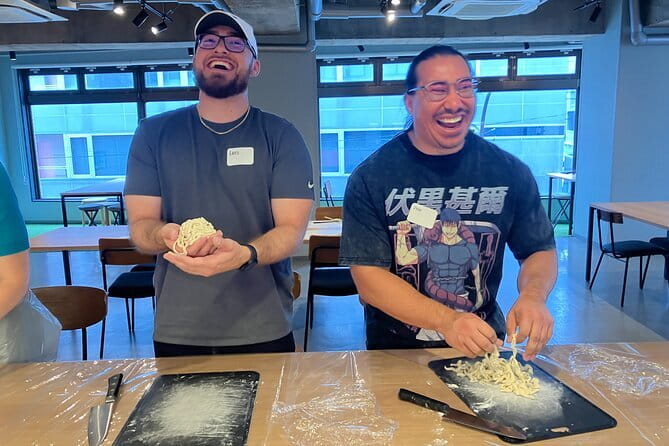
- You make the noodles yourself: The 90-minute class covers fresh noodles, broth, toppings, and chashu pork rather than only assembling a prepared meal.
- A small group keeps the class personal: The maximum is 12 people, with English-speaking instruction.
- Lunch is included: You eat the Jiro-style ramen you prepare during the class.
- The route includes a train ride: Allow 15 to 30 minutes to reach the kitchen studio after the supermarket stop.
- Plan around the food policy: Vegetarian and vegan versions are not available, and at least two people are required per booking.
Why this Tokyo ramen class is more than a meal
Tokyo has no shortage of ramen shops. You can order a bowl in minutes, often for far less than this experience costs. The value here is in learning what sits behind that bowl: the noodles, seasoning, broth, pork, and shopping choices.
At $123.55 per person, this is not a budget lunch. You are paying for about three and a half hours of guided activity, a grocery store visit, transport between the first stop and the studio, instruction in English, lunch, and digital photographs. For someone who simply wants to eat ramen, the price will feel high. For someone who wants a hands-on food lesson and an easy introduction to Japanese ingredients, it is easier to justify.
The class also gives you something you can repeat at home. You will not just hear a chef explain ramen while watching from the side. You will work with the ingredients and bring the bowl together yourself.
The experience is recommended by all 107 people included in the rating information, with a five-star average. The strongest praise centers on the friendly staff, clear English, the useful Akihabara orientation, and the fact that children can take part in the cooking. That makes this a strong choice for families and first-time visitors who want an activity with a clear structure.
More Japanese Cooking Classes in Tokyo
- Sushi Making Tokyo Roll and Authentic Japanese Sushi Class
★ 5.0 · 3,971 reviews - Tokyo: Roll and Authentic Sushi Making Class in Asakusa
★ 4.9 · 1,957 reviews - Tokyo: Sushi Making Class in a Happi Coat near a Famous Spot
★ 4.9 · 1,377 reviews
Meeting in Akihabara at 11:00 a.m.
Your day begins at Akihabara Station, at 1 Chome Sotokanda in Chiyoda City. The 11:00 a.m. start is practical for a morning activity, though you should leave enough time to find the meeting point. Akihabara Station is served by public transportation, and the activity is listed as being near transit.
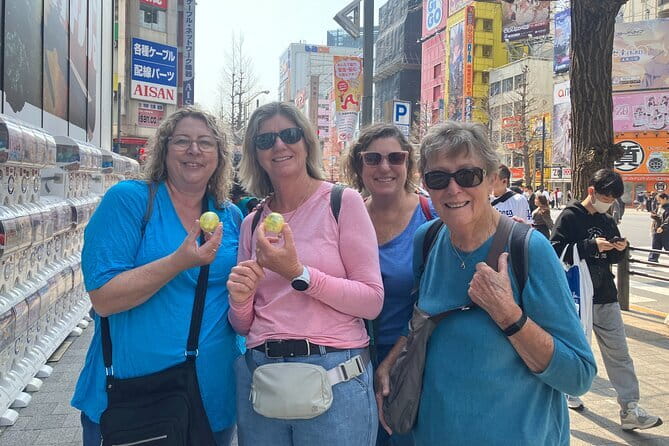
Akihabara is best known for electronics, anime, manga, games, and pop culture. The opening walk lasts about 20 minutes and takes you through some of the district’s well-known areas on the way to the supermarket.
This is a short orientation, not a full sightseeing tour. You should not expect hours inside shops or a detailed history of the neighborhood. Its value is more direct: the guide helps you get your bearings before the food part begins.
Guides named in the experience information and personal feedback include Saori and Bunga for the Akihabara portion. Saori is described as friendly and helpful when explaining the area and helping visitors decide what interested them. That is useful in a district that can feel crowded with signs, stores, and choices, especially on a first Tokyo visit.
The walk gives the class a bit of place and context. You are not simply being driven to a cooking studio with no connection to the city around it. You begin among the shops and streets that define Akihabara, then move into the practical side of Japanese food shopping.
Shopping for ramen ingredients in a Japanese supermarket
The supermarket visit lasts about 20 minutes. You will pick up fresh ingredients for the class and learn how Japanese seasonings and foods are used in cooking.
This is one of the most useful parts for anyone who plans to spend more than a few days in Japan. Restaurant menus can tell you what to order, but a grocery store shows you what local cooks actually buy. Labels, sauces, noodles, prepared foods, and seasonings can be difficult to understand when you are shopping alone. Having a guide explain the ingredients gives you a better chance of recognizing them later.
The stop is also short, so keep your expectations in check. You are not getting a full supermarket lesson or a long food tour. The focus is on gathering what the class needs and giving you a practical introduction to Japanese ingredients.
You may also find this stop more interesting than it sounds. Ramen depends on small choices, including noodles, seasonings, broth components, and toppings. Seeing those ingredients before cooking helps connect the finished bowl with the products on the shelf.
The grocery visit adds a local detail that many cooking classes skip. Instead of treating Japanese food as something that appears only in restaurants, it shows you how the building blocks are sold and selected.
The train ride to the kitchen studio
After the supermarket, you take a train to the modern kitchen studio. The ride takes about 15 to 30 minutes, depending on the route and conditions.
This transfer is worth noting when planning your day. The cooking studio is not at the Akihabara meeting point, and the activity ends in a different location. The exact ending point is not specified in the supplied details, so avoid booking a tight appointment immediately afterward.
The train ride also makes the schedule feel like a real Tokyo outing rather than a single-location demonstration. At the same time, it uses part of your three-and-a-half-hour window. If you want every minute devoted to cooking, this route may feel less efficient. If you like seeing how the pieces of a city connect, the change of setting works well.
You should stay with the group and follow the guide’s directions during this transition. The experience is designed as one continuous outing, beginning in Akihabara and finishing after the cooking portion elsewhere.
Same city, a completely different kind of day:
- Mt Fuji and Hakone 1-Day Bus Tour Return by Bullet Train
★ 5.0 · 26,383 reviews - 1-Day Tokyo Bus Tour
★ 5.0 · 14,250 reviews - Tokyo: TOKYO SKYTREE® Admission ticket
★ 4.5 · 11,192 reviews - Tokyo: teamLab Planets TOKYO Digital Art Museum Entry Ticket
★ 4.6 · 9,779 reviews
Making fresh noodles during the 90-minute class

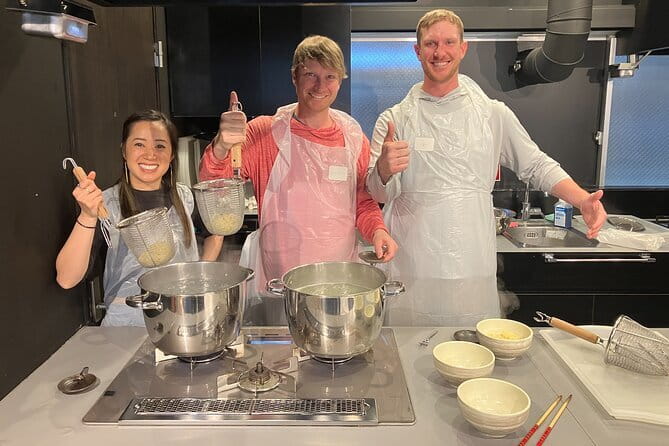
The cooking class lasts about 90 minutes and takes place in a modern kitchen studio. An English-speaking instructor guides you through the process from preparation to the finished bowl.
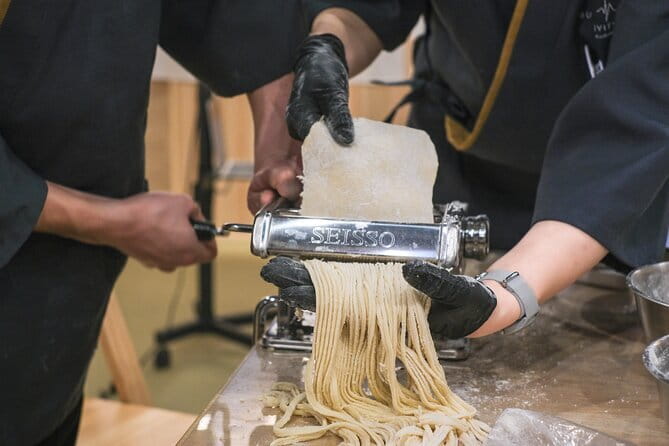
The first major skill is making ramen noodles from scratch. This is the part that turns the activity from a standard cooking demonstration into a hands-on lesson. You get to see how the noodles begin, how they are prepared, and how they fit into the finished dish.
Fresh noodles also make the class suitable for people who want to understand texture, not just flavor. Ramen is a balance of noodles, broth, pork, and toppings. The noodle-making step gives you a clearer sense of why the bowl works as a whole.
The instructions are intended for beginners. The supplied feedback specifically praises the kitchen staff’s English and the amount of interaction during the class. You should expect guidance rather than being left to work out each stage alone.
Families are a good match for this format. One family described the children as enjoying every part of preparing and making the ramen. That does not mean every child will have the same patience for a 90-minute class, but the sequence of practical tasks gives younger cooks something active to do.
Preparing broth, chashu pork, and toppings
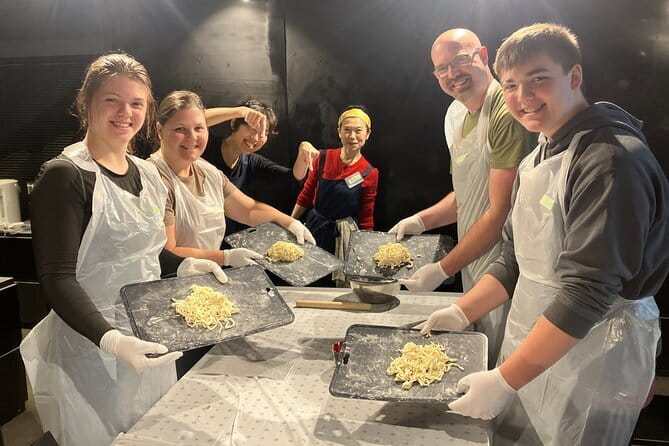
The class also covers the broth and toppings, including chashu pork for a Jiro-style ramen bowl. Jiro-style ramen is known for a substantial serving and strong, filling character, so this is not presented as a delicate tasting menu.
The broth is a key reason to choose this class over a simple noodle workshop. You will learn how the liquid base is prepared and how it supports the other ingredients. The class description does not provide a full recipe or a detailed list of every seasoning, so you should not book expecting a printed professional formula unless the instructor supplies one during the session.
Chashu pork adds another useful piece of ramen knowledge. It is a familiar topping in Japan, but preparing it yourself helps you understand how the meat becomes part of the bowl rather than arriving as a ready-made garnish.
The supermarket visit and cooking lesson work together here. You first see Japanese food products in a store, then use ingredients in a kitchen. That link gives the three-hour-thirty-minute activity a clear purpose.
You also get lunch at the end. The meal is the ramen you have made, which gives the class a satisfying finish and lets you judge the result immediately. A cooking lesson can feel incomplete when the food is packed away or served separately. Here, eating your own bowl is part of the experience.
What the guides and staff add
The people leading the experience matter, especially when the class includes a neighborhood walk, shopping, a train ride, and cooking. Saori is named as an Akihabara guide, while Bunga is also associated with the walking portion. Kyoko and Hioroko are named in connection with the cooking class.
The strongest personal feedback points to friendly staff, good English, and plenty of interaction. One participant described the whole activity as informative and pleasant, with opportunities to share everyday experiences while learning new techniques.
That mix is useful in a cooking class. You want enough instruction to make the food correctly, but you also want a relaxed setting where questions are welcome. The available information suggests that the staff aim for both.
The group size helps. With no more than 12 people, you are less likely to feel like an anonymous face at the back of a demonstration. Still, 12 is a maximum, not a guarantee of a tiny private class. If you want a one-on-one lesson, this is not the right format.
Who will get the most from the $123.55 price
I would recommend this to you if you want three things in one outing: a brief look at Akihabara, a practical introduction to Japanese grocery shopping, and a hands-on ramen class.
It works particularly well for:
- Families looking for an activity that includes children
- First-time visitors who want help understanding Japanese food products
- Ramen fans who want to make noodles and broth, not just eat them
- Couples or friends who can meet the two-person booking minimum
- People who value English-language guidance and digital photos afterward
The value is weaker for a vegetarian or vegan traveler, since those options are not available. It is also less suitable if you have only a short time in Tokyo and need to stay in one district. The train transfer and separate ending location make this a scheduled activity, not something to fit casually between nearby attractions.
The price includes groceries, the cooking experience, lunch, and downloadable photographs taken during the activity. Those extras matter, but the main value remains the instruction and the chance to make the ramen yourself. If you are comparing it with an inexpensive bowl at a restaurant, the restaurant wins on cost. If you are comparing it with a private cooking lesson, a small-group experience lasting about three and a half hours may look more reasonable.
The activity is booked an average of 52 days ahead, so popular dates may fill early. That is not a promise that every departure will sell out, but it is a sensible reason to reserve ahead if your Tokyo schedule is fixed.
Practical details for a smooth day
Bring your mobile ticket and arrive ready for a walking start at 11:00 a.m. The experience includes movement through Akihabara, a supermarket visit, and a train ride, so comfortable shoes are sensible.
The class is near public transportation, but hotel pickup and drop-off are not included. You are responsible for reaching Akihabara Station and for arranging your own way onward after the activity ends.
The total duration is approximately three hours and 30 minutes. The known sections add up to about 20 minutes of walking, 20 minutes in the supermarket, 15 to 30 minutes on the train, and 90 minutes cooking. The remaining time allows for meeting, transitions, preparation, and eating.
The activity requires at least two people per booking. It also requires good weather, likely because part of the experience takes place outdoors in Akihabara. If poor weather cancels the activity, you are offered another date or a full refund.
Free cancellation is available until 24 hours before the start time. Canceling or changing the booking less than 24 hours ahead does not qualify for a refund, and the cut-off follows Tokyo local time.
Should you book this ramen experience?
Book it if you want to learn by doing and you are happy to devote most of a half day to the outing. The combination of Akihabara, grocery shopping, a train ride, and ramen preparation gives you more variety than a cooking class held in one room.
I especially like it for families and first-time Tokyo visitors. Saori and the other guides help make Akihabara easier to approach, while the English-speaking kitchen staff give the cooking a clear shape. The downloadable photos are a nice extra, but the real souvenir is knowing how the bowl came together.
Skip it if you need vegan or vegetarian food, want a private class, or are mainly looking for the cheapest ramen lunch in Tokyo. At $123.55, the cost only makes sense when you value the lesson, the local shopping stop, the included meal, and the time spent with a small group.
For a food-focused day with a practical Tokyo twist, this is a strong pick. Just leave room in your schedule after the class, since the ending point is different from the Akihabara meeting point.
FAQ
Where does the ramen experience begin?
It begins at Akihabara Station, at 1 Chome Sotokanda, Chiyoda City, Tokyo 101-0028, Japan.
What time does the experience start?
The start time is 11:00 a.m.
How long does the activity last?
The experience lasts approximately three hours and 30 minutes.
Is lunch included?
Yes. Lunch is included, and you eat the ramen prepared during the cooking class.
Are vegetarian or vegan options available?
No. Vegan and vegetarian options are not available.
Can I cancel for a full refund?
Yes, if you cancel at least 24 hours before the experience start time. Cancellations or changes made less than 24 hours ahead are not refunded or accepted.
More Workshops in Tokyo
- Tokyo Shinjuku Chopsticks Making Class
★ 5.0 · 1,763 reviews - Chopstick Making Workshop in Ginza
★ 4.8 · 1,366 reviews - Tokyo Sushi Making Class in Tsukiji with Professional Chef
★ 5.0 · 1,177 reviews - Matcha Making Class in Tokyo with Authentic Japanese Sweets Set
★ 5.0 · 744 reviews
More Cooking Classes in Tokyo
- Ramen & Gyoza Cooking Class in Tokyo with Local Supermarket Visit
★ 5.0 · 823 reviews - Tokyo: Easy Ramen Cooking Experience in Kabukicho, Shinjuku
★ 4.6 · 321 reviews - Ramen and Sushi Cooking Class with Sake Pairing Set in Tokyo
★ 5.0 · 291 reviews - Tokyo: Wagyu and 7 Japanese Dishes Cooking Class
★ 4.9 · 273 reviews
Just added around Tokyo
- Private Memorable Tokyo Tour with English Speaking Driver★ 5.0 · 30 reviews
- Private Tokyo Custom Full-Day Tour by Chartered Vehicle★ 5.0 · 16 reviews
- Private Sightseeing to Mt Fuji and Hakone with English Driver★ 5.0 · 51 reviews
- Tokyo Photography Masterclass – Private Photography Lesson★ 5.0 · 25 reviews
- Private Mt. Fuji Day Trip from Tokyo with English-Speaking Driver★ 5.0 · 33 reviews
- 4 Day Tour – Mount. Fuji, Tokyo, Hakone, Kamakura and Yokohama★ 5.0 · 19 reviews
- Private Unforgettable Mt Fuji Tour with English Speaking Driver★ 5.0 · 142 reviews
- Private Tokyo Food Tour – A Journey Through Time Through Food★ 5.0 · 36 reviews
Japanese Cooking Classes, compared.
Sushi Making Tokyo Roll and Authentic Japanese Sushi Class
Read our review →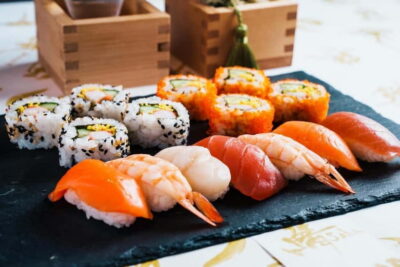
Roll and Authentic Sushi Making Class in Asakusa
Read our review →
Ramen Cooking Class at Ramen Factory in Kyoto
Read our review →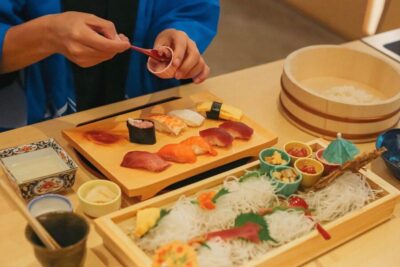
Sushi Making Class in a Happi Coat near a Famous Spot
Read our review →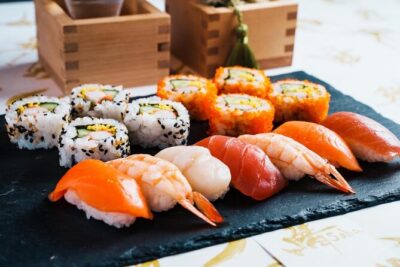
Sushi Making Osaka Roll and Authentic Japanese Sushi Class
Read our review →
Tokyo Sushi Making Class in Tsukiji with Professional Chef
Read our review →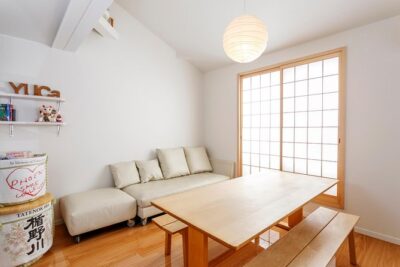
Ramen & Gyoza Cooking Class in Tokyo with Local Supermarket Visit
Read our review →
Tsukiji Fish Market Guided Tour and Sushi Making with Pro Chef
Read our review →Browse the lists this tour appears in