REVIEW · JAPANESE COOKING CLASSES
Osaka Cooking Class and Sake Tasting with Local Supermarket Visit
Osaka’s food culture is at its best when you stop watching and start cooking. This four-hour class takes you first to a local supermarket, then into a small studio to prepare niku-sui, okonomiyaki, and gyoza with a guide at your side. It is a practical way to see how everyday ingredients become some of Osaka’s most familiar dishes.
I like the supermarket visit because it gives you a look at ordinary food shopping, not just a staged cooking demonstration. I also like the hands-on format, especially the chance to fold gyoza and get live help from guides such as Yuka and Mari. The main consideration is time: four hours is a sizable block, and the class may feel too slow if you only want a quick meal or a short food stop.
In This Review
- Key points to know before booking
- Starting at Minami-Morimachi Station
- The supermarket visit shows Osaka’s everyday food
- Cooking niku-sui, Osaka’s beef soup
- Making okonomiyaki the Osaka way
- Folding gyoza by hand
- Eating with sake, beer, or soft drinks
- What the guide adds to the experience
- Who will get the most from the four hours
- Is $92.50 a fair price?
- Timing, cancellation, and practical planning
- Should you book this Osaka cooking class?
- FAQ
- Where does the Osaka cooking class begin?
- What time does the activity start?
- How long does the cooking and sake experience last?
- What dishes will I prepare?
- Are drinks included with the meal?
- Is the class suitable for beginners?
Key points to know before booking
- Three Osaka dishes in one class: Prepare niku-sui, okonomiyaki, and gyoza rather than focusing on only one recipe.
- The supermarket visit comes first: Your guide explains local ingredients while you shop for the cooking session.
- Small groups keep the class personal: The maximum group size is seven people.
- Beginners are welcome: Instructions are step by step, with live feedback as you cook.
- Drinks are part of the meal: Taste local sake, beer, or soft drinks with the food you prepare.
- The class starts at 10:00 a.m.: Meet at FamilyMart on the south side of Minami-Morimachi Station and return there at the end.
Starting at Minami-Morimachi Station
Your morning begins at 10:00 a.m. outside FamilyMart Minamimorimachi station South side, at 2-chōme 3-10, 1F, in Osaka’s Kita Ward. The meeting point is near public transportation, which makes it a sensible choice for a morning activity.
You should allow a little time to find the correct side of the station. The meeting point is specifically on the south side, so do not simply exit and wait at the first convenience store you see. A mobile ticket is useful here, particularly if you are moving around Osaka with a phone rather than carrying printed confirmations.
The class ends back at the same meeting point. That makes the activity easy to fit into a wider day, though the four-hour duration means you should not plan a tight lunch reservation immediately afterward. A 10:00 a.m. start also gives you time to reach the meeting point without turning breakfast into a race.
The group is limited to seven people. That matters in a cooking class. You are not standing at the back of a large room trying to see a demonstration. You should have a reasonable chance to ask questions, handle ingredients, and receive corrections while working.
More Japanese Cooking Classes in Osaka
- Sushi Making Osaka Roll and Authentic Japanese Sushi Class
★ 5.0 · 1,220 reviews - Osaka Sushi Making Experience
★ 5.0 · 400 reviews - Osaka: Ramen and Gyoza Cooking Class in Dotonbori
★ 5.0 · 378 reviews
The supermarket visit shows Osaka’s everyday food
The first stop is a local supermarket. This is more than a shopping errand. It gives your guide a natural place to explain the ingredients used in the recipes and helps you connect finished dishes with the products on Japanese shelves.
You may already recognize familiar items such as beef, cabbage, dumpling wrappers, and sauces. The useful part is seeing how they are presented and used in Osaka cooking. Your guide helps select what is needed for niku-sui, okonomiyaki, and gyoza, while explaining the local ingredients along the way.
This part should appeal to you if Japanese food labels, packaged ingredients, or supermarket displays usually feel hard to interpret. A cooking class can teach a recipe, but the supermarket visit helps with the next step: knowing what to buy when you try the dish at home.
It also gives the morning a local feel. You are not only entering a studio and following a prepared script. You begin with a small piece of daily Osaka life, then carry those ingredients into the cooking session.
The drawback is that the supermarket stop is not a sightseeing tour. It is tied to the recipes, so you should expect a focused visit rather than a long exploration of Japanese food shopping. If you enjoy practical details, it adds real value. If you want a market with many food stalls and a free period to browse, this is a different sort of experience.
Cooking niku-sui, Osaka’s beef soup
Back at the studio, you prepare niku-sui, a beef soup associated with Osaka’s home-style food culture. The dish is a useful choice for a class because it shows how a few familiar ingredients can become a warm, satisfying meal.
The class presents the recipes in a simple, beginner-friendly way. You do not need previous cooking experience, and the guide leads you through each stage. That makes niku-sui a good place to settle in before moving to the more hands-on work of okonomiyaki and gyoza.
You should pay attention to the ingredient balance and preparation steps rather than treating the soup as a side dish to hurry through. Since the recipes are designed to be recreated at home, the point is not only to eat the finished bowl. You are learning a method you can use again.
The exact cooking setup and equipment are not specified, so you should not assume a full professional kitchen or advanced culinary lesson. This is a friendly cultural class, not chef training. The strength is access and clarity, especially for people who want to cook Japanese dishes without complicated techniques.
Making okonomiyaki the Osaka way
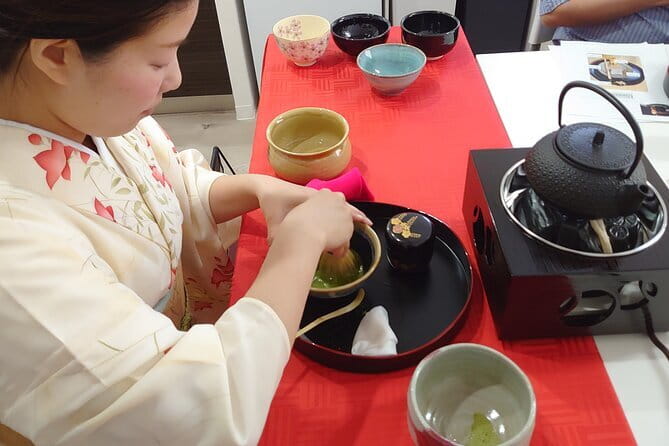
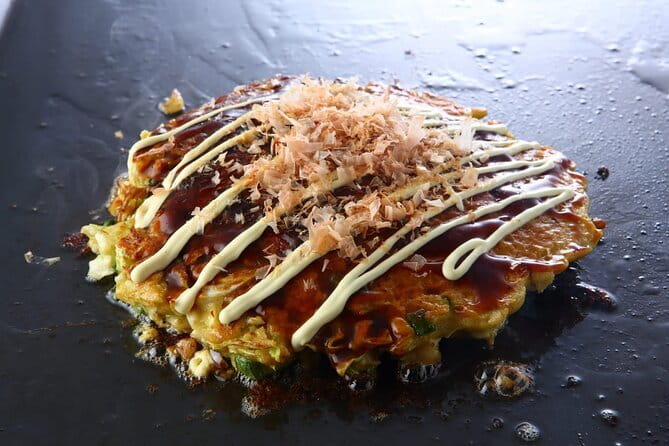
Okonomiyaki is the class’s most obvious Osaka specialty. The name is often explained as cooking what you like, and the dish is known as a savory pancake. Here, you get to prepare it yourself rather than ordering one at a restaurant and watching someone else handle the hot plate.
The guide walks you through the process, and live feedback is part of the appeal. You can ask for help while mixing, shaping, and cooking instead of discovering later that something went wrong. For a first-time cook, that support removes much of the worry.
I like okonomiyaki in this setting because it connects food and place. Osaka is widely associated with casual, filling dishes, and okonomiyaki feels more like everyday local food than a formal restaurant specialty. Making it yourself gives you a better sense of how the dish comes together.
The class is also useful for families and friends because the work is easy to share. One person can focus on mixing, another can help with preparation, and everyone can take part in the final meal. Solo participants should also fit comfortably into the small-group format, though the experience naturally includes cooperation with others.
You should expect a social cooking lesson, not a private lesson tailored only to your pace. With a maximum of seven people, the group remains limited, but the guide still needs to divide attention among everyone.
More Sake & Bar Hopping Tours in Osaka
- Osaka Bar Hopping Night Walking Tour in Namba (3 bars, 6 tastes)
★ 5.0 · 958 reviews - Osaka: Izakaya Bars Guided Walking Tour
★ 4.9 · 385 reviews - Osaka Sake Tasting with Takoyaki Cooking
★ 5.0 · 156 reviews - Osaka Sake Tasting & Takoyaki Cooking Experience
★ 5.0 · 149 reviews
Folding gyoza by hand
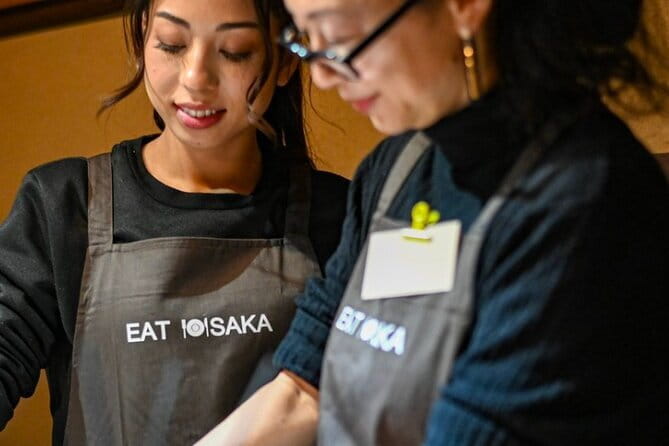
Gyoza brings the most tactile part of the class. You learn to fold the dumplings, a small skill that looks simple until you try to make several pieces with a neat, closed edge.
This is where live instruction earns its keep. A guide can show you how to place the filling, close the wrapper, and adjust your technique as you work. Your first dumpling may look different from your last one, and that is part of the fun.
Gyoza also gives you a recipe you can repeat at home. You are not just learning a restaurant trick. You are practicing a basic Japanese cooking skill with ingredients introduced during the supermarket visit.
The class description does not specify how many dumplings you make or the exact cooking method, so do not book expecting a detailed professional lesson on every regional style. Think of it as a welcoming introduction that gives you confidence to keep practicing.
This activity works well for mixed skill levels. An experienced cook can move more quickly and focus on shaping, while a beginner can receive help without needing to know Japanese cooking terms in advance.
Eating with sake, beer, or soft drinks
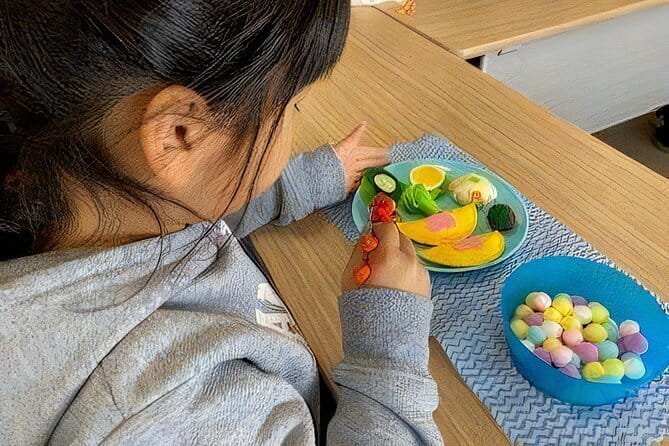
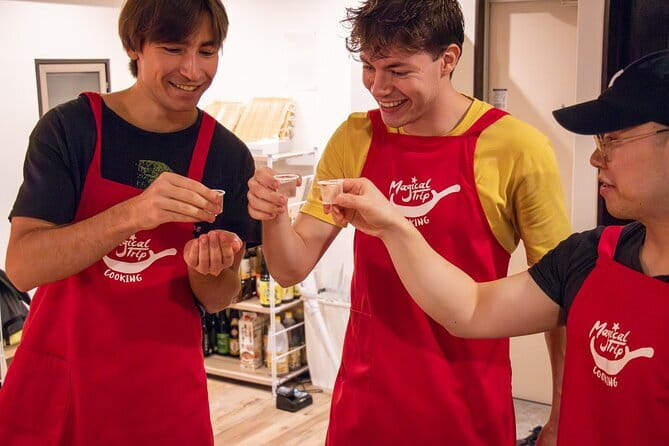
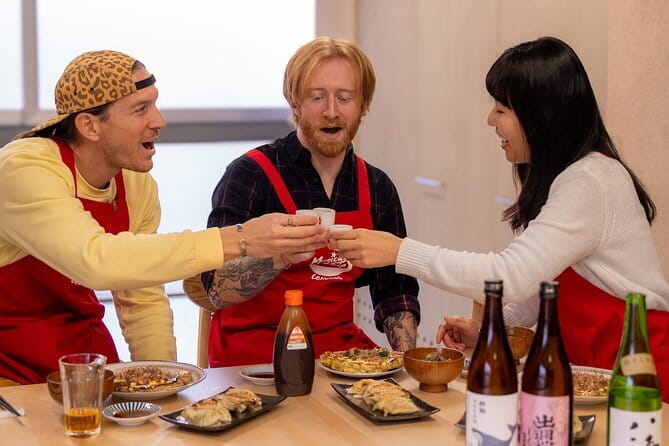
Once the dishes are prepared, you eat what you have made with a choice of local sake, beer, or soft drinks. The drinks turn the class into a shared meal rather than a lesson that ends as soon as the cooking is finished.
The sake tasting is a clear bonus for adults interested in Japanese food and drink. Tasting sake alongside Osaka-style dishes gives you a practical sense of how the flavors work together. It also adds a second experience without requiring another stop across town.
Beer and soft drinks make the meal flexible for people who do not drink alcohol. That is important for families, non-drinkers, and anyone who wants to focus on the food. The information does not state how many sake varieties are served, so you should not expect a formal tasting flight with extensive instruction.
The cooking and meal are part of the same relaxed session. You can eat immediately after preparing the dishes, which makes the food feel connected to the work. It is a simple pleasure, but an effective one.
What the guide adds to the experience
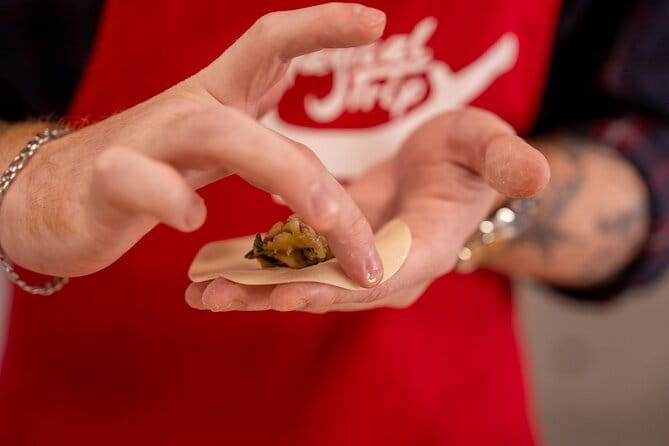
The guide is central to the quality of this class. The experience includes step-by-step instruction and live feedback, so the personality and clarity of the instructor matter as much as the recipes.
Yuka has led the four-hour format, including the supermarket visit and cooking of okonomiyaki, niku-sui, and yaki-gyoza. Mari has also guided the shopping and cooking, with particular attention to explaining what to buy for each recipe. If your assigned guide is Yuka or Mari, you can expect an instructor who takes an active role in the practical parts of the morning.
Guide assignments can vary, so you should not book on the assumption that one specific instructor is guaranteed unless the operator confirms it. The useful feature is the teaching structure: you receive help while shopping and cooking, rather than being left to copy a demonstration from a distance.
The setting is described as friendly and relaxed. That makes this a good choice if you feel unsure about joining a cooking class because you are not an experienced cook. You only need enthusiasm and an appetite.
Who will get the most from the four hours
I would recommend this class to several kinds of visitors:
- First-time visitors to Osaka who want food culture connected to ordinary local life.
- Home cooks who want recipes they can try again after returning home.
- Couples and friends looking for an activity that combines work, conversation, and a meal.
- Families who want a practical food experience rather than a lecture.
- Solo visitors who prefer a small group and a guided activity.
- People curious about sake who would like to taste it with food.
It is less suitable if you dislike group activities, have no interest in cooking, or want a short experience that leaves most of the day free. Four hours gives the class enough room for shopping, instruction, cooking, eating, and drinks, but it is not a quick add-on.
You should also consider your appetite and schedule. The session ends around four hours after the 10:00 a.m. start, and it includes a full meal. Plan your next activity with some breathing room.
Is $92.50 a fair price?
At $92.50 per person, this is not the cheapest way to eat okonomiyaki or gyoza in Osaka. A restaurant meal will cost less and take far less time.
The comparison changes when you count what is included in the experience. You receive a guided supermarket visit, instruction in three dishes, hands-on practice, a meal, and sake, beer, or soft drinks. You also leave with cooking methods that may be useful at home. For you, the value depends on how much you want to learn rather than simply eat.
The maximum of seven people supports the price better than a large demonstration would. A small group gives the guide more room to answer questions and check your technique. It also keeps the session personal without requiring the cost of a fully private class.
I see the price as reasonable for a focused half-day cultural activity, especially if you already planned to spend money on several meals and want one of them to be an experience. It is harder to justify if you are watching every yen or mainly want to sample Osaka food.
Timing, cancellation, and practical planning
Confirmation arrives when you book, and the activity uses a mobile ticket. Keep the booking details easy to reach on your phone when you meet the guide.
Free cancellation is available if you cancel at least 24 hours before the 10:00 a.m. start time. Cancellations or changes made inside that period are not accepted for a refund, and the cut-off follows local Osaka time.
The activity returns to the starting point. That is helpful if you want to continue sightseeing in the same general part of Osaka, but the information does not provide a separate end location or a detailed route beyond the supermarket and studio.
Because food preparation is involved, arrive ready to participate. The class is built around doing the work, not simply watching. Comfortable clothing and a willingness to try unfamiliar steps will serve you better than culinary experience.
Should you book this Osaka cooking class?
Book it if you want a friendly, hands-on introduction to Osaka food, especially if you like the idea of buying ingredients with a local guide and then using them yourself. The supermarket stop, three-dish menu, small group, and drink pairing give the morning more substance than a standard cooking demonstration.
Skip it if your priority is a low-cost meal, a fast activity, or a formal sake seminar. You are paying for instruction, conversation, and participation as much as for the food.
For most visitors who want a practical cultural experience, the balance is good. You leave with a better sense of Osaka’s everyday ingredients, a few recipes to try at home, and the memory of making your own okonomiyaki and gyoza rather than only ordering them.
FAQ
Where does the Osaka cooking class begin?
The class begins at FamilyMart Minamimorimachi station South side, at Japan, 530-0041 Osaka, Kita Ward, Tenjinbashi, 2-chōme 3-10, 1F.
What time does the activity start?
The start time is 10:00 a.m.
How long does the cooking and sake experience last?
The experience lasts approximately four hours.
What dishes will I prepare?
You will prepare niku-sui, okonomiyaki, and gyoza, also described as yaki-gyoza in the class details.
Are drinks included with the meal?
After cooking, you can enjoy local sake, beer, or soft drinks with the dishes you prepare.
Is the class suitable for beginners?
Yes. The class is suitable for all skill levels, and no cooking experience is needed. The guide provides step-by-step instruction and live feedback.
More Drinking Tours in Osaka
- Osaka: Namba Pub Bar Crawl with a Local Guide
★ 4.9 · 424 reviews - Osaka: Guided Pub Crawl
★ 4.4 · 331 reviews - Osaka Pub Crawl and Nightlife Tour
★ 5.0 · 293 reviews - Osaka Local Bar Crawl in Dotombori & Uranamba Area
★ 5.0 · 199 reviews
More Cooking Classes in Osaka
- Osaka Cooking Class: Okonomiyaki &Japanese cuisines experience
★ 5.0 · 261 reviews - Ramen and Gyoza Cooking Class in Osaka
★ 5.0 · 202 reviews - Cooking Ramen&Gyoza/KatsuCurry/Bento/Okonomiyaki+Store Tour@Osaka
★ 5.0 · 138 reviews - Three Types of Ramen Cooking Class in Osaka
★ 5.0 · 119 reviews
Just added around Osaka
- Samurai dress-up and shows, plus Tea Ceremony & Calligraphy★ 5.0 · 27 reviews
- Kyoto & Nara Private customized tour with English speaking Guide★ 4.5 · 99 reviews
- Well-balanced BENTO (lunch box) Cooking Class★ 5.0 · 35 reviews
- Urban Canvas: Osaka Street Art Bike Tour★ 5.0 · 47 reviews
- OSAKA:Feel the Power! Learn Taiko Drum from Professionals★ 5.0 · 28 reviews
- Volleyball in Osaka & Kyoto with Locals!★ 5.0 · 21 reviews
- 1.5〜2 Hours Traditional Kintsugi Work Shop in Namba Osaka★ 5.0 · 75 reviews
- Umami Town Street Food Tour★ 5.0 · 120 reviews
Japanese Cooking Classes, compared.

Sushi Making Tokyo Roll and Authentic Japanese Sushi Class
Read our review →
Roll and Authentic Sushi Making Class in Asakusa
Read our review →
Ramen Cooking Class at Ramen Factory in Kyoto
Read our review →
Sushi Making Class in a Happi Coat near a Famous Spot
Read our review →
Sushi Making Osaka Roll and Authentic Japanese Sushi Class
Read our review →
Tokyo Sushi Making Class in Tsukiji with Professional Chef
Read our review →
Ramen & Gyoza Cooking Class in Tokyo with Local Supermarket Visit
Read our review →