
REVIEW · WORKSHOPS
Kyoto: Kintsugi Jewelry Workshop with Natural Stones
Broken Japanese pottery becomes wearable art in this 150-minute kintsugi jewelry workshop near Fushimi Inari Taisha. You choose the ceramic fragments, natural stones, shells, and pearls, then turn them into pieces such as earrings, rings, necklaces, or brooches.
I like the thoughtful setting: a 100-year-old Kyoto townhouse that feels far removed from the crowds outside. I also like that you leave with handmade jewelry, not just a quick demonstration. The main consideration is that the workshop is not suitable for wheelchair users, and the narrow alley has no parking.
The small group is limited to 10 people, and instructor Natsuka gives patient, step-by-step help in English or Japanese. Allow extra time if you like to fuss over your design. One session ran nearly twice the planned time for a slow-moving group, without pressure to hurry.
In This Review
- Key points to know before booking
- Why this Kyoto craft class feels different
- Entering a 100-year-old Kyoto townhouse
- Choosing pottery, stones, shells, and pearls
- The 150-minute making process
- What Natsuka adds to the experience
- Is $106 good value?
- Who will enjoy this workshop most?
- Pairing the class with Fushimi Inari
- Booking, timing, and cancellation details
- Should you book it?
- FAQ
- How long does the kintsugi jewelry workshop last?
- How many jewelry pieces can I make?
- What types of jewelry can I create?
- What materials are included?
- Where is the atelier located?
- Is the workshop available in English?
Key points to know before booking
- Make two jewelry pieces: The price includes enough time and materials to create a couple of finished accessories.
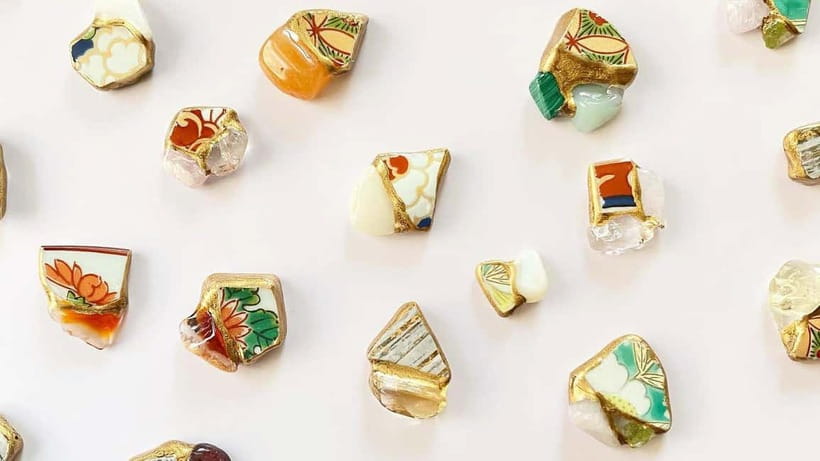
- Choose from real Japanese pottery shards: Options include Arita, Karatsu, Oribe, Kyoto, Shigaraki, and Hagi ceramics.
- Work with more than ceramic: Natural stones, stained glass, shells, and pearls let you build a piece with your own color and texture.
- Learn the meaning of kintsugi: The gold repair lines connect the craft with wabi-sabi, the Japanese appreciation of imperfection and change.
- Create near Fushimi Inari Taisha: The atelier is about a three-minute walk from the shrine and five minutes from JR Inari or Keihan Ryukoku Daimae-Fukakusa stations.
- Expect a calm, hands-on class: Natsuka’s patient instruction suits beginners, families, and anyone wanting a quieter Kyoto afternoon.
Why this Kyoto craft class feels different
Kintsugi is the Japanese practice of repairing broken ceramics with lacquer and gold. Instead of hiding a crack, the repair makes it part of the object’s story. Here, that idea is adapted into small jewelry pieces made from broken pottery and decorative materials.
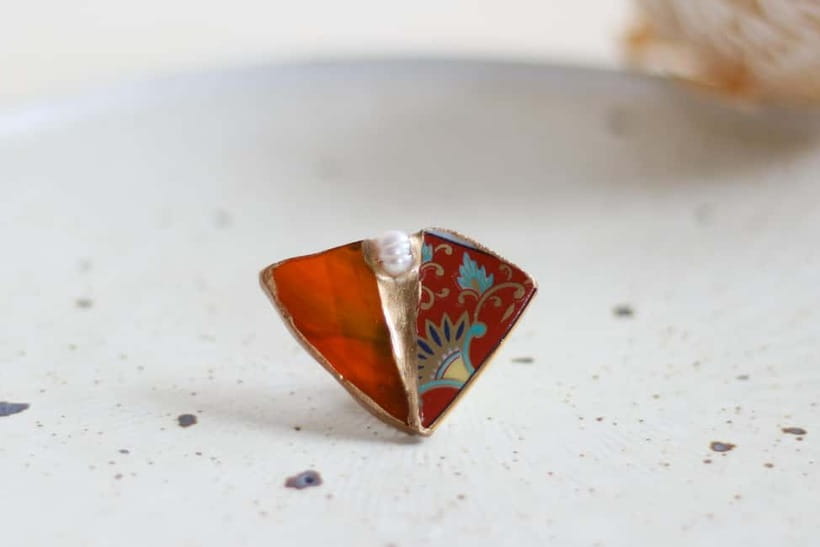
You are not repairing one large bowl or plate. You are selecting fragments and arranging them into a new object. That makes the class less about copying a set design and more about making choices: a blue ceramic shard with a pale stone, a glossy fragment with a pearl, or a small piece of stained glass beside a gold-edged pottery piece.
The result is personal because the materials already carry visual character. A shard from Arita pottery will look different from one from Oribe or Hagi. You might find a bold glaze, a muted earthen finish, or a pattern that gives your jewelry a clear Japanese connection without making it look like a mass-produced souvenir.
The class also gives useful cultural context. Natsuka explains the background of kintsugi, the pottery regions represented in the workshop, and the idea of wabi-sabi. That short lesson matters because the gold is not simply decoration. It helps explain why an object made from something broken can be valued for its repaired form.
A few more Kyoto trips to weigh up
- Kyoto: 45-Minute Tea Ceremony Lesson Experience
★ 4.3 · 2,378 reviews - Ramen Cooking Class at Ramen Factory in Kyoto
★ 5.0 · 1,937 reviews - Kyoto : Chopsticks Making Workshop in Gion with Engraving Option
★ 5.0 · 958 reviews
Entering a 100-year-old Kyoto townhouse
The workshop takes place in a traditional one-story Kyoto house with a white entrance curtain. This is not a large commercial studio with rows of worktables. It is a more intimate setting, and the scale suits the craft.
I like the contrast between the busy shrine district and the quiet room where you work. Fushimi Inari is one of Kyoto’s best-known sights, with its famous rows of red torii gates and steady stream of visitors. A creative class nearby gives you a way to spend part of the day sitting down, focusing on something small, and using your hands.
The house itself adds atmosphere without taking over the experience. You are there to make jewelry, not to tour a preserved building, but the age and traditional design of the home help the workshop feel tied to Kyoto. Refreshments may also be provided during the session, according to the experience details given by the host.
Finding the atelier requires a little care. It is about a five-minute walk from JR Inari Station or Keihan Ryukoku Daimae-Fukakusa Station. Look for the traditional one-story house with the white curtain at the entrance, and use the supplied photo map if needed. The street directly outside is a narrow alley, so you cannot drive to the door and there is no parking.
Choosing pottery, stones, shells, and pearls
The materials are a major part of the fun. You begin by looking through pottery shards and other decorative pieces, then decide what will become your jewelry.
The ceramic choices include:
- Arita
- Karatsu
- Oribe
- Kyoto pottery
- Shigaraki
- Hagi
These names are useful because they represent different Japanese pottery traditions, but you do not need to be a ceramics expert to choose well. Let the color, shape, and surface guide you. A piece with a strong glaze may work as the center of a brooch, while a smaller fragment might suit an earring or tie pin.
Natural stones add color and a less formal look. Shells and pearls can make a piece feel delicate, while stained glass may give it a brighter, sharper tone. You are combining materials rather than following one strict formula, so the same workshop can produce very different results.
This selection stage can take longer than you expect. That is not a problem unless you are trying to fit the class into a tightly timed sightseeing plan. The host gives you room to design, and that patience is one of the strongest parts of the experience. You are not pushed toward the first attractive stone you see.
The 150-minute making process
The class lasts about two and a half hours. It is long enough to include an explanation, material selection, hands-on work, and finishing time without feeling like a quick craft stop.
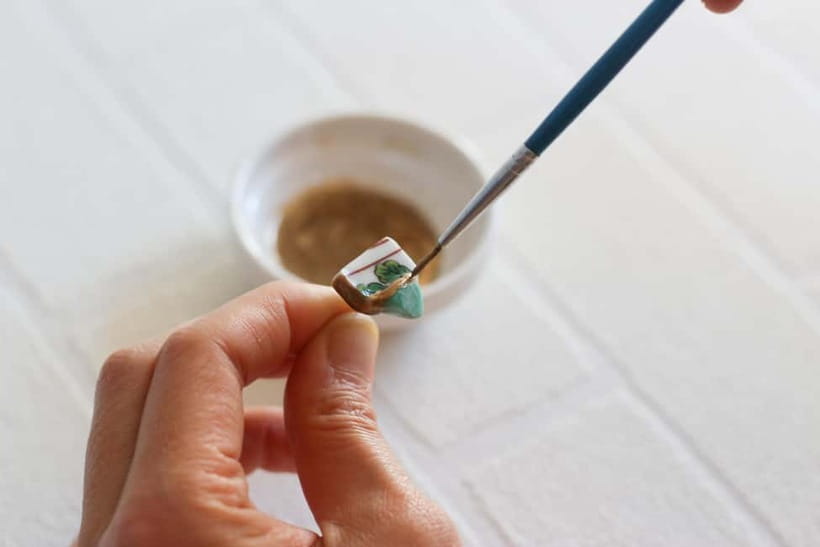
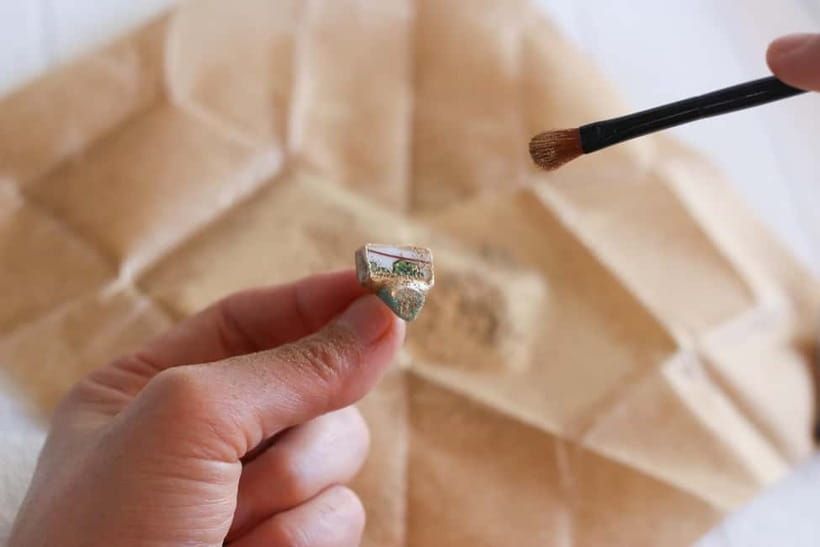
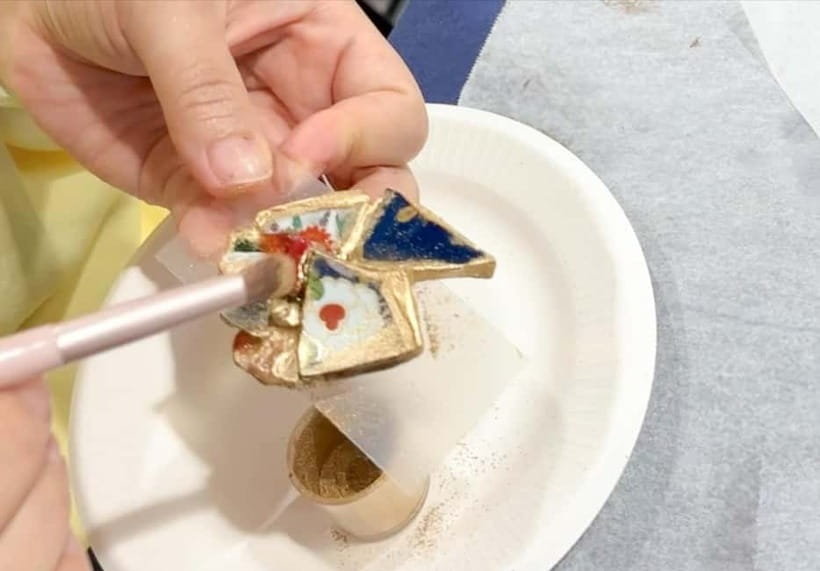
Natsuka begins by explaining kintsugi and showing you how the process works. The instructor then guides you through the stages of creating a jewelry piece. The materials include synthetic lacquer and gold powder. Synthetic lacquer is used instead of traditional urushi lacquer to reduce the risk of allergic reactions.
You first settle on the overall design. This is where the workshop feels more like a small art session than a standard souvenir activity. You need to think about the shape of the ceramic, the balance of the stones, and the type of accessory you want to make.
Available accessory styles include earrings, rings, necklaces, brooches, tie pins, cufflinks, and other options. The exact best choice depends on the fragment and materials you select. A broad, irregular piece may work well as a brooch, while a smaller design may be better suited to earrings or a ring.
The gold powder gives the finished piece its kintsugi character. It highlights the joins and turns the repair into the focal point. This is also the stage where careful instruction helps. You do not need previous craft experience, but you do need to follow the steps and take your time.
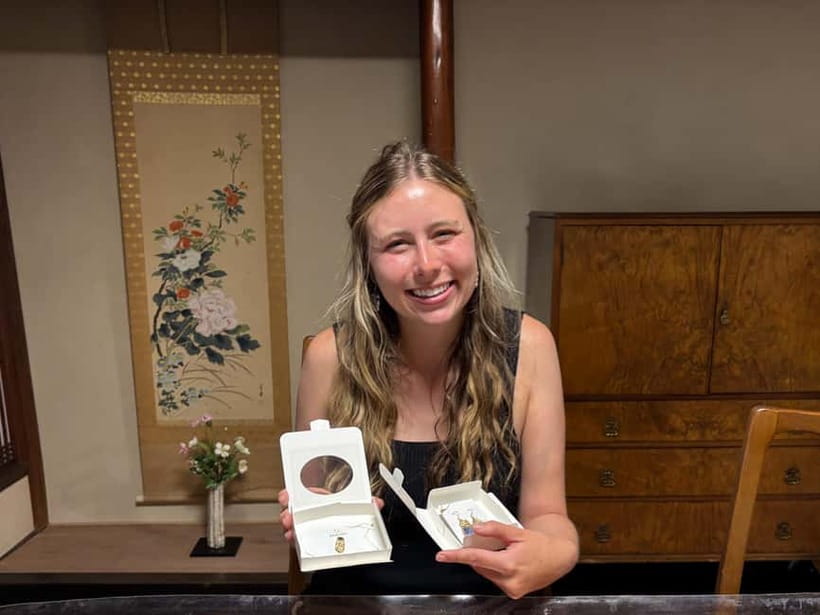
The workshop generally provides enough time to make two pieces. That is an important value point at $106 per person. You are not paying only for a short introduction. You receive instruction, materials, access to a varied selection of components, and finished jewelry to take home the same day.
One practical note: the process is creative rather than fast. If you enjoy making small adjustments, you will appreciate the pace. If you prefer a quick activity with a fixed result, the selection and design stages may feel slow.
Same city, a completely different kind of day:
- PERFECT KYOTO 1-Day Bus Tour
★ 5.0 · 13,518 reviews - Kyoto: Fushimi Inari, Kinkakuji, Bamboo Grove 1 Day Bus Tour
★ 4.8 · 4,316 reviews - Kyoto: Tea Ceremony in a Traditional Tea House in Kiyomizu
★ 4.9 · 3,519 reviews - Kyoto Geisha Walking Tour: Gion District & Hidden Gems
★ 4.7 · 3,273 reviews
What Natsuka adds to the experience
The instructor makes a real difference here. Natsuka explains each step clearly and calmly, and the format allows her to give individual advice. With a maximum of 10 participants, the group is small enough for you to ask for help without waiting through a long line.
Her explanations also go beyond the mechanics of applying lacquer and gold. You learn about the origins of the pottery fragments, the regions where different ceramics come from, kintsugi’s place in Japanese culture, and wabi-sabi.
That balance is valuable. A craft class can become either a lecture with no time to create or a hands-on session with no cultural meaning. This workshop aims for both. You learn why the method matters, then use it to make something personal.
The tone is gentle and encouraging. It is especially useful if you are nervous about making a mistake. Kintsugi itself is built around the idea that flaws can become part of an object’s beauty, so a slightly uneven result does not ruin the point of the class.
English and Japanese instruction are available. The English guidance has been clear enough for international participants to follow the process and ask questions.
Is $106 good value?
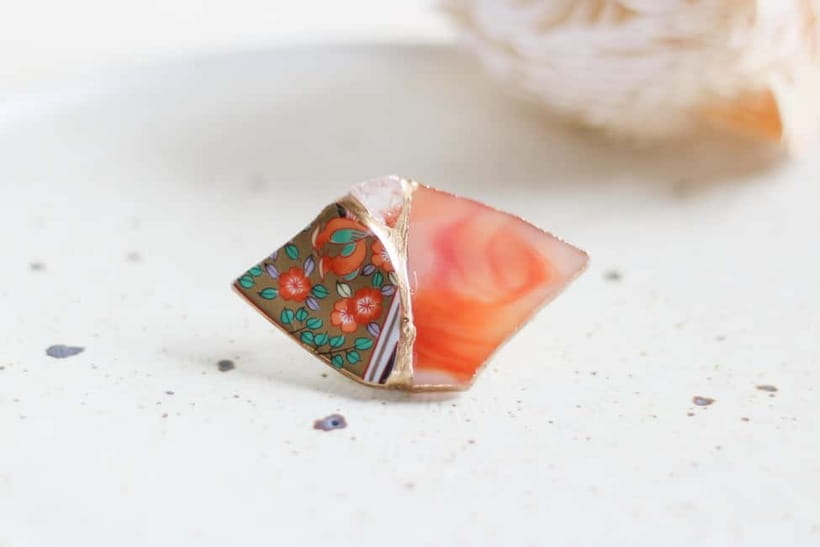
At $106, this is not a bargain-basement craft class. Kyoto has many low-cost cultural activities, and you should compare this price with how much time you want to spend and what you want to take home.
The value becomes clearer when you count what is included. You get 150 minutes of instruction, synthetic lacquer and gold powder, a choice of Japanese pottery shards, stones, shells, pearls, and other materials, plus the chance to make two jewelry pieces. You also leave with a souvenir that is handmade and different from anything sold in a standard shop.
The setting adds to the appeal, too. You are creating the jewelry in a traditional Kyoto townhouse close to one of the city’s best-known sights. That makes it easy to combine with a visit to Fushimi Inari Taisha.
I would consider the price fair for someone who values a guided activity and a personal keepsake. It is less attractive if you only want inexpensive souvenirs or if you are not interested in sitting for a focused creative session.
The work is not completely separate from spending. If you choose a design because it has meaning, the finished piece can hold a stronger memory of Kyoto than another purchased trinket. The material may be small, but the making process is the main part of what you are paying for.
Who will enjoy this workshop most?
This class suits adults, couples, families, solo visitors, and friends who want a quieter change from temple visits. It can also work well on a rainy afternoon. Several participants found the slow, careful process relaxing, and the indoor setting gives you a useful break from Kyoto’s weather and crowds.
Children can take part with an adult. An eight-year-old joined the activity with her mother, and the patient teaching made it a positive family experience. Since the work involves small materials and careful steps, an adult should stay involved with younger children.
You will probably enjoy it most if you like:
- Handmade crafts
- Japanese design and pottery
- Personal souvenirs
- Small group activities
- Calm, focused experiences
- Learning a cultural idea through making
The class may not suit you if you want a major sightseeing attraction, a fast demonstration, or a large group social event. It is also not suitable for wheelchair users, and the traditional house and narrow approach may be difficult for some people with limited mobility.
Pairing the class with Fushimi Inari
The location makes planning simple. JR Inari Station and Keihan Ryukoku Daimae-Fukakusa Station are both about a five-minute walk away, and the atelier is roughly three minutes from Fushimi Inari Taisha.
A sensible plan is to visit the shrine before or after the workshop. Fushimi Inari can take as little as a short walk through the lower torii gates or much longer if you continue up the mountain paths. Keep an eye on your energy and the class start time. You do not want to arrive at the atelier rushed after an ambitious shrine walk.
The workshop gives you a different view of the area. Instead of only photographing Kyoto’s famous sights, you spend time with materials connected to Japanese craft traditions. It is a good pairing for a day that already includes Fushimi Inari but needs a slower middle section.
Because there is no parking, plan to arrive by train and walk. The stations are close, but the last stretch is along a narrow lane, so leave enough time to identify the entrance.
Booking, timing, and cancellation details
The class runs for 150 minutes, with starting times available according to the date you choose. A small group limit of 10 keeps the instruction personal.
You can cancel up to 24 hours in advance for a full refund. The reserve-now, pay-later option may help if your Kyoto schedule is still changing.
Book with enough room around the class for choosing materials and finishing your pieces. You can take the jewelry home on the same day, which makes it easy to include the workshop late in your Kyoto stay.
Should you book it?
Book this experience if you want a meaningful souvenir, enjoy making things with your hands, and like the idea of connecting a Japanese philosophy with a modern piece of jewelry. The combination of pottery from several Japanese regions, natural stones, gold powder, and a traditional townhouse gives the class a clear sense of place.
I especially recommend it for a rainy afternoon, a family looking for a calm activity, or a repeat visitor who has already seen many of Kyoto’s major temples. Natsuka’s patient guidance and the small group format make it friendly to beginners.
Skip it if $106 feels high for two small handmade pieces, if you need wheelchair access, or if your schedule allows no room for a slow creative activity. For the right person, though, this is a thoughtful way to remember Kyoto: not by buying something perfect, but by helping turn broken materials into something you will wear.
FAQ
How long does the kintsugi jewelry workshop last?
The workshop lasts 150 minutes, or two and a half hours.
How many jewelry pieces can I make?
The experience provides enough time and materials to make two jewelry pieces.
What types of jewelry can I create?
You can choose from accessories such as earrings, rings, necklaces, brooches, tie pins, and cufflinks.
What materials are included?
Materials include synthetic lacquer, gold powder, Japanese pottery shards, natural stones, stained glass, shells, and pearls.
Where is the atelier located?
The atelier is about a five-minute walk from Keihan Ryukoku Daimae-Fukakusa Station or JR Inari Station, and about a three-minute walk from Fushimi Inari Taisha.
Is the workshop available in English?
Yes. Instruction is available in English and Japanese.
Just added around Kyoto
- Taste of Nishiki Market Walking Food Tour with Local guide★ 5.0 · 17 reviews
- Kyoto: Sushi Making Class with Sushi Chef★ 4.8 · 64 reviews
- Kyoto: City Secrets eBike Tour★ 4.9 · 196 reviews
- Sacred Pathways: Discover the Philosopher’s Path of Kyoto★ 4.9 · 20 reviews
- Private Tour to Monkey Park and Arashiyama Highlights★ 5.0 · 22 reviews
- Private Nara Tour from Osaka – Meet at Your Hotel★ 5.0 · 22 reviews
- Private Sake Tasting in Central Kyoto with Sake Sommelier★ 5.0 · 13 reviews
- Kyoto : Private Custom Walking Tour With A Local Guide★ 4.6 · 144 reviews
Workshops, compared.
Sushi Making Tokyo Roll and Authentic Japanese Sushi Class
Read our review →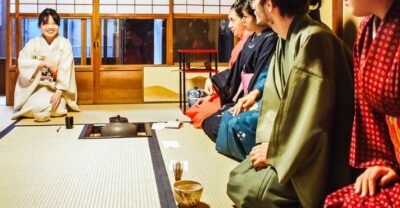

Roll and Authentic Sushi Making Class in Asakusa
Read our review →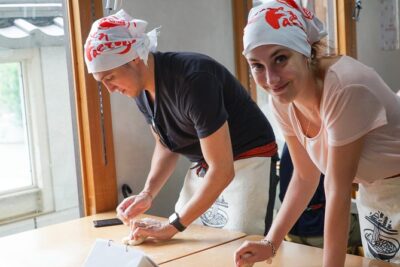
Ramen Cooking Class at Ramen Factory in Kyoto
Read our review →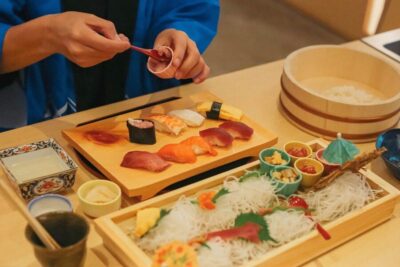
Sushi Making Class in a Happi Coat near a Famous Spot
Read our review →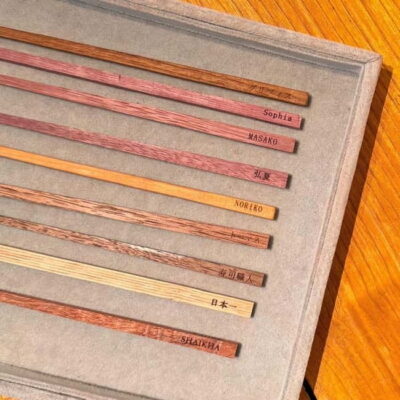

Sushi Making Osaka Roll and Authentic Japanese Sushi Class
Read our review →
Tokyo Sushi Making Class in Tsukiji with Professional Chef
Read our review →Browse the lists this tour appears in