

REVIEW · WORKSHOPS
Kyo-arashi Shibori Scarf Class
The best part of this Kyoto craft class is the reveal. You fold the silk, bind it tightly around a pipe, dye it, then unfold the cloth to see a pattern you helped create. Your scarf is both an activity and a useful souvenir, not a factory-made keepsake.
I like the one-on-one feel of the class and the chance to choose your own color. I also like that the waiting time is put to good use with museum displays and a shibori kimono try-on. The main drawback is the short session: at 30 to 60 minutes, you get a focused introduction rather than a full course in Japanese textile art.
In This Review
- Key points to know before booking
- What makes the Kyoto Shibori Museum class special
- Folding silk and wrapping the pipe
- Choosing color and watching the pattern form
- Using the museum while your scarf dries
- Why the short duration can work in a Kyoto schedule
- Price, private format, and practical value
- Who will enjoy this craft class most
- Booking ahead and building it into your day
- The strongest reason to go
- Should you book the Kyo-arashi Shibori Scarf Class?
- FAQ
- How long does the Kyo-arashi Shibori Scarf Class last?
- What size scarf will I make?
- Is museum admission included?
- Can I try on a kimono?
- What is the minimum age?
- Can I cancel for a full refund?
Key points to know before booking

- Make a 180 cm by 44 cm silk scarf: The finished item is a generous size and easy to pack flat.
- Follow the full dyeing process: You fold, wrap, bind, dye, press, and finally open the fabric.
- English help is available: Nina is named as an English-speaking instructor, and the staff assist closely.
- Museum admission is included: Use the scarf-drying time to see the displays and try on a shibori kimono.
- Private, small-scale format: Only your group takes part, with classes usually handled individually.
- Best for ages 12 and up: Adult pricing applies to everyone, and you can cancel free of charge up to 24 hours ahead.
What makes the Kyoto Shibori Museum class special
Kyoto gives you endless chances to admire traditional craft, but far fewer chances to make something yourself. This class solves that problem neatly. You do not just look at a finished textile behind glass. You take part in the steps that create the pattern.
Shibori is a family of Japanese resist-dyeing methods. Parts of the cloth are folded, wrapped, tied, stitched, or compressed so dye reaches some areas but not others. The Kyo-arashi method used here centers on folding the silk and wrapping it around a pipe before binding and dyeing it.
The result is not fully predictable. That is part of the fun. Your chosen color matters, but so do the folds and the pressure of the string. When you open the cloth, the pattern appears as a small surprise.
This is also a good way to bring home something with a clear connection to Kyoto. A scarf takes up little room in your luggage, and its irregular pattern shows that it was made through a hands-on process. At $50.30 per person, the price covers the class, the silk item, museum admission, and the help of a professional instructor. That is fair value if you want an activity rather than another sightseeing stop.
A few more Kyoto trips to weigh up
- Kyoto: 45-Minute Tea Ceremony Lesson Experience
★ 4.3 · 2,378 reviews - Ramen Cooking Class at Ramen Factory in Kyoto
★ 5.0 · 1,937 reviews - Kyoto : Chopsticks Making Workshop in Gion with Engraving Option
★ 5.0 · 958 reviews
Folding silk and wrapping the pipe
The class begins with the fabric itself. The scarf measures about 180 centimeters by 44 centimeters, or roughly 70 inches by 17 inches. That gives you a substantial piece of silk, not a small sample square.
Your first task is to fold the fabric in a particular way. This step may look simple, but it controls the shape of the final pattern. Take your time here. If you rush the folds, the dye result may be less even or less like the design you had in mind.
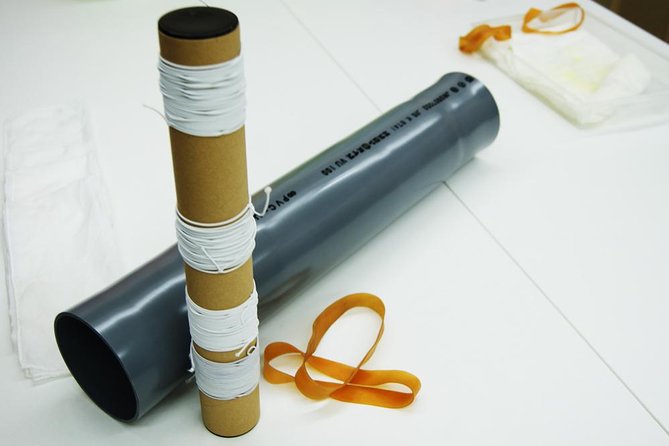
Next, the folded silk is wrapped around a pipe. You wind string around the pipe and push or compress the cloth toward the bottom. The fabric gathers into tight ridges. Those compressed areas resist the dye, creating the light and dark contrast that gives shibori its character.
The instructions are practical and direct. You do not need prior sewing or dyeing experience. The class is designed to guide you through the method, and the activity is usually individual or limited to your own group. That makes it easier to ask for help than in a large demonstration.
The reviews supplied for this experience repeatedly praise the staff’s patience and friendly manner. Nina is specifically named as an English-speaking instructor. The staff are also described as accommodating, which matters when you are handling unfamiliar materials or working with children aged 12 and older.
Choosing color and watching the pattern form
Once the cloth is bound, you select your preferred dye color. This is one of the most personal parts of the class. You are not simply receiving a standard blue or red scarf chosen by the workshop. Your color choice becomes part of the souvenir.
The actual dyeing is brief but important. The bound fabric is placed in the dye, then the class moves to unwinding the string. This is where the shape starts to become clear.
The cloth is then rolled with a towel and pressed. Finally, you unfold it. The pattern appears section by section, showing the marks made by your folding and binding.
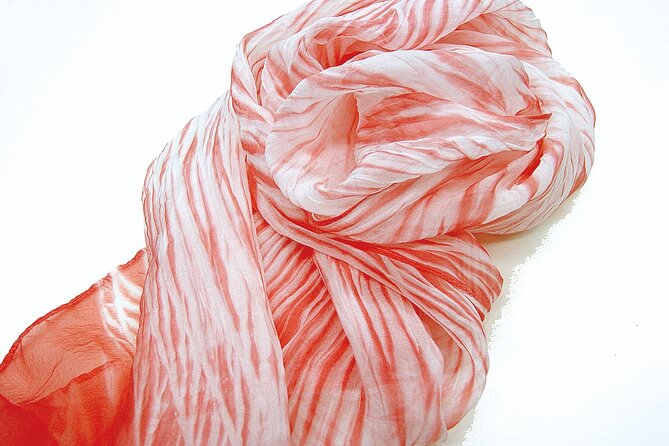
Do not expect a perfectly uniform design. Shibori is attractive precisely because small variations are visible. The finished scarf should feel personal rather than machine-perfect. If you prefer complete control over the final appearance, this element of uncertainty may be a minor frustration. If you enjoy making something with an unpredictable result, it is a strong part of the class.
The scarf needs time to dry. The listed class length is approximately 30 minutes to one hour, so the exact timing can vary. Your active work is compact, but the process still feels complete because you handle the material from preparation through the final reveal.
Using the museum while your scarf dries

The Kyoto Shibori Museum is more than a waiting area. Admission is included, so you can look through the displays while the scarf dries. This gives the short class more context and helps you understand how the small technique you used fits into Japanese textile work.
The museum visit is especially useful if you know little about shibori. You can see examples beyond your own scarf and compare the patterns, folds, and colors. The class then becomes easier to appreciate because you have a clearer idea of how much skill can go into larger or more detailed pieces.
There is also an opportunity to try on a shibori kimono. This is a welcome extra, particularly if you want a cultural activity that goes beyond simply taking home fabric. It adds a visual and physical sense of the craft, though the supplied details do not specify how long the kimono try-on lasts or what styles are available.
The gift shop is another worthwhile stop. It gives you a chance to see finished shibori items and perhaps pick up an additional souvenir. Since the scarf class already provides a personal item, you can browse without feeling that you need to buy more.
Same city, a completely different kind of day:
- PERFECT KYOTO 1-Day Bus Tour
★ 5.0 · 13,518 reviews - Kyoto: Fushimi Inari, Kinkakuji, Bamboo Grove 1 Day Bus Tour
★ 4.8 · 4,316 reviews - Kyoto: Tea Ceremony in a Traditional Tea House in Kiyomizu
★ 4.9 · 3,519 reviews - Kyoto Geisha Walking Tour: Gion District & Hidden Gems
★ 4.7 · 3,273 reviews
Why the short duration can work in a Kyoto schedule
Kyoto days fill quickly. A visit to a temple, a market, and a museum can leave little room for a long workshop. This class fits more easily into a packed plan because it lasts about 30 minutes to one hour.
Multiple start times are available, which helps you place it around other plans. You might schedule it between nearby sightseeing stops or use it as a quieter break from walking. The activity ends back at the museum, so there is no second drop-off point to manage.
The short format has limits. You will learn one specific method rather than several shibori styles. You also will not have time for a large project or a slow, highly detailed design. Think of it as a clear introduction with a finished result, not a multi-session craft school.
That distinction helps set the right expectation. If your aim is to understand the basic mechanics and leave with a scarf, the timing is useful. If you want a serious textile course, look for a longer workshop.
Price, private format, and practical value
The price is $50.30 per person. Adult pricing applies to all ages, so families should calculate the total before booking. Children must be at least 12 years old.
For the fee, you receive instruction, the silk scarf, dyeing materials, museum admission, and the kimono opportunity. You also get a private activity in which only your group participates. That combination makes the price easier to justify than a basic museum ticket or a short demonstration.
The private format is particularly useful for couples, families, or friends who want to work at their own pace. It also removes the awkwardness of trying to follow a craft lesson in a large room full of strangers.
There are two car parking spaces and bicycle parking spaces at the site. That is limited, so do not treat it as guaranteed parking for a larger group. The museum is near public transportation, which is likely the simpler choice in Kyoto.
A mobile ticket keeps the entry process simple. Confirmation is received at booking, and the meeting point is the Kyoto Shibori Museum at 135-5 Shikiamicho, Nakagyo Ward, Kyoto, postal code 604-8261.
Who will enjoy this craft class most

I would recommend this activity to anyone who wants a small amount of guided creativity during a Kyoto visit. It works well for:
- Families with children aged 12 and up
- Couples who want a shared souvenir
- First-time visitors curious about Japanese crafts
- People who prefer making an item to buying one
- Shoppers looking for a light, packable souvenir
- Visitors with a tight schedule
The class also suits people who are new to dyeing. The process is explained step by step, and the staff are described as attentive and accommodating. English support is available, including the instructor Nina named in the supplied experience details.
It may be less suitable if you dislike uncertainty or want a long, quiet workshop. The finished pattern depends on the folding and binding, so your scarf may not look exactly as you imagined. The session also moves quickly.
Families should note the minimum age carefully. The supplied information says most participants can take part, but the activity is not listed for children under 12. Adult pricing applies to every participant.
Booking ahead and building it into your day
This class is booked an average of 23 days in advance. That does not mean you must book exactly 23 days ahead, but it is a useful warning for popular Kyoto dates and family trips. If the experience fits your schedule, reserving early is sensible.
Multiple start times make planning easier. Still, leave enough breathing room around the booking. Kyoto transport and temple visits can take longer than expected, and a craft class is more enjoyable when you are not hurrying through the door.
The cancellation terms are friendly. You can cancel for a full refund up to 24 hours before the start time. Cancellations or changes made less than 24 hours before the activity are not accepted for a refund. Cut-off times follow local Kyoto time.
The class begins and ends at the museum. That makes it easy to combine with other plans, but the supplied information does not identify a nearby attraction or give walking times from major stations. Use the exact museum address when planning your route.
The strongest reason to go
The best reason to book is the complete arc of the activity. You start with plain silk, make a series of physical choices, apply the dye, and then open the cloth to see the result. That sense of cause and effect is more satisfying than a quick demonstration.
The staff receive the strongest praise in the supplied feedback. They are described as friendly, attentive, and helpful, with English instruction available. Families also report that children enjoyed the process and finished with beautiful scarves.
The museum and kimono try-on add value without making the visit feel overloaded. You get enough background to understand the craft, but the main focus remains your own scarf.
Should you book the Kyo-arashi Shibori Scarf Class?
Book it if you want a personal Kyoto souvenir, a short hands-on activity, and a gentle introduction to Japanese textile dyeing. The $50.30 price is reasonable for the silk scarf, instruction, museum entry, kimono opportunity, and private format.
Skip it if you want a long technical workshop, a fully predictable design, or an activity for children under 12. For everyone else, this is an easy class to fit into a Kyoto day, especially if you reserve ahead and choose a start time that leaves room for transport.
FAQ
How long does the Kyo-arashi Shibori Scarf Class last?
The class takes approximately 30 minutes to one hour. The active process includes folding, wrapping, binding, dyeing, pressing, and unfolding the scarf.
What size scarf will I make?
You will dye a silk scarf measuring approximately 180 centimeters by 44 centimeters, or 70 inches by 17 inches.
Is museum admission included?
Yes. Admission to the Kyoto Shibori Museum is included, and you can view the displays while your scarf dries.
Can I try on a kimono?
Yes. The experience includes an opportunity to try on a shibori kimono.
What is the minimum age?
The minimum age is 12. Adult pricing applies to all ages.
Can I cancel for a full refund?
Yes. You can cancel at least 24 hours before the experience start time for a full refund. Cancellations or changes made less than 24 hours before the start time are not accepted for a refund.
Just added around Kyoto
- Private Guided Traditional Buddhist Cooking in Japan★ 5.0 · 16 reviews
- Kyoto: Gion Geisha District & Sake-in-Hand Walking Tour★ 5.0 · 37 reviews
- Your Private Vacation Photography Session In Kyoto★ 5.0 · 110 reviews
- Kyoto: Zen Meditation at a Private Temple with a Monk★ 5.0 · 25 reviews
- Traditional Japanese Washi Papermaking- Kyoto morning★ 5.0 · 77 reviews
- Kyoto Wagashi(Japanese sweets) Cooking Class near Fushimiinari★ 5.0 · 60 reviews
- Private Pewter Sake Cup Experience with a Kyoto Artisan★ 5.0 · 31 reviews
- Kyoto Private 6 hour Tour: English Speaking Driver Only, No Guide★ 5.0 · 88 reviews
Workshops, compared.
Sushi Making Tokyo Roll and Authentic Japanese Sushi Class
Read our review →

Roll and Authentic Sushi Making Class in Asakusa
Read our review →
Ramen Cooking Class at Ramen Factory in Kyoto
Read our review →
Sushi Making Class in a Happi Coat near a Famous Spot
Read our review →

Sushi Making Osaka Roll and Authentic Japanese Sushi Class
Read our review →
Tokyo Sushi Making Class in Tsukiji with Professional Chef
Read our review →Browse the lists this tour appears in