
REVIEW · SUMO EXPERIENCES
Watch Sumo Morning Practice at Stable in Tokyo
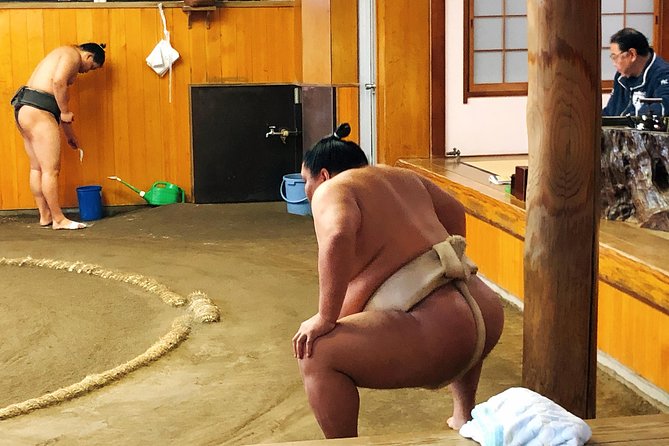
Sumo morning practice is not a staged show. Inside a working sumo stable, you sit quietly while wrestlers stretch, stamp, grapple, and absorb heavy collisions at close range. The room may be plain, the rules strict, and the floor hard, but the access is special.
I like the honest look at the sport, especially the slow build from warm-ups to fierce sparring. I also like the small-group format, with a maximum of 10 people listed for the activity, plus the chance for photos with wrestlers afterward. The main drawback is comfort: you may sit on the floor for up to two hours, often in near silence, and explanations can be limited.
In This Review
- Key points before you book
- What you are really watching inside the stable
- The quiet rules are part of the lesson
- From warm-ups to hard sparring
- Floor seating can make or break the morning
- Photos come at the end, not during practice
- Why the exact location can be a late surprise
- How much value do you get for $95.77?
- Who will enjoy this most
- Booking, date changes, and seasonal limits
- Should you book this sumo stable visit?
- FAQ
- How long does the sumo practice last?
- Where does the activity begin?
- Is Ryogoku Kokugikan the sumo stable?
- Can I take photos during practice?
- Do I have to sit on the floor?
- Is food included?
- What is the minimum age?
- What is the cancellation policy?
Key points before you book
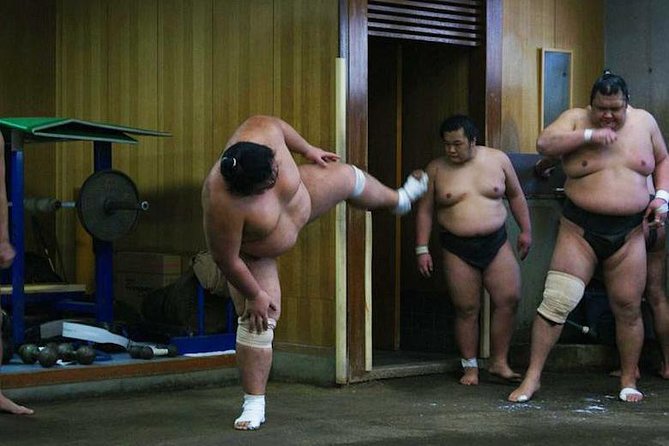
- Practice, not performance: You watch real morning training, including stretching, technique work, and sparring.
- Close but quiet viewing: You sit near the dohyo and must avoid eating, loud talking, and bright or intrusive photography.
- Floor seating matters: Participants should be able to sit on the floor for an extended period. A stool or chair may be available by request, but views can be poorer.
- The schedule can shift: Practice usually lasts 60 to 90 minutes, but it may run longer or finish earlier.
- Tournament months change the visit: In Tokyo tournament season, especially January, May, and September, practice may last only 30 to 40 minutes.
- The stable location is confirmed late: Conditions and the exact venue depend on the stable’s schedule and may be confirmed only about a week ahead.
What you are really watching inside the stable
The morning begins with a meeting at an accessible Tokyo location. You make your own way there, meet the guide and other members of the group, and then go inside the stable. The listed itinerary includes Ryogoku Kokugikan, Tokyo’s famous sumo district, but the exact practice venue can vary with the stable’s schedule.
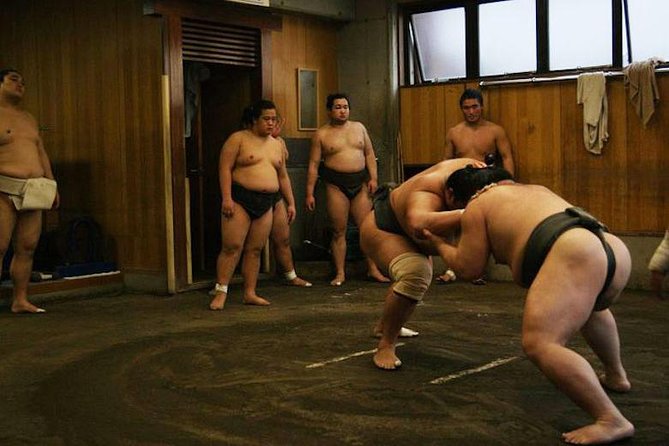
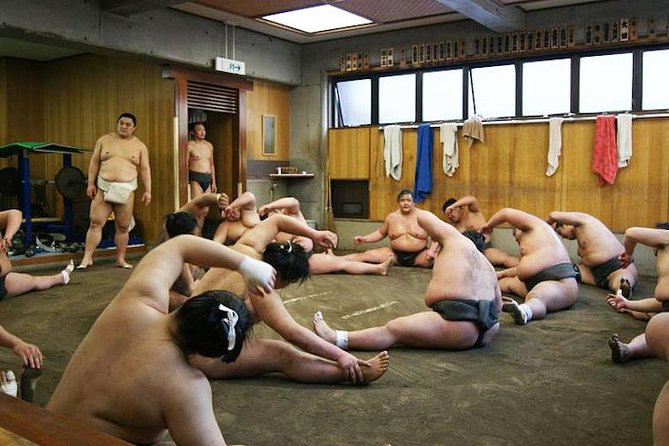
Once seated, you watch the wrestlers work through a serious training session. Expect stretching and warm-ups first, followed by repeated technique drills and contact practice in the dohyo, the raised ring used for sumo. The pace is not constant. Long periods of preparation can lead to sudden bursts of force when two wrestlers collide.
That contrast is the heart of the experience. Sumo can look slow from a distance, yet a full-power charge happens in an instant. You notice the slap of bodies, the effort required to stay balanced, and the careful routines that prepare the wrestlers for harder work.
This is also a lesson in discipline. The wrestlers are not performing for an audience. They are training in their own workplace, and visitors are expected to fit into that setting. Do not eat, speak loudly, or use a camera flash. Avoid intrusive camera sounds as well. The best approach is to watch closely and let the practice unfold without trying to turn it into a show.
More Sumo Experiences in Tokyo
- Tokyo: Sumo Show and Dining Experience
★ 4.8 · 2,742 reviews - the SUMO show
★ 5.0 · 1,960 reviews - Tokyo Shinjuku Sumo Show & Experience with Photo
★ 5.0 · 1,750 reviews
The quiet rules are part of the lesson
The silence may surprise you. Some people find it absorbing, even meditative. Others expect a guide to explain each movement and feel lost when nobody talks. Both reactions are understandable.
A strong introduction would help. You may want to read about sumo ranks, stable life, and basic rules before arriving. Knowing the difference between warm-up drills and sparring makes the session easier to follow. It also helps you understand why a wrestler may repeat the same movement many times without any obvious competition taking place.
The experience is best for someone who enjoys watching a real practice session rather than receiving a nonstop cultural lecture. Some departures have included support from guides such as Ricko, and Hiroko has helped arrange transport and spaces for groups. Still, the level of explanation can vary, so do not book this expecting a full guided lesson in sumo.
Think of the guide mainly as your access point and organizer. The wrestlers and their training remain the focus.
From warm-ups to hard sparring
The practice commonly follows a gradual pattern. First come stretches and basic movements. The wrestlers prepare their legs, hips, shoulders, and balance, often repeating actions that look simple until you consider the power needed to perform them properly.
Next, the work becomes more specific. You may see footwork, pushing drills, stance practice, and repeated attempts to control an opponent’s position. These exercises show that sumo is not simply about body size. Timing, grip, balance, and the ability to drive forward all matter.
The most dramatic section is the sparring. The impact can be startling when you are seated close to the ring. The wrestlers may pause between bouts, listen to advice, joke with one another, or support less experienced members of the stable. That mixture of toughness and team life gives the visit more depth than a single bout in a tournament hall.
Still, the session may contain a lot of repetition. If you need constant action, an hour of stretching and drills could feel slow. If you are interested in how athletes prepare, those same repetitions become the point.
The exact ending time is not fixed. Practice can last between 60 and 90 minutes, and it may run longer on a particular morning. Plan nothing tight immediately afterward, especially if you have a train, reservation, or flight to catch.
Floor seating can make or break the morning
This is the most important practical warning. You may sit on a tatami-covered floor for a long time, with your legs tucked or folded. The surface can feel unforgiving, especially for anyone with knee, hip, or back trouble.
A limited number of stools or chairs may be available on request. They are not always the best solution. A higher seat can make it easier to remain comfortable, but it may give you a poorer view than a place on the floor. Ask about seating when booking rather than assuming a chair will be ready.
Arrive early if your instructions allow it. The viewing area can be crowded, and people seated toward the back may struggle to see between heads. Front positions offer a much better look at the dohyo, but do not push ahead or disturb the stable’s routine.
Wear clothing that allows you to sit comfortably. You should also be ready to remain still. Constant shuffling is uncomfortable for you and distracting for the wrestlers.
The activity is limited to people aged 13 and older. Most people can participate, but the floor requirement is real. This is not a good choice if you cannot sit on the floor for an extended period.
Same city, a completely different kind of day:
- Mt Fuji and Hakone 1-Day Bus Tour Return by Bullet Train
★ 5.0 · 26,383 reviews - 1-Day Tokyo Bus Tour
★ 5.0 · 14,250 reviews - Tokyo: TOKYO SKYTREE® Admission ticket
★ 4.5 · 11,192 reviews - Tokyo: teamLab Planets TOKYO Digital Art Museum Entry Ticket
★ 4.6 · 9,779 reviews
Photos come at the end, not during practice
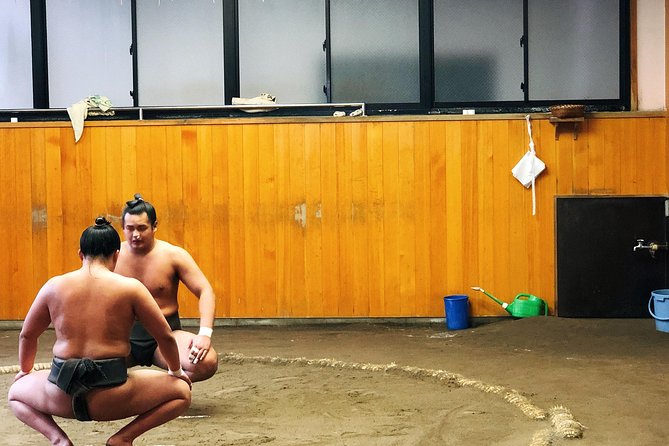
Photography during training has strict limits. Bright flashes and intrusive camera sounds are not suitable in the stable. You are there to observe, not to interrupt the work.
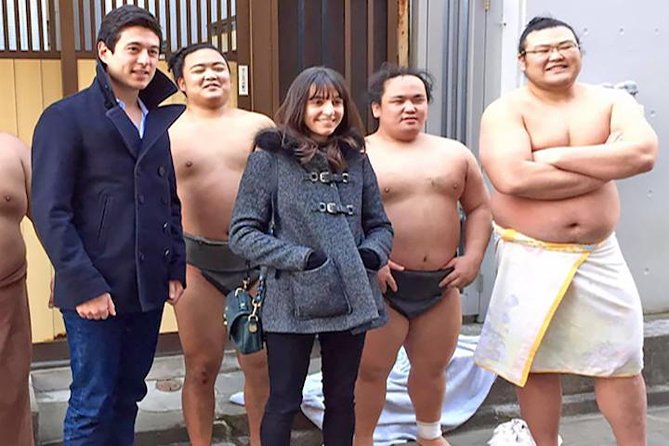
After practice, there is time for photos with the wrestlers. This is included in the entrance fee and can be a memorable finish, especially after watching the athletes work at close range. But treat it as a bonus, not the main reason to book.
The schedule is unpredictable, and the photo session may be shortened or missed if practice runs long. One practical lesson is clear: do not arrange an important appointment immediately after the activity. The listed time may say 8:00 to 10:00, but the actual practice can end at a different time.
During Tokyo tournament season in January, May, and September, practice may be much shorter, around 30 to 40 minutes. The price remains the same even when the training period is reduced. That makes the timing worth checking carefully before you pay.
Why the exact location can be a late surprise
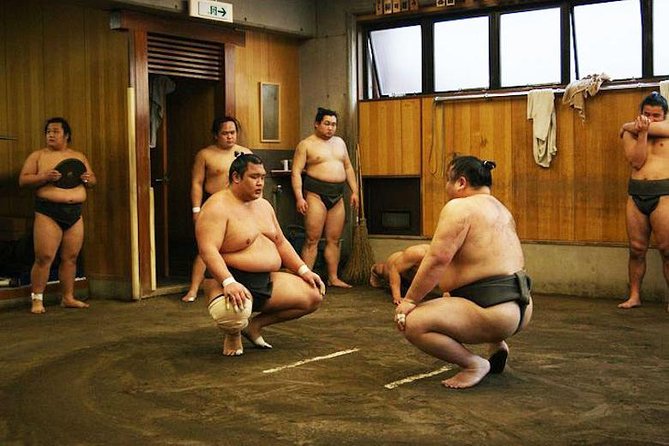
You start and finish in Tokyo, but the stable itself is not always a fixed public attraction. The operator depends on the stable’s training calendar, and the location and conditions may be confirmed only about one week before the visit.
This creates two planning concerns. First, do not assume the stable will be beside Ryogoku Kokugikan just because that is the listed itinerary stop. Second, allow extra time for the final journey once the address arrives.
The meeting point is prearranged, which helps prevent the classic Tokyo problem of searching for a private venue in a maze of streets. Even so, the final stable may be far from central Tokyo. One reported departure was more than an hour outside central Tokyo, so check the address as soon as you receive it.
A taxi can be useful from Asakusa, especially if you are carrying luggage or traveling with older family members. Keep the address in Japanese for the driver. Public transport and walking may also work, but the stable can be difficult to find without the exact local address.
How much value do you get for $95.77?
At $95.77 per person, this is not a cheap way to fill an hour. You are paying for access to a private training environment, advance arrangements, and the chance to observe a sport that most visitors see only during a ticketed tournament.
The value is strongest if you care about authentic access. A tournament gives you the excitement of formal competition, but a stable visit shows the less polished work behind it: repetitive drills, ritual, coaching, waiting, and the quiet behavior expected inside the room.
The value is weaker if you expect a show with narration, comfortable seating, or a guaranteed two-hour program. Food and drinks are not included. Group discounts and mobile tickets are available, but the main cost is still significant for a short activity.
I would judge the price by your interest in sumo. For a dedicated fan, close viewing and the included photo opportunity can justify it. For a casual sightseer, a shorter tournament-season practice may feel expensive, particularly when the practice is mostly warm-up work.
Who will enjoy this most
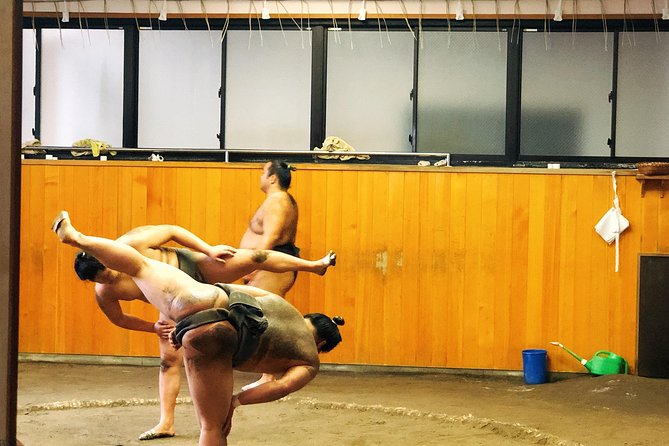
I would recommend it to you if you like sports training, traditional customs, and quiet observation. Families with teenagers can enjoy it, and the minimum age is 13. The physical size and strength of the wrestlers are easier to appreciate from the stable floor than from distant stadium seating.
It also suits people who want a cultural experience outside the usual temples, shopping streets, and observation decks. You see a working side of Japanese life that is not arranged as a public performance.
You may want to skip it if you dislike sitting on the floor, need a firm end time, or want detailed explanations throughout. It is also a poor fit for anyone who becomes restless during repeated drills. The activity rewards patience.
Before booking, ask yourself three questions:
- Can I sit quietly on the floor for at least 60 minutes?
- Am I comfortable watching practice without constant commentary?
- Can I keep my schedule flexible after the session?
If the answer is yes, the visit has real promise.
Booking, date changes, and seasonal limits
Confirmation arrives within 48 hours, subject to availability. The stable’s schedule can only be confirmed close to the date, and tournaments held in other months may cause the stable to close. Exact dates vary each year.
The listed operating periods include Monday through Saturday mornings from 8:00 to 10:00 during February 2 to February 14, March 31 to April 30, and May 1 to May 9, 2026. Do not assume every month is available.
Cancellation terms are strict near the visit. Cancel at least six full days before the start time for a full refund. A cancellation two to six full days ahead receives a 50 percent refund, while cancellation less than two full days ahead is nonrefundable. Date changes are not accepted within three days, and flight delays or illness are treated as cancellations.
The activity also requires good weather. If poor weather causes cancellation, you should be offered another date or a full refund.
Should you book this sumo stable visit?
Book it if you want a close, respectful look at how sumo wrestlers train, and if you accept that the experience is quiet, physical, and unscripted. The best moments come when warm-ups give way to heavy sparring and you realize how much strength is packed into each short exchange.
Go prepared: read a little about sumo first, arrive early, bring the Japanese address, and request a stool if your back or knees need help. Leave space in your schedule afterward.
I would not book it for a guaranteed photo session, a full history lesson, or comfortable sightseeing. I would book it for the rare chance to sit beside a real training ring and watch an old sporting tradition at work. For the right person, that is worth far more than another polished attraction.
FAQ
How long does the sumo practice last?
The practice usually lasts between 60 and 90 minutes. During Tokyo tournament season in January, May, and September, it may last only 30 to 40 minutes. The ending time varies each day.
Where does the activity begin?
You make your own way to a prearranged meeting point in Tokyo. The exact stable location depends on the stable’s schedule and may be confirmed about one week before the activity.
Is Ryogoku Kokugikan the sumo stable?
Ryogoku Kokugikan is listed as the itinerary stop, but the exact practice venue can vary. The stable’s schedule determines the final location.
Can I take photos during practice?
You must avoid bright flashes and intrusive camera sounds during training. Time for photos with sumo wrestlers is included at the end, although it can be missed if practice runs long.
Do I have to sit on the floor?
Yes. Participants should be able to sit on the floor for an extended period. A chair or stool may be available by request, but it may provide a less favorable view.
Is food included?
No. The activity does not include food or beverages.
What is the minimum age?
The minimum age is 13 years.
What is the cancellation policy?
Cancel at least six full days before the start time for a full refund. Cancellations two to six full days ahead receive a 50 percent refund. Cancellations less than two full days before the activity are nonrefundable.
More Morning in Tokyo
- Tokyo: Sumo Morning Practice Viewing Tour
★ 4.8 · 570 reviews - Tokyo: Sumo Morning Training Visit
★ 4.4 · 370 reviews - Tokyo: Sumo Morning Practice Tour at Sumida City
★ 4.8 · 308 reviews - Tokyo Sumo Morning Practice Tour at Stable
★ 5.0 · 298 reviews
Just added around Tokyo
- Tokyo: Customizable Private Guided Walking Tour★ 4.5 · 129 reviews
- Private Harajuku Omotesando Architecture Tour★ 4.9 · 18 reviews
- Tokyo: Guided Helicopter Ride★ 4.9 · 24 reviews
- Tokyo: Guided Walking Tour of Tsukiji Market with Lunch★ 4.4 · 24 reviews
- Tokyo: Private Personalized Local Food Tour★ 4.5 · 101 reviews
- Tokyo GINZA: KONPARU Japanese Cabaret Show with Drink★ 4.8 · 38 reviews
- Tokyo: Guided Walking Tour of Tsukiji Market with Breakfast★ 4.4 · 134 reviews
- Tokyo: Gotokuji Cat Temple, Shinjuku Cat Cafe & 3D Cat Tour★ 4.9 · 38 reviews
Sumo Experiences, compared.
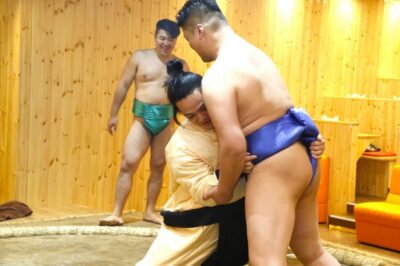
Sumo Show Experience with Chicken Hot Pot and a Photo
Read our review →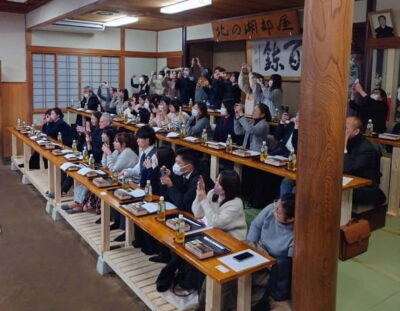
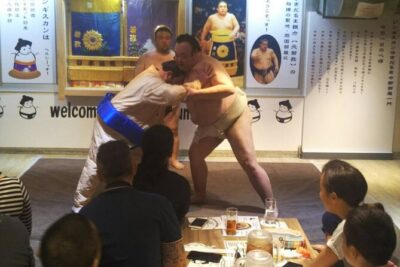
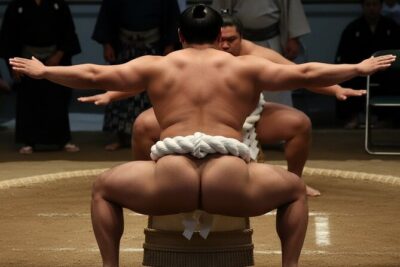
Tokyo Shinjuku Sumo Show & Experience with Photo
Read our review →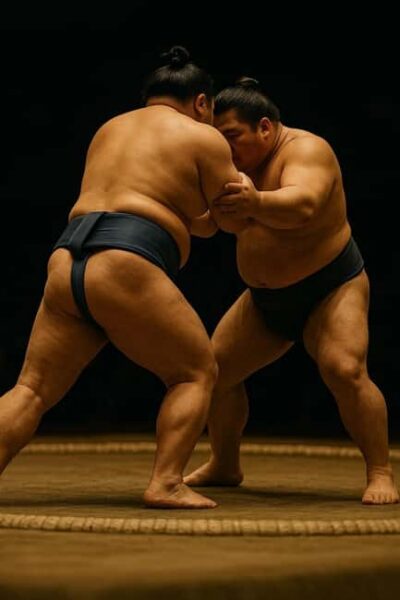
Sumo Show & Experience w/ Optional Kimono & Hot Pot
Read our review →
Authentic Sumo Experience in Tokyo: Enter the Sanctuary
Read our review →Browse the lists this tour appears in