
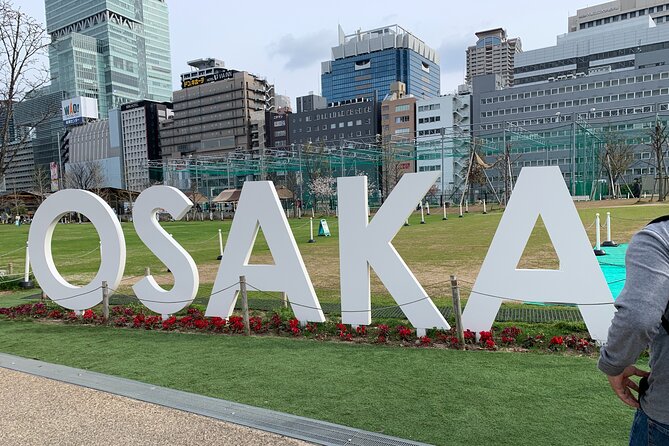
REVIEW · WALKING TOURS
Osaka Highlights: 4Hrs Guided Walking Tour with a Native Expert
Osaka reveals itself in sharp contrasts on this four-hour walk: the formal grounds of Osaka Castle, the retro streets around Tsutenkaku, and the neon energy of Dotonbori. Your local guide connects those places by train and on foot, adding the history and small details that are easy to miss on your own.
I like the small maximum group of 12, which gives you a fair chance to ask questions. I also like the route itself: you get Osaka’s major landmark, an old entertainment district, a tiny temple, and the city’s famous food quarter in one morning. The main drawback is pace. Four hours is enough for an introduction, but not enough for long museum visits, a full meal, or much free time.
In This Review
- Key points to know before booking
- A smart four-hour introduction to Osaka
- Osaka Castle: a grand start with real historical weight
- Hokoku Shrine and the quieter side of the castle park
- The train connection saves time, not all effort
- Tsutenkaku and the retro streets of Shinsekai
- A stone-paved lane and the small beauty of Hozenji
- Dotonbori, Ura-Namba, and Osaka’s famous food quarter
- What the price gives you for $62.05
- Who should book this walking tour
- Should you book Osaka Highlights?
- FAQ
- How long does the Osaka Highlights tour last?
- How much does the tour cost?
- Is Osaka Castle admission included?
- Is public transportation included?
- Where does the tour start?
- Where does the tour end?
- What places does the tour visit?
- How large is the group?
- What level of fitness is needed?
- What happens if the weather is poor?
Key points to know before booking
- Osaka Castle tower admission is included, making the city’s grandest sight the tour’s anchor.
- Short train rides link the main areas, but you pay ¥430 per person for public transportation.
- The route ends at Ebisu Bridge in Dotonbori, a useful place to continue eating and sightseeing.
- Shinsekai adds an older, rough-edged Osaka feel, with Tsutenkaku, Janjan Yokocho, and retro lanes.
- The guides are praised for clear English and patience, with Aki, Tatsuya, and Yuya named in the feedback.
- Rain can affect the experience, and the company may reschedule or refund if poor weather cancels it.
A smart four-hour introduction to Osaka
This tour works because Osaka’s main sights are spread across different parts of the city. Osaka Castle shows the city’s political and military past. Shinsekai and Tsutenkaku offer a more local, old-fashioned character. Dotonbori finishes the route with food, signs, crowds, and nightlife energy.
You are not simply walking from one monument to another. The guide helps explain how these areas fit together, then uses short train rides to save your legs and time. The connections take about 10 minutes, though the walking around each station and neighborhood adds to the effort.
The group size matters here. A guide handling 12 people can still stop for questions and keep the route together. The feedback names Aki, Tatsuya, and Yuya as especially strong guides. Yuya is noted for speaking excellent English after five years in the United Kingdom, while Tatsuya is praised for patience and kindness. Those details matter because a history walk is only as good as the explanations you can follow.
The meeting point is outside the 7-Eleven at 3-chōme-1-17 Tanimachi, in Osaka’s Chuo Ward. The tour finishes at Ebisu Bridge in Dotonbori. Check your route to the starting point before you leave your hotel, and allow extra time for Osaka’s large stations.
More Walking Tours in Osaka
- Osaka Kickstart: Hotspots & Hidden Gems Tour
★ 5.0 · 1,306 reviews - Osaka: Hotspots & Hidden Gems Walking Tour Private or Group
★ 4.9 · 1,300 reviews - Osaka Local Foodie Walking Tour in Dotonbori and Shinsekai
★ 5.0 · 985 reviews
Osaka Castle: a grand start with real historical weight
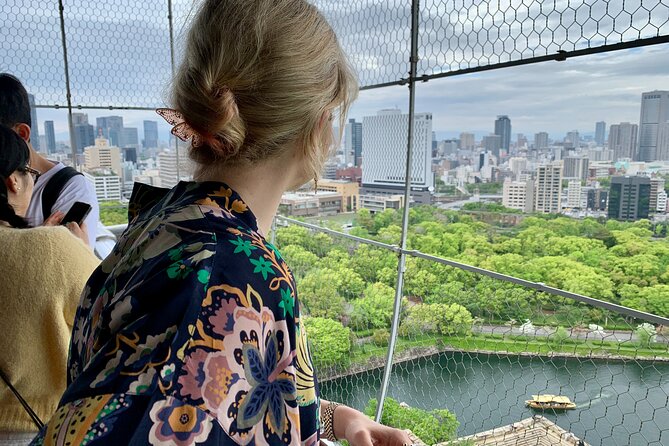
The tour begins by walking toward Osaka Castle’s main tower. This first section takes about 1 hour and 20 minutes, including the approach and entry into the tower. The admission fee is included, which is important because Osaka Castle is the one major paid attraction built into the price.
The castle is one of Osaka’s defining sights. Its broad grounds and impressive tower give the tour an immediate sense of scale, while the guide explains the castle’s role in Osaka and Japan. You will not just see a photogenic building. You will get a basic framework for understanding the city’s past.
Inside the main tower, your guide accompanies you. The supplied details do not specify which floors or displays receive the most attention, so expect guided context rather than a fixed lecture on every exhibit. The highlight for many people is the view from the top, which one guest called spectacular. If you have only a short time in Osaka, that high view helps you understand the city’s size before you move into its smaller neighborhoods.
The castle section also sets the rhythm for the morning. You walk through the park, listen, enter the tower, and then continue on foot before catching a train. Wear shoes that are comfortable for pavement and stairs. A moderate level of fitness is requested, and this is not a ride-and-stop sightseeing trip.
Hokoku Shrine and the quieter side of the castle park
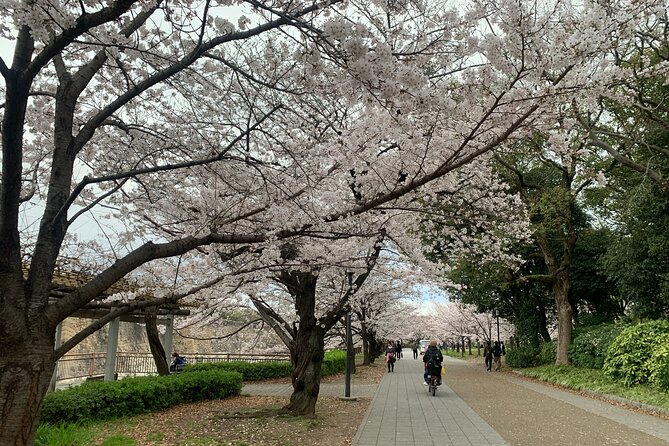
Hokoku Shrine sits within Osaka Castle Park and receives about 15 minutes of the route. The shrine is dedicated to Toyotomi Hideyoshi, the warlord who unified Japan in the late 16th century. It was originally built in 1879.
This is a short stop, but it adds useful context after the castle. Hideyoshi is closely tied to Osaka’s identity, and the shrine gives the guide a natural place to explain that connection. You will not have a long time for private reflection or detailed shrine study, so think of Hokoku Shrine as a compact historical pause.
The route information also includes Tennoji Park, a public park near Tennoji Station. It is home to Tennoji Zoo, the Osaka City Museum of Fine Arts, Keitakuen Garden, and the modern Tenshiba area. The supplied schedule does not assign a clear stop length or explain exactly how long you spend there, so I would treat it as part of the surrounding route rather than plan your day around a full park visit.
The train connection saves time, not all effort
After Osaka Castle, the group takes a train for about 10 minutes toward the next sightseeing area. Public transportation is not included, and the stated cost is ¥430 per person. That is a small extra charge, but it is worth knowing before you book because the headline price does not cover every part of the route.
Short train rides are a good choice for this tour. Walking between Osaka Castle and Tsutenkaku would eat up much of the morning and leave less time for the neighborhoods that make the experience worthwhile. The train also gives you a quick change of scene, from castle grounds to the older streets of southern Osaka.
You still need to handle station movement, boarding, and walking at the other end. If you have luggage, mobility limits, or trouble with stairs, ask about the route before booking. The tour calls for moderate physical fitness, and the overall experience includes several walking sections rather than one continuous, flat promenade.
Same city, a completely different kind of day:
- Osaka Go Karting Tour with Funny Costume
★ 5.0 · 2,658 reviews - Osaka Castle: Museum and Tower Entry Ticket
★ 4.5 · 2,380 reviews - Osaka: Shinsekai Food Tour with 13-15 Dishes at 5 Eateries
★ 4.8 · 2,204 reviews - Osaka Food Tour: 13 Dishes at 5 Local Eateries
★ 5.0 · 2,149 reviews
Tsutenkaku and the retro streets of Shinsekai
The second major sightseeing stop is Tsutenkaku, reached by train and then a walk from the station. The Tsutenkaku section lasts about 50 minutes, with the guide explaining the tower and the history of the surrounding area. Admission to this stop is listed as free.
Tsutenkaku is more than a tower for a quick photograph. It is the visual marker of Shinsekai, a district with a retro character and a distinct food culture. The area feels quite different from Osaka Castle. The castle presents power and ceremony. Shinsekai feels more casual, colorful, and tied to everyday entertainment.
The walking route includes Janjan Yokocho, a lively alley known for old-style atmosphere, street food, and local culture. Its name comes from the sound of shamisen music once heard there. That detail gives the alley a useful sense of place, even if you have only a short time to look around.
You should not expect a long food crawl here. The schedule gives the area limited time, and the tour still has Hozenji and Dotonbori ahead. You may see places worth returning to later, but the morning is designed to introduce the district, not let you sample every dish.
A stone-paved lane and the small beauty of Hozenji
The route continues along a beautiful stone-paved alley preserved from the Edo period. This is one of the tour’s most appealing changes of pace. After the open castle grounds and the colorful streets around Tsutenkaku, a narrow historic lane offers a quieter look at Osaka.
Hozenji Temple receives about 15 minutes. Its main attraction is Mizukake Fudo, a moss-covered statue of Fudo Myoo, also known as Acala. People pour water over the statue while making a wish or prayer.
This is a small place, so the stop is brief and focused. You will not spend an hour wandering temple buildings. Instead, you get a memorable custom and a glimpse of an older religious site tucked into the city. The temple also prepares you for the final move into Namba, where old lanes, restaurants, shopping streets, and nightlife sit close together.
Dotonbori, Ura-Namba, and Osaka’s famous food quarter
The final major section lasts about 1 hour and 10 minutes and takes place in Dotonbori. The guide walks through the district, explains its past, and takes a detour through back streets toward Ura-Namba. A temple is also included along the way.
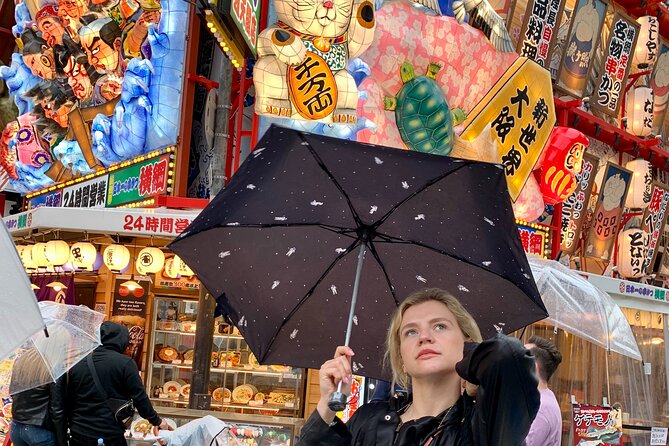
This is where the tour becomes most useful for planning the rest of your Osaka visit. Dotonbori is famous for its giant signs, canal-side setting, restaurants, and street food. The main streets can feel crowded and loud, especially around Ebisu Bridge, but the guide’s detour helps you see more than the standard photo stops.
You finish at Ebisu Bridge, which is a practical endpoint. You can stay in Dotonbori for food and shopping, or use the area as a base for more exploring. The tour does not include a meal, so budget separately for whatever you want to eat. That is both a limitation and a benefit: you are not locked into a preset restaurant or menu.
The Ura-Namba section is particularly helpful if you want a look beyond Osaka’s biggest signs. The guide can point out how the smaller lanes differ from the main Dotonbori strip, though the supplied details do not promise specific restaurants or food tastings. Go with an appetite, but do not book this expecting an organized food tour.
What the price gives you for $62.05
At $62.05 per person, the value depends on how you use the four hours. You receive a local guide, entry to Osaka Castle’s main tower, and a compact route through several major districts. The ¥430 transportation cost is extra, but it is modest compared with the time saved.
For a first morning in Osaka, the price is reasonable because it combines orientation with history. You avoid spending half a day working out train connections between distant sights, and you get explanations at places that can otherwise feel disconnected.
The value is strongest if you have limited time. One person with only 10 hours in Osaka found the tour useful even in light rain, and the guide helped by sharing an umbrella. That kind of small practical care can make a difference when weather turns poor.
The value is weaker if you prefer to set your own pace. You will not have unlimited time at the castle, Tsutenkaku, Hozenji, or Dotonbori. Independent visitors who already understand Osaka’s train system may prefer choosing one district and exploring it slowly.
Who should book this walking tour
I would suggest this experience for a first visit, a short stay, or a stopover. It gives you a quick map of Osaka’s central sights and helps you decide where to return later.
It also suits you if you enjoy history with your city walk. The castle and Hokoku Shrine provide a clear historical thread, while Tsutenkaku, Janjan Yokocho, and Dotonbori show Osaka’s entertainment and food culture.
The tour is a good fit for solo visitors and couples who want a local guide without joining a huge group. The maximum of 12 people keeps it more personal than a coach tour, while the fixed route removes some planning work.
I would think twice if you need a slow pace, use a wheelchair, or want extensive time inside museums and landmarks. The experience requires moderate fitness, includes train travel, and covers several districts in about four hours. It is also weather dependent. If the company cancels because of poor weather, you can choose another date or receive a full refund.
Free cancellation is available up to 24 hours before the start time. Inside that window, changes and refunds are not accepted, so keep your plans firm once the final day approaches.
Should you book Osaka Highlights?
Book it if you want a fast, well-connected first look at Osaka and value a local guide who can explain what you are seeing. The mix of Osaka Castle, Shinsekai, Hozenji, and Dotonbori is broad enough to make the morning feel worthwhile, while the short train rides prevent the route from becoming a long march.
Skip it if your priority is freedom, shopping time, or a leisurely food crawl. You will see many places, but you will not linger at all of them.
For most first-time visitors with one day or less in Osaka, I think the tour is a sensible choice. Come ready to walk, bring money for ¥430 in train fares and your own food, and use the finish at Ebisu Bridge as the starting point for your afternoon.
FAQ
How long does the Osaka Highlights tour last?
The experience lasts approximately four hours.
How much does the tour cost?
The listed price is $62.05 per person.
Is Osaka Castle admission included?
Yes. Admission to Osaka Castle’s main tower is included.
Is public transportation included?
No. Public transportation costs ¥430 per person and is paid separately.
Where does the tour start?
The meeting point is at the 7-Eleven at 3-chōme-1-17 Tanimachi, Chuo Ward, Osaka, 540-0012, Japan.
Where does the tour end?
The tour ends in Dotonbori at Ebisu Bridge.
What places does the tour visit?
The route includes Osaka Castle, Hokoku Shrine, Tsutenkaku, Janjan Yokocho, a preserved stone-paved alley, Hozenji Temple, Ura-Namba, and Dotonbori.
How large is the group?
The tour has a maximum of 12 people.
What level of fitness is needed?
A moderate level of physical fitness is required because the experience includes walking between sights and train stations.
What happens if the weather is poor?
If poor weather causes the tour to be canceled, you will be offered another date or a full refund. You can also cancel up to 24 hours before the start time for a full refund.
Just added around Osaka
- Samurai dress-up and shows, plus Tea Ceremony & Calligraphy★ 5.0 · 27 reviews
- Kyoto & Nara Private customized tour with English speaking Guide★ 4.5 · 99 reviews
- Well-balanced BENTO (lunch box) Cooking Class★ 5.0 · 35 reviews
- Urban Canvas: Osaka Street Art Bike Tour★ 5.0 · 47 reviews
- OSAKA:Feel the Power! Learn Taiko Drum from Professionals★ 5.0 · 28 reviews
- Volleyball in Osaka & Kyoto with Locals!★ 5.0 · 21 reviews
- Three Types of Ramen Cooking Class in Osaka★ 5.0 · 119 reviews
- 1.5〜2 Hours Traditional Kintsugi Work Shop in Namba Osaka★ 5.0 · 75 reviews
Walking Tours, compared.

Kyoto Geisha Walking Tour: Gion District & Hidden Gems
Read our review →
Tokyo Tsukiji Fish Market Food and Culture Walking Tour
Read our review →
Gion Magical Night Walking Tour with Geisha Trivia
Read our review →
Imperial Palace and Shogun Historical Walking Tour
Read our review →
Gion Geisha District Walking Tour – Stories of Geisha
Read our review →
Asakusa Walking Tour with Sensoji Temple Visit
Read our review →
Kyoto Gion Geisha District Walking Tour – The Stories of Geisha
Read our review →Browse the lists this tour appears in