REVIEW · KYOTO TOURS
Explore Hidden Alleyway with a Local Expert (Afternoon Tour)
Kyoto’s best moments often arrive between the famous sights. This three-hour afternoon bike tour takes you through narrow lanes, old wooden houses, quiet waterways, and local neighborhoods before reaching major places such as Gion and the Imperial Palace. You get a quick but useful look at several sides of the city without spending the whole day on foot.
I like the small private group, limited to six people per guide, and the way the route mixes postcard Kyoto with ordinary streets. I also like the practical rain plan: you can ride with a free poncho or switch to a walking tour using public transport. The main drawback is the price, $102.47 per person, which makes the tour best for visitors who value a guide and efficient sightseeing over a cheap independent ride.
In This Review
- Key points to know before you book
- Why a bike is a smart way to see Kyoto
- Starting at 2 pm near Kyoto Station
- Miyagawacho: old wooden houses and a quieter geisha district
- Gion: Kyoto’s most recognizable old district
- Tatsumi Bridge: a graceful pause by the water
- Kyoto Imperial Palace: a wider view of the old capital
- Kashiwayacho and the Kamo River
- What the guiding adds
- Rain, bicycles, and age limits
- Who should book this Kyoto ride
- Should you book Explore Hidden Alleyway with a Local Expert?
- FAQ
- How long does the bike tour last?
- What time does the tour start?
- Where does the tour begin?
- Where does the tour end?
- How many people can join each guide?
- What happens if it rains?
- Can children join the tour?
- Is the tour private?
Key points to know before you book
- Quiet Kyoto comes first: The route uses narrow backstreets and traditional wooden-house lanes, not just the city’s headline sights.
- Five stops in three hours: You visit Miyagawacho, Gion, Tatsumi Bridge, the Kyoto Imperial Palace, and Kashiwayacho by the Kamo River.
- A small private group: Two to six people ride with one guide, so the experience feels more personal than a large city tour.
- Yuichi earns special praise: He is described as personable, funny, and full of useful cultural and historical information.
- Rain does not automatically cancel the outing: You can ride with a free poncho or change to a walking route by bus or metro.
- Cycling ability matters: Children must be at least 10 years old, 145 centimeters or taller, and able to ride safely on the road without help.
Why a bike is a smart way to see Kyoto
Kyoto is spread out enough that walking between its best areas can eat up a good part of your day. Buses can be crowded, and taxis add cost quickly. A bicycle gives you a middle ground: you cover more ground than on foot while still moving slowly enough to notice a side lane, a stream, or a row of wooden houses.
This outing is not a long countryside ride. It is a city ride built around changes in atmosphere. One minute you may be moving through a quiet alley lined with traditional homes. Soon after, you reach a main road and the more familiar Kyoto of temples, shops, and city traffic.
I like that contrast. It helps you understand that Kyoto is not a museum set aside for sightseeing. People still live in these neighborhoods, use the river paths, and pass through the same streets as you.
The guides receive training in Kyoto culture, traffic safety, group cycling, and local manners. That matters here. Kyoto’s old lanes can be narrow, and the route includes city roads as well as gravel paths around the Imperial Palace. You are not simply handed a bicycle and sent off with a map.
The group size also improves the experience. With two to six people per guide, you can hear explanations without standing at the back of a crowd. If your party has seven to twelve people, an additional guide can be arranged.
Other Kyoto days people book alongside this one:
- PERFECT KYOTO 1-Day Bus Tour
★ 5.0 · 13,518 reviews - Kyoto: Fushimi Inari, Kinkakuji, Bamboo Grove 1 Day Bus Tour
★ 4.8 · 4,316 reviews - Kyoto: Tea Ceremony in a Traditional Tea House in Kiyomizu
★ 4.9 · 3,519 reviews
Starting at 2 pm near Kyoto Station
The meeting point is at 552-13 Higashiaburanokōjichō in Shimogyo Ward. The tour begins at 2 pm and returns to that same meeting point after about three hours.
An afternoon start works well if you have spent the morning at a temple or need a slower first half of the day. It also gives you time to reach the meeting point without rushing out of bed after a long flight. The tradeoff is that you do not get the soft morning light in Gion, and the tour may feel short if you want a detailed visit inside every landmark.
Think of this as a guided orientation by bicycle, not a full museum tour. The stops are short, usually 15 to 20 minutes. You will see the setting, learn why it matters, and continue riding rather than settling in for a long visit.
The price is $102.47 per person. That is a considerable amount for three hours, especially if you are comfortable cycling around a city on your own. The value improves if you want cultural explanations, route planning, traffic support, and a private group. It can also make sense for a family with limited time, since the ride links several areas that would take more effort to connect independently.
The tour has an average booking lead time of 13 days, so I would not leave it until the last minute during a busy Kyoto visit.
Miyagawacho: old wooden houses and a quieter geisha district
The first stop is Miyagawacho Kaburenjo, one of Kyoto’s five geisha districts and the second largest among them. The stop lasts about 15 minutes, with no admission fee.
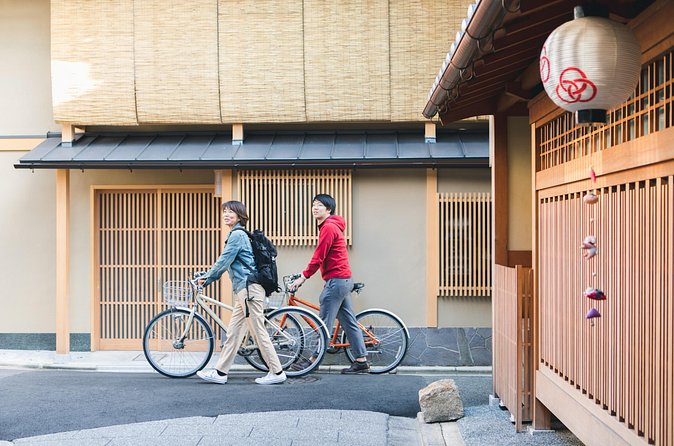
The appeal here is the street itself. Traditional wooden houses line both sides of the alley, creating a calm setting that feels far removed from a major sightseeing route. The buildings and narrow passage give you a sense of the old entertainment districts without requiring a stage performance or ticketed attraction.
Your guide can help explain the role of Miyagawacho within Kyoto’s geisha culture. You should also remember that this is a working neighborhood, not a theme park. Keep your bicycle under control, avoid blocking doorways, and follow the local etiquette your guide gives you.
Fifteen minutes is enough to see the character of the lane and take in the architecture. It is not enough for a detailed history lesson, so enjoy this stop as a visual introduction. The value comes from arriving by bicycle through a backstreet rather than approaching only from a busy commercial road.
Gion: Kyoto’s most recognizable old district
The ride continues to Gion, another major geisha district. The stop lasts about 15 minutes and is free.
Gion is likely the place you already picture when you think of traditional Kyoto: refined streets, wooden facades, and a strong connection to geiko and maiko culture. The area has a polished, elegant feel, but it is also one of Kyoto’s best-known sightseeing zones. You should expect more activity here than in Miyagawacho.
This is where a local guide adds real value. A good explanation can help you understand the difference between the district’s appearance and its living cultural role. The guide can also keep the group moving respectfully through streets where residents, workers, and businesses share space.
The short stop is both a strength and a limitation. You get a useful look at Gion without losing an hour to wandering, but you will not explore every lane or enter a cultural venue as part of this itinerary. If Gion is your top priority, plan separate time to return on foot.
Same city, a completely different kind of day:
- Kyoto Geisha Walking Tour: Gion District & Hidden Gems
★ 4.7 · 3,273 reviews - Kyoto: Tea Ceremony Ju-An at Jotokuji Temple
★ 4.9 · 3,207 reviews - Kyoto: Gion Magical Night Walking Tour with Geisha Trivia
★ 4.9 · 2,393 reviews - Kyoto: 45-Minute Tea Ceremony Lesson Experience
★ 4.3 · 2,378 reviews
Tatsumi Bridge: a graceful pause by the water
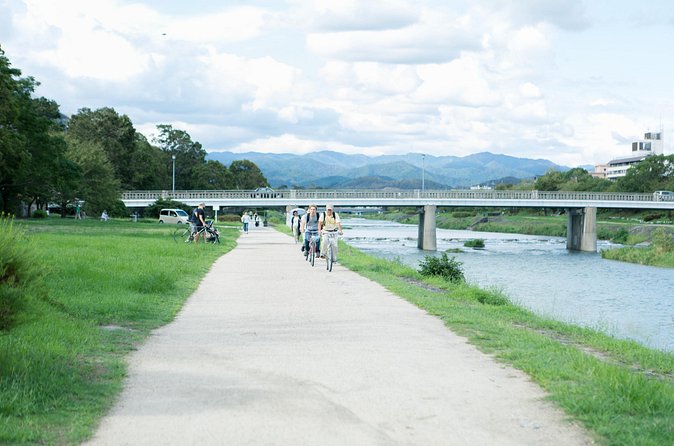
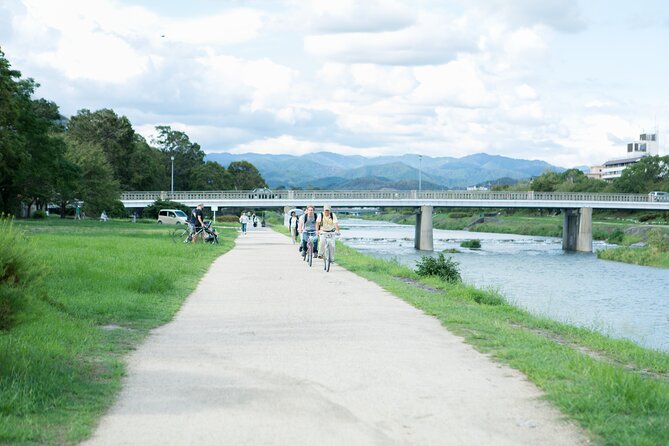
Tatsumi Bridge is another 15-minute stop. A path follows a narrow stream, with willow trees moving in the breeze and water adding a quiet break to the city ride.
This part of the route changes the pace. After the wooden-house lanes and Gion’s more famous streets, the stream gives you a place to pause and look at Kyoto’s softer side. The appeal is simple: water, trees, a path, and the refined atmosphere that makes this part of the city so popular.
A bicycle tour can be especially pleasant here because you arrive without a long walk from another district. You can take in the view, listen to the guide, and continue before the stop becomes a long photo session.
Again, the 15-minute timing keeps the tour efficient. If you want a slow stroll across the bridge or time for careful photography, you may wish to return later. The tour gives you the introduction, not a full afternoon in the district.
Kyoto Imperial Palace: a wider view of the old capital
The route then opens up at Kyoto Imperial Palace, once the residence of Japan’s Imperial Family. The palace grounds are now open to the public as a national garden, with seasonal flowers and broad gravel paths.
You spend about 20 minutes cycling along those gravel paths. This is one of the itinerary’s biggest changes in scale. The earlier stops focus on alleys, streams, and tightly packed traditional buildings. Here, you get open garden space and a clearer sense of the former imperial center.
The palace grounds are valuable even if you have already seen several temples. They show another side of Kyoto’s past, one connected to the court and the city’s long role as Japan’s capital. Seasonal flowers add interest, though the exact display depends on when you visit.
The gravel surface is worth noting. It is not the same as a smooth bike lane, so you should ride carefully and follow your guide’s pace. This section is not designed as an athletic challenge. It is a calm ride through an important public space.
Do not expect a full palace tour during this stop. The schedule allows roughly 20 minutes, so the focus is on cycling through the grounds and hearing context rather than entering every building or garden area.
Kashiwayacho and the Kamo River
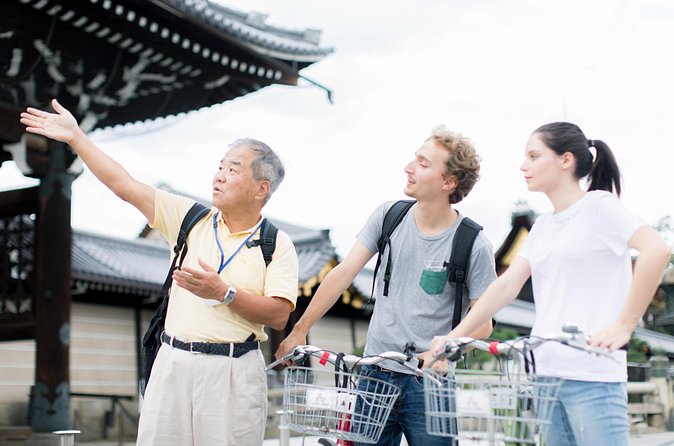
The final listed stop is Kashiwayacho, where you can relax beside the Kamo River. This stop lasts about 20 minutes and includes admission.
The Kamo River is part of daily Kyoto life, not only a sightseeing backdrop. A pause here gives you room to rest after the ride and watch the city from a local gathering place. The river also helps tie the earlier stops together. You have moved from old entertainment districts to palace grounds and now finish beside the water that runs through the city.
This is a good place for the guide to connect the route’s themes: Kyoto’s traditional neighborhoods, public spaces, and everyday routines. The stop is less about checking off a monument and more about seeing how residents use the city.
Because the tour returns to its starting point, the Kamo River is not your final drop-off. You finish back at the meeting point, which makes onward plans easier if you have dinner reservations or an evening activity.
What the guiding adds
The strongest part of this experience is not simply the bicycle. It is the combination of a carefully linked route and an informed local host.
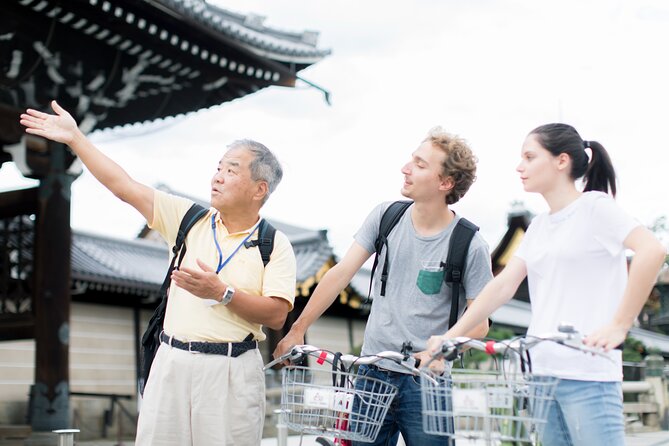
Yuichi receives especially warm attention for being personable, funny, and clear in his explanations. Those qualities matter on a short tour. A guide who can keep the group relaxed while explaining Kyoto’s culture makes the ride feel less like a transfer between stops and more like a conversation through the city.
The guide training also covers traffic safety, group cycling methods, and local etiquette. That is useful for first-time visitors who may not know when to stop, how to move through a narrow lane, or how to behave around residential streets.
The tour is private, so only your group takes part. That gives you more freedom than a large scheduled outing, though the route still needs to keep moving because five stops are packed into three hours.
A previous family booking found the tour a good way to see several parts of Kyoto under time pressure. I agree with that fit. If you have only a short stay, the route gives you a broad first look. If you have a full week in Kyoto, it works better as a relaxed introduction than as your only cultural activity.
Rain, bicycles, and age limits
The tour operates in rain. You can continue on bicycles with a free rain poncho, or switch to a walking tour using buses or the metro, with that public transport included in the tour fee.
This is a useful policy, but the two options offer different experiences. Riding in rain may keep the planned route closer to its original form. Walking and using public transport may be more comfortable, though the timing and exact feel of the outing can change.
Children must be at least 10 years old, 145 centimeters or taller, and able to ride a bicycle safely on the road without assistance. Most people can participate, but you should take the road-riding requirement seriously. This is not a slow ride entirely on private paths.
The experience is listed as a bike tour, and the feedback specifically praises the e-bikes. If an e-bike is important to you, confirm the current equipment details before booking, since the supplied information does not clearly state the bike type as a standard feature.
Who should book this Kyoto ride
I would choose this tour if you want to see several distinct parts of Kyoto in one afternoon and prefer local explanation to independent navigation. It is especially useful for first-time visitors, families with limited sightseeing time, and anyone who finds Kyoto’s bus system confusing.
It also suits you if the thought of cycling through old streets sounds more appealing than following a guide with a flag. The ride keeps you active without turning into a serious workout, and the frequent stops prevent the route from feeling like a race.
I would think twice if you are seeking long visits inside the Imperial Palace grounds, extended photography time in Gion, or a low-cost way to rent a bicycle. The $102.47 price reflects the private format, trained guide, route planning, and safety support. It is not the cheapest way to move around Kyoto.
You should also check the cancellation terms carefully before paying. The supplied booking details say cancellations made at least three days before the tour date by 6 pm Japan time may be refunded, while the stated policy also describes the experience as non-refundable and unchangeable. Because those terms conflict, confirm the rule that applies to your reservation.
Should you book Explore Hidden Alleyway with a Local Expert?
Book it if you want a compact, well-planned introduction to Kyoto that goes beyond the major streets. The mix of Miyagawacho’s wooden houses, Gion, Tatsumi Bridge, the Imperial Palace, and the Kamo River gives you a good range of scenery and context in three hours.
The tour earns its price through the private group, safety training, rain flexibility, and the chance to ask questions as you ride. Yuichi is a strong choice if available, especially if you enjoy a guide with humor as well as cultural knowledge.
Skip it if you are already confident cycling in Kyoto and would rather set your own pace. For everyone else, this is a practical way to get your bearings, see several neighborhoods efficiently, and leave the crowded sightseeing routes for a while.
FAQ
How long does the bike tour last?
The tour lasts approximately three hours.
What time does the tour start?
The tour starts at 2 pm.
Where does the tour begin?
It begins at 552-13 Higashiaburanokōjichō, Shimogyo Ward, Kyoto, 600-8235, Japan.
Where does the tour end?
The activity ends back at the meeting point.
How many people can join each guide?
A guide can accept a minimum of two and a maximum of six people. For groups of seven to twelve, an additional guide can be arranged.
What happens if it rains?
You can continue by bicycle with a free rain poncho, or switch to a walking tour using buses or the metro. Public transport is included in the tour fee.
Can children join the tour?
Children must be at least 10 years old, at least 145 centimeters tall, and able to ride a bicycle safely on the road without assistance.
Is the tour private?
Yes. Only your group participates in the activity.
Just added around Kyoto
- Private Guided Traditional Buddhist Cooking in Japan★ 5.0 · 16 reviews
- Kyoto: Gion Geisha District & Sake-in-Hand Walking Tour★ 5.0 · 37 reviews
- Your Private Vacation Photography Session In Kyoto★ 5.0 · 110 reviews
- Kyoto: Zen Meditation at a Private Temple with a Monk★ 5.0 · 25 reviews
- Traditional Japanese Washi Papermaking- Kyoto morning★ 5.0 · 77 reviews
- Kyoto Wagashi(Japanese sweets) Cooking Class near Fushimiinari★ 5.0 · 60 reviews
- Private Pewter Sake Cup Experience with a Kyoto Artisan★ 5.0 · 31 reviews
- Kyoto Private 6 hour Tour: English Speaking Driver Only, No Guide★ 5.0 · 88 reviews
Kyoto Tours, compared.
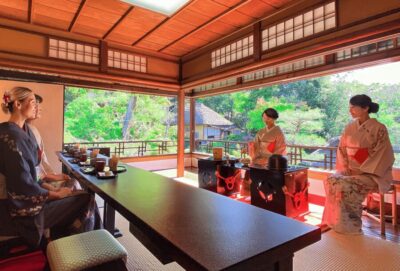
Tea Ceremony in a Traditional Tea House in Kiyomizu
Read our review →
Kyoto Geisha Walking Tour: Gion District & Hidden Gems
Read our review →
Gion Magical Night Walking Tour with Geisha Trivia
Read our review →
Gion Geisha District Walking Tour – Stories of Geisha
Read our review →
Best of Kyoto: Gion, Geisha, Pagodas & Cobblestones
Read our review →