
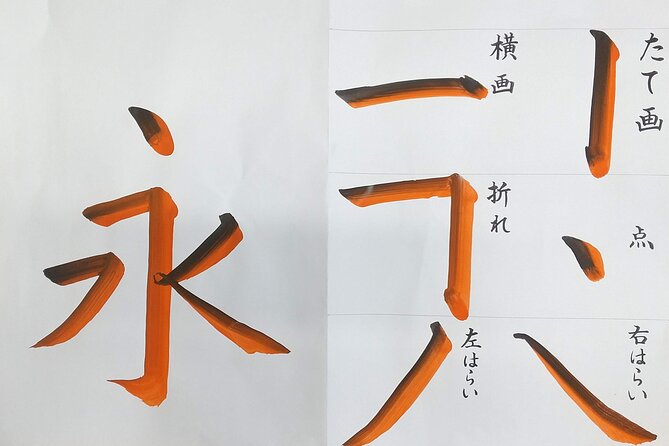
REVIEW · KIMONO & CULTURE EXPERIENCES
Calligraphy Experience at Tokyo Ginza and Tsukiji Area
The best part of this Tokyo experience is that you do not simply watch someone write beautiful characters. You work through the process yourself, from basic brush patterns to a finished piece you can take home. Yuko-sensei teaches the class, with Kenji-san assisting, and the private format gives you room to ask questions.
I like the patient, step-by-step teaching and the personal souvenir you create. I also like the location: after class, you are close to Ginza shopping and the Tsukiji food street, so the lesson fits neatly into a larger afternoon or evening.
The main consideration is timing. The class lasts about 90 minutes, but dinner, shopping, and transportation are not included in the $51.24 price. You will need to plan those extras yourself.
In This Review
- Key points to know before booking
- Why this small Tsukiji class works so well
- Meeting Yuko-sensei and Kenji-san
- Step 1: Learning the basic brush patterns
- Step 2: Taking on a difficult character
- Step 3: Choosing a word for your finished piece
- What the $51.24 price includes
- Making the most of the Tsukiji location
- Who will enjoy this experience most
- Small details that improve the session
- Cancellation and planning flexibility
- Is this calligraphy class worth booking?
- FAQ
- How long does the calligraphy experience last?
- Is the calligraphy class private?
- Who teaches the class?
- What will I learn during the class?
- Are calligraphy supplies included?
- Can I take my calligraphy work home?
- Where does the class meet?
- Does the activity include transportation or dinner?
- What is the cancellation policy?
Key points to know before booking
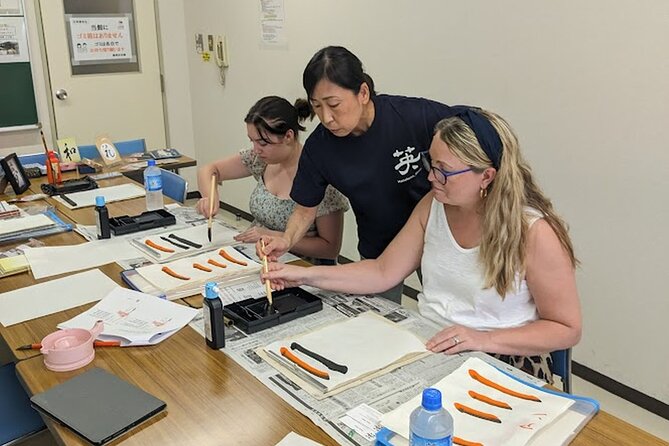
- Private instruction: Only your own group takes part, so you can ask questions freely and work at your own pace.
- Three-part lesson: You begin with basic patterns, try a difficult character, and finish with a favorite Japanese word or words.
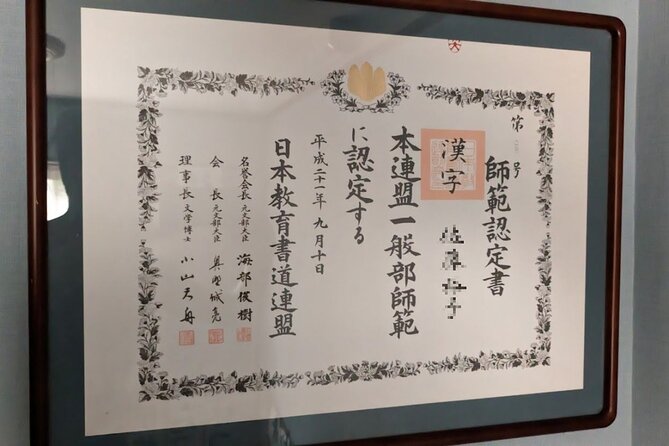
- Experienced teachers: Yuko-sensei is a professional calligraphy writer authorized by the Japan Educational Calligraphy Federation, with Kenji-san assisting.
- Useful Tokyo location: The meeting point is at 3-chōme-15-1 Tsukiji, near public transportation and close to Ginza and Tsukiji attractions.
- A real keepsake: Your finished calligraphy products are designed for display at home, not just for practice and disposal.
- Flexible planning: Free cancellation is available up to 24 hours before the scheduled start time.
Why this small Tsukiji class works so well
Japanese calligraphy can look intimidating. A skilled writer makes a single character appear with a few calm brush movements, while your own first attempt may look rather less calm. This class handles that gap sensibly.
You begin with simple patterns. That matters because the brush does not behave like a pencil. Pressure, speed, angle, and the amount of ink all affect the mark. Basic practice gives you a feel for those movements before you tackle a more complicated character.
The class then moves toward a finished product. You choose a Japanese word or words and use what you have learned to create something suitable for display at home. You are not expected to arrive with calligraphy experience, and the class is designed for beginners who want to make something personal.
I especially like the private setup. In a larger workshop, you might hesitate to ask how to hold the brush or why a stroke looks uneven. Here, your group is the only group taking part. That creates a quieter setting and lets Yuko-sensei adjust the lesson to your level.
More Food Market Tours in Tokyo
- Tokyo: Shinjuku Food Tour (13 Dishes at 4 Local Eateries)
★ 5.0 · 6,603 reviews - Tokyo Tsukiji Fish Market Food and Culture Walking Tour
★ 5.0 · 3,184 reviews - Tokyo: Shinjuku Food Tour (15 Dishes and 4 Eateries)
★ 4.9 · 2,033 reviews
Meeting Yuko-sensei and Kenji-san
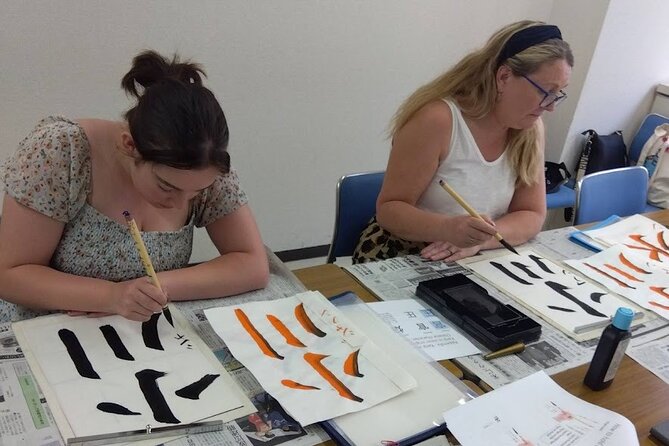
Yuko-sensei leads the instruction, and Kenji-san helps with explanations and the practical side of the class. Their teaching style comes across as warm, patient, and encouraging. That is useful when you are trying to copy a character with several precise strokes and the result does not match the example.
Yuko-sensei is described as a professional calligraphy writer and an instructor authorized by the Japan Educational Calligraphy Federation. Those qualifications do not turn this into a formal Japanese school lesson, but they do give the activity a solid foundation. You are learning from someone who treats calligraphy as an art and a discipline, not as a quick tourist trick.
Kenji-san also helps make the session accessible to visitors who do not know Japanese. Past participants have appreciated his friendly manner, humor, and help with translation. The class includes an introduction to Japanese writing systems, including kanji, hiragana, and katakana, so you gain some useful context before choosing your word.
The teaching is not only about copying shapes. You get a sense of why the strokes matter and how calligraphy connects writing with presentation, balance, and expression. That cultural explanation gives the finished piece more meaning.
Step 1: Learning the basic brush patterns
The first stage is simple pattern writing. This may sound modest, but it is where the most important physical skills begin.
You work with the brush, ink, paper, and inkstone provided for the session. The tools are included, so you do not need to buy a starter set before arriving. You learn how to create controlled strokes and how the brush responds to changes in pressure.
A useful point for beginners is that the goal is not immediate perfection. You are building hand control and learning to look at each stroke as part of a whole character. The teachers guide you through the process step by step, which is helpful if you have never held a Japanese calligraphy brush.
The first part also gives you time to settle in. Calligraphy rewards care rather than speed. If you rush, the character can lose its shape. If you slow down and follow the instruction, even a basic practice sheet can show clear progress.
Step 2: Taking on a difficult character
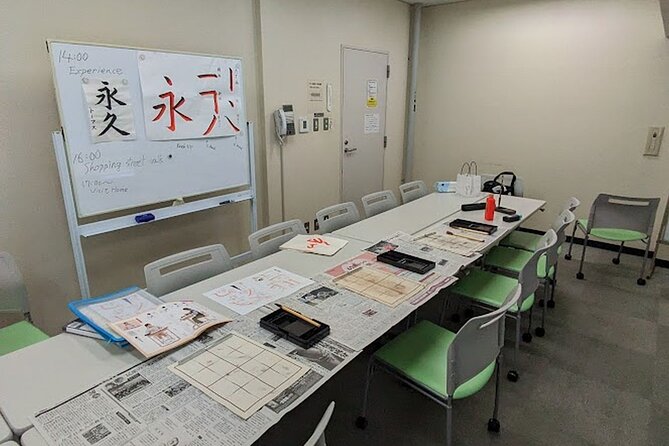
Once you have worked through the basic patterns, the lesson becomes more challenging. You try writing a difficult character.
This is the point where the private class becomes particularly useful. You can ask why a line should begin or end in a certain way, request another demonstration, or try the character again without feeling that you are holding up a large group.
Do not expect every attempt to look like Yuko-sensei’s work. That is not really the point. The exercise helps you understand how several individual strokes fit together. A complicated character can reveal the balance and order behind Japanese writing more clearly than a simple one.
The activity is also suitable for families and mixed-age groups, based on the format described. Everyone can take part in the same lesson, while the private arrangement gives each person room to receive help.
More Kimono & Culture Experiences in Tokyo
- Tokyo: Samurai Ninja Museum Guided tour and Experience
★ 4.6 · 1,010 reviews - Tokyo: Samurai Sword & Archery Class from Samurai Descendant
★ 5.0 · 603 reviews - Best Samurai Experience in Tokyo
★ 5.0 · 458 reviews - Ninja Experience (Family Friendly) at Samurai Ninja Museum TOKYO
★ 5.0 · 441 reviews
Step 3: Choosing a word for your finished piece
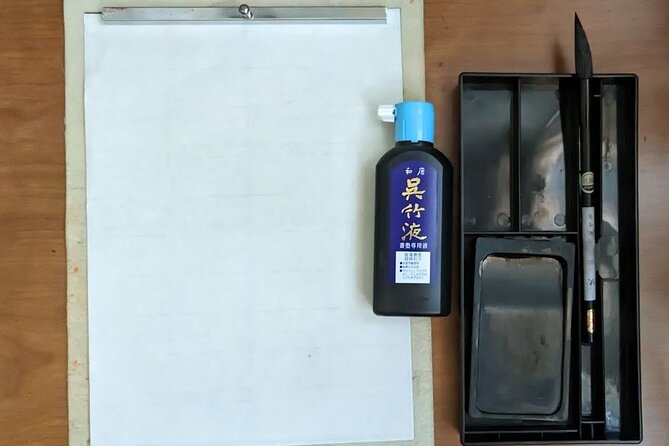
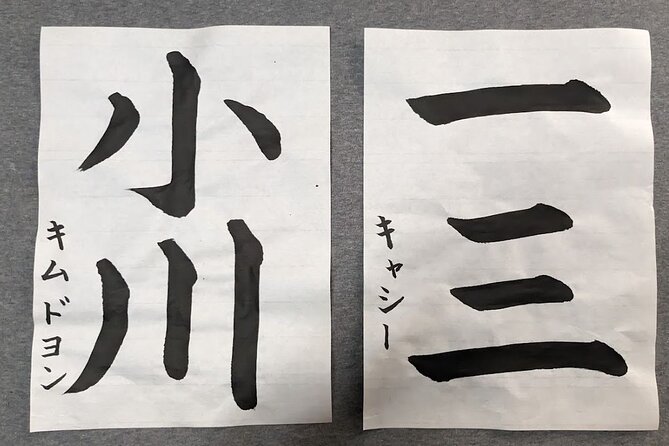
The final stage is the most personal. You choose your favorite Japanese word or words and use them to complete your calligraphy products.
The information provided does not set out a fixed menu of words, so you should ask the instructors for help choosing and understanding your selection. That is important. A word may look attractive on paper but have a meaning or nuance you do not expect. Kenji-san and Yuko-sensei can help connect the writing with the intended meaning.
This stage turns the class from a handwriting exercise into a souvenir-making activity. You are not simply taking home a generic item purchased in a shop. You create the work during the lesson, with guidance from the instructors.
The finished piece is intended for display at home. It may not have the polished look of a professional calligrapher’s work, but that is part of its value. It records your effort, your chosen word, and your time in Tokyo.
What the $51.24 price includes
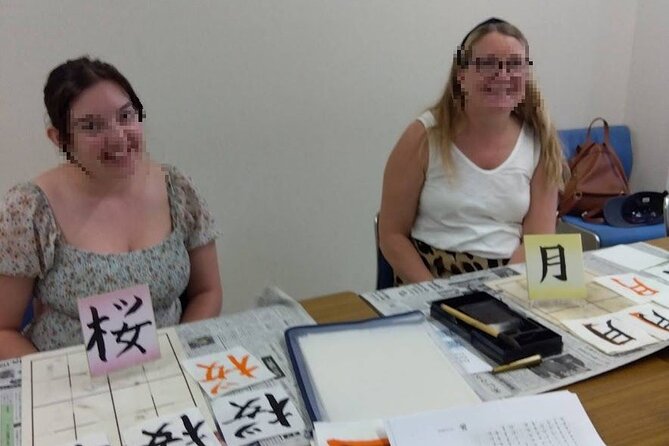
At $51.24 per person, this is priced above a casual drop-in craft activity, but the comparison is not quite fair. You are paying for roughly 90 minutes of private instruction, an experienced calligraphy teacher, an assistant, and the use of the required tools.
Brushes, ink, paper, and an inkstone are provided. That saves you the trouble of finding supplies and makes the price easier to understand. The private format also matters. Your group does not share the teacher with another booking.
The value is strongest if you want instruction and a finished piece. If you only want to try a brush for a few minutes or buy a ready-made souvenir, Tokyo has other options. This class makes more sense for someone who wants to understand the process and take part in making the object.
Remember that the price does not include private transportation, personal travel insurance, shopping, or dinner. The class ends at the meeting point, so treat the nearby Ginza and Tsukiji activities as plans you can add before or after, not as included services.
Making the most of the Tsukiji location
The meeting point is at 3-chōme-15-1 Tsukiji, Chuo City, Tokyo 104-0045. The area is near public transportation, which makes the class practical to combine with other Tokyo plans.
Ginza is nearby for shopping. You might browse department stores, smaller shops, or the district’s well-known retail streets after the lesson. The activity description specifically points toward Ginza, but it does not include a guided shopping visit or purchases. Plan enough time if shopping is one of your main reasons for choosing this location.
Tsukiji food street is another natural follow-up. You can arrange dinner after class and explore the area at your own pace. Food is not part of the calligraphy booking, so you pay separately and choose your own meal.
This pairing gives the day a nice rhythm. You begin with a focused cultural activity, then move into Tokyo’s food and shopping scene. It is more satisfying than stacking several similar sightseeing stops together.
The one practical caution is scheduling. Because the lesson lasts about 90 minutes and the activity ends where it began, you should leave room for travel to your next stop. The exact route and transportation are not provided, so check your directions before setting out.
Who will enjoy this experience most
I would recommend this class to first-time visitors who want a hands-on introduction to Japanese culture. It suits people who prefer making something to simply taking photographs, and it gives you an activity with a clear beginning, middle, and end.
Families can also benefit from the private format. A family group can learn together without being mixed with strangers. The class is not limited to experts, and most participants can take part.
It is also a good choice for couples, friends, and solo visitors who enjoy patient instruction. You do not need to know Japanese calligraphy in advance. The lesson begins at the foundation level and builds toward a personal word.
You may want to choose another activity if you dislike seated craft lessons or want a fast, highly polished souvenir. Calligraphy requires concentration, and your final piece will show your own hand. That is rewarding for some people and less appealing for others.
Small details that improve the session
Think about your favorite Japanese word before the class, but do not feel that you must arrive with a final decision. You can ask the instructors for help with the meaning and presentation.
Wear something you do not mind wearing during a craft activity. The class provides ink and paper, but no information is given about protective clothing or stain treatment. A little care is sensible.
Arrive with enough time to find the meeting point. The address is specific, but Tokyo neighborhoods can take longer to cross than they appear on a map. Since no private transportation is included, you are responsible for getting there and returning from the area.
If you want a record of the experience, ask about photographs during the session. Photos have been shared with participants in the past, but the supplied details do not state this as a guaranteed inclusion. Your finished work is the dependable souvenir.
The mobile ticket is convenient for keeping your booking details available on your phone. Confirmation is received at the time of booking, and the activity is listed as suitable for most participants.
Cancellation and planning flexibility
You can cancel for a full refund if you do so at least 24 hours before the experience start time. Cancellations made less than 24 hours before the start are not refunded, and changes within that period are not accepted.
The cut-off is based on Tokyo local time. That is worth checking if you are booking from another time zone.
This policy gives you reasonable flexibility while you are arranging a Tokyo itinerary. Still, do not wait until the last minute if your schedule is uncertain. The experience is commonly booked well ahead, with an average booking time of about 34 days before the date.
Is this calligraphy class worth booking?
I would book it if you want a quiet, personal activity that teaches a real skill and leaves you with something you made yourself. The combination of Yuko-sensei’s instruction, Kenji-san’s assistance, private attention, and the nearby Tsukiji and Ginza areas gives the class practical value beyond the 90 minutes at the table.
I would skip it if your main goal is a quick stop with no concentration or if you expect dinner, shopping, and transportation to be included. For everyone else, $51.24 is a fair price for private instruction, supplies, and a handmade Japanese keepsake.
Schedule it beside Tsukiji food or Ginza shopping, choose a word with personal meaning, and give yourself enough time to enjoy the process rather than chase perfect brushwork.
FAQ
How long does the calligraphy experience last?
The class lasts approximately 1 hour and 30 minutes.
Is the calligraphy class private?
Yes. Only your own group takes part, and no other group joins the activity.
Who teaches the class?
Yuko-sensei teaches the calligraphy, with Kenji-san assisting. Yuko-sensei is a professional calligraphy writer authorized by the Japan Educational Calligraphy Federation.
What will I learn during the class?
You begin with basic pattern writing, then try a difficult character, and finally choose a favorite Japanese word or words for your finished products.
Are calligraphy supplies included?
Yes. The class provides a brush, ink, paper, inkstone, and other calligraphy tools needed for the activity.
Can I take my calligraphy work home?
Yes. The finished calligraphy products are intended for you to take home and display.
Where does the class meet?
The meeting point is 3-chōme-15-1 Tsukiji, Chuo City, Tokyo 104-0045, Japan.
Does the activity include transportation or dinner?
No. Private transportation, personal travel insurance, shopping, and dinner are not included. The activity ends back at the meeting point.
What is the cancellation policy?
You can cancel for a full refund up to 24 hours before the experience start time. Cancellations or changes made less than 24 hours before the start are not accepted for a refund.
Just added around Tokyo
- Private Memorable Tokyo Tour with English Speaking Driver★ 5.0 · 30 reviews
- Private Tokyo Custom Full-Day Tour by Chartered Vehicle★ 5.0 · 16 reviews
- Private Sightseeing to Mt Fuji and Hakone with English Driver★ 5.0 · 51 reviews
- Tokyo Photography Masterclass – Private Photography Lesson★ 5.0 · 25 reviews
- Private Mt. Fuji Day Trip from Tokyo with English-Speaking Driver★ 5.0 · 33 reviews
- 4 Day Tour – Mount. Fuji, Tokyo, Hakone, Kamakura and Yokohama★ 5.0 · 19 reviews
- Private Unforgettable Mt Fuji Tour with English Speaking Driver★ 5.0 · 142 reviews
- Private Tokyo Food Tour – A Journey Through Time Through Food★ 5.0 · 36 reviews
Kimono & Culture Experiences, compared.

Kyoto Geisha Walking Tour: Gion District & Hidden Gems
Read our review →
Gion Magical Night Walking Tour with Geisha Trivia
Read our review →
Gion Geisha District Walking Tour – Stories of Geisha
Read our review →
Best of Kyoto: Gion, Geisha, Pagodas & Cobblestones
Read our review →
Kyoto Gion Geisha District Walking Tour – The Stories of Geisha
Read our review →
Browse the lists this tour appears in