
REVIEW · KIMONO & CULTURE EXPERIENCES
Samurai Armor & Sword experience with phot near Osaka Castle
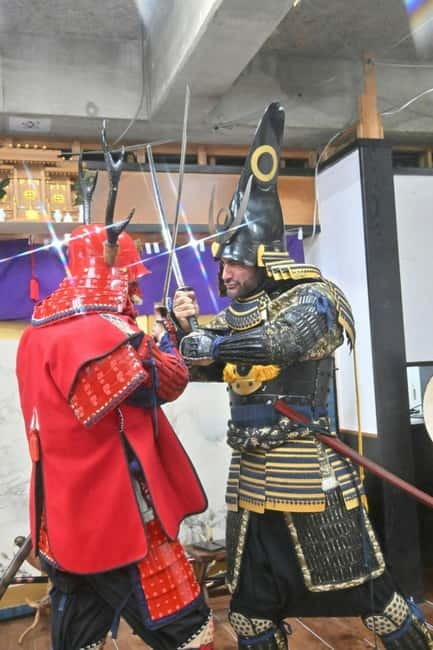
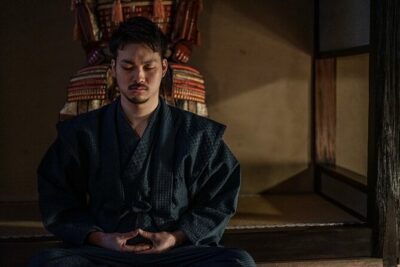
The sharpest part of this Osaka experience is not the costume photo. It is the chance to handle a real samurai sword and try a controlled cutting exercise after learning the basic movements. You begin in dogi and hakama, bow at a shrine, practice drawing and returning the blade, then finish in armor with a helmet and sword at your waist.
I like the careful connection between samurai manners and sword work, rather than treating the activity as a quick dress-up stop. I also like the private-group format, the English instruction, and the fact that your armor photos are sent to a designated email address. The main caution is practical: two recent bookings were cancelled for overbooking, so I would confirm the schedule before building a tightly timed Osaka day around it.
In This Review
- Key points to know before booking
- What happens inside the 90-minute session
- Changing into dogi and hakama
- Bowing before the shrine
- Learning why the sword was carried with care
- Walking with a sword and practicing samurai manners
- The four movements behind a clean sword stroke
- Cutting with a real samurai sword
- Wearing armor and posing for photographs
- Is $106 per person good value?
- Who should book this experience?
- Language, timing, and booking cautions
- My call: book it if you want more than a costume photo
- FAQ
- Where does the samurai experience take place?
- What is the meeting point landmark?
- Should I use Google Maps or Apple Maps?
- How early should I arrive?
- How long does the activity last?
- What languages are available?
- Is the experience private?
- Is samurai armor included?
- Are photographs included?
- What should I bring?
- Can children join?
- Can I cancel for a refund?
Key points to know before booking
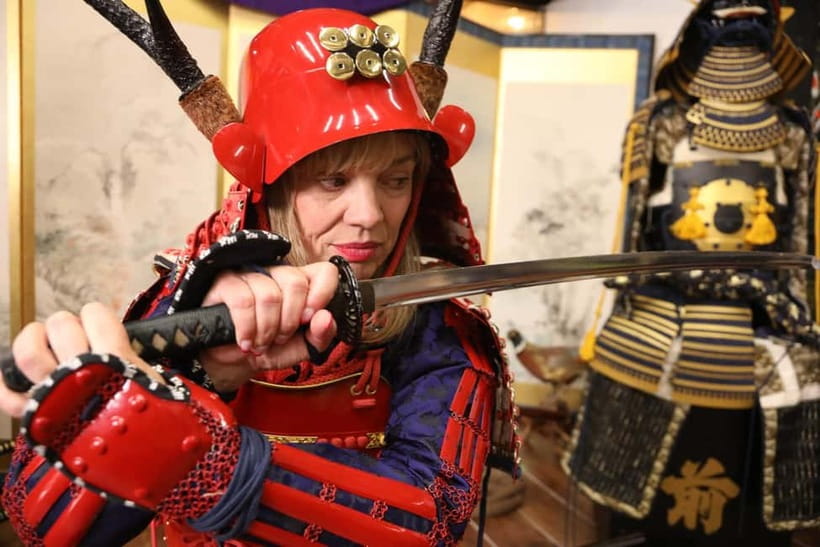
- Real sword cutting follows practice: You first learn stance, drawing, swinging, blood-removal gestures, and sheathing before trying the blade.
- The ceremony matters: Each session begins and ends with a bow before a shrine in the dojo.
- Armor is worn indoors: You put on samurai armor and a helmet for photographs, not for a walk around Osaka Castle.
- English instruction is available: The standard languages are English and Japanese, with other languages possible only if staff availability allows.
- Arrive 30 minutes early: Look for the wooden Samurai Honor sign and allow time to change clothes.
- The session costs $106 per person: That is a fair price if you value instruction, real cutting, armor, and private photos, but it is more than a simple costume rental.
What happens inside the 90-minute session
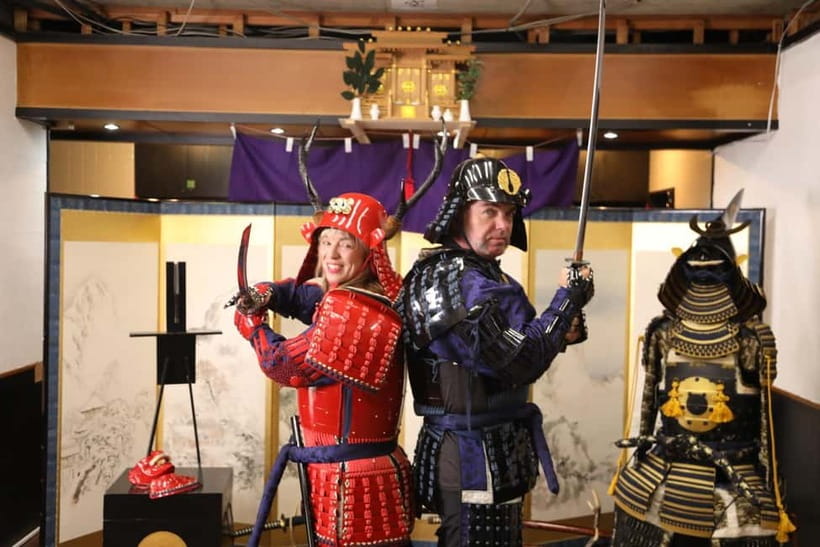
This is a compact lesson, not a full-day martial arts course. In 90 minutes, you move through clothing, ceremony, instruction, sword practice, real cutting, armor, and photography. The pace should keep you busy, but it also means the teacher cannot spend long on every technique.
You will work at Bushi no Homare, also presented as Samurai Honor, at Excellence Takayama 1F, 2-3-19 Shiginonishi, Joto-ku, Osaka. The wooden sign reading Samurai Honor is the main landmark. A rack of activity pamphlets sits in front, and kimonos and hakama may be hanging nearby.
Use Google Maps for the address. The supplied directions specifically warn that Apple Maps shows the wrong location. That is the sort of small detail that can save you from arriving flustered and late. Plan to arrive 30 minutes before your reserved time for directions and changing.
More Garden & Palace Tours in Osaka
- Osaka Castle: Museum and Tower Entry Ticket
★ 4.5 · 2,380 reviews - Ultimate Osaka Walking Tour: Castle, Dotonbori & Hidden Gems
★ 5.0 · 862 reviews - Osaka Castle Walking Tour and Castle Tower Admission
★ 5.0 · 561 reviews
Changing into dogi and hakama
Your first step is to change into samurai clothing. The outfit includes a dogi, the martial arts top, and hakama, the pleated trousers associated with formal Japanese dress and traditional practice.
This part does more than set up the photographs. It changes the way you move. The sword belt, clothing, and formal posture make you pay attention to where your hands and feet are. You are not simply handed a sword and told to swing it.
A T-shirt is the only item specifically requested, so wear one under the clothing. You do not need to bring food or drinks into the activity, and food, alcohol, and drugs are not allowed. Pets are not allowed, although assistance dogs are permitted.
Bowing before the shrine
The lesson begins with a bow before a shrine in the dojo. The explanation connects training with the ancient god of war, and the bow is repeated at the end.
I appreciate this opening because it gives the session a sense of purpose. The experience presents sword use as a practice tied to restraint, respect, and responsibility, not just a chance to pose with a weapon. You do not need prior knowledge of Japanese martial arts to follow along. The instructor explains what to do.
The ceremony will not suit everyone. If you want nonstop action from the first minute, the formal opening may feel slow. If you enjoy learning why a physical practice has rules, it is an important part of the hour and a half.
Learning why the sword was carried with care
The explanation of samurai life forms the bridge between history and practice. You learn that boys from samurai families began with wooden swords and were traditionally permitted to wear a serious sword at age 15. The point is not only skill. Carrying a deadly weapon meant carrying personal responsibility and self-respect.
The lesson also explains how closely a samurai lived with the sword. It was kept nearby during ordinary life, including meals and sleep, so it could be drawn quickly if needed. This gives meaning to the small gestures that follow.
Some historical explanations in a short activity are necessarily simplified. You should treat them as an introduction rather than a full course in Japanese history. Still, the discussion helps you understand why the teacher cares about the sword belt, the blade direction, and the way you walk.
More Kimono & Culture Experiences in Osaka
- Osaka: Sumo Show & Experience w/ Optional Kimono & Hot Pot
★ 4.5 · 609 reviews - Samurai Training Experience KENDO in Osaka
★ 5.0 · 515 reviews - OSAKA NIGHT FUSION Japanese Taiko Kabuki Samurai Dance Show
★ 4.8 · 155 reviews - Osaka: Samurai Training Experience KENDO in Osaka
★ 5.0 · 111 reviews
Walking with a sword and practicing samurai manners
You will place the sword through the belt at your waist with the blade facing upward. Then you practice walking with it.
The activity explains the traditional reason for walking on the left side of the road. A samurai wanted to avoid the scabbard striking another person’s scabbard as the two passed. You also learn about keeping the koiguchi, the scabbard opening, cut and ready for a fast draw.
These details are easy to miss in a costume display. Here, they become physical instructions. You must think about your waist, your stride, and the position of the sword. I find this more useful than a long lecture because you feel how the equipment affects movement.
You should also remember that the sword work takes place under instruction. This is not a free-form chance to swing a blade. Listen closely, follow the instructor’s movements, and do not rush the draw or return.
The four movements behind a clean sword stroke
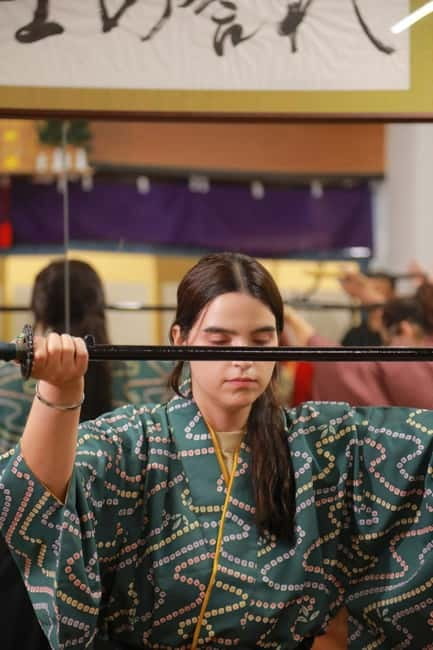
The basic practice uses an iai practice sword before you handle the real samurai sword. This stage teaches the main sequence:
- Battou: pulling the sword from its scabbard to cut
- Chiburui: the symbolic motion of removing blood from the blade after a cut
- Nottou: returning the sword to its scabbard
- The downward swing: learning to let the sword’s weight do the work
The instructor also shows basic kata and stances. You practice drawing from a set position and swinging downward with control. The advice is to avoid relying on arm strength. A correct swing should produce a hi-nari sound from the sword.
That sound is a useful check, but do not turn it into a contest. The aim is to learn the movement, not to hit hard. The sequence of cut, symbolic cleaning, and sheathing also reinforces the idea that every sword action has a proper finish.
This is one of the strongest parts of the session for adults and older children who like hands-on instruction. You are learning a sequence with names and purpose, rather than repeating an unexplained motion for a photograph.
Cutting with a real samurai sword
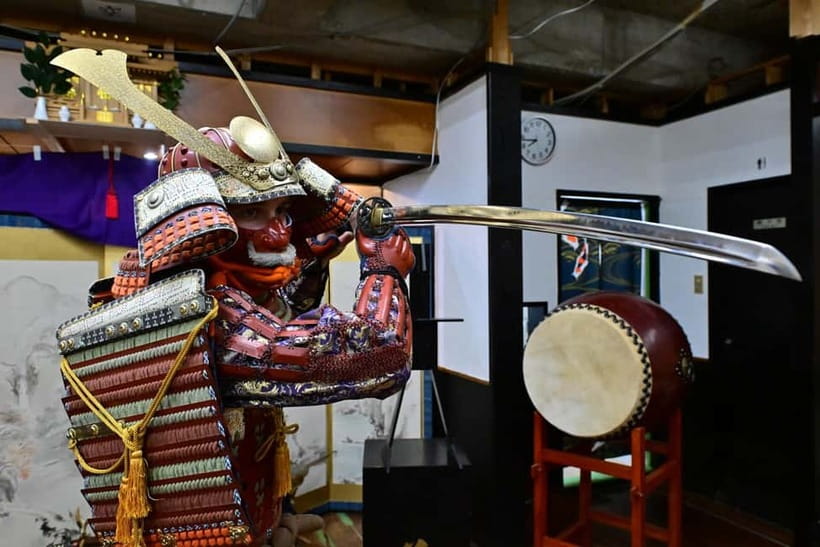
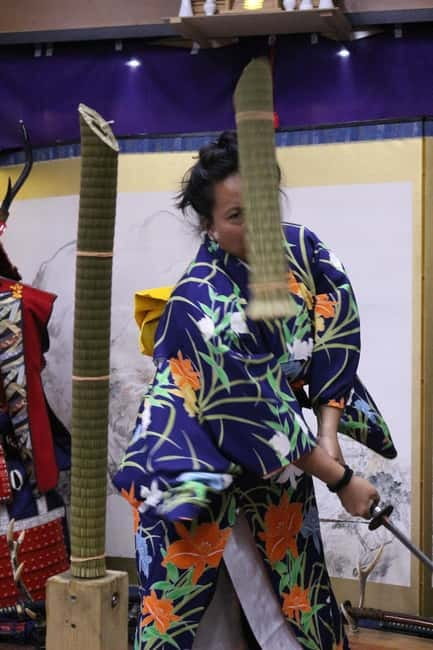
After practicing with the iai sword, you try cutting with a real samurai sword. This is the moment many people book the activity for, and it gives the session a clear sense of progression.
The experience describes the Japanese sword as an exceptionally effective blade. The important point for you is that cutting depends on technique, angle, and movement, not brute force. The earlier practice prepares you to handle the sword with more care.
Because this is real blade work, safety and instruction matter. The activity includes a certified professional instructor, and you should follow every direction exactly. The information provided does not specify the cutting material, the number of attempts, or the exact safety equipment, so do not assume you will get repeated cuts or an extended sword class.
That uncertainty is worth keeping in mind when judging the $106 price. If your main goal is a long technical lesson, this short session may feel limited. If you want a guided first encounter with real cutting, combined with clothing, armor, and photographs, the price makes more sense.
Wearing armor and posing for photographs
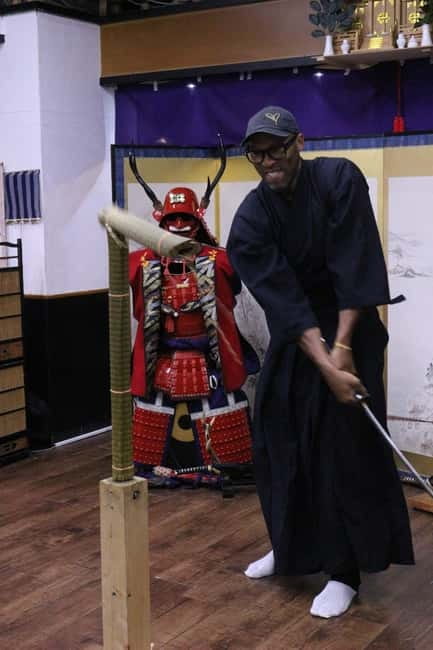
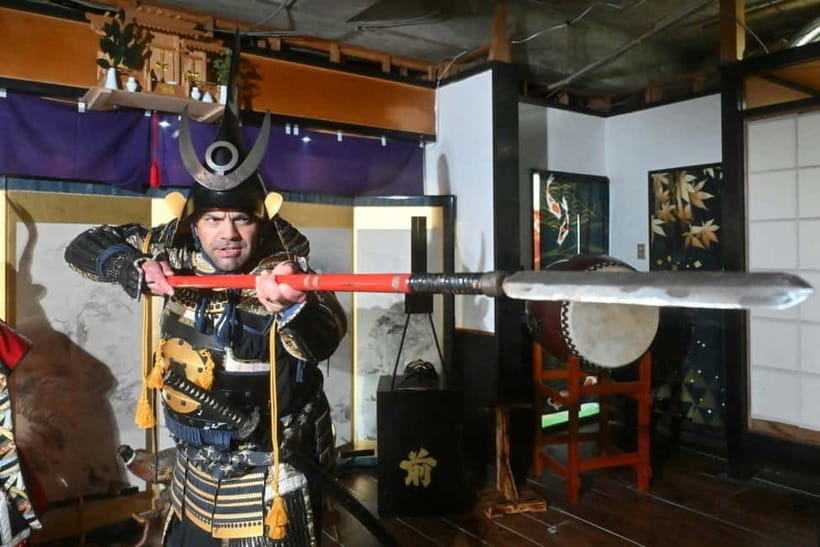
The armor section comes after the sword practice. You put on samurai armor and a helmet, with the sword at your waist and a naginata, or long-bladed polearm, ready for the pose.
The armor is worn indoors. You are not taking it through the streets or wearing it into Osaka Castle. That matters if you are imagining a long outdoor photo walk. The setting instead gives you a controlled place to put on the equipment and learn how it changes your posture.
The session explains that samurai wore armor before battle to show dignity and inspire others. The photograph then becomes more than a souvenir of fancy clothing. It records the contrast between the earlier practice clothes and the formal battle appearance.
Photos are taken during the armor portion and sent to the designated email address. That is convenient because you do not have to depend on a companion’s phone or remember to take pictures while dressed in heavy gear. The information does not state how many images you receive or how quickly they arrive, so I would not book this solely for a guaranteed large photo package.
Is $106 per person good value?
At $106 per person, this is not a bargain activity. You are paying for a private 90-minute session with a certified instructor, samurai clothing, use of armor and helmet, sword instruction, real sword cutting, and professional photography. Tax and tips are included.
For me, the value depends on what you want from Osaka. A basic costume rental would cost less, but it would not offer the same guided sequence. A history talk would explain samurai life, but it would not let you practice battou, chiburui, and nottou or try a real blade.
The private-group setup is another part of the calculation. You are not joining a large public class, and instruction can focus on your group. The listing does not give a maximum group size, so ask before booking if the number of people in your party matters.
The experience is especially good value if you already plan to visit Osaka Castle and want a structured activity to follow the sightseeing. It gives you a physical connection to the subject instead of another museum hour. It is less compelling if your budget is tight, you dislike formal instruction, or you want a long outdoor activity.
Who should book this experience?
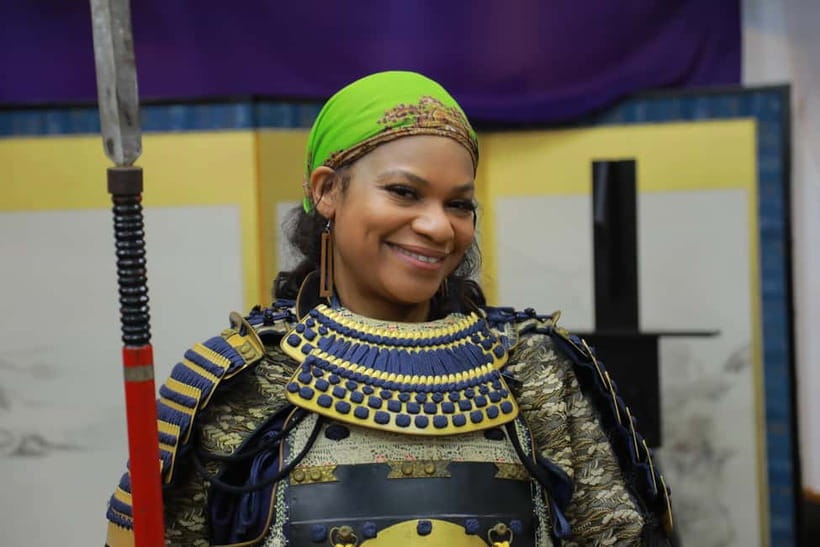
I would recommend it for adults, couples, families with children aged 10 and older, and small private groups who want a memorable cultural activity with clear instruction. It suits people who enjoy dressing up but also want a real skill component.
The safety-conscious design makes it approachable for beginners. You start with explanation and practice, then progress to the real sword. You do not need to arrive with martial arts experience.
Children under 10 are not suitable. The activity also excludes babies under one, people over 80, and people with altitude sickness. The altitude restriction seems unusual for an Osaka indoor activity, but it is part of the stated suitability rules, so check before paying.
Avoid bringing a baby stroller or carriage, food, alcohol, or party equipment. Bachelor and bachelorette groups are not accepted. Assistance dogs are allowed, but other pets are not.
Language, timing, and booking cautions
English and Japanese are the standard languages, and the instructor is described as English speaking and certified. Italian, Spanish, French, Chinese, Thai, and Indonesian interpretation may be possible, but staff schedules are limited. Contact the provider before reserving if you need one of those languages.
The experience provider is 株式会社武士の誉れ. The site name is Bushi no Homare, or Samurai Honor. Keep both names available when checking directions.
You can cancel up to 24 hours in advance for a full refund, and the reserve-now, pay-later option lets you hold a place without paying immediately. Those terms help if your Osaka schedule is still moving.
I would still pay close attention to confirmation messages. Two bookings were cancelled for overbooking, including one cancellation on the morning of the scheduled activity. That is a serious planning concern, especially if you have arranged the session around Osaka Castle tickets, dinner, or a train departure.
The overall rating is 4.6 from 16 reviews, with strong praise for clear teaching, friendly hosts, safety, the quality of the photographs, and the fun of learning the techniques. One Italian-speaking couple found the staff helpful and the guidance precise, while an English-speaking participant called it one of the best activities of a Japan trip. Those strengths match the structure of the session: the teaching is not an afterthought.
My call: book it if you want more than a costume photo
I would book this Samurai Armor and Sword experience if you want a short, private cultural activity with real instruction and a strong souvenir. The best parts are the formal bow, the explanation of samurai responsibility, the named sword movements, the controlled real-sword cutting, and the final armor photographs.
I would skip it if you want to spend several hours studying samurai history, walk outdoors in armor, or practice advanced swordsmanship. I would also avoid locking it into an unforgiving itinerary until the booking is confirmed, given the reported overbooking cancellations.
For the right person, $106 buys a focused introduction to samurai conduct and sword handling, not merely a costume change. Arrive early, use Google Maps, wear a T-shirt, and keep your expectations centered on a 90-minute lesson with a memorable photo finish.
FAQ
Where does the samurai experience take place?
It takes place at Bushi no Homare, also called Samurai Honor, at Excellence Takayama 1F, 2-3-19 Shiginonishi, Joto-ku, Osaka-shi, Osaka 536-0014.
What is the meeting point landmark?
Look for a wooden sign that reads Samurai Honor. A rack with activity pamphlets is in front of the store, and kimonos and hakama may also be hanging nearby.
Should I use Google Maps or Apple Maps?
Use Google Maps. The provided directions warn that the address shown on Apple Maps is incorrect.
How early should I arrive?
Arrive 30 minutes before your reserved start time. This allows time for instructions and changing into samurai clothing.
How long does the activity last?
The experience lasts 90 minutes.
What languages are available?
Instruction is available in English and Japanese. Interpretation in Italian, Spanish, French, Chinese, Thai, and Indonesian may be possible if staff schedules allow, but it is not guaranteed.
Is the experience private?
Yes. It is offered for a private group.
Is samurai armor included?
Yes. Samurai clothing and indoor use of samurai armor are included, along with the helmet for the armor portion.
Are photographs included?
Yes. Photos are taken in the armor, and the data is sent to the designated email address.
What should I bring?
Bring a T-shirt to wear under the samurai clothing.
Can children join?
Children under 10 are not suitable for this activity. Babies under one are also not suitable.
Can I cancel for a refund?
You can cancel up to 24 hours in advance for a full refund. The reserve-now, pay-later option is also available.
Just added around Osaka
- (Ticket Included) Explore Osaka Castle & Museum of History★ 4.8 · 21 reviews
- Hidden Osaka – Yukaku Red Light Tour & Culinary Adventure★ 4.8 · 96 reviews
- Osaka: Walking Tour and Top Highlights★ 4.8 · 104 reviews
- Osaka: Private Ceramic Painting Workshop★ 5.0 · 13 reviews
- Pickleball in Osaka, Kobe & Kyoto with Locals!★ 4.7 · 80 reviews
- Eat Like a Local in Osaka – Private Custom Street Food Tour★ 4.3 · 33 reviews
- Osaka:SUMO BEATS SHOWCASE: Taiko Drum and Wagyu burger!★ 4.2 · 37 reviews
- Kimono photoshoot-Includes 100 photo data★ 5.0 · 21 reviews
Kimono & Culture Experiences, compared.
Kyoto Geisha Walking Tour: Gion District & Hidden Gems
Read our review →
Gion Magical Night Walking Tour with Geisha Trivia
Read our review →
Gion Geisha District Walking Tour – Stories of Geisha
Read our review →
Best of Kyoto: Gion, Geisha, Pagodas & Cobblestones
Read our review →
Kyoto Gion Geisha District Walking Tour – The Stories of Geisha
Read our review →
Browse the lists this tour appears in