
REVIEW · WALKING TOURS
Osaka: Dark Side of Osaka Night Walking Tour
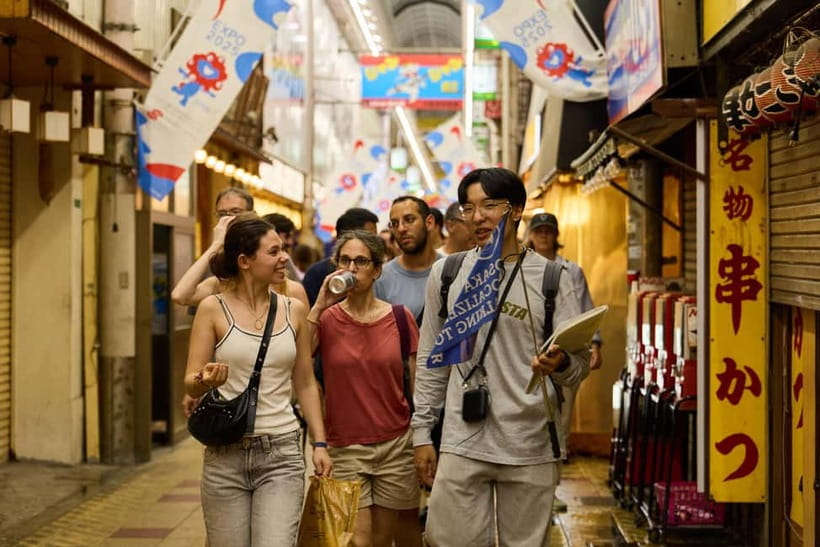
Osaka’s unpolished side is the subject here: not the neon postcard version, but the streets shaped by day labor, poverty, entertainment, and social rules that are rarely explained on a standard city tour. You’ll walk through Shinsekai, Nishinari, and Tobita Shinchi after dark, with a guide putting the scenery into social and historical context.
I like the way this tour connects old Osaka with present-day life, and I like the small details, such as the meaning of a torii painted on a wall or the unusual design of Shinsekai. Guides including Jay, Rico, and Matt are praised for clear explanations, warmth, and thoughtful handling of sensitive subjects.
The main consideration is the subject matter. Some scenes and stories may feel confronting, and this is not a good choice for children or anyone looking for a light sightseeing stroll. You’ll also need comfortable shoes, weather-ready clothing, and enough English to follow a fast-moving discussion.
In This Review
- Key points to know before you go
- Why this Osaka night walk feels different
- Meeting beneath the giant penguin
- Shinsekai and the idea of a New World
- Nishinari and Osaka’s working-class story
- Jyanjyan Yokocho, old shops and everyday atmosphere
- Tobita Shinchi and the rules of discretion
- Tsutenkaku marks the finish
- Guide style and group experience
- Is $25 a fair price for two hours?
- Who should book this walk?
- Final call: book it for context, not shock value
- FAQ
- How long does the Dark Side of Osaka Night Walking Tour last?
- What language is the tour conducted in?
- Where does the tour meet?
- Where does the tour finish?
- What areas does the walk visit?
- Is food included in the $25 price?
- Can children or wheelchair users join?
Key points to know before you go
- Shinsekai began as a Western-inspired entertainment district: Its southern side drew on Paris, while its northern side looked toward New York’s Coney Island.
- Tobita Shinchi offers a discreet look at Osaka nightlife: The district is famous for its traditional architecture and carefully controlled public face.
- The tour covers social issues, not just landmarks: Expect discussion of poverty, day labor, class, changing neighborhoods, and modern Japanese society.
- Guides make a major difference: Jay, Rico, and Matt are noted for personal, respectful explanations and willingness to answer questions.
- The two-hour route is compact but full: It includes Shinsekai, Nishinari, Jyanjyan Yokocho, Tobita Shinchi, and Tsutenkaku.
- This is an adults-only experience: Children under 18 and wheelchair users cannot join.
Why this Osaka night walk feels different
Many Osaka tours stay in the familiar orbit of Dotonbori, Osaka Castle, and food stalls. This one takes you south, into areas with a more complicated story. You’ll see old entertainment streets, modest housing, working-class neighborhoods, and a famous red-light district, but the real subject is how Osaka has handled people and businesses that polite society prefers not to discuss.
I appreciate that the tour does not treat these areas as a set for an edgy photo opportunity. The better guides explain the forces behind what you see. Nishinari’s connection with day laborers, the changing role of budget accommodation, and the rules surrounding Tobita Shinchi all help you read the streets with more care.
The tone can vary slightly by guide, but the strongest experiences are thoughtful rather than sensational. Matt is praised for his understanding of Osaka’s modern history and for treating the people connected with the tour’s subject matter respectfully. Jay is described as warm, attentive, and good at expanding on questions. Rico is noted for his historical detail, adaptable manner, and useful restaurant advice.
That personal element matters. A printed guidebook can tell you when Tsutenkaku was built or where a red-light district is located. It cannot easily explain the local customs, unwritten rules, and small signs that make a street meaningful.
More Walking Tours in Osaka
- Osaka Kickstart: Hotspots & Hidden Gems Tour
★ 5.0 · 1,306 reviews - Osaka: Hotspots & Hidden Gems Walking Tour Private or Group
★ 4.9 · 1,300 reviews - Osaka Local Foodie Walking Tour in Dotonbori and Shinsekai
★ 5.0 · 985 reviews
Meeting beneath the giant penguin
The tour begins beneath the Giant Penguin outside MEGA Don Quijote Shinsekai. Your English-speaking guide holds a GetYourGuide sign, which gives you a clear way to identify the group in a busy part of Osaka.
This is a practical starting point because you are already near Shinsekai and Tsutenkaku. Do not arrive expecting hotel pickup. You make your own way to the meeting point, and the walk ends at Tsutenkaku.
Wear shoes you can walk in for two hours. The tour is outdoors, so rain, heat, cold, or humidity can affect your comfort. One guide adapted well to a rainy evening, but you should still dress for the forecast rather than count on perfect conditions.
Shinsekai and the idea of a New World
The first major stop is Shinsekai, whose name means New World. The district was laid out in 1912 as a modern entertainment center, drawing on Western ideas of urban leisure.
The design had an unusual split personality. The southern part was modeled after Paris, while the northern section took inspiration from New York’s Coney Island. That ambition has faded, but the district still carries a retro look and a slightly eccentric mood that feels unlike Osaka’s newer commercial zones.
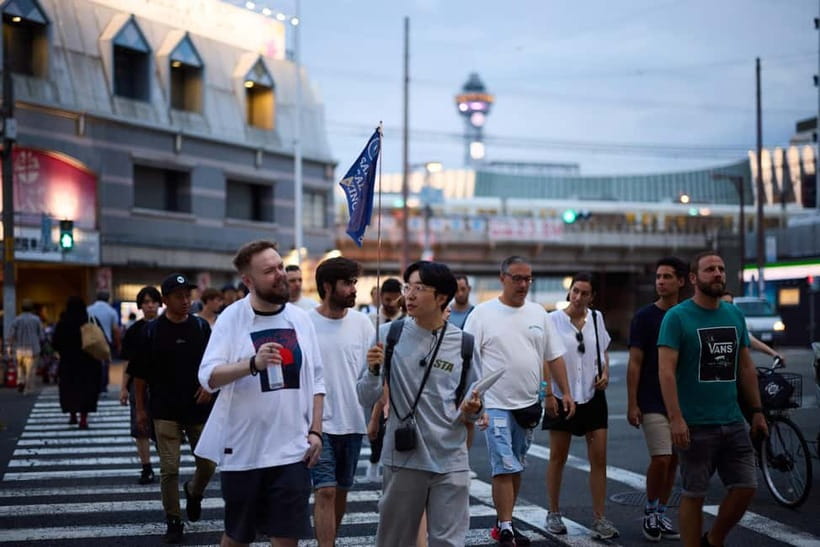
Tsutenkaku Tower is the area’s best-known landmark. It gives Shinsekai a visual anchor and helps you understand how the district was planned around entertainment and public life. You’ll have the tower as a reference point during much of the walk, even when the focus shifts to side streets and older shopping lanes.
I like this opening because it gives you a familiar landmark before the discussion becomes more serious. Shinsekai is not presented as a museum piece. Its older character sits beside active restaurants, shops, and everyday local movement, making it easier to see how a once-grand district changes without disappearing.
The 30-minute opening section is long enough for context without exhausting the subject. If you want polished architecture and big-ticket attractions, this will not be the most rewarding part of your Osaka visit. If you enjoy urban history, it provides a useful frame for everything that follows.
Nishinari and Osaka’s working-class story
The route then moves into Nishinari, an area in southern Osaka known for its connection with day laborers and working-class life. This is where the tour’s social focus becomes clearer.
Your guide may explain how the district developed around people seeking temporary work and low-cost accommodation, then discuss how its public image has changed as budget visitors and urban explorers began paying attention to the area. The important point is not simply that Nishinari looks different from central Osaka. It is that the district reflects economic change, social divisions, and the way outsiders view poorer neighborhoods.
You should listen closely here and avoid treating local residents as part of the scenery. The best approach is to let the guide explain what can be observed and what should remain private. Several guides are praised for using a diplomatic tone when discussing delicate subjects, and that is exactly what this part requires.
The walk may challenge easy assumptions about Japan as uniformly orderly and prosperous. Japan has poverty, marginal communities, and difficult social questions, just as other countries do. Nishinari makes those issues more visible, but visibility is not the same as permission to photograph people or make jokes at their expense.
This stop is especially useful if you have already seen Osaka’s bright commercial side. It adds a missing piece without pretending that two hours can explain every cause or consequence. Think of Nishinari as a starting point for better questions, not a final answer.
Same city, a completely different kind of day:
- Osaka Go Karting Tour with Funny Costume
★ 5.0 · 2,658 reviews - Osaka Castle: Museum and Tower Entry Ticket
★ 4.5 · 2,380 reviews - Osaka: Shinsekai Food Tour with 13-15 Dishes at 5 Eateries
★ 4.8 · 2,204 reviews - Osaka Food Tour: 13 Dishes at 5 Local Eateries
★ 5.0 · 2,149 reviews
Jyanjyan Yokocho, old shops and everyday atmosphere

Jyanjyan Yokocho is a narrow shopping and dining lane close to Tsutenkaku. Its name and appearance carry a strong mid-20th-century feel, with small eateries, bars, and shops lining a compact passage.
This section gives the walk a welcome change of pace. After hearing about class, work, and social exclusion, you return to the ordinary pleasures of eating and meeting friends. The lane shows how history survives through places people still use, not only through preserved buildings.
Food is not included, so plan your expectations accordingly. You may finish the walk with ideas for where to eat, and one guide is specifically praised for sharing a top restaurant recommendation. Another person enjoyed ending around Shinsekai and trying local food afterward, but the tour itself is a guided walk, not a tasting experience.
If you are hungry, you can treat Jyanjyan Yokocho as a preview and return after the tour. That is often better than trying to eat while keeping up with the group. You’ll have more freedom to choose a restaurant once the guided portion is finished.
The lane can also be visually tempting. Take care with photography, especially around businesses and people. A respectful glance and a good explanation are more valuable here than collecting dramatic pictures.
Tobita Shinchi and the rules of discretion
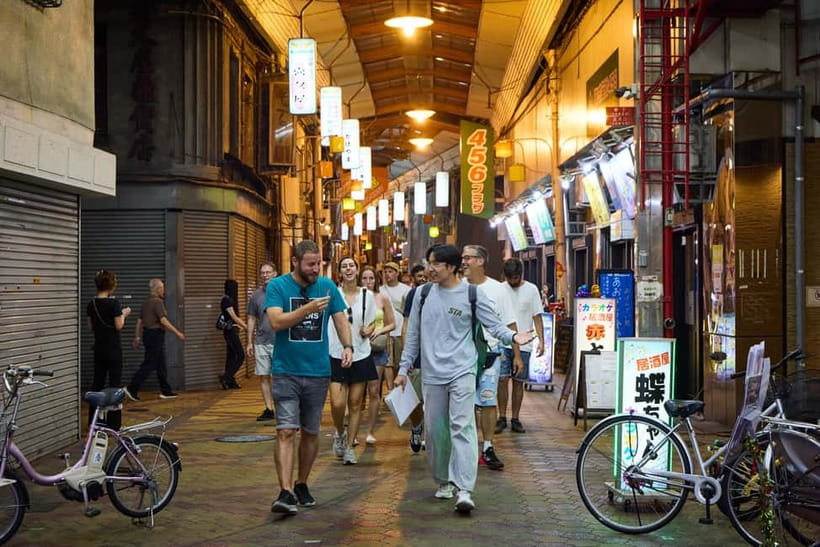
Tobita Shinchi is the most sensitive stop. It is Osaka’s best-known and largest red-light district, with more than a century of history. The area is known for a distinctive architectural style and a tightly regulated public environment.
This is not a stop for gawking. The point is to understand how the district operates within Japanese urban culture, where tradition, business, discretion, and legal boundaries can overlap in complicated ways. Your guide explains what you are seeing while helping you avoid behavior that could cause discomfort or disrespect.
Expect some information to be direct. The tour is intended to show an aspect of Japan that is often left out of ordinary sightseeing, and the subject can be uncomfortable. One useful detail shared on the walk concerns a torii painted on a wall, which can signal that people should not urinate there. Small facts like this reveal how communities manage public behavior in ways that guidebooks rarely cover.
Tobita Shinchi may be the strongest reason to book the tour, but it can also be the reason to skip it. If you prefer family-friendly history or cheerful nightlife, choose another Osaka activity. If you want a frank explanation of the city’s less visible institutions, this stop gives the tour its purpose.
Tsutenkaku marks the finish
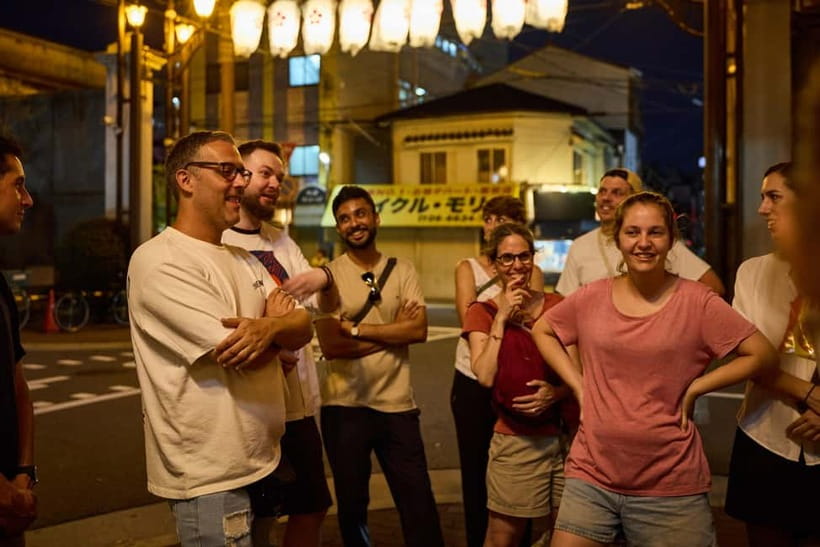
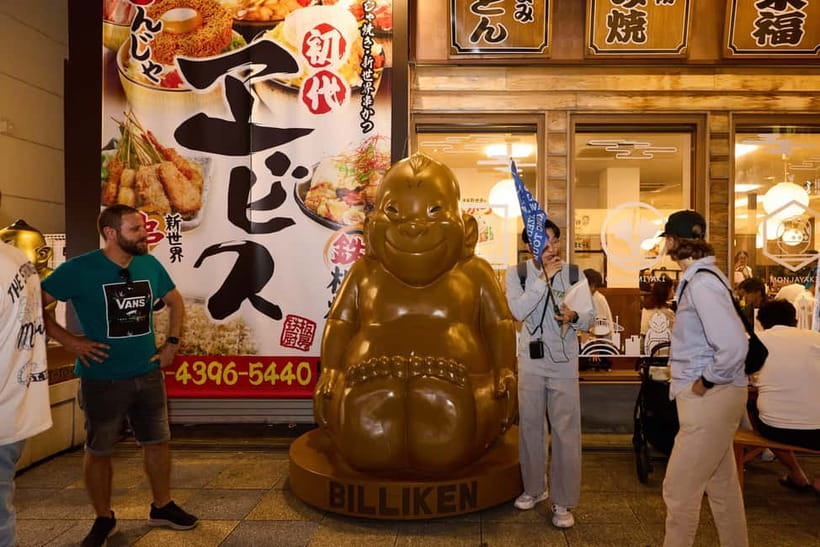
The stated finish is Tsutenkaku, bringing you back to the central landmark of Shinsekai. That makes the ending easy to understand and gives you a useful location for continuing your evening.
You can look for food around Shinsekai, follow a guide’s restaurant suggestion, or make your own way elsewhere in Osaka. Since no hotel transfer is provided, you remain responsible for your onward plans.
The route lasts two hours, with time divided among the main districts and stops. That is a sensible length for a subject that demands attention. A shorter walk might feel rushed, while a much longer one could become heavy, especially in poor weather or if the group is discussing difficult material at length.
Guide style and group experience
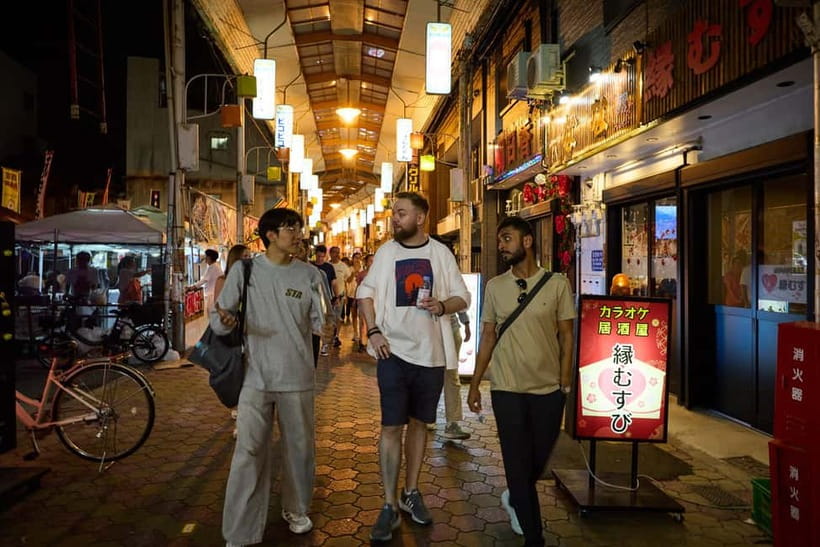
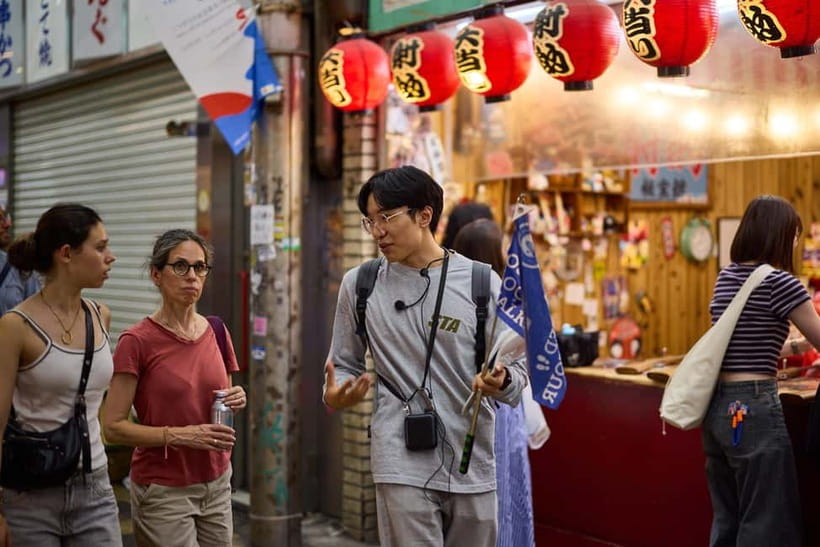
The guide is the most important part of this activity. The strongest named guides are Jay, Rico, and Matt, though the guide assigned to your date may differ.
Jay is described as friendly, engaging, considerate, and attentive to questions. Rico is praised for historical detail, clear explanations, and helpful local food suggestions. Matt is noted for his grasp of Osaka’s modern history and respectful treatment of sensitive topics.
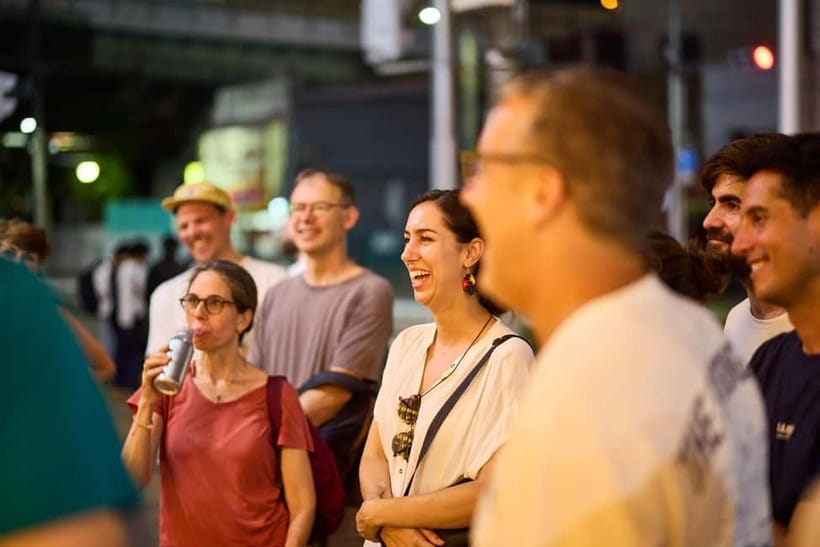
You should be comfortable asking questions. The tour allows time for discussion, and the guides adjust explanations when a subject catches the group’s interest. One account describes a group of six, suggesting that at least some departures are small enough for conversation, though a fixed group size is not provided.
English is the only stated tour language. One guide is described as speaking quickly, which may be easy for fluent English speakers but harder for people who are still building confidence. If you need simple, slow English, keep that in mind before booking.
The overall tone is friendly but serious. You may laugh at an odd local detail, then move into a discussion of poverty or commercial sex a few minutes later. That contrast is part of the experience, not a flaw.
Is $25 a fair price for two hours?
At $25 per person, this is a reasonable price for an English-speaking guided walk in Osaka, especially if you value explanation over admission tickets or transport. You are paying for a local route, a live guide, historical background, and the chance to ask questions about subjects that are hard to understand alone.
The value depends on your interests. If you mainly want food, views, or famous buildings, $25 may be better spent on another activity. If you want social history and a part of Osaka that standard sightseeing often skips, the cost is modest.
Food and drinks are not included. That keeps the price down, but you should budget separately if you plan to eat in Jyanjyan Yokocho or Shinsekai afterward.
Free cancellation is available up to 24 hours before the start time, and you can reserve now while paying later. Those terms are useful when your Osaka schedule is still changing, but check the available departure times before committing.
Who should book this walk?
I would recommend it to adults who:
- Want a candid look at Osaka beyond its major attractions
- Enjoy urban history and social issues
- Are comfortable discussing poverty, nightlife, and red-light districts
- Prefer a walking tour with questions and conversation
- Can follow an English-speaking guide for two hours
- Respect privacy and local rules
I would not choose it for children, wheelchair users, or anyone wanting a relaxed evening of food and sightseeing. The route also demands emotional maturity. You are not being taken to a theme park version of Osaka’s darker side.
Final call: book it for context, not shock value
Book the Dark Side of Osaka Night Walking Tour if you want the city explained through its less comfortable stories. The best parts are the links between Shinsekai’s Western-inspired design, Nishinari’s working-class past, Jyanjyan Yokocho’s old dining culture, and Tobita Shinchi’s discreet rules.
Skip it if your idea of a good night is bright signs, casual snacks, and easy photographs. This walk asks you to pay attention, listen carefully, and show respect. For the right adult visitor, $25 buys more than a route through unusual neighborhoods. It gives you a clearer sense of the social forces behind Osaka’s streets.
FAQ
How long does the Dark Side of Osaka Night Walking Tour last?
The tour lasts two hours.
What language is the tour conducted in?
The live tour guide speaks English.
Where does the tour meet?
Meet beneath the Giant Penguin at MEGA Don Quijote Shinsekai. Your guide will hold a GetYourGuide sign.
Where does the tour finish?
The stated finish point is Tsutenkaku.
What areas does the walk visit?
The route includes Shinsekai, Nishinari, Jyanjyan Yokocho, Tobita Shinchi, and other nearby parts of Osaka.
Is food included in the $25 price?
No. Food and drinks are not included.
Can children or wheelchair users join?
The tour is not suitable for children under 18 or wheelchair users.
More Evening Experiences in Osaka
- Osaka Bar Hopping Night Walking Tour in Namba (3 bars, 6 tastes)
★ 5.0 · 958 reviews - Osaka After Dark: Small-Group Night Food Tour (Max 6)
★ 4.5 · 245 reviews - OSAKA NIGHT FUSION Japanese Taiko Kabuki Samurai Dance Show
★ 4.8 · 155 reviews - Osaka: Bar-Hopping Night Tour in Namba
★ 4.7 · 117 reviews
Just added around Osaka
- (Ticket Included) Explore Osaka Castle & Museum of History★ 4.8 · 21 reviews
- Hidden Osaka – Yukaku Red Light Tour & Culinary Adventure★ 4.8 · 96 reviews
- Osaka: Walking Tour and Top Highlights★ 4.8 · 104 reviews
- Osaka: Private Ceramic Painting Workshop★ 5.0 · 13 reviews
- Pickleball in Osaka, Kobe & Kyoto with Locals!★ 4.7 · 80 reviews
- Eat Like a Local in Osaka – Private Custom Street Food Tour★ 4.3 · 33 reviews
- Osaka:SUMO BEATS SHOWCASE: Taiko Drum and Wagyu burger!★ 4.2 · 37 reviews
- Kimono photoshoot-Includes 100 photo data★ 5.0 · 21 reviews
Walking Tours, compared.
Kyoto Geisha Walking Tour: Gion District & Hidden Gems
Read our review →
Tokyo Tsukiji Fish Market Food and Culture Walking Tour
Read our review →
Gion Magical Night Walking Tour with Geisha Trivia
Read our review →
Imperial Palace and Shogun Historical Walking Tour
Read our review →
Gion Geisha District Walking Tour – Stories of Geisha
Read our review →
Asakusa Walking Tour with Sensoji Temple Visit
Read our review →
Kyoto Gion Geisha District Walking Tour – The Stories of Geisha
Read our review →Browse the lists this tour appears in