

REVIEW · GARDEN & PALACE TOURS
Osaka: Castle History Walking Tour / Castle Tower Admission
Osaka Castle makes far more sense when you stop treating it as a pretty tower and start reading it as a military machine. This 90-minute walk shows you how moats, zigzag gates, steep stone walls, arrow slits, and gun ports worked together to slow an army. I especially like the look at the castle’s largest stone and the story of how 16th-century workers moved it.
I also like the skip-the-line entry and the way the guide builds the story before you reach the tower. Guides including Mao, Spike, Saya, Yuta, Ken, and Kaz have been praised for clear English, friendly energy, and patience with children and older members of a group. The main consideration is that the castle museum’s individual floors are not guided, so you still explore those displays on your own.
In This Review
- Key points at a glance
- Why Osaka Castle is more than a photogenic tower
- Meeting at Lawson S Otemae Rest House Store
- Following the outer moats and defensive layers
- Stone walls, climbing problems, and craftsmen’s marks
- Hokoku Shrine and the Toyotomi connection
- Entering the castle tower and looking over Osaka
- The fall of an apparently invincible fortress
- The guides make the difference
- Is $33 a fair price?
- Who should book this Osaka Castle tour?
- Should you book it?
- FAQ
- Where does the tour meet?
- How long does the Osaka Castle tour last?
- Is Osaka Castle Tower admission included?
- Is the tour conducted in English?
- Does the guide explain every floor of the castle museum?
- What should I bring?
Key points at a glance
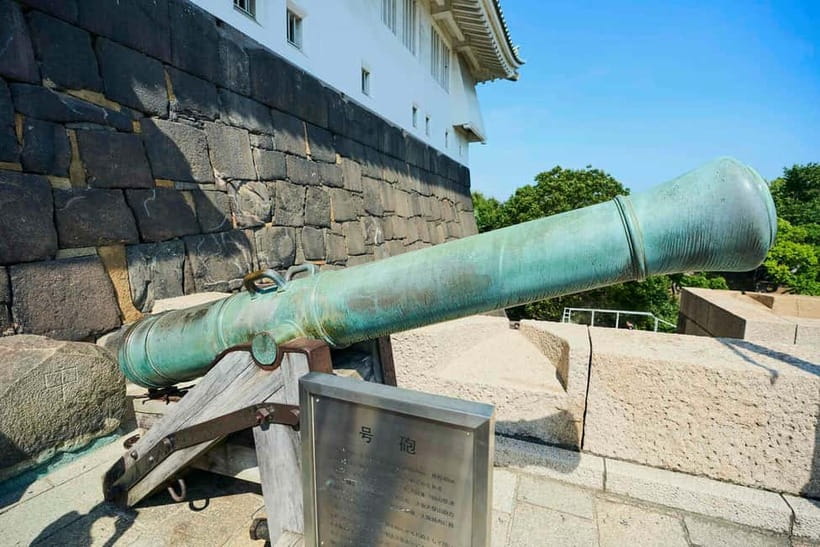
- Read the castle as a battlefield: Outer moats, layered gates, and masugata entrances reveal how attackers were delayed and divided.
- See the largest stone: Learn how huge blocks were transported and spot marks left by the craftsmen who placed them.
- Reach the tower with less waiting: Admission is included, with access through a separate entrance.
- Understand the castle’s visual tricks: Gold decoration helped project power and unsettle enemies.
- Visit Hokoku Shrine: Add a quieter cultural stop tied to Toyotomi Hideyoshi’s legacy.
- Best for history-minded visitors: The guide adds details and context that are easy to miss on a solo visit.
Why Osaka Castle is more than a photogenic tower
The familiar image of Osaka Castle is a white tower with green roofs and gold details. It makes a fine photograph, but the real lesson begins outside the tower. The castle’s defenses were designed to make an invading force lose time, direction, and numbers before reaching the center.
Your guide points out triple moats, multiple defensive layers, and gates arranged to force attackers into exposed positions. Instead of walking straight toward the tower, an enemy had to follow routes that bent, narrowed, and turned back on themselves. Defenders could attack from several angles while invaders struggled to see what waited ahead.
I find this approach useful because it changes the visit from a quick climb to a study in planning. You are not simply looking at old walls. You are seeing how architecture controlled movement.
The castle was built to project strength as well as provide protection. Gold decoration on the tower and other features served as psychological warfare. The message was clear: this was the seat of a powerful ruler, backed by wealth, planning, and force.
More Garden & Palace Tours in Osaka
- Osaka Castle: Museum and Tower Entry Ticket
★ 4.5 · 2,380 reviews - Ultimate Osaka Walking Tour: Castle, Dotonbori & Hidden Gems
★ 5.0 · 862 reviews - Osaka Castle Walking Tour and Castle Tower Admission
★ 5.0 · 561 reviews
Meeting at Lawson S Otemae Rest House Store
The tour begins in front of Lawson S Otemae Rest House Store. There are several Lawson stores in the area, so check the supplied Google Maps location carefully before setting out. Look for the Local Guide Stars sign.
This is a small but important practical point. Arriving at the wrong convenience store could create needless stress at the start of a short tour. Give yourself enough time to confirm the meeting place, especially if you are navigating Osaka Castle Park for the first time.
Bring comfortable shoes and clothing suited to the weather. The tour crosses historical grounds and includes walking between the outer defenses, shrine, and tower. It is not described as a strenuous hike, but hard pavement, gates, and castle approaches are easier with sensible footwear.
Following the outer moats and defensive layers
The opening part of the walk focuses on the castle grounds and the logic behind them. Your guide explains how the outer moats created distance between the castle and an attacking army. Water alone was not the whole defense. Each moat worked with walls, gates, turns, and changes in elevation to create a series of obstacles.
The triple-moat system is one of the most useful things to see with a guide. On your own, you might register a moat as scenery. With the military explanation, you can picture how an advancing force would be forced to stop, regroup, cross, and face another barrier.
The gates are equally important. The castle used multi-layered entrances and masugata layouts, a type of square or boxed entry designed to trap attackers between gate sections. An army could enter one space only to find itself turned sideways or halted before the next barrier.
Look closely at the route you walk. The zigzag pattern was not an accident or an inconvenience for modern visitors. It reduced the attacker’s momentum and exposed soldiers to fire from defenders positioned above and beside the passage.
This is where the tour earns its price for many people. A self-guided walk gives you access to the grounds, but it may not explain why the path keeps bending or why a gate is placed at an apparently awkward angle.
Stone walls, climbing problems, and craftsmen’s marks
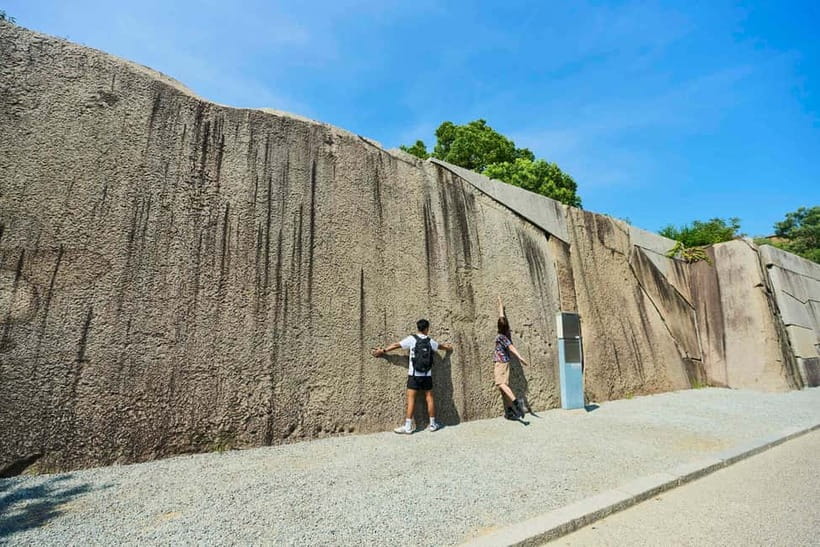
Osaka Castle’s stone walls are among the most impressive parts of the visit. Your guide explains how the angles and placement of the stones made the walls difficult to climb. The walls were not just tall barriers. Their shape denied an attacker an easy handhold and helped defenders control the space below.
You will also see the castle’s largest stone and hear how it was transported in the 16th century. The tour does not reduce the achievement to a vague claim about ancient skill. It connects the stone to the labor, organization, and practical methods needed to move enormous blocks into position.
The stonework also carries small clues from the people who built it. Hidden marks left by master craftsmen can be spotted in the walls. These marks are easy to miss if you are focused only on the tower, but they give the construction a human scale. Behind the grand design were teams of specialists, each working within a large and carefully organized project.
I would pay close attention here if you enjoy architecture, engineering, or military history. This section is less about famous names and more about how a fortress actually functioned.
More Walking Tours in Osaka
- Osaka Kickstart: Hotspots & Hidden Gems Tour
★ 5.0 · 1,306 reviews - Osaka: Hotspots & Hidden Gems Walking Tour Private or Group
★ 4.9 · 1,300 reviews - Osaka Local Foodie Walking Tour in Dotonbori and Shinsekai
★ 5.0 · 985 reviews - Osaka Bar Hopping Night Walking Tour in Namba (3 bars, 6 tastes)
★ 5.0 · 958 reviews
Hokoku Shrine and the Toyotomi connection
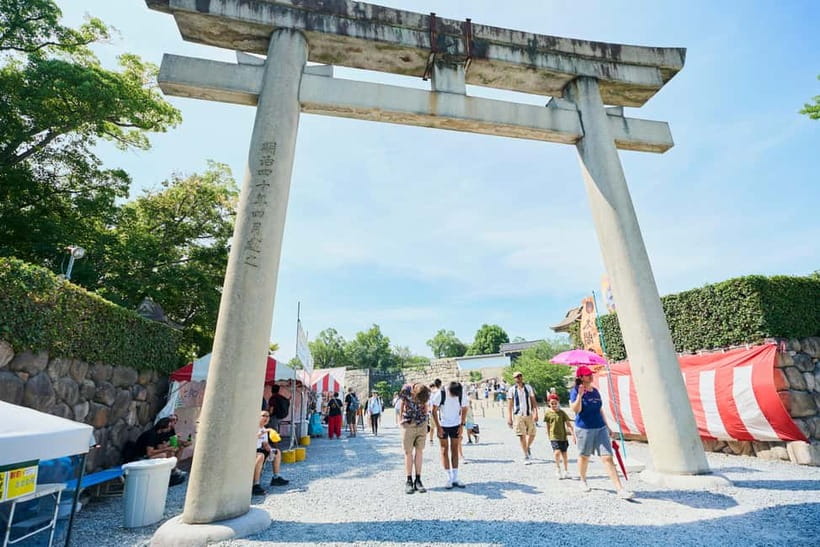
The route includes a guided visit to Hokoku Shrine. This stop adds a cultural and political layer to the castle story, linking the site to Toyotomi Hideyoshi and the legacy that shaped Osaka.
The shrine is also a useful change of pace. After examining moats, gates, and stonework, you get a more reflective setting in which to consider the people who built and ruled from the castle. One participant happened to encounter a traditional Japanese wedding ceremony during a visit, though that is an occasional event rather than something you should expect on every tour.
Your guide may also explain elements of Japanese culture as well as the castle’s political background. Several guides have been praised for answering questions about both Osaka and Japan more broadly, which makes this stop worthwhile for first-time visitors who want context rather than a string of isolated facts.
The shrine visit is guided for about 20 minutes according to the published schedule. As with any outdoor historical stop, the experience can depend on weather and what is happening at the site that day.
Entering the castle tower and looking over Osaka
The tower is the final reward, and admission to Osaka Castle Tower is included in the $33 price. The tour uses a separate entrance to help you avoid the regular ticket line, and the guide leads you toward the tower and upward before leaving time for independent exploration.
Several people specifically valued reaching the tower with less waiting. One useful timing tip is to consider an early start, such as 9 a.m. A morning group noted that the line was much longer by around 11 a.m., including waiting for the elevator. That pattern will not be identical every day, but an early tour can protect your sightseeing time.
From the top, you get city views that make the castle’s position easier to understand. The view is not only a photo opportunity. It lets you see how much ground the fortress controlled and how its open surroundings would have affected an approaching army.
Inside, the tower functions as both a museum and a commanding symbol. You can learn about its defensive features, including arrow slits and gun ports. The guide explains these details as part of the larger system, rather than presenting them as decorative openings.
The museum floors are not guided individually. This matters if you want a floor-by-floor explanation of every exhibit. The tour instead gives you the historical framework and key architectural details, then leaves you free to inspect the museum displays at your own pace.
That arrangement suits me. I prefer having the main story explained outdoors, then the freedom to linger over exhibits without keeping a group together. If you want a fully guided museum tour, this is not that product.
The fall of an apparently invincible fortress
The tour’s historical arc ends with the castle’s defeat in 1614 and 1615. This is a strong ending because it challenges the idea that impressive defenses guarantee victory.
The fall grew from the rivalry between Toyotomi Hideyoshi’s legacy and Tokugawa Ieyasu’s ambition. Osaka Castle was tied to the Toyotomi family, while the Tokugawa side had its own plans for control. The result was not simply a contest between two walls or two armies. It was a struggle over political authority and the future of Japan.
Your guide connects the fortress’s military design to the limits of military design. A castle can delay an attacker, make an assault costly, and create powerful symbolism. It cannot operate independently of politics, leadership, supplies, and changing alliances.
This final lesson gives the visit more weight. You leave understanding both why the castle was feared and how it could still be overcome.
The guides make the difference
The strongest feature of this experience is the quality of the live English guidance. The guide team includes people such as Mao, Spike, Saya, Yuta, Ken, Kaz, Yu, Ami, and others. Individual guides vary, but the feedback consistently points to friendly delivery, strong English, and an ability to explain the castle without making the material feel stiff.
Specific strengths include:
- Mao is often praised for warmth, enthusiasm, and details that are easy to miss without a guide.
- Spike has been described as especially strong on the castle’s military past and patient with different ages and mobility needs.
- Saya is noted for making the history easy to follow and for adding cultural background.
- Yuta has been praised for answering detailed questions and creating a relaxed, conversational atmosphere.
- Ken has been recognized for clear explanations, good photo stops, and a useful recap at the end.
- Yu has been appreciated for allowing time for photos while still covering the main content.
The tour can work well for families. One guide kept a three-year-old engaged for the full experience, while another group found that teenagers stayed interested. That comes down to storytelling and pacing, not just the subject itself.
Small groups can also be lucky. On some departures, a guest has ended up with a private or nearly private experience when few people booked. You should not count on that, but it shows that the format can feel personal.
Is $33 a fair price?
At $33 per person, the value depends on how much context you want. If you only want to enter the tower, take photographs, and browse the museum, visiting independently may be enough. The ticket is the main included admission, so the tour price is paying for the guide, route planning, and line-saving access.
For me, the strongest value comes from the outdoor explanations. The guide helps you notice the masugata entrances, read the angles of the walls, identify stone marks, and understand the purpose of the moats. Those are precisely the details that can disappear during a fast solo visit.
The separate entrance can also save time, particularly later in the morning when queues may grow. Time has real value in Osaka, where a saved hour can mean another neighborhood, meal, or museum.
The limitation is clear: the museum floors are self-guided. You are paying for a guided interpretation of the grounds and tower experience, not a private historian for every exhibit.
Who should book this Osaka Castle tour?
I would choose this tour if you enjoy military strategy, architecture, Japanese history, or guided sightseeing with a clear narrative. It is also a good fit for a first Osaka visit, families who want the children engaged, and small groups that prefer asking questions as they go.
It suits you less if you dislike structured tours, want to wander entirely alone, or plan to spend several hours studying every museum display. The advertised duration is 90 minutes, so it gives you a focused introduction rather than an entire day at the castle.
Book an early start if possible, especially if avoiding long entry lines matters to you. Check the meeting map carefully, wear comfortable shoes, and allow extra time after the tour if you want to explore the museum on your own.
Should you book it?
Yes, if you want Osaka Castle to become more than a backdrop for photographs. The best parts are the explanation of the defensive design, the look at the huge foundation stones, the shrine visit, and the efficient route into the tower.
The $33 cost is reasonable for the included admission, English-speaking guide, and separate entrance, especially on a busy morning. Skip it only if you prefer silent self-guided visits or want a detailed guide to every museum floor. For most first-time visitors with an interest in how castles worked, this is a practical and well-focused way to see Osaka Castle.
FAQ
Where does the tour meet?
Meet in front of Lawson S Otemae Rest House Store. There are multiple Lawson stores nearby, so confirm the exact location on Google Maps and look for the Local Guide Stars sign.
How long does the Osaka Castle tour last?
The activity lasts 90 minutes. The published schedule includes guided time at Osaka Castle, a guided visit to Hokoku Shrine, and further time at the castle for photographs and independent exploration.
Is Osaka Castle Tower admission included?
Yes. The Osaka Castle Tower admission ticket is included in the price.
Is the tour conducted in English?
Yes. The tour has a live English-speaking guide.
Does the guide explain every floor of the castle museum?
No. Guided explanations cover the castle grounds, defenses, history, and tower experience. Individual floors in the Osaka Castle museum are not guided.
What should I bring?
Bring comfortable shoes and clothing suitable for the weather. The experience includes walking through historical sites and castle grounds.
More Historical Tours in Osaka
- Osaka: Osaka Castle & Historical Museum Guided Tour
★ 4.8 · 28 reviews - (Ticket Included) Explore Osaka Castle & Museum of History
★ 4.8 · 21 reviews - Osaka: Kyoto & Nara & Uji Historical and Scenic One-Day Tour
★ 4.7 · 21 reviews - Osaka: Osaka Castle 3 hours Historical Walking Tour
★ 4.6 · 14 reviews
Just added around Osaka
- (Ticket Included) Explore Osaka Castle & Museum of History★ 4.8 · 21 reviews
- Hidden Osaka – Yukaku Red Light Tour & Culinary Adventure★ 4.8 · 96 reviews
- Osaka: Walking Tour and Top Highlights★ 4.8 · 104 reviews
- Osaka: Private Ceramic Painting Workshop★ 5.0 · 13 reviews
- Pickleball in Osaka, Kobe & Kyoto with Locals!★ 4.7 · 80 reviews
- Eat Like a Local in Osaka – Private Custom Street Food Tour★ 4.3 · 33 reviews
- Osaka:SUMO BEATS SHOWCASE: Taiko Drum and Wagyu burger!★ 4.2 · 37 reviews
- Kimono photoshoot-Includes 100 photo data★ 5.0 · 21 reviews
Garden & Palace Tours, compared.

Imperial Palace and Shogun Historical Walking Tour
Read our review →
Tokyo Castle & Imperial PalaceーShogun Walking Tour
Read our review →
Nijo-jo Castle and Ninomaru Palace Guided Tour
Read our review →

Ultimate Osaka Walking Tour: Castle, Dotonbori & Hidden Gems
Read our review →Tokyo Castle & Imperial PalaceーShogun Walking Tour
Read our review →Browse the lists this tour appears in