
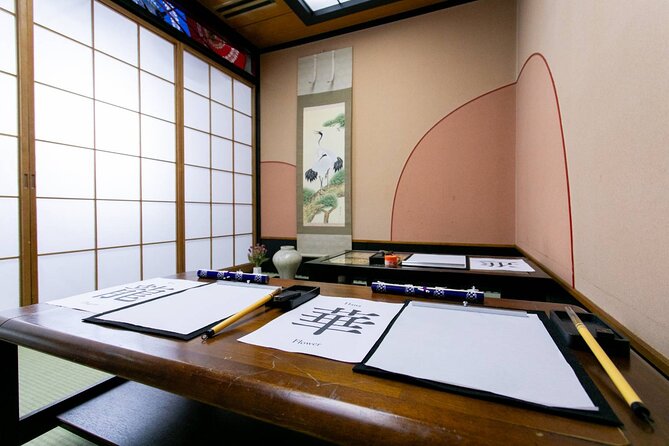
REVIEW · KIMONO & CULTURE EXPERIENCES
Learning Zen of Japanese Calligraphy in kimono near Osaka Castle
The most memorable part of this Osaka activity is the switch from sightseeing to sitting on tatami in traditional clothing, brush in hand, trying to make a single kanji character look balanced. You learn the basic shodo movements, including tome, hane, and harai, then create a final piece to keep.
I like the personal kanji name tag, written by the teacher on a wooden tag, and the patient, hands-on teaching described by many participants. The one-hour format also fits neatly after Osaka Castle. The main caution is practical: the small storefront can be hard to spot, and several bookings were affected by a temporary closure in June 2025, so confirm the meeting details before you go.
In This Review
- Key points to know before booking
- From Osaka Castle Park to a tatami calligraphy room
- Changing into kimono, hakama, or other traditional clothing
- What makes shodo different from ordinary decorative writing
- Choosing a kanji with meaning
- Practicing the brush before the final draft
- The photo session and digital keepsake
- Is $43.59 good value for one hour?
- Who will enjoy this most
- The important meeting-point warning
- Cancellation and practical details
- Should you book the Osaka calligraphy class?
- FAQ
- Where does the calligraphy experience take place?
- How long does the experience last?
- What is included in the price?
- Is the class suitable for beginners?
- Can children participate?
- Is the class taught in English?
- Do I get to choose a kanji character?
- Do I receive a souvenir?
- Are photos included?
- Is hair styling included?
Key points to know before booking
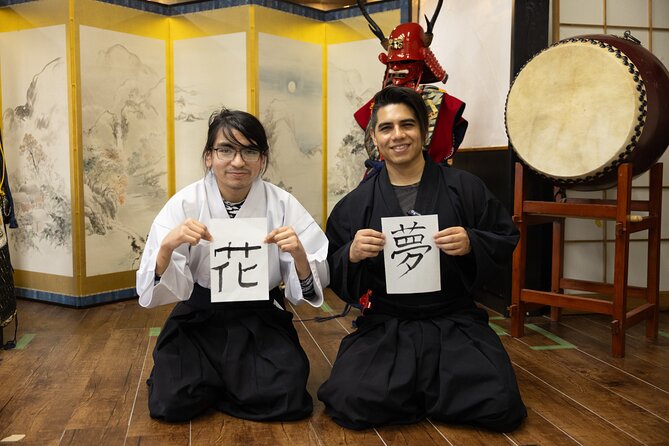
- Kimono comes before calligraphy: Allow time to change and use the restroom first.
- You choose a kanji character: The teacher explains its meaning and stroke order before you practice.
- The lesson is beginner-friendly: Children and adults with no Japanese experience can take part.
- Your name becomes a souvenir: The teacher writes participants’ foreign names using kanji on wooden tags.
- Photos are included: Staff photograph you in traditional clothing with your completed artwork and email the files.
- The group is small: The maximum is 10 people, though the class still takes place in a shared activity setting.
From Osaka Castle Park to a tatami calligraphy room
This experience works best as a cultural pause after visiting Osaka Castle. The meeting point is in Osaka’s Joto Ward, at 2-chome 3-19 Shiginonishi, in the Excellence Takayama building. The activity ends at the same place.
The operator describes the venue as close to public transportation and about a one-minute walk from Osaka Castle Park Station. Still, do not arrive at the last second. One participant found the Google Maps directions accurate but walked past the small storefront. Give yourself extra time to identify the entrance, especially if you are coming straight from the castle grounds.
The experience has a maximum of 10 participants. That is a useful size for brush instruction because the teacher can watch your hand and correct your angle, pressure, and posture. It is not a private lesson, though, so the feel may depend on how many people are booked for your time.
You receive a mobile ticket and confirmation when you book. Arriving more than 30 minutes late can mean being refused entry, even if you contact the provider. This is one activity where punctuality matters, since changing everyone into traditional clothing takes time.
More Garden & Palace Tours in Osaka
- Osaka Castle: Museum and Tower Entry Ticket
★ 4.5 · 2,380 reviews - Ultimate Osaka Walking Tour: Castle, Dotonbori & Hidden Gems
★ 5.0 · 862 reviews - Osaka Castle Walking Tour and Castle Tower Admission
★ 5.0 · 561 reviews
Changing into kimono, hakama, or other traditional clothing
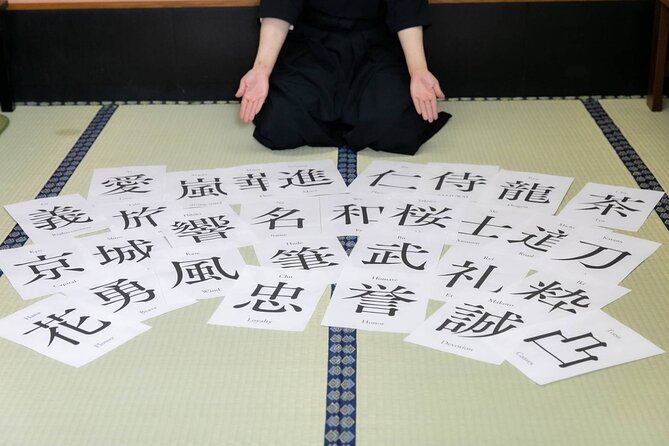
Before you touch the ink, you change into traditional Japanese clothing. Options may include kimono and hakama, with other attire used by the venue for its cultural activities.
The dressing process is part of the experience, not just a costume photo stop. A participant described being fitted with roughly 12 components, which gives you a sense of why the schedule needs a full hour. Wear something that is comfortable under the clothing and avoid arriving in a rush.
Use the restroom before dressing. The instructions specifically ask you to do this, and it is sensible advice once layers and ties are in place. You may also feel warm while wearing the outfit, particularly during summer or while practicing for an extended period.
The included clothing helps make the price easier to justify. Renting a kimono separately, learning a craft separately, and arranging a photo session separately would take more planning. Here, those elements are joined in one short appointment.
Hair styling is not included. A collected-hair and kanzashi option is available for ¥3,300 per person, but it is an added expense. If you want a more formal look, ask about that option before the session rather than assuming it is part of the standard booking.
What makes shodo different from ordinary decorative writing
The teacher begins by explaining shodo, the Japanese art of calligraphy, and how it differs from decorative writing traditions found elsewhere. This context is brief because the class lasts about an hour, but it helps you understand why the brush is handled with care.
Shodo is not simply handwriting made with ink. Brush movement, order, pressure, pauses, and the shape of each character all matter. The goal is not to produce perfect Japanese after one lesson. You are learning how a few controlled movements create a character with meaning.
The basic techniques include tome, a stopping movement; hane, a hooked or lifted finish; and harai, a sweeping stroke. These terms give you something concrete to watch for as the teacher demonstrates.
The class is taught in English by default. Translators may assist with English-Japanese or Chinese-Japanese communication, and other languages such as Italian, Spanish, French, Thai, and Indonesian can be requested. However, language support beyond English depends on staff availability, so do not book assuming a particular language will be available.
The language barrier appears manageable for the mechanics of the lesson. The instructor demonstrates the strokes, guides your hand position, and watches your practice. One participant did feel that the background explanation of Japan’s writing systems could have been fuller. If you want a detailed lesson on hiragana, katakana, and kanji, this is probably too short. If you want to try a brush and make a meaningful keepsake, the format is better suited.
Choosing a kanji with meaning
The next decision is your kanji character. Kanji are not just sounds. A single character can carry several meanings depending on its use and context, so the choice has more weight than picking a decorative symbol at random.
The teacher helps you select a character and explains its meaning. You then learn the stroke order, which is important because the order shapes the balance and final form of the character.
You may also have your foreign name translated into kanji. The teacher writes the names of participants on wooden tags as a surprise souvenir. This is one of the nicest personal touches because you leave with something made for you, not simply a mass-produced charm.
Take a moment to ask about the meaning of the characters used for your name. The provider’s own explanation stresses that kanji meanings change with context. That makes the name tag more interesting, but it also means you should treat the translation as a cultural interpretation rather than a literal one-to-one spelling.
More Kimono & Culture Experiences in Osaka
- Osaka: Sumo Show & Experience w/ Optional Kimono & Hot Pot
★ 4.5 · 609 reviews - Samurai Training Experience KENDO in Osaka
★ 5.0 · 515 reviews - OSAKA NIGHT FUSION Japanese Taiko Kabuki Samurai Dance Show
★ 4.8 · 155 reviews - Osaka: Samurai Training Experience KENDO in Osaka
★ 5.0 · 111 reviews
Practicing the brush before the final draft
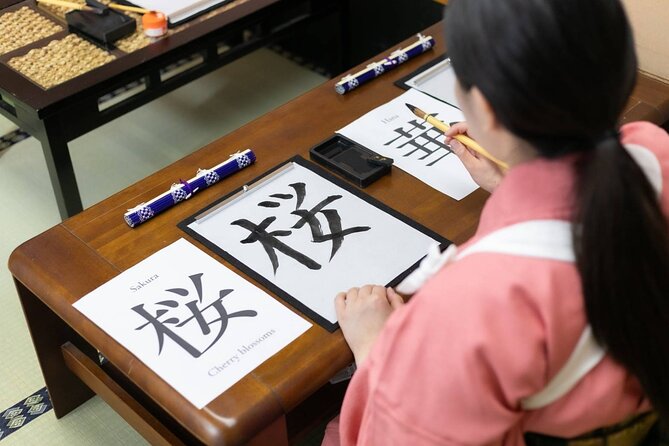
After the demonstration, you work through practice sheets. This is where the class becomes more than a photo opportunity.
You learn how to hold the brush and use the ink and other calligraphy tools. Then you repeat the character while keeping the stroke order in mind. The teacher corrects the basic technique and encourages you to try again. Many first-time students find the repetition calming, though anyone hoping to produce a polished masterpiece immediately may need to reset expectations.
The instructors are described as friendly, patient, and willing to offer direct help. Staff also take photographs during the process, so you are not forced to choose between concentrating on the lesson and documenting it yourself.
You should expect some ink marks and imperfect attempts. That is part of the appeal. The final character shows what you learned, but the practice sheets reveal the process. Some participants have taken home bags filled with their calligraphy attempts, and other sessions have included final work on fans or scrolls. The exact souvenir format can vary, so ask what is included on your date.
At the end, you write a final draft. This is the point where posture, brush pressure, pauses, and stroke order come together. You do not need Japanese language skills, and you do not need previous calligraphy experience. You do need patience. Kanji is difficult even for people accustomed to alphabetic writing.
The photo session and digital keepsake
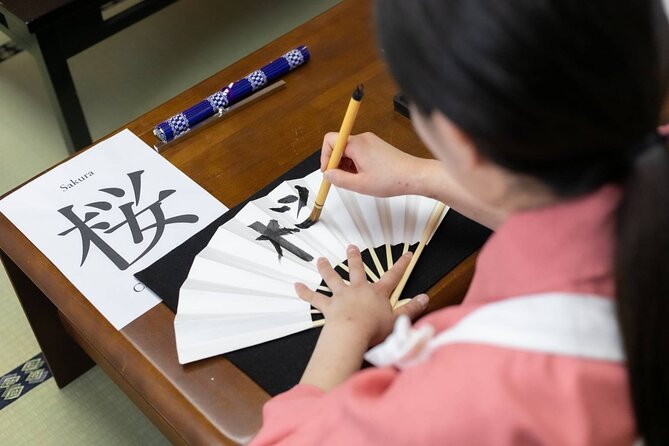
Once you have finished, the staff photograph you in your kimono with your artwork. The digital images are sent to the designated email address, with photography and taxes included in the stated price.
This is a practical benefit. You can put your phone away during the lesson and still receive a record of the outfit and final piece. Personal smartphone photography is permitted, but you may not take selfies or photograph other participants. Fixed tripods and video recording are discouraged because they can disturb the class.
The photo session also gives the activity a clear finish. You have changed clothes, learned a few brush techniques, chosen a character, practiced, written a final draft, and received a personal tag. For a one-hour appointment, that is a well-packed sequence.
Do not expect a full studio portrait session. The supplied information promises digital photos, but not a fixed number, professional retouching, or printed copies. If printed artwork or an additional wall hanging is offered, it may cost extra. One participant found an optional hanging worth the added price, but it was not required.
Is $43.59 good value for one hour?
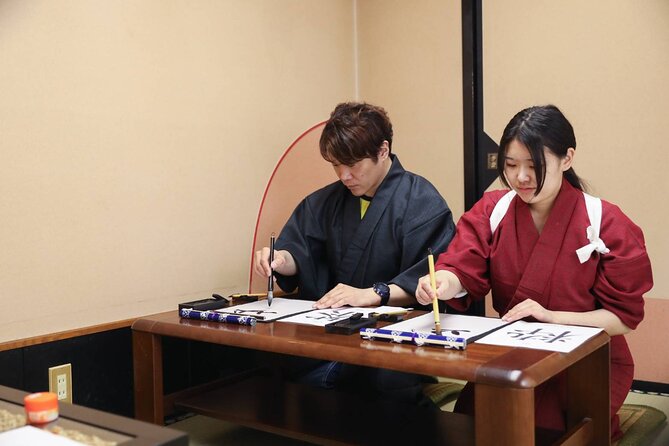
At $43.59 per person, this is not the cheapest activity you can add to an Osaka day. It is good value if you want several small cultural experiences combined: traditional clothing, a shodo lesson, a kanji name translation, a souvenir, and digital photographs.
The price is less attractive if your main goal is serious calligraphy instruction. One hour can teach you the foundations, but it cannot make you proficient. A participant who attended a longer session estimated that even 90 minutes would only provide an introduction. Think of this as a first encounter with shodo, not a formal course.
The small-group limit adds value because calligraphy depends on seeing the teacher’s movements and receiving corrections. The included clothing and photography save you from separate rental and portrait costs. Gratuities and taxes are included, so the advertised price covers the main activity.
You may spend more if you choose hair styling with kanzashi or buy optional artwork. Those extras are not necessary for a satisfying class, but they could appeal to you if you want a more finished visual souvenir.
The tour is often booked well ahead, with an average booking lead time of 36 days. That suggests you should reserve before your Osaka schedule fills, especially if you need a particular date or time.
Who will enjoy this most
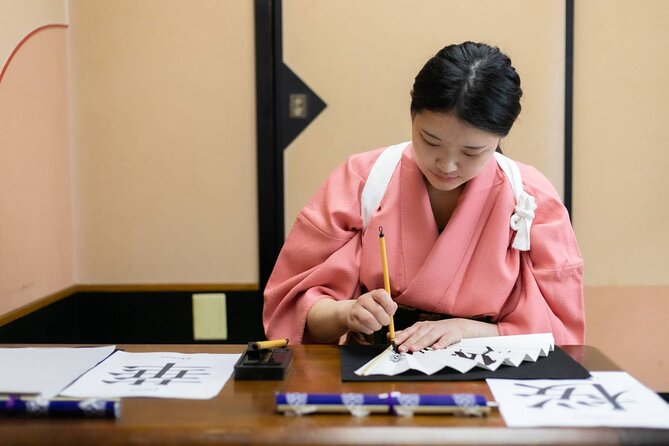
I would recommend it to first-time visitors who want a hands-on cultural activity rather than another observation deck or museum. It suits couples, families, and friends, and children can participate because the class is open to all skill levels.
It is also a good choice after a long walk around Osaka Castle. The change of pace is welcome: you move from a major historic sight to a quiet table, a brush, and one character that asks for concentration.
This is not ideal for people with back problems or heart conditions. The activity is not stroller accessible, pets are not suitable, and you should not bring a pet simply because service animals are allowed. Sitting, dressing, and practicing may be uncomfortable for some people, so read those restrictions seriously.
The activity can also be a nice companion to the provider’s tea ceremony. Some participants have combined calligraphy and tea ceremony in one visit. Do not assume both are included in this booking, though. The calligraphy experience described here is the product you are paying for.
The important meeting-point warning
The most serious concern is not the brushwork. It is reliability at the venue.
Two low-rated experiences described people arriving at the supplied address and finding what appeared to be a shuttered or difficult-to-identify location, with no one answering messages. The operator later explained that Samurai Honor had temporarily closed from June 9 through June 29, 2025 because of an operating-company problem. The manager, Yasumatsu, said affected customers would receive full refunds through the booking site and that management and staff arrangements had changed.
That explanation addresses a specific past closure, but it does not erase the inconvenience of missing an activity during a short trip. Before you leave for the appointment, check your confirmation, verify the address, and make sure you have current contact details. Arrive early enough to find the storefront. If the venue has sent a last-minute update, read it carefully.
The strong overall score, 4.7 out of 5 from 53 ratings, and 92 percent recommendation rate point to many successful sessions. Still, the operational warning deserves more attention than the score alone. A good class is valuable only if the door is open.
Cancellation and practical details
Free cancellation is available up to 24 hours before the local start time for a full refund. Cancellations or changes made less than 24 hours before the start are not accepted for a refund.
The activity is approximately one hour and returns to the meeting point. Private transportation, hotel transfers, personal expenses, and the optional ¥3,300 hair arrangement are not included.
Wear comfortable clothing beneath the kimono, use the restroom before changing, and keep your schedule slightly flexible around the start time. The class is compact, but the clothing change and photo session mean you should not treat the one-hour duration as a reason to arrive at the exact start minute.
Should you book the Osaka calligraphy class?
Book it if you want a friendly, beginner-level introduction to shodo with a kimono fitting, a personal kanji souvenir, and photographs. The strongest parts are the patient instruction, the chance to learn tome, hane, and harai, and the way the class turns your chosen character into a keepsake.
Skip it if you want a long technical lesson, detailed instruction in every Japanese writing system, or a guaranteed private photo shoot. Also pause before booking if sitting or wearing layered traditional clothing will be difficult.
For most visitors, the deciding factor is logistics. Confirm that the venue is operating, allow extra time to find the small storefront, and keep the provider’s closure history in mind. With those checks made, this is a pleasant way to add a personal, creative hour near Osaka Castle.
FAQ
Where does the calligraphy experience take place?
The meeting point is in Osaka, Japan, at 2-chome 3-19 Shiginonishi, Joto Ward, in the Excellence Takayama building. The activity ends back at the same meeting point.
How long does the experience last?
The activity lasts approximately one hour.
What is included in the price?
The price includes the calligraphy lesson, traditional Japanese clothing such as kimono or hakama, photography, digital photo files sent to your designated email address, taxes, and gratuities.
Is the class suitable for beginners?
Yes. The class is open to all skill levels, including people with no previous calligraphy experience.
Can children participate?
Yes. Children can participate because the activity is designed for all skill levels.
Is the class taught in English?
English is the default language. English-Japanese or Chinese-Japanese translation may be available, and other languages can be requested, but support depends on staff availability.
Do I get to choose a kanji character?
Yes. You choose a Japanese kanji character, learn its meaning and stroke order, and practice writing it during the class.
Do I receive a souvenir?
The teacher writes participants’ foreign names using kanji characters on wooden tags. You also take home your calligraphy work. The exact final artwork format may vary.
Are photos included?
Yes. Staff photograph you in your traditional clothing with your artwork and send the digital data to your designated email address. Personal smartphone photography is allowed, subject to the venue’s restrictions.
Is hair styling included?
No. Collected hair and kanzashi are an optional paid add-on costing ¥3,300 per person.
Just added around Osaka
- Samurai dress-up and shows, plus Tea Ceremony & Calligraphy★ 5.0 · 27 reviews
- Kyoto & Nara Private customized tour with English speaking Guide★ 4.5 · 99 reviews
- Well-balanced BENTO (lunch box) Cooking Class★ 5.0 · 35 reviews
- Urban Canvas: Osaka Street Art Bike Tour★ 5.0 · 47 reviews
- OSAKA:Feel the Power! Learn Taiko Drum from Professionals★ 5.0 · 28 reviews
- Volleyball in Osaka & Kyoto with Locals!★ 5.0 · 21 reviews
- Umami Town Street Food Tour★ 5.0 · 120 reviews
- Three Types of Ramen Cooking Class in Osaka★ 5.0 · 119 reviews
Kimono & Culture Experiences, compared.

Kyoto Geisha Walking Tour: Gion District & Hidden Gems
Read our review →
Gion Magical Night Walking Tour with Geisha Trivia
Read our review →
Gion Geisha District Walking Tour – Stories of Geisha
Read our review →
Best of Kyoto: Gion, Geisha, Pagodas & Cobblestones
Read our review →
Kyoto Gion Geisha District Walking Tour – The Stories of Geisha
Read our review →
Browse the lists this tour appears in