
REVIEW · 1-DAY TOURS
Kyoto Customized Private Tour: See Top Attractions in 1 Day
Kyoto is too spread out for a casual checklist, and this private tour lets you shape the day around what you actually want to see. You can focus on famous sights such as Kinkaku-ji and Fushimi Inari, or choose food, gardens, architecture, temples, and old neighborhoods instead.
I like the freedom to choose two or three stops on a half-day outing, or three to four on a full day. I also like the personal guidance: guides such as Kiyoto, Takuma, Toshi, Yuka, Saeko, and Naomi have been praised for clear English, cultural explanations, route planning, and adjusting the pace for children or mobility needs.
The catch is cost control. At $132.65 per person, the tour can be good value for a group that wants private help, but entrance fees, transportation for you and the guide, and lunch are extra. Confirm the pickup plan and the day’s likely transport costs before setting out.
In This Review
- Key points to know before you book
- A private Kyoto day instead of a fixed bus route
- What four hours can realistically cover
- What eight hours adds to the experience
- Kinkaku-ji, Kyoto’s Golden Pavilion
- Fushimi Inari and the torii-gate climb
- Kiyomizu-dera and the Higashiyama streets
- Gion, Pontocho, and old Kyoto after dark
- Arashiyama, Tenryu-ji, and the bamboo grove
- Ryoan-ji and Kyoto’s garden tradition
- Nishiki Market, Kyoto’s food corridor
- Nijo Castle and the imperial story
- The quieter eastern choices
- How the guide affects the value
- Price, extra costs, and real value
- Who should book this Kyoto tour
- FAQ
- How long does the private Kyoto tour last?
- Is the tour private?
- Where does the tour start?
- Is hotel pickup available?
- Are entrance fees included?
- Is transportation included?
- Is lunch included?
- Can I choose the sights?
- Does the tour run in bad weather?
- How much walking is involved?
- Should you book it?
Key points to know before you book
- You choose the day’s shape: Pick two to three places for four hours, or three to four for eight hours.
- Private means personal: Only your group takes part, so the guide can adjust the route and pace.
- The famous sights are possible: Kinkaku-ji, Fushimi Inari, Kiyomizu-dera, Gion, Nijo Castle, and Arashiyama are all on the menu.
- Transport is not included: You pay transportation costs for yourself and the guide, along with admissions and lunch.
- Walking is part of the deal: Comfortable shoes matter, especially around Fushimi Inari, Higashiyama, and Arashiyama.
- Guide quality matters: Strong experiences have come from guides including Kiyoto, Takuma, Toshi, Yuka, Saeko, Naomi, and Hiro, though your assigned guide may differ.
A private Kyoto day instead of a fixed bus route
The best feature here is control. You do not have to spend half a day at a place that does not interest you, and you can tell the guide what you have already seen in Kyoto.
At the start, you meet at the Kyoto Tourist Information Center, Kyo-Navi, on the second floor of Kyoto Station Building. Pickup is also offered, so confirm the exact meeting arrangement when you book. The stated end point is back at the meeting point, although the general description says drop-off can be arranged at your preferred location. That difference is worth clarifying in advance.
Your guide begins by discussing your priorities. That simple conversation can make a big difference in Kyoto, where the main sights sit across a wide area and travel time can eat into a short tour. A good guide can help you avoid an overpacked plan and choose a sensible order.
This is not a tour where you simply follow a flag through a crowd. It is closer to hiring a local city companion for several hours. The quality of that companion is central to the experience. Strong guides have explained Shinto and Buddhist customs, helped with train schedules, suggested restaurants, taken photographs, and adjusted plans for children or mobility concerns.
A few more Kyoto trips to weigh up
- PERFECT KYOTO 1-Day Bus Tour
★ 5.0 · 13,518 reviews - Kyoto: Fushimi Inari, Kinkakuji, Bamboo Grove 1 Day Bus Tour
★ 4.8 · 4,316 reviews - 10 Must-see Spots in Kyoto One Day Private Tour (up to 7 people)
★ 5.0 · 1,108 reviews
What four hours can realistically cover
The half-day option allows two to three stops. That sounds modest, but Kyoto’s major sites are not next door to one another. A four-hour plan pairing Kinkaku-ji with Ryoan-ji works better than trying to add Fushimi Inari and Arashiyama from the opposite side of town.
For eastern Kyoto, a practical half-day might center on Kiyomizu-dera, Sannenzaka and Ninenzaka, and Gion. This gives you one major temple, two old hillside streets, and Kyoto’s traditional entertainment district without scattering your time across the city.
A food-focused plan could combine Nishiki Market with Gion and Pontocho. A garden-focused plan might use Ryoan-ji, Nanzen-ji, or Ginkaku-ji, depending on the route and the guide’s advice.
The four-hour option suits you if you have only a morning or afternoon, or if you want an introduction before exploring alone. It is less suitable if your main goal is to see every headline attraction. Trying to force too many sites into a short booking can leave you with photographs but little sense of place.
What eight hours adds to the experience
The full-day option allows three to four stops. Eight hours gives you room for a longer route and a proper lunch break, but it still does not mean you can comfortably see all 13 listed possibilities.
A full day might pair Ryoan-ji, Kinkaku-ji, Nishiki Market, and Gion. Another route could take in Fushimi Inari, Kiyomizu-dera, the Higashiyama streets, and Pontocho. Arashiyama can fill a day on its own if you include Tenryu-ji and the bamboo grove at an unhurried pace.
The key is to group nearby sights. Fushimi Inari and Kiyomizu-dera are both essential for many first visits, but combining them with Kinkaku-ji and Arashiyama creates a much harder day. Ask your guide to explain the travel time before you approve the final plan.
A full day also lets you slow down. You can spend more time asking about Japanese family life, religion, food, and daily customs, rather than rushing from gate to gate. Several highly praised guides, including Takuma and Toshi, are noted for giving historical context while leaving time to look around.
Kinkaku-ji, Kyoto’s Golden Pavilion
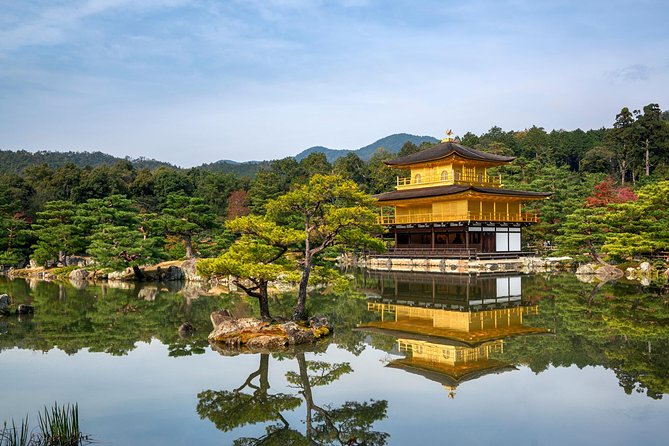
Kinkaku-ji, also called the Golden Pavilion, is the classic Kyoto photograph: a three-story pavilion reflected in a pond, framed by trees. It is striking, but your visit is likely to be short, with about 30 minutes listed for the stop.
That timing is enough to see the main view and walk the prescribed route. It is not enough for a long, quiet examination of every garden feature. Admission is not included, so add the entrance charge to your budget.
A guide can make this stop more useful by explaining the building’s place in Kyoto’s history and the meaning of the surrounding grounds. One poor experience described only brief, basic explanations at Kinkaku-ji, which is a useful warning: ask for the level of detail you want at the start.
Same city, a completely different kind of day:
- Kyoto: Tea Ceremony in a Traditional Tea House in Kiyomizu
★ 4.9 · 3,519 reviews - Kyoto Geisha Walking Tour: Gion District & Hidden Gems
★ 4.7 · 3,273 reviews - Kyoto: Tea Ceremony Ju-An at Jotokuji Temple
★ 4.9 · 3,207 reviews - Kyoto: Gion Magical Night Walking Tour with Geisha Trivia
★ 4.9 · 2,393 reviews
Fushimi Inari and the torii-gate climb
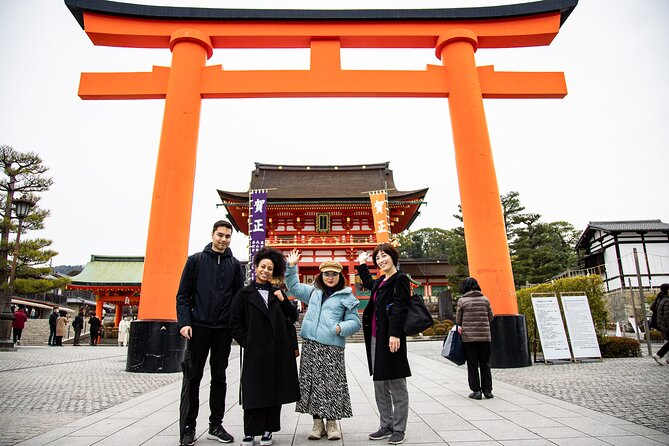
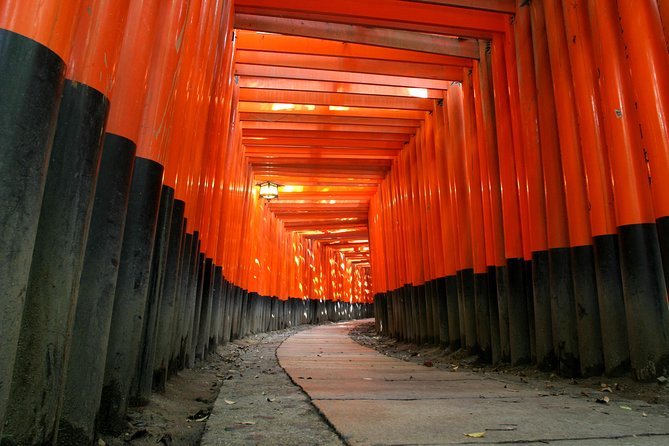
Fushimi Inari-taisha is free to enter, and the lower shrine area can be visited without paying an admission fee. Its rows of orange torii gates create one of Kyoto’s most recognizable scenes.
The suggested stop lasts about 45 minutes. That is enough to walk through the first section and get a feel for the shrine, but not enough to hike far up the mountain. If you want the longer walk, say so before the itinerary is fixed, since it changes the pace of the rest of the day.
This is one place where comfortable shoes and water matter. The ground rises, and the experience changes as the crowds thin farther from the entrance. A private guide can help you decide how far to go without sacrificing the rest of your plan.
Kiyomizu-dera and the Higashiyama streets
Kiyomizu-dera is an eighth-century Buddhist temple with broad views over Kyoto. The temple is famous for its wooden stage and its hillside setting, but the approach is part of the experience.
Sannenzaka and Ninenzaka are steep historic streets lined with traditional wooden buildings, tea shops, and small stores. The streets are pleasant for browsing, though they can feel crowded and commercial at busy times. If you are not interested in souvenirs, tell your guide. You can spend more time on the temple grounds or move toward Gion instead.
The listed time for Kiyomizu-dera is about 30 minutes, followed by roughly 45 minutes for the two streets. That is a brisk look, not a full exploration. The route includes slopes and uneven walking, so mention mobility concerns when arranging the tour. Saeko has been praised for reshaping a day around a mobility limitation, but that kind of adjustment should be discussed before the tour.
Gion, Pontocho, and old Kyoto after dark
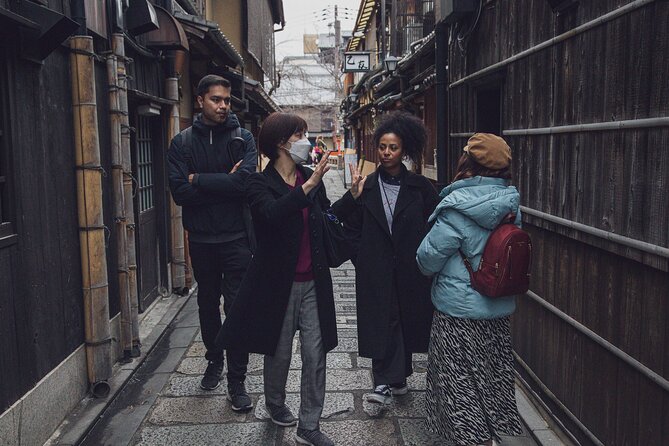
Gion is known for wooden machiya houses, tea houses, and geisha culture. The short visit listed here is about 30 minutes, enough for a walk through the district and an explanation of how the area developed.
Treat Gion with care. It is a living neighborhood, not a stage set. Your guide can help you understand the difference between seeing traditional architecture and intruding on private life.
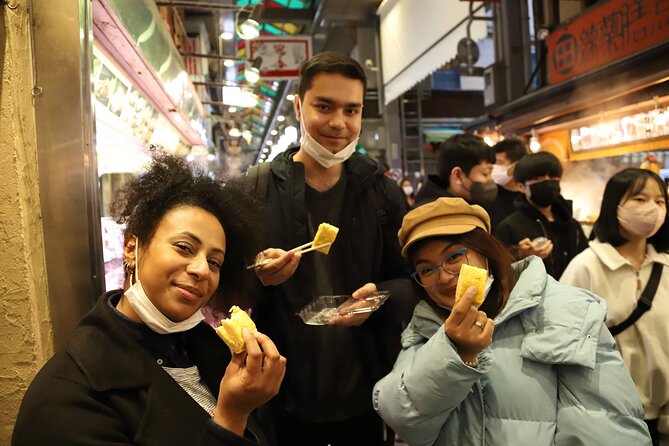
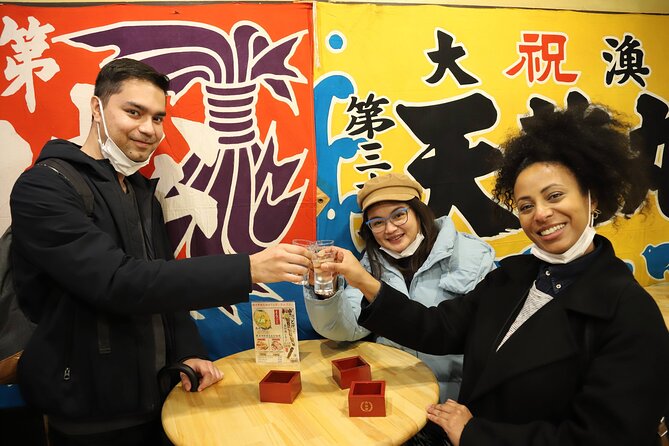
Nearby Pontocho is a narrow dining district along the Kamo River. It is best appreciated as an atmospheric walk and as a place to consider dinner after the tour. The experience does not include lunch or dinner, but guides have offered restaurant suggestions, and one guide took a group to a traditional restaurant in an old Japanese house.
Arashiyama, Tenryu-ji, and the bamboo grove
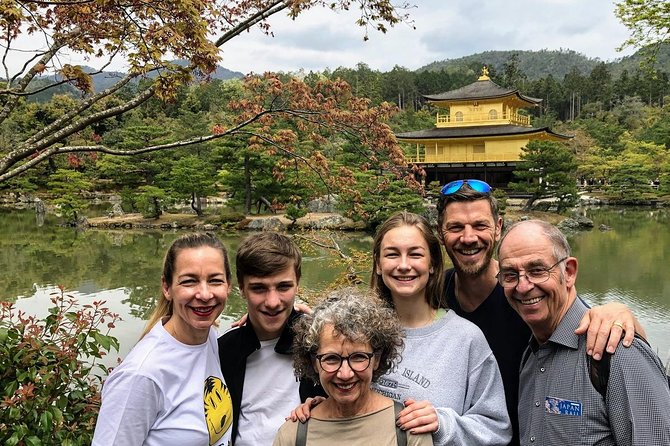
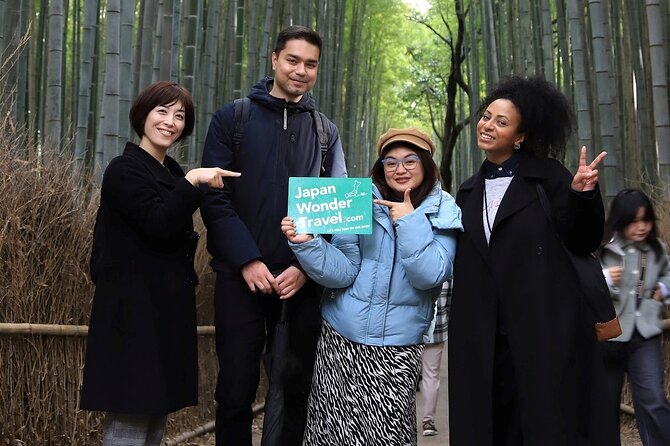
Arashiyama lies on the western side of Kyoto, so it deserves careful planning. The bamboo grove is free and takes about 45 minutes in the suggested schedule. It is visually memorable, but the path can be crowded, and the short visit will not provide much time for wandering beyond the main route.
Tenryu-ji is the stronger choice if you care about temple gardens and Zen design. The temple is a UNESCO World Heritage site, and its grounds offer more to study than a quick photograph through the bamboo.
One unusual detail from the feedback is that Osamu stayed beyond the four-hour booking to guide a group through the bamboo forest. Do not treat extra time as guaranteed, but it shows why a flexible guide can add value when the schedule permits.
Ryoan-ji and Kyoto’s garden tradition
Ryoan-ji is famous for its dry rock garden, a restrained composition of stones and gravel associated with Zen practice. The suggested stop lasts 30 minutes, and admission is not included.
This is a place where a guide’s explanation can help, but you should also allow yourself a quiet moment. The garden is not a spectacle that reveals everything at once. It rewards sitting, looking, and noticing how much is left open to interpretation.
Ryoan-ji pairs naturally with Kinkaku-ji because both are in the northwest part of the city. That pairing is sensible for a half-day plan, though the two temples can feel similar if you want more variety.
Nishiki Market, Kyoto’s food corridor
Nishiki Market is known as Kyoto’s Kitchen, and the free market walk lasts about 45 minutes in the sample schedule. It is a useful choice for you if food tells you more about a city than another temple does.
You can look for traditional Japanese ingredients, prepared snacks, pickles, sweets, and other local foods. The market is narrow, so browsing can be slow when busy. Keep your expectations practical: this is a market visit, not a seated meal, and lunch is not included.
Ask your guide what is worth trying and how to behave at food stalls. A private guide is especially useful here if you want explanations rather than a quick pass through the aisles.
Nijo Castle and the imperial story
Nijo Castle is in central Kyoto and was built in 1603 as the official residence of Tokugawa Ieyasu. The castle’s interiors, decorative art, and gold-leaf ceilings connect Kyoto’s court culture with the power of the samurai government.
The sample stop is about 45 minutes, with admission extra. That schedule gives you a useful introduction, but you may want more time if architecture and political history are your priorities.
As with Kinkaku-ji, the guide’s level of explanation matters. One disappointing outing included little more than basic reading at Nijo Castle, while other guides have been praised for explaining the meaning behind what you are seeing. Tell your guide you want context, not just directions.
The quieter eastern choices
Ginkaku-ji, or the Silver Pavilion, offers restrained architecture and carefully shaped Zen gardens. Despite its name, it is not covered in silver. The sample timing is only one minute, which clearly functions as a placeholder rather than a meaningful visit, so ask for a realistic stop length.
The Philosopher’s Path follows a canal for about two kilometers near Ginkaku-ji. It is a scenic walking route and works best when you want a slower day. It may not fit neatly with distant sites in a short booking.
Nanzen-ji is another important Zen temple, with temple grounds and a major gate. The listed one-minute duration is also too short for a proper visit, so discuss the timing before booking this as a main stop.
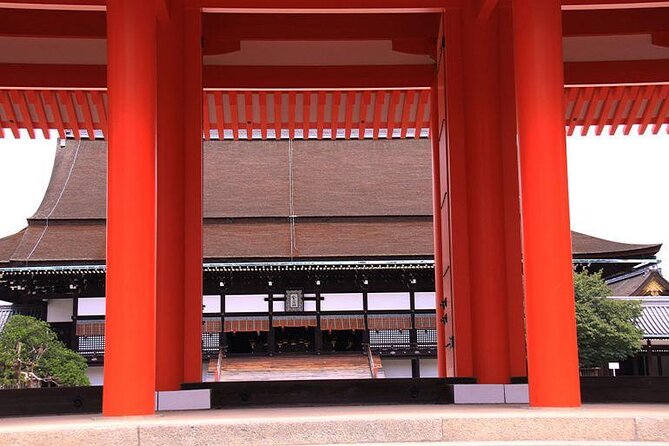
Kyoto Imperial Palace was once home to Japan’s imperial family for more than a thousand years. Entry is listed as free, but the sample itinerary gives it only one minute. That is not enough to see the grounds properly, making it another site that needs a custom time agreement.
How the guide affects the value
The most repeated strength of this experience is the guide. Names that appear in especially strong accounts include Kiyoto Noda, Takuma Goda, Toshi, Yuka, Saeko, Naomi, Hiro, Mitsuhiko, Mika, Osamu, Kenji, and Yuki.
Their praised qualities are practical: clear English, good route planning, useful explanations, help with trains, photo advice, restaurant suggestions, and a friendly manner. Kiyoto was singled out for balancing history with a relaxed pace. Takuma was praised for explaining the meaning of each place. Toshi was valued for keeping a group away from crowds while covering major sights.
That does not guarantee the same person or the same style for your booking. If language, pace, photography, children, or mobility are important, put those requests in writing. One especially unhappy experience involved a guide who gave little information, ended the tour early at the group’s request, and pointed the guest in the wrong direction afterward. That is not typical of the strong feedback, but it is a reminder to confirm expectations early.
Price, extra costs, and real value
The advertised price is $132.65 per person. Since the tour is private, the value improves when several people share the experience. A solo booking pays more for personal attention, but the price may feel high if the guide provides only basic commentary and the outing finishes early.
Your actual cost is higher because admissions, transportation for you and the guide, and lunch are not included. One complaint focused on being asked midway through the tour to cover the guide’s transit costs. The policy does support that charge, but it should be clear before departure.
The tour earns its price when it saves you from poor routing, helps you use limited time, and gives you cultural context you would not get from reading signs alone. It is weaker value if you already know Kyoto well, enjoy planning train routes, or prefer spending an entire morning at one temple.
Free cancellation is available if you cancel at least 24 hours before the start time. Changes or cancellations inside that window are not accepted for a refund.
Who should book this Kyoto tour
I would consider this for a first visit with only one day in Kyoto, especially if your group has mixed interests. A family can combine a major shrine with food or gardens. A couple can focus on old streets and temples. A visitor with limited mobility can ask for fewer stops and a slower pace.
It also suits you if you dislike fixed group tours. You can choose a food-centered route, a Zen-garden route, an architecture route, or a first-timer’s greatest-hits day.
I would be cautious if your priority is a detailed visit to many paid sites. The four-hour plan is short, the eight-hour plan still allows only three to four stops, and the extra costs can add up. I would also avoid booking without sending a clear list of must-sees and asking how the guide plans to connect them.
FAQ
How long does the private Kyoto tour last?
The tour lasts approximately four to eight hours. The half-day format generally includes two to three stops, while the full-day format generally includes three to four stops.
Is the tour private?
Yes. Only your group participates in the private activity.
Where does the tour start?
The stated meeting point is the Kyoto Tourist Information Center, Kyo-Navi, on the second floor of Kyoto Station Building in Shimogyo Ward.
Is hotel pickup available?
Pickup is offered, and the general tour description also says hotel pickup and drop-off are included. Since the meeting point information lists Kyoto Station, confirm the exact pickup and end arrangements when booking.
Are entrance fees included?
No. Entrance fees are not included. This applies to paid sites such as Kinkaku-ji, Ryoan-ji, Kiyomizu-dera, Nijo Castle, Tenryu-ji, Nanzen-ji, and Ginkaku-ji.
Is transportation included?
No. Transportation fees are not included for you or the guide. You should clarify the planned transport and expected costs before the tour begins.
Is lunch included?
No. Lunch for you and the guide is not included.
Can I choose the sights?
Yes. You can discuss your interests with the guide and select from major attractions, food areas, historic districts, gardens, temples, and other Kyoto sites.
Does the tour run in bad weather?
Yes. The tour takes place rain or shine.
How much walking is involved?
A moderate amount of walking is included. Comfortable walking shoes are recommended, especially for sites with slopes, steps, and extended paths.
Should you book it?
Book this tour if you want a private Kyoto plan shaped around your interests, and if saving time and getting personal cultural explanations matter more than keeping every extra cost low. It is particularly useful for a first visit, a family group, or anyone who wants help combining temples, markets, and old neighborhoods.
Skip it if you want a fixed low-cost outing, dislike paying separately for transport and admissions, or prefer to explore one district slowly on your own. If you do book, send your priorities in advance, ask for a realistic route, request the guide style you want, and confirm all extra charges. With those details settled, this can turn one crowded Kyoto day into a much more focused one.
Just added around Kyoto
- Taste of Nishiki Market Walking Food Tour with Local guide★ 5.0 · 17 reviews
- Kyoto: Sushi Making Class with Sushi Chef★ 4.8 · 64 reviews
- Kyoto: City Secrets eBike Tour★ 4.9 · 196 reviews
- Sacred Pathways: Discover the Philosopher’s Path of Kyoto★ 4.9 · 20 reviews
- Private Tour to Monkey Park and Arashiyama Highlights★ 5.0 · 22 reviews
- Private Nara Tour from Osaka – Meet at Your Hotel★ 5.0 · 22 reviews
- Private Sake Tasting in Central Kyoto with Sake Sommelier★ 5.0 · 13 reviews
- Kyoto : Private Custom Walking Tour With A Local Guide★ 4.6 · 144 reviews
1-Day Tours, compared.
Mt Fuji and Hakone 1-Day Bus Tour Return by Bullet Train
Read our review →
Mt Fuji & Hakone Cruise, Drum Show Bullet Train 1 Day from Tokyo
Read our review →
Peaceful Hiroshima & Miyajima UNESCO 1 Day Bus Tour
Read our review →
Hiroshima and Miyajima UNESCO Sites 1-Day Tour
Read our review →
Tokyo Customized Private Tour (Must See Places in 1 Day)
Read our review →
Kamakura & Enoshima Day Trip including Temple Tickets
Read our review →Browse the lists this tour appears in