
REVIEW · TEMPLE & SHRINE TOURS
Gion and Fushimi Inari Shrine Kyoto Highlights with Government-Licensed Guide
Kyoto’s geisha districts are easiest to appreciate on foot, but their narrow lanes can be confusing. This six-hour tour pairs Fushimi Inari’s vermilion torii gates with Gion’s elegant streets, then adds Yasaka Shrine, Kiyomizu-dera, and Kennin-ji. It gives you a broad look at southern and eastern Kyoto without asking you to plan every turn yourself.
I like the small maximum of 10 people, which should make it easier to hear the guide and ask questions. I also like the focus on geisha culture, including the distinction between maiko and geiko and the long training required for the profession. The main consideration is the price, $154.37 per person, plus the fact that this is a walking tour with some admission costs not included.
In This Review
- Key points to know before booking
- Why this route works for a first Kyoto visit
- Fushimi Inari and the first hour among the torii gates
- Gion’s narrow streets and geisha traditions
- Shirakawa and Tatsumi Daimyojin Shrine
- Yasaka Shrine and the Gion connection
- Kiyomizu-dera and the cost of admission
- Kennin-ji’s gardens near Hanamikoji
- The guide and small-group format
- Is $154.37 a fair price?
- Who should book this Kyoto walk?
- Practical details that affect your day
- Should you book it?
- FAQ
- How long does the tour last?
- Where does the tour start?
- Where does the tour end?
- Is hotel pickup included?
- Is transportation by private vehicle included?
- Is the tour conducted in English?
- How many people can join the tour?
- Are entrance fees included?
- Does the tour include a geisha or maiko show?
- Can I cancel for a full refund?
Key points to know before booking
- Fushimi Inari begins the day with about an hour of torii gates, shrine grounds, and mountain paths.
- Gion is explored on foot, including Pontocho, Miyagawacho, Hanamikoji, and the Shirakawa canal area.
- A licensed English-speaking guide explains geiko and maiko traditions, rather than treating the district as a photo stop.
- The group is capped at 10 people, a useful size for narrow lanes and conversation.
- Kiyomizu-dera and Kennin-ji admissions are not included, so budget for those separately.
- The tour starts and ends at Tatsumi Daimyojin Shrine, with no private vehicle or hotel pickup.
Why this route works for a first Kyoto visit
This tour covers several places that are often planned as separate outings. Fushimi Inari is in southern Kyoto, while Gion and the Higashiyama temples are farther north. Joining them in one guided day saves planning time, though it also makes for a full schedule.
The tour is especially useful if you want context as you walk. Gion can look like a series of pretty wooden buildings and quiet lanes if you do not know what you are seeing. A guide can explain the role of ochaya teahouses, the difference between geiko and maiko, and how the district developed around entertainment and dining.
You should also understand what this is not. It is not a private tour, not a vehicle-based sightseeing trip, and not a guaranteed geisha-spotting outing. The schedule is built around walking and interpretation. You may see maiko or geiko, but sightings are not promised.
The route begins and ends at Tatsumi Daimyojin Shrine in Gion. That arrangement is practical if you are already near central Kyoto, but less convenient if you expect transportation from your hotel. Plan your way to the meeting point before the start time, since the operator provides no private vehicle.
More Private Guided Tours with Driver in Kyoto
- Kyoto 6hr Private Tour with Government-Licensed Guide
★ 5.0 · 1,369 reviews - Kyoto 4hr Private Tour with Government-Licensed Guide
★ 5.0 · 629 reviews - Kyoto: Private Tour with Local Licensed Guide
★ 4.8 · 463 reviews
Fushimi Inari and the first hour among the torii gates
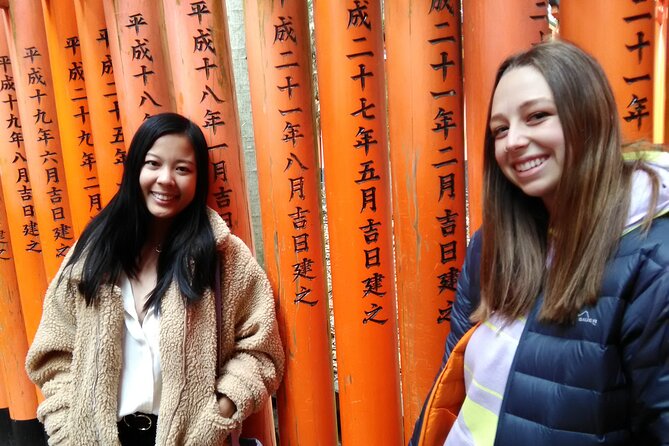
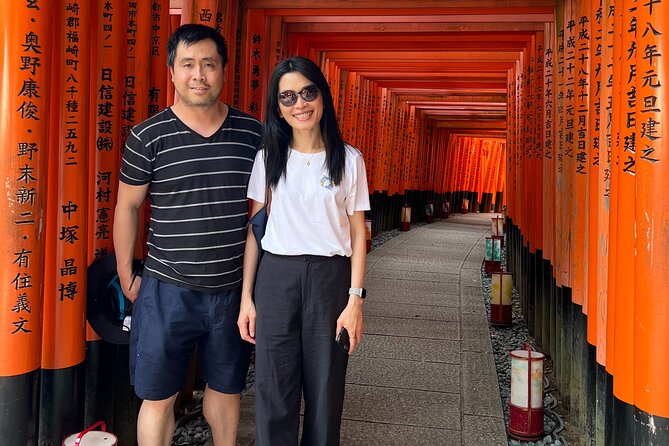
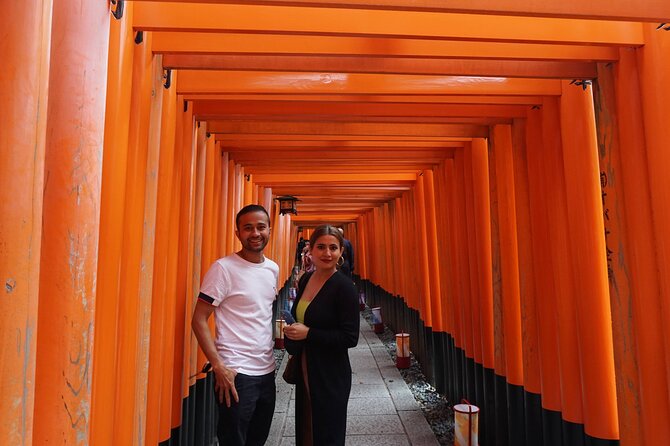
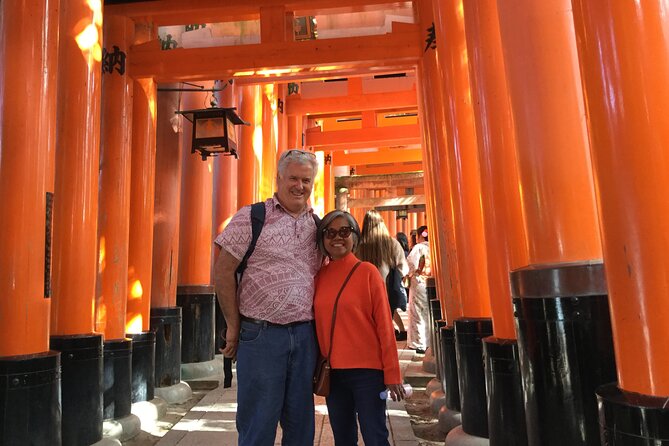
Fushimi Inari-taisha is famous for its thousands of vermilion torii gates, which form a network of paths behind the main shrine. The gates are dedicated by individuals and businesses, and they create one of Kyoto’s most recognizable walks.
The tour allows about one hour here. That is enough to see the main shrine area and walk into the torii-lined route, but not enough for a long climb through the full mountain trail system. If you want to reach the higher viewpoints and spend several hours walking, you will need a separate visit.
A guide adds value at Fushimi Inari by explaining what you are looking at, rather than leaving you to photograph the gates and move on. The shrine is dedicated to Inari, a Shinto deity associated with rice, agriculture, and business. Fox statues appear around the grounds because foxes are regarded as messengers of Inari.
Admission to Fushimi Inari is free. The attraction is open to the public, but the paths can be crowded at popular times. Since the tour is on foot, wear shoes that you can use comfortably for steps and uneven paths.
Gion’s narrow streets and geisha traditions
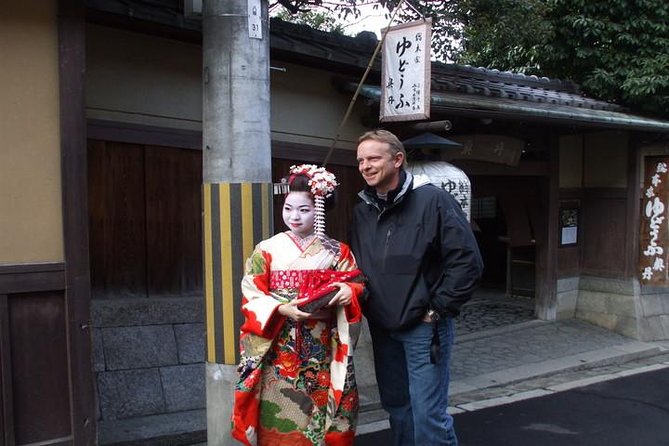
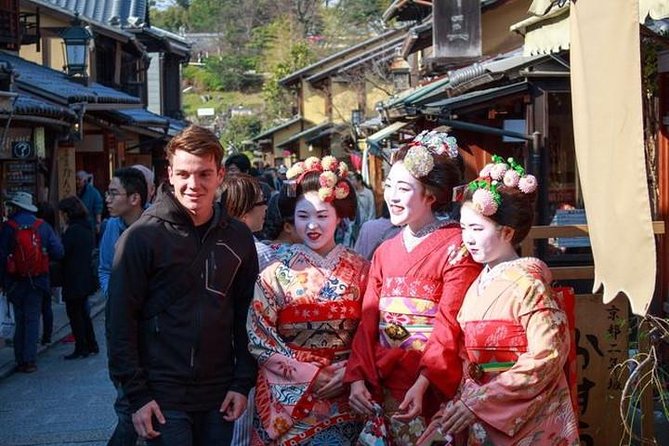
Gion is Kyoto’s best-known geisha district, located around Shijo Avenue between the Kamo River and Yasaka Shrine. Its lanes include shops, restaurants, ochaya teahouses, and traditional buildings that give the area its particular character.
The guide helps you read the neighborhood. You can learn how maiko and geiko differ, how a young woman trains for the profession, and why the teahouses operate differently from ordinary restaurants. These explanations turn a quiet street into a place with social rules and a long cultural tradition.
The experience should also help you behave respectfully. Gion is not a stage set. People live and work here, and the district has faced problems with intrusive photography and unwanted attention. Follow your guide’s instructions, avoid blocking lanes, and do not treat a possible maiko sighting as permission to chase someone for a picture.
The route includes areas around Gion, Pontocho, and Miyagawacho. These districts are close enough to connect by foot but each has its own feel. Pontocho is a narrow dining lane near the Kamo River. Miyagawacho is another traditional entertainment district. Seeing all three gives you a broader picture than simply walking along one famous street.
Shirakawa and Tatsumi Daimyojin Shrine
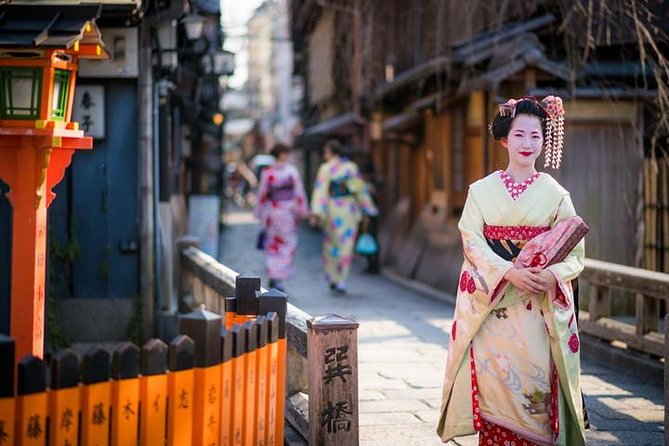
The Shirakawa area follows the canal parallel to Shijo Avenue. Willow trees line the water, while high-end restaurants and ochaya occupy traditional buildings along the route. It is one of the prettiest sections of the walk, especially for visitors who want a calmer contrast to the main streets.
The starting point, Tatsumi Daimyojin Shrine, is also part of the Gion story. It sits near Shirakawa and is linked with the local geisha district. The shrine itself is small, so do not expect a major temple complex. Its value comes from its setting and connection to the surrounding streets.
The tour includes a short stop of about 10 minutes at Tatsumi Daimyojin Shrine. That is enough for an introduction and a few pictures, not an extended religious visit. The shrine’s background is not always clearly explained in popular accounts, so a guide can help separate known facts from local tradition.
One practical point matters here: narrow lanes are part of the appeal, but they also make it easy to lose your bearings. The guide’s route planning is useful because cars cannot reach many of these streets. You get an on-foot view of Gion that a bus tour simply cannot provide.
More Temple & Shrine Tours in Kyoto
- Kyoto: Fushimi Inari, Kinkakuji, Bamboo Grove 1 Day Bus Tour
★ 4.8 · 4,316 reviews - Kyoto: Tea Ceremony in a Traditional Tea House in Kiyomizu
★ 4.9 · 3,519 reviews - Kyoto: Tea Ceremony Ju-An at Jotokuji Temple
★ 4.9 · 3,207 reviews - Fushimi Inari Hidden Hiking Tour (Private Option Available)
★ 5.0 · 1,750 reviews
Yasaka Shrine and the Gion connection
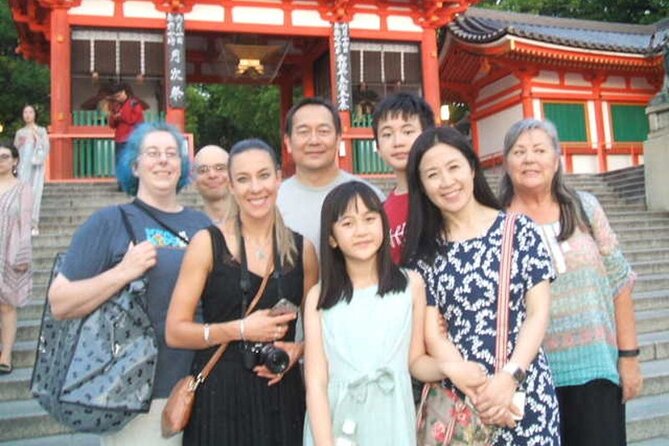
Yasaka Shrine, also called Gion Shrine, sits between Gion and the Higashiyama area. It was founded more than 1,350 years ago and remains one of Kyoto’s best-known Shinto shrines.
The scheduled visit lasts about 10 minutes. That is a brief stop, but it gives you time to see the main grounds and understand the shrine’s place beside Gion. Do not expect a long ceremony or a detailed architectural study at this pace.
Yasaka Shrine works well in the middle of this route because it connects the entertainment district with Kyoto’s religious traditions. You move from teahouses and narrow lanes to a large shrine precinct, then continue toward the Higashiyama temples.
The admission is free. As with the other stops, the guide can explain customs and details, but you should still leave room for your own quiet observation. Shrines are active religious places, not only sightseeing sites.
Kiyomizu-dera and the cost of admission
Kiyomizu-dera is more than 1,250 years old and sits partway up Mount Otowa in Kyoto’s Higashiyama range. Its hillside setting gives the approach a different character from the flat streets of Gion.
The tour allows about one hour here. That gives you a useful first look at the temple grounds, but Kiyomizu-dera can easily fill half a day if you explore every lane, hall, and viewpoint nearby. You may need to keep moving to stay with the group.
Admission to Kiyomizu-dera is not included. This matters when you compare the tour price with a self-guided day. The guide provides access to the route and explanations, but you pay separately for this temple entry.
Kiyomizu-dera is one of the tour’s strongest stops because it combines history, worship, and a memorable setting on the wooded slopes above Kyoto. The visit also places you close to Higashiyama’s traditional streets, though the tour description does not promise extra free time for shopping or independent exploration.
If you have limited mobility, think carefully about the walking demands. The tour is described as suitable for most people, but it includes shrine grounds, temple approaches, and paths that may involve slopes or steps. Service animals are allowed.
Kennin-ji’s gardens near Hanamikoji
Kennin-ji is close to Hanamikoji and Shijo streets, yet its grounds provide a quieter pause from the surrounding city. The temple has two dry gardens, which give the visit a more restrained and reflective feel.
The planned stop is only about one minute. That is the biggest limitation in the schedule. You may receive a quick introduction or pass by the grounds, but you should not book this tour expecting a full Kennin-ji visit.
Admission to Kennin-ji is not included. If this temple interests you, return independently with enough time to see the gardens properly. The brief stop is best viewed as a location marker within the Gion route, not a major part of the day.
This is a good example of why you should read the timing closely. The tour names many important places, but the time at each one varies sharply. Fushimi Inari and Kiyomizu-dera receive about an hour each. Yasaka Shrine and Tatsumi Daimyojin receive about 10 minutes. Kennin-ji receives only a very brief stop.
The guide and small-group format

The experience includes a government-licensed local English-speaking guide. That is important in Gion, where the most useful information concerns customs, language, and local context rather than just dates and building names.
One guide specifically praised in the supplied information is Mari, who led an evening Gion walk and explained the history of the district and the difference between maiko and geiko. You cannot assume Mari will lead your departure, but her example shows the sort of personal, explanatory guiding the tour aims to provide.
A maximum of 10 people is a sensible limit. A large group would be awkward in the narrow lanes, and it would be harder to hear explanations near busy streets. With a smaller group, you have a better chance to ask about a particular shrine, building, or custom.
The tour is not suitable for combining multiple tour groups. You join the designated group at the meeting point, and the guide entry fees are covered only for sights listed as included under the tour arrangements. The published details clearly state that private transportation is not part of the experience.
Is $154.37 a fair price?
At $154.37 per person, this is not a budget walking tour. You are paying for a licensed English-speaking guide, a six-hour route, and the convenience of joining several Kyoto highlights in one organized outing.
The value depends on how much help you want. If you are comfortable navigating Kyoto by train and walking independently, you can visit Fushimi Inari and much of Gion on your own for far less. Fushimi Inari and Yasaka Shrine do not charge admission, while Kiyomizu-dera and Kennin-ji require separate payment.
The tour makes more financial sense if you value interpretation and time saved. You do not need to build the route, research geisha customs, or work out how the southern and eastern parts of Kyoto fit together. The guide also takes you through lanes that are easy to miss.
Group discounts may be available, which could improve the cost for families or parties booking together. Check the current price for your group before booking, since the quoted $154.37 is a per-person rate.
I would not choose this tour solely for temple admissions or transportation. Those are not included benefits. I would choose it for the guide, the compact route, and the chance to ask questions while walking through Gion.
Who should book this Kyoto walk?
This tour suits a first-time Kyoto visitor who wants a structured introduction to Gion and the major sights around Higashiyama. It is also useful if you have only one day for this part of the city and want someone else to handle the route.
It works well for people curious about geiko and maiko culture but unsure how to explore the district respectfully. The guide can provide context that you might miss when walking alone.
You should be comfortable walking for roughly six hours, with time outdoors and possible slopes or steps. The tour is not a good fit if you want a slow temple visit, long shopping breaks, or private transportation.
Photographers may enjoy the torii gates, canal, traditional streets, and shrine buildings. Still, the pace may not suit anyone who wants to spend a long time setting up pictures. Sightings of geiko or maiko are possible but not guaranteed, and one supplied experience specifically described an evening when none appeared.
Practical details that affect your day
The tour starts at Tatsumi-jinja Shrine in Gion and ends back at the same meeting point. Pickup and drop-off are on foot, so plan your own public transportation to the start.
Confirmation is provided at booking. The activity is near public transportation, service animals are allowed, and the operator says most people can participate.
You can cancel for a full refund up to 24 hours before the experience start time. Changes or cancellations made within 24 hours are not accepted for a refund, and cut-off times use Kyoto local time.
The tour is commonly booked well in advance, with an average booking time of about 89 days. That does not guarantee that every departure sells out, but it is a useful sign to reserve early if your Kyoto dates are fixed.
Should you book it?
Book this tour if you want a guided cultural walk through Gion and prefer a planned route to independent navigation. The small group, licensed English-speaking guide, and clear attention to geiko and maiko traditions are its best features.
Skip it if you want to climb deeply into Fushimi Inari, linger at Kiyomizu-dera, or spend a full hour at Kennin-ji. The schedule touches many places, but some stops are short, and admission costs at two major temples are extra.
For a first Kyoto visit, the tour offers a useful overview and strong cultural context. For repeat visitors, it makes the most sense if you want a guide for Gion’s social history and narrow lanes rather than another general temple tour.
FAQ
How long does the tour last?
The tour lasts approximately six hours.
Where does the tour start?
It starts at Tatsumi-jinja Shrine, also called Tatsumi Daimyojin Shrine, in Kyoto’s Gion area.
Where does the tour end?
The tour ends back at the meeting point at Tatsumi-jinja Shrine.
Is hotel pickup included?
No. Pickup and drop-off are on foot, and you must meet the guide within the designated area.
Is transportation by private vehicle included?
No. The experience does not include a private vehicle.
Is the tour conducted in English?
Yes. The tour includes a licensed local English-speaking guide.
How many people can join the tour?
The group has a maximum of 10 travelers.
Are entrance fees included?
Fushimi Inari-taisha Shrine and Yasaka Shrine have free admission. Admission to Kiyomizu-dera and Kennin-ji is not included.
Does the tour include a geisha or maiko show?
No. The tour does not include a geisha show.
Can I cancel for a full refund?
Yes. You can cancel at least 24 hours before the experience start time for a full refund. Cancellations or changes made less than 24 hours before the start are not accepted for a refund.
Just added around Kyoto
- Private Guided Traditional Buddhist Cooking in Japan★ 5.0 · 16 reviews
- Kyoto: Gion Geisha District & Sake-in-Hand Walking Tour★ 5.0 · 37 reviews
- Your Private Vacation Photography Session In Kyoto★ 5.0 · 110 reviews
- Kyoto: Zen Meditation at a Private Temple with a Monk★ 5.0 · 25 reviews
- Traditional Japanese Washi Papermaking- Kyoto morning★ 5.0 · 77 reviews
- Kyoto Wagashi(Japanese sweets) Cooking Class near Fushimiinari★ 5.0 · 60 reviews
- Private Pewter Sake Cup Experience with a Kyoto Artisan★ 5.0 · 31 reviews
- Kyoto Private 6 hour Tour: English Speaking Driver Only, No Guide★ 5.0 · 88 reviews
Temple & Shrine Tours, compared.
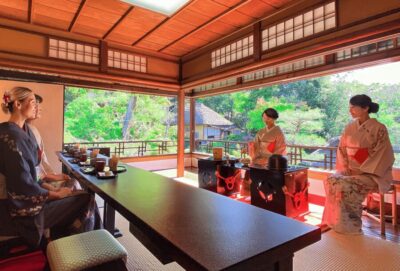
Tea Ceremony in a Traditional Tea House in Kiyomizu
Read our review →
Meiji Shrine, Asakusa, Skytree Bus Tour and Cruise
Read our review →
Asakusa Walking Tour with Sensoji Temple Visit
Read our review →
Kamakura & Enoshima Day Trip including Temple Tickets
Read our review →
Kyoto/Osaka: Nara, Fushimi Inari Taisha, Arashiyama Bus Tour
Read our review →
Nikko Toshogu Shrine and Kegon Waterfall Tour
Read our review →
Tokyo Panoramic 1 Day: Meiji Shrine, Asakusa, Odaiba and SKYTREE®
Read our review →Browse the lists this tour appears in