
REVIEW · PRIVATE GUIDED TOURS WITH DRIVER
Kyoto 6hr Private Tour with Government-Licensed Guide
Kyoto is too spread out to conquer by guesswork, and this private six-hour tour gives you a smart way to choose your battles. You pick three or four places from a long list, then travel between them with a licensed local guide who can explain what you are seeing and help you use Kyoto’s trains and buses.
I like the personal format, especially for a first day, and I like the freedom to shape the route around your group. Guides such as Yuka, Rie, Kazuhiko, Yasu, and Kaeko have tailored days to suit families, seniors, food interests, and tight schedules. The catch is simple: six hours goes quickly, and the many listed sights are options, not stops you can all visit in one day.
In This Review
- Key points at a glance
- Why six hours in Kyoto can be worth it
- Picking a route that actually works
- Fushimi Inari and the southern temples
- Kiyomizu-dera, Higashiyama, and Gion
- Nijo Castle and Kyoto’s central neighborhoods
- Kinkaku-ji, Ryoan-ji, and the western temples
- Arashiyama’s bridge and bamboo paths
- Northern mountains, villas, and Uji
- What the price includes, and what it does not
- Guides, pace, and the small risk of inconsistency
- Who should book this Kyoto tour
- Should you book it?
- FAQ
- How long is the Kyoto private tour?
- Is the tour private?
- How many places can I choose?
- Is the guide licensed?
- Is transportation provided by private vehicle?
- Is hotel pickup available?
- Are admission tickets included?
- Is lunch included?
- Can I visit Byodoin Temple in Uji?
- What is the cancellation policy?
Key points at a glance
- Choose three or four sights: Build a sensible route instead of racing through Kyoto’s entire map.
- Travel like a local: The tour uses public transportation and walking, not a private vehicle.
- A guide for your group alone: You can ask questions freely and adjust the pace more easily than on a group bus tour.
- Strong overall rating: The experience has a 4.9 rating from 1,369 reviews, with 98 percent recommending it.
- Admission costs are extra: Temple and castle tickets are not included, and lunch is also on your own.
- Meet on foot: Pickup and drop-off are walking arrangements within a designated Kyoto area.
Why six hours in Kyoto can be worth it
Kyoto rewards planning, but planning takes time. You can spend an evening studying train lines, temple hours, neighborhood locations, and the difference between a shrine and a temple. Or you can tell your guide what matters to you and spend those six hours seeing the city.
The private setup is the real selling point. Your guide can slow down for questions, change the order of stops, and keep the day at a pace that works for your group. This mattered to families with teenagers, older couples, and people visiting Kyoto for only a day from Tokyo.
The guides also do more than point toward famous buildings. Akira used photos and diagrams to explain sites, while Noriko helped a group feel more at ease with Kyoto’s subway and train system. Kaeko added food and shopping advice, and Yuki helped plan a route that included Fushimi Inari, Uji, lunch, and Nijo Castle.
Still, set realistic goals. This is not a private car tour, and it is not a ticket that grants access to every location on the long sightseeing list. You walk, wait for public transport, and cover a city with attractions scattered from the northern mountains to the southern edge of Kyoto.
More Private Guided Tours with Driver in Kyoto
- Kyoto 4hr Private Tour with Government-Licensed Guide
★ 5.0 · 629 reviews - Kyoto: Private Tour with Local Licensed Guide
★ 4.8 · 463 reviews - Private Kyoto Tour with Licensed Guide & Vehicle (Max 15 persons)
★ 5.0 · 417 reviews
Picking a route that actually works
The tour allows three or four sites from the available choices. That sounds restrictive until you look at Kyoto on a map. Fushimi Inari in the south, Kinkaku-ji in the northwest, and Arashiyama in the west are not quick hops between neighboring sights.
A good route groups nearby places. For example, Kinkaku-ji, Ryoan-ji, and Arashiyama make a logical western Kyoto day, though even this plan requires steady movement. One group enjoyed exactly that combination, with Kinkaku-ji as the highlight.
An eastern route might pair Fushimi Inari with Sanjusangendo, Kiyomizu-dera, and Gion. This gives you a strong mix of Shinto worship, Buddhist art, hillside streets, and old Kyoto atmosphere. Another sensible choice is Nijo Castle, Nishiki Market, the Imperial Palace, and Pontocho, though market and dining areas work best if you leave room for wandering.
If you want Uji’s Byodoin Temple, tell the guide early. It sits outside central Kyoto, and the extra travel time means you should not combine it casually with a far-western route. The same warning applies to Kurama, Kibune, Yoshimine-dera, Katsura Imperial Villa, and Shugakuin Imperial Villa.
The best pre-tour question is not How many places can we see? It is Which three places would we regret missing? Your guide can then suggest a route that respects distance and opening hours.
Fushimi Inari and the southern temples
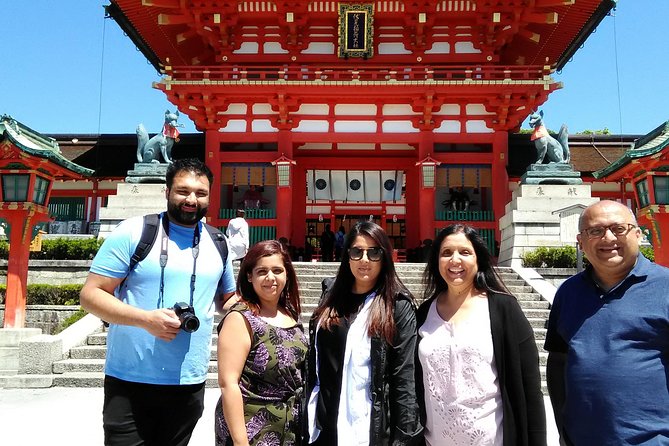
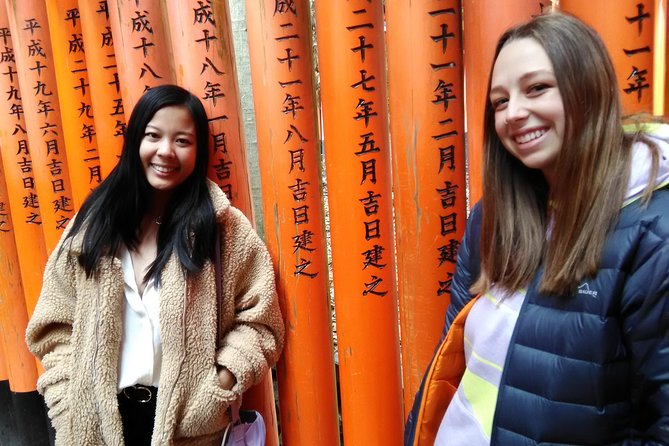
Fushimi Inari-taisha is the tour’s most instantly recognizable stop. Thousands of vermilion torii gates climb the wooded slopes behind the shrine, forming the famous passages that appear in so many Kyoto photographs.
A guide adds useful context here. The shrine has stories tied to Japanese religion and culture, and your guide can explain the meaning of the gates, the shrine’s role, and the customs you see along the way. Admission is free.
Do not assume you must walk the entire mountain route. The tour description allows time for a chosen visit, not an all-day hike. Tell your guide how much walking you want before you begin, especially in hot weather or if someone in your group has limited stamina.
Nearby southern options include Tofuku-ji and Toji. Tofuku-ji is a major Zen temple known for autumn color, while Toji dates to the early Heian period and is known for its large Buddhist statues and historic role as Kyoto’s East Temple. These are better choices for travelers who want temple architecture and religious history without spending the whole day in the city center.
Sanjusangendo offers a very different experience. Its long hall is famous for 1,001 statues of Kannon, the Buddhist figure associated with mercy. Admission is extra, but the scale of the interior makes it a memorable choice, particularly when paired with Fushimi Inari and Kiyomizu-dera.
Kiyomizu-dera, Higashiyama, and Gion
Kiyomizu-dera is one of Kyoto’s essential stops, but the temple itself is only part of the experience. The approach leads through the preserved Higashiyama area, where traditional streets, shops, and old-style buildings create one of the clearest impressions of historic Kyoto.
The one-hour guided visit gives you time to understand the temple grounds rather than simply take a photograph from the famous wooden stage. Admission is not included. Expect walking on slopes and through busy streets, so comfortable shoes matter.
From Kiyomizu-dera, your guide can help you make sense of Gion, Kyoto’s geisha district. The narrow lanes can be confusing, and a local guide is useful for explaining the area’s customs and pointing out places without treating the neighborhood as a stage set.
You should follow local etiquette carefully here. Do not photograph people without permission, and keep your voice low in residential lanes. The value of a private guide is partly the chance to ask respectful questions about geisha culture instead of relying on movie clichés.
Kennin-ji, close to Hanamikoji and Shijo streets, can add a quieter temple stop to this part of town. Its spacious grounds and dry gardens offer a calmer contrast to the surrounding lanes. If you have only six hours, your guide may recommend choosing either a longer Kiyomizu and Gion visit or an additional temple, not trying to force in everything.
Same city, a completely different kind of day:
- PERFECT KYOTO 1-Day Bus Tour
★ 5.0 · 13,518 reviews - Kyoto: Fushimi Inari, Kinkakuji, Bamboo Grove 1 Day Bus Tour
★ 4.8 · 4,316 reviews - Kyoto: Tea Ceremony in a Traditional Tea House in Kiyomizu
★ 4.9 · 3,519 reviews - Kyoto Geisha Walking Tour: Gion District & Hidden Gems
★ 4.7 · 3,273 reviews
Nijo Castle and Kyoto’s central neighborhoods
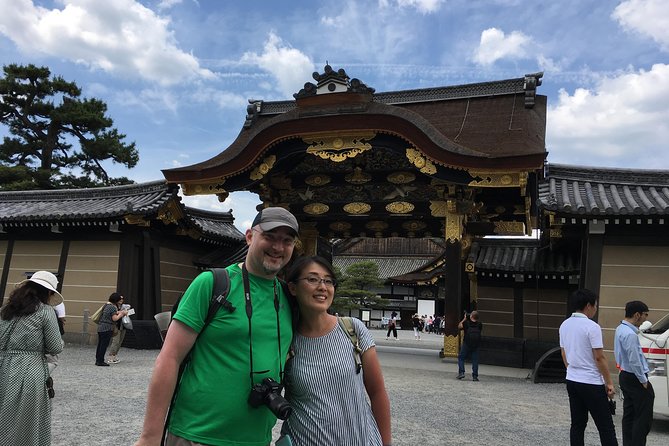
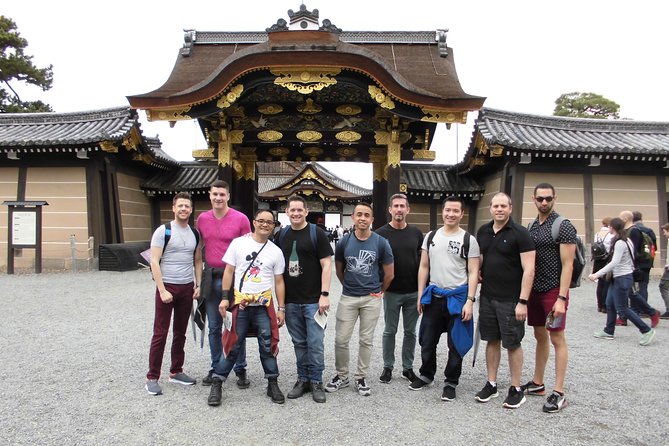
Nijo Castle gives you a look at political power rather than temple devotion. Built to display the authority of Tokugawa Ieyasu, the castle is known for its grand design and interiors associated with the shogunate.
Admission is extra, and you should allow time to appreciate the buildings and grounds. A guide can explain why the castle was built, how it functioned, and what its decorations said about power in early modern Japan.
Nishiki Market is known as Kyoto’s Kitchen. It is a narrow, five-block shopping street lined with more than 100 shops and restaurants. You might find pickles, seafood, sweets, kitchen goods, and other local foods, but the tight passage can feel crowded and difficult to navigate alone.
This is a good place to tell your guide what you eat and what you want to avoid. Food stops can consume time quickly, so decide if you want a proper lunch, a few small tastes, or simply a walk through the market.
The Kyoto Imperial Palace offers a different kind of open space. It served as the Imperial Family’s residence until 1868, when the emperor and capital moved to Tokyo. Its broad grounds provide a break from narrow lanes and packed temple approaches.
Pontocho, running one block west of the Kamogawa River, is best saved for the end of a central Kyoto route if you want restaurant suggestions. It is an atmospheric dining lane, but this tour does not include lunch. One guide helped a group find a good meal in Uji, and other guides have offered restaurant advice, but you pay for your own food.
Kinkaku-ji, Ryoan-ji, and the western temples
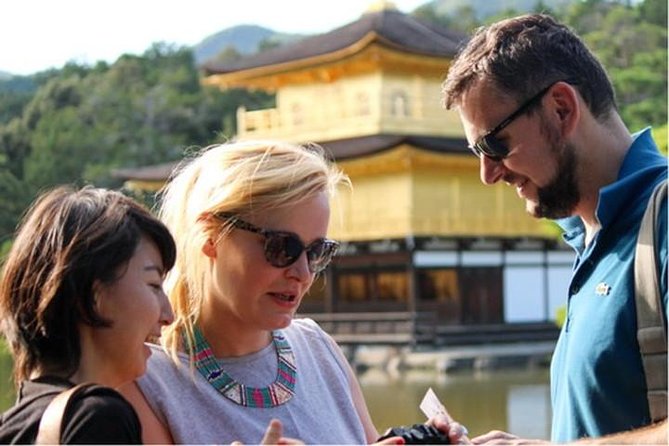
Kinkaku-ji, the Golden Pavilion, is one of Kyoto’s most familiar sights. The upper two floors are covered in gold leaf, and the building reflects over a pond in a carefully arranged setting. Admission is extra.
It is a high-demand stop, so a private guide cannot remove the crowds. What your guide can do is explain the pavilion’s former role as a shogun’s retirement villa and help you understand the relationship between the building, water, and garden.
Ryoan-ji is home to Japan’s most famous rock garden. Its spare arrangement invites quiet attention, though you may find the viewing area busy. A guide can give you cultural background, then allow you time to look without filling every pause with commentary.
Ninna-ji adds another World Heritage temple to the northwest route. Founded in 888, it is the head temple of the Omuro school of Shingon Buddhism. Daitoku-ji and Myoshin-ji offer large temple complexes with many subtemples, but their size makes them better for people who want a slower, more focused temple day.
This western circuit works well for visitors who want classic Kyoto images. It works less well if you also want Fushimi Inari, central Kyoto, and Arashiyama in the same six hours.
Arashiyama’s bridge and bamboo paths
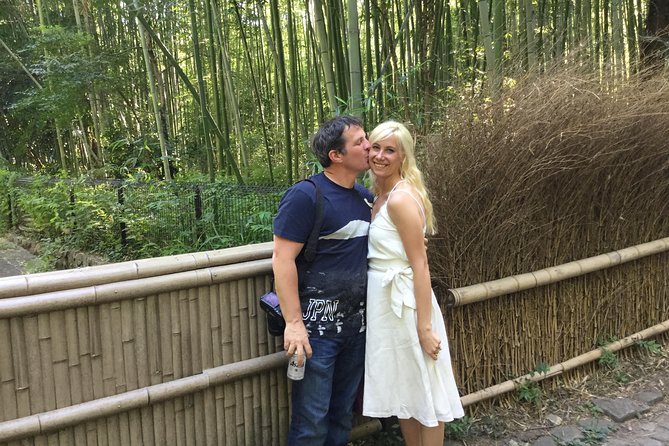
Arashiyama is a pleasant district on Kyoto’s western edge, known for the Togetsukyo Bridge, bamboo groves, temples, and mountain views. The bridge, whose name means Moon Crossing Bridge, is the area’s best-known landmark.
The bamboo paths are beautiful but do not expect a long stretch of empty forest. The walk is relatively concentrated, and the area can be busy. Your guide helps you find the route and decide how much time to give the groves compared with nearby Tenryu-ji or Okochi Sanso Garden.
Tenryu-ji is Arashiyama’s leading Zen temple and a World Heritage site. Its grounds give you a more structured visit, while Okochi Sanso offers gardens and buildings from the former villa of actor Okochi Denjiro. Both require separate admission.
Jojakko-ji, Nisonin, Gio-ji, Adashino Nenbutsu-ji, and Otagi Nenbutsu-ji are quieter possibilities farther along the Saga-Toriimoto area. Gio-ji is known for its moss garden, while Otagi Nenbutsu-ji has 1,200 stone figures, each with a different expression.
These places are appealing if you have already seen Kyoto’s headline sights or want a more subdued day. They are not sensible additions to a route that already includes Fushimi Inari and Kinkaku-ji.
Northern mountains, villas, and Uji
The tour’s options extend well beyond the central city. Kibune is a small mountain town built around Kifune Shrine, while Kurama is known for Kurama-dera and its hot spring. Both offer a forested change of pace, but the distance makes them poor companions for a packed central Kyoto schedule.
Shugakuin Imperial Villa and Katsura Imperial Villa are prized for architecture and garden design. Since both are special-purpose imperial sites, ask your guide about access and timing before selecting them. The supplied information does not promise entry arrangements, so treat them as planning-sensitive choices.
Yoshimine-dera sits in Kyoto’s western mountains and is built along a hillside, much like Kiyomizu-dera on the opposite side of town. It is a fine choice for scenery and temple setting, but the slopes increase the physical demand.
Byodoin in Uji is the farthest listed option. Its Phoenix Hall is a National Treasure and part of a World Heritage site. The extra travel time is clearly noted, so choose Uji for its own sake rather than trying to squeeze it between several distant Kyoto attractions.
One successful route combined Uji with Fushimi Inari and Nijo Castle. That plan worked because it treated Uji as a main destination, not a quick add-on.
What the price includes, and what it does not
At $155.86 per person, this tour is not the cheapest way to visit Kyoto’s temples. The value depends heavily on group size. A private guide costs more than a shared walking tour, but the per-person price becomes easier to justify when divided among a family or small group.
You receive a licensed local English-speaking guide and a customizable six-hour itinerary. You do not receive a private vehicle, lunch, personal expenses, or admission tickets. Many temples and castles on the list charge entry fees, so include those in your day’s budget.
Public transportation is part of the experience. That keeps the tour closer to ordinary Kyoto life and avoids paying for a full private vehicle, but it also means walking to stations, sharing trains or buses, and allowing time for transfers.
The strongest value is orientation. A good guide can help you understand Kyoto’s layout, customs, and transport system, leaving you better prepared to explore independently afterward. That benefit came through clearly in the way guides such as Noriko and Kazuhiko helped people get their bearings on their first day.
Guides, pace, and the small risk of inconsistency
The guide makes or breaks this experience. The best examples include Yuka, who prepared carefully and adjusted the day for a family; Rie, who planned every stop and spoke clear English; and Kazuo, who worked out a rough itinerary with his group through WhatsApp before the tour.
Other strong guide names include Yasu, Kiyoshi, Ken, Michi, Akira, Kaeko, Nori, and Yuji. Their strengths vary. Some focus on history, some on food and shopping, and some on transport and efficient routing.
The overall rating is excellent, but one poor experience reported a guide losing track of the group, weak English, and no lunch break during an 8 a.m. to 2 p.m. schedule. That is a useful warning, not a reason to dismiss the tour. Confirm your route, pace, meeting plan, and lunch expectations before the day begins.
This is also why I would contact the operator at least two weeks ahead. The tour is customizable, and the more clearly you explain your priorities, the better chance you have of receiving a practical route.
Who should book this Kyoto tour
This tour suits first-time Kyoto visitors, families, small groups, and anyone with only one day in the city. It is especially useful if you want to combine cultural explanation with practical help on trains and buses.
It also works well for people who dislike fixed group schedules. You can ask to focus on gardens, Buddhist temples, Shinto shrines, food, imperial sites, or classic Kyoto neighborhoods.
I would hesitate if you want a relaxed, slow visit to one or two temples. Six hours can feel rushed when you add public transport and walking. I would also choose another format if a private vehicle is essential or if you want lunch and entrance fees bundled into one price.
Free cancellation is available up to 24 hours before the start time. The activity is private, service animals are allowed, and most people can participate, but remember that pickup and drop-off are on foot and the tour itself involves walking.
Should you book it?
Book this tour if you want a strong first look at Kyoto and are willing to make clear choices. Ask for three or four sites that fit together, tell the guide your walking pace, and reserve time for lunch instead of hoping it appears on its own.
I would particularly consider it for a family or small group that wants personal attention. The 4.9 rating and 98 percent recommendation figure support the basic promise, but your planning still matters. Kyoto is too large for a wish list of 35 attractions. Choose a route with care, and this can give you both memorable sights and the confidence to explore the city on your own afterward.
FAQ
How long is the Kyoto private tour?
The tour lasts approximately six hours.
Is the tour private?
Yes. Only your group participates, and you cannot combine multiple tour groups.
How many places can I choose?
The tour includes a customizable itinerary of three to four sites from the available choices.
Is the guide licensed?
Yes. The experience includes a licensed local English-speaking guide.
Is transportation provided by private vehicle?
No. The tour uses public transportation and walking. A private vehicle is not included.
Is hotel pickup available?
Pickup and drop-off are handled on foot within a designated area of Kyoto.
Are admission tickets included?
No. Admission tickets for places such as Kiyomizu-dera, Nijo Castle, Kinkaku-ji, and other paid sites are not included.
Is lunch included?
No. Lunch is not included, so you should discuss a meal stop with your guide when planning the route.
Can I visit Byodoin Temple in Uji?
Yes, Byodoin Temple is one of the listed choices, but extra travel time is expected because it is in Uji city.
What is the cancellation policy?
You can cancel up to 24 hours before the experience start time for a full refund. Cancellations or changes made less than 24 hours before the start time are not accepted for a refund.
Just added around Kyoto
- Taste of Nishiki Market Walking Food Tour with Local guide★ 5.0 · 17 reviews
- Kyoto: Sushi Making Class with Sushi Chef★ 4.8 · 64 reviews
- Kyoto: City Secrets eBike Tour★ 4.9 · 196 reviews
- Sacred Pathways: Discover the Philosopher’s Path of Kyoto★ 4.9 · 20 reviews
- Private Tour to Monkey Park and Arashiyama Highlights★ 5.0 · 22 reviews
- Private Nara Tour from Osaka – Meet at Your Hotel★ 5.0 · 22 reviews
- Private Sake Tasting in Central Kyoto with Sake Sommelier★ 5.0 · 13 reviews
- Kyoto : Private Custom Walking Tour With A Local Guide★ 4.6 · 144 reviews
Private Guided Tours with Driver, compared.
Tokyo 4hr Private Tour with Government-Licensed Guide
Read our review →
Hiroshima / Miyajima Full-day Private Tour with Government Licensed Guide
Read our review →
Kyoto 4hr Private Tour with Government-Licensed Guide
Read our review →
Mt. Fuji Day Trip from Tokyo with English Speaking Driver Guide
Read our review →
Hiroshima City 4hr Private Walking Tour with Licensed Guide
Read our review →
Private Kyoto Tour with Licensed Guide & Vehicle (Max 15 persons)
Read our review →Browse the lists this tour appears in