
REVIEW · KIMONO & CULTURE EXPERIENCES
Calligraphy Culture SHODO Experience in Tokyo
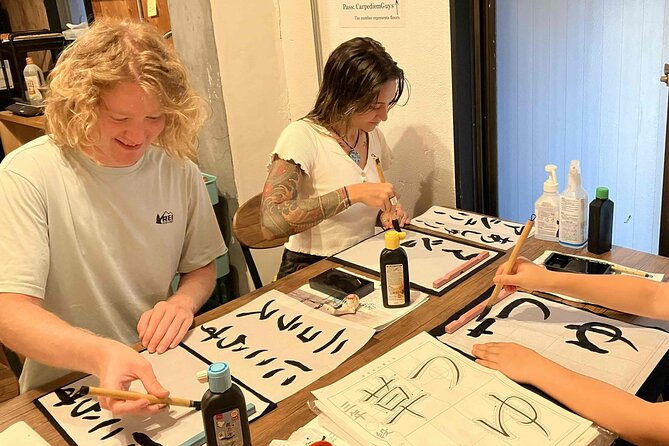
Japanese calligraphy is more than writing with a brush. In this 90-minute shodo lesson, you learn how posture, pressure, and the speed of each stroke shape the final character. Then you write your name in Japanese or choose a favorite word in kanji, hiragana, or katakana.
I like the small class size, capped at five people, and the personal attention from teachers such as Sachie and Zuisen. I also like that you finish with an autograph board to take home, rather than leaving with only a few practice sheets. The main drawback is the setting: the class takes place in a hostel or shared boarding-house space, and one participant found household activity distracting.
In This Review
- Key points at a glance
- What the 90-minute Tokyo shodo class is really about
- Starting with brush grip, posture, and basic lines
- Choosing a name or word in Japanese
- A small class with room for individual help
- The hostel setting: local character, possible interruptions
- Finishing your calligraphy board
- Location near Iriya, Ueno, and Asakusa
- Is $33.03 a fair price for 90 minutes?
- Who will enjoy this experience most?
- Practical planning for your class
- Should you book Tokyo Iriya Shodo Club?
- FAQ
- How long does the calligraphy experience last?
- How many people can join the class?
- Where does the experience begin?
- How far is the meeting point from public transportation?
- What can I write during the lesson?
- Are calligraphy materials included?
- Can I cancel for a full refund?
Key points at a glance
- Write your own name in Japanese: Choose katakana, hiragana, or kanji with the teacher’s help.
- Practice the fundamentals first: Learn brush grip, posture, pressure, and basic lines before attempting a finished piece.
- Small groups make the lesson personal: The maximum is five people, and some sessions may feel nearly private.
- Take home a finished autograph board: Your final word or name becomes a compact souvenir.
- Reach it easily from Iriya Station: The meeting point is about a five-minute walk and close to Asakusa and Ueno.
- Expect a shared hostel setting: It feels local and informal, but occasional background activity is possible.
What the 90-minute Tokyo shodo class is really about
I see this experience as a gentle introduction to Japanese writing, not a formal art course. You arrive at Tokyo Iriya Shodo Club and begin with the basics, including how to hold the brush, how to sit or stand with proper posture, and how to draw clean lines.
That beginning matters. A Japanese character is not simply a collection of marks. The order, direction, weight, and finish of each stroke affect its appearance. You may be surprised by how much attention goes into a single line.
The teacher then helps you practice simple forms before moving toward words. You can work on your name in Japanese or select a favorite word in kanji. The supplied information also confirms practice with the three main writing systems: hiragana, katakana, and kanji.
The class is designed for foreign visitors, so you do not need previous calligraphy experience. Most people can take part, and the teachers explain the process in English. Zuisen is described as speaking excellent English, while Sachie receives repeated praise for her patience, warmth, and ability to guide complete beginners.
More Kimono & Culture Experiences in Tokyo
- Tokyo: Samurai Ninja Museum Guided tour and Experience
★ 4.6 · 1,010 reviews - Tokyo: Samurai Sword & Archery Class from Samurai Descendant
★ 5.0 · 603 reviews - Best Samurai Experience in Tokyo
★ 5.0 · 458 reviews
Starting with brush grip, posture, and basic lines
The first part may feel slow if you are eager to write your name right away. I think that is a good thing. Without an explanation of brush control, your first character would be little more than a guess.
You learn how to hold the brush and how to position your body. You also practice drawing lines and basic shapes. The purpose is not to make you an expert in a few minutes. It is to help you feel how much ink and pressure the brush needs.
This hands-on start works well for a mixed group. One person may have an artistic background, while another may describe himself as artistically challenged. The lesson does not depend on natural drawing skill. You repeat the forms, receive corrections, and try again.
A patient instructor is especially important here. Sachie is praised for making the lesson comfortable and for helping people who felt unsure about their artistic ability. Zuisen is also described as patient and clear in English. If you worry that your first strokes will look awkward, you are in good company, and the teaching style is built for beginners.
Choosing a name or word in Japanese
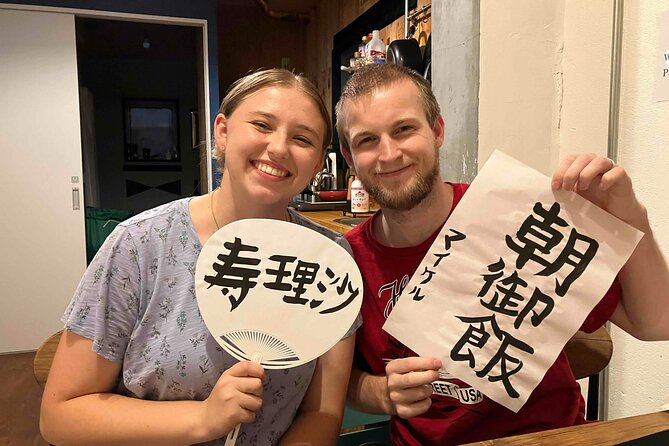
The most personal part of the class is choosing what you want to write. You can use your name or a favorite word, and the teacher can guide you toward a suitable Japanese form.
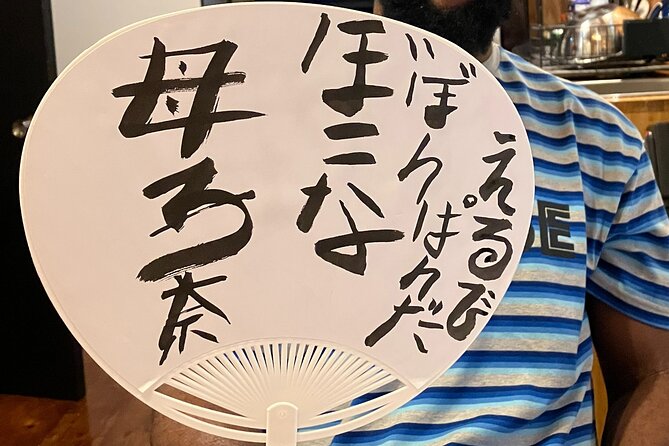
Names are often written in katakana when representing foreign names. One participant worked on a name in katakana and later found that Google Translate recognized the writing. That is a small but satisfying test of how clearly the characters turned out.
You can also choose a word in kanji, though some words are much harder than others. One student attempted the Japanese word for knitting, which involves complicated characters. The point is not to select the easiest possible word. It is to attempt something meaningful, then learn how the characters are built.
If you are unsure what to choose, ask the teacher. The class description specifically allows a favorite word in kanji, and the instruction is personalized. You may be able to write something tied to your interests, your name, or your trip.
The choice of writing system changes the feel of the finished piece:
- Hiragana has rounded, flowing forms and is used for Japanese words and grammatical elements.
- Katakana has more angular forms and is commonly used for foreign names and borrowed words.
- Kanji uses characters with meaning, but the forms can be more complex.
You do not need to arrive knowing which system is right. Part of the lesson is understanding these differences through practice.
A small class with room for individual help
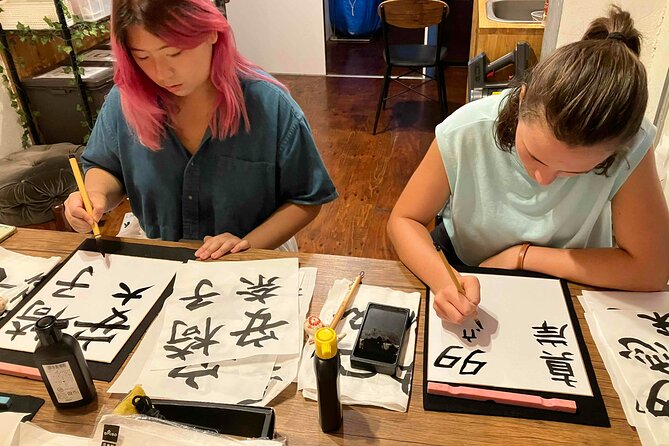
The group limit is five people. That is one of the strongest reasons to choose this class over a large cultural demonstration.
With only a few students, the teacher can look closely at your grip and strokes. The experience can become almost private if other places are not filled. One session had only one student, which allowed for a personal lesson and time to work on a difficult word.
A small group also makes the activity less intimidating. You can see how other beginners approach the brush without feeling as though you are performing for a room full of people. At the same time, the class does not promise complete solitude. The listed maximum is five, and the setting is shared.
Families can also fit well here. A family session with Sachie was described as engaging and enjoyable for everyone. The activity gives each person a separate final piece, so adults and children can work on different names or words rather than producing one shared souvenir.
Same city, a completely different kind of day:
- Mt Fuji and Hakone 1-Day Bus Tour Return by Bullet Train
★ 5.0 · 26,383 reviews - 1-Day Tokyo Bus Tour
★ 5.0 · 14,250 reviews - Tokyo: TOKYO SKYTREE® Admission ticket
★ 4.5 · 11,192 reviews - Tokyo: teamLab Planets TOKYO Digital Art Museum Entry Ticket
★ 4.6 · 9,779 reviews
The hostel setting: local character, possible interruptions
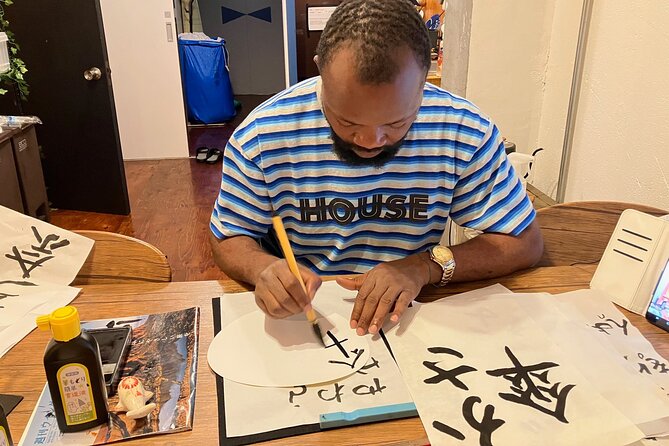
The meeting point is Tokyo Iriya Shodo Club, at 2-chome 29-2, second floor, in Iriya, Taito City. Some class descriptions place the lesson in a hostel kitchen or an old-style boarding-house room. You may need to ask inside the hostel when you arrive.
This is not a polished museum studio. The informal space can feel like an actual neighborhood Japanese language school, which adds a local quality that a purpose-built tourist venue might lack. You are learning in a working space rather than watching a staged cultural show.
There is a tradeoff. One participant found that people sharing the space were preparing food and washing clothes during the class. Those interruptions took attention away from the lesson. I would not book this experience expecting silence or a formal gallery atmosphere.
For many people, the relaxed room will be perfectly acceptable, especially during a short introductory class. If you need a quiet, highly controlled setting, this is the main point to consider before booking. The teaching itself receives the strongest praise, but the room is part of the experience.
Finishing your calligraphy board
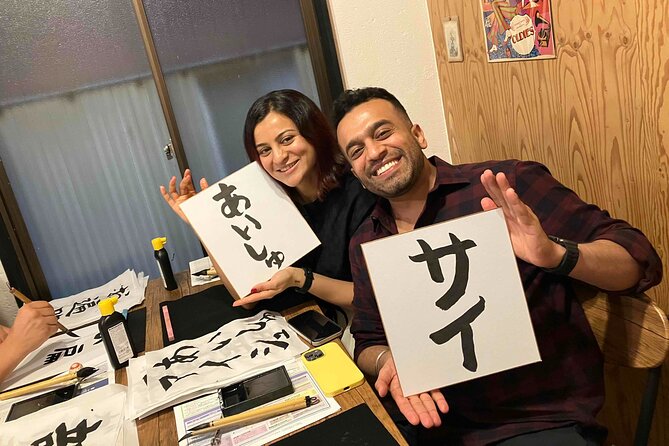
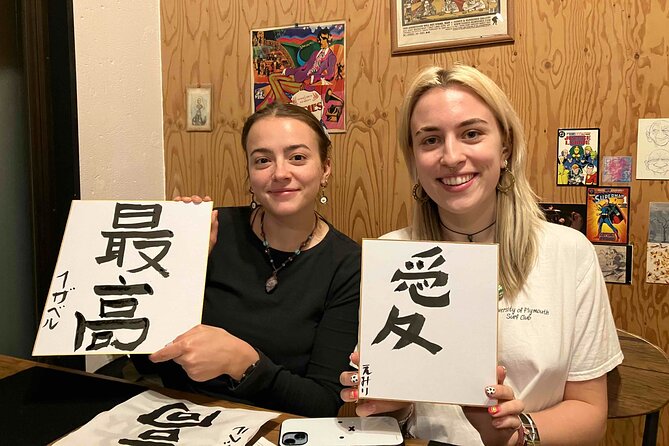
After practice, you create a final piece on an autograph board. This is the part that gives the class lasting value. You do not simply try a brush for a few minutes and leave with disposable practice paper. You put the lesson into one finished work that you can carry home.
The board is a lightweight souvenir, so it should be easy to fit into your luggage. It also has more meaning than a generic item from a shop because you chose the word and wrote it yourself.
Do not expect museum-quality calligraphy from a first lesson. Your lines may wobble, and the spacing may not be perfect. That is part of the charm. The teacher helps you produce something presentable while still allowing the final work to show your hand.
I would leave enough room in your schedule after the class to look at the finished piece and let it dry as needed, though no specific drying procedure is provided. Handle it carefully on the way back to your hotel.
Location near Iriya, Ueno, and Asakusa
The class is about a five-minute walk from Iriya Station and is close to Ueno and Asakusa. That makes it easy to pair with other plans in Taito City.
Iriya is useful as a quieter base for this kind of activity. After the lesson, you can continue toward Ueno or Asakusa, both of which are nearby areas to explore. A family who attended the class specifically found Taito worth additional time, so I would not treat the neighborhood as a place to rush through.
The short walk from the station is practical when you are carrying a brush board or visiting in hot, rainy, or cold weather. The activity ends at the same place where it starts, so you do not need to arrange a separate pickup or find your way across Tokyo afterward.
Use the exact meeting address when planning your route. The experience is near public transportation, but the entry is in a shared building, and the note about asking inside the hostel is useful. Arriving a little early should give you time to identify the correct room without cutting into your lesson.
Is $33.03 a fair price for 90 minutes?
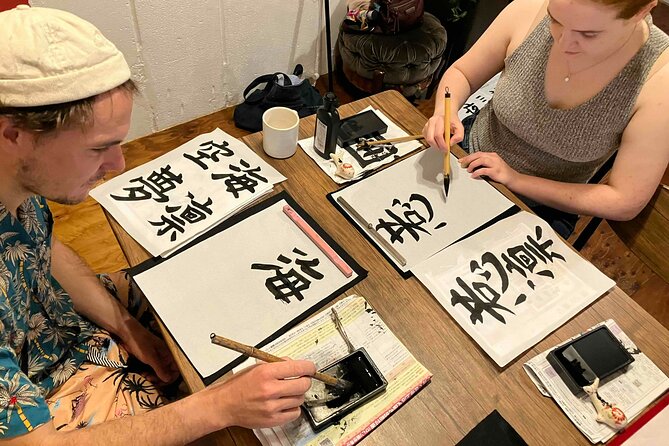
At $33.03 per person, the value depends on what you want from a cultural activity. This is not a long tour with several sights, meals, or transportation included. It is a focused lesson with all calligraphy supplies provided.
I think the price is reasonable for three things: direct instruction, a small group, and a finished board to take home. The personal nature of the class matters here. A large demonstration might explain shodo, but it would not give you the same time with the brush or the same chance to correct your own strokes.
The value is also stronger if you are looking for a souvenir with a story. A purchased fan or printed charm may be attractive, but your handwritten name or favorite word connects directly to the afternoon or morning you spent learning.
It is less compelling if you only want to see calligraphy performed. In that case, a brief cultural display might suit you better. This class asks you to participate, practice, and accept that your first work will be that of a beginner.
The experience is booked an average of 27 days ahead, which suggests that you should reserve before arriving if your schedule is fixed. Confirmation is received at booking, and a mobile ticket is available. Free cancellation applies when you cancel at least 24 hours before the start time. Changes or cancellations inside that window are not accepted for a refund.
Who will enjoy this experience most?
I would recommend it to first-time visitors who want a hands-on cultural activity without committing half a day. Ninety minutes is long enough to learn the basics and make a final piece, but short enough to fit between sightseeing plans.
It suits:
- Couples who want a personal souvenir from Tokyo.
- Families looking for an activity that does not depend on advanced Japanese.
- Solo visitors who appreciate direct teacher attention.
- Anyone curious about the differences between hiragana, katakana, and kanji.
- People who prefer making something over watching a demonstration.
It may be less suitable if you want a silent art studio, a highly formal venue, or advanced instruction. The shared hostel setting can have ordinary household activity around it, and the lesson is aimed at beginners rather than experienced calligraphers.
Practical planning for your class
Book ahead if you need a particular day, since the activity is often reserved several weeks in advance. Keep the 24-hour cancellation deadline in mind, especially if your Tokyo plans may change.
The class provides the calligraphy supplies, so you do not need to bring a brush or ink. Wear something comfortable and avoid clothing you would worry about near ink, although no special dress requirement is listed.
Plan to meet at the Tokyo Iriya Shodo Club rather than expecting to be collected elsewhere. The class returns to that meeting point when it ends. Since the location is inside a shared building, check with the hostel staff if you are uncertain where to go.
I would place this activity near a visit to Ueno or Asakusa. That gives you a natural half-day plan without adding a long cross-city journey. Save a little time for Taito City itself, rather than treating the calligraphy class as the only reason to visit the area.
Should you book Tokyo Iriya Shodo Club?
I would book this class if you want to do something personal and practical in Tokyo. The strongest features are the patient English-speaking teachers, the maximum group of five, and the chance to leave with your own calligraphy board.
The 97 percent recommendation rate and 4.9 rating from 66 reviews support the idea that the teaching is consistently strong, especially with Sachie and Zuisen. Still, keep your expectations clear: this is a friendly beginner lesson in a shared hostel setting, not a quiet professional studio.
Choose it if you like learning by doing, want to understand Japanese writing at a basic level, and value a souvenir you created yourself. Skip it only if background activity would spoil the lesson for you or if you are seeking advanced calligraphy training.
FAQ
How long does the calligraphy experience last?
The activity lasts approximately 1 hour and 30 minutes.
How many people can join the class?
The maximum group size is five people.
Where does the experience begin?
It begins at Tokyo Iriya Shodo Club in Iriya, Taito City, Tokyo, at Japan, 110-0013 Tokyo, Taito City, Iriya, 2-chome 29-2, second floor.
How far is the meeting point from public transportation?
The club is about a five-minute walk from Iriya Station.
What can I write during the lesson?
You can write your name in Japanese or choose a favorite word in kanji. The lesson also introduces hiragana and katakana.
Are calligraphy materials included?
Yes. Calligraphy supplies are included in the experience.
Can I cancel for a full refund?
Yes, if you cancel at least 24 hours before the experience start time. Cancellations or changes made less than 24 hours before the start time are not accepted for a refund.
Just added around Tokyo
- Private Memorable Tokyo Tour with English Speaking Driver★ 5.0 · 30 reviews
- Tokyo Photography Masterclass – Private Photography Lesson★ 5.0 · 25 reviews
- Private Tokyo Custom Full-Day Tour by Chartered Vehicle★ 5.0 · 16 reviews
- Private Sightseeing to Mt Fuji and Hakone with English Driver★ 5.0 · 51 reviews
- Private Mt. Fuji Day Trip from Tokyo with English-Speaking Driver★ 5.0 · 33 reviews
- 4 Day Tour – Mount. Fuji, Tokyo, Hakone, Kamakura and Yokohama★ 5.0 · 19 reviews
- Private Unforgettable Mt Fuji Tour with English Speaking Driver★ 5.0 · 142 reviews
- Private Tokyo Food Tour – A Journey Through Time Through Food★ 5.0 · 36 reviews
Kimono & Culture Experiences, compared.
Kyoto Geisha Walking Tour: Gion District & Hidden Gems
Read our review →
Gion Magical Night Walking Tour with Geisha Trivia
Read our review →
Gion Geisha District Walking Tour – Stories of Geisha
Read our review →
Best of Kyoto: Gion, Geisha, Pagodas & Cobblestones
Read our review →
Kyoto Gion Geisha District Walking Tour – The Stories of Geisha
Read our review →
Browse the lists this tour appears in