
REVIEW · DINNER EXPERIENCES
Authentic Maiko Experience&Kyoto Dinner (Free drink) at Noh Stage
The most memorable part of this Kyoto evening is not simply seeing a maiko dance. It is sitting close enough to ask questions, watch the details of her kimono and hair ornaments, play traditional ozashiki games, and share a meal in a historic house. The setting on a Noh stage gives the night a quiet formality that a large theater show cannot match.
I like two things especially: the live shamisen music, which makes the dance feel connected to the room, and the chance for real conversation rather than a quick photograph and goodbye. A Kyoto-certified interpreter helps keep the exchange open and useful. The main consideration is the price, $150, which makes this a special-event splurge rather than a casual evening out.
In This Review
- Key points at a glance
- Why this maiko evening feels different
- Arriving at Okazaki-an
- The Noh stage photo time
- Dinner, toast, and Kyoto food
- Maiko dance with live shamisen
- Meeting the maiko face to face
- Questions, photos, and the two-shot portrait
- Ozashiki games on the stage
- Is $150 a fair price?
- Who should book this experience?
- Timing, clothing, and useful planning tips
- Should you book the Kyoto maiko dinner?
- FAQ
- Where does the maiko dinner experience take place?
- What time does the experience start and end?
- Is dinner included?
- Are drinks included?
- Can I take a photo with the maiko?
- Are children or people with limited mobility allowed to participate?
- What happens if I need to cancel?
Key points at a glance
- Noh stage setting: The maiko dances and photo sessions take place on the second floor of a traditional Noh stage venue.
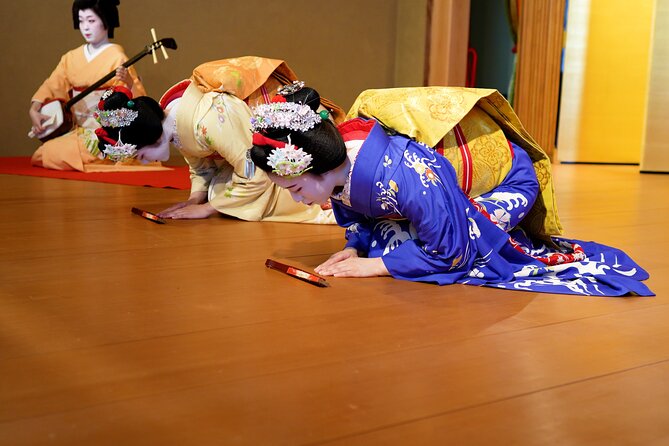
- Live shamisen: A jikata musician accompanies the maiko, giving the performance its proper musical setting.
- Conversation and questions: You have time to ask about the maiko’s life, clothing, kanzashi hair ornaments, and traditions.
- Dinner and free drinks: A traditional Kyoto meal and drinks are included for the full two-hour program.
- Ozashiki games: You take part in playful traditional games with the maiko, not just watch from a seat.
- Small group format: The maximum group size is 20, and the experience requires at least two participants.
Why this maiko evening feels different
Kyoto’s maiko culture is often presented through short public performances. Those shows can be enjoyable, but they usually keep you at a distance. This experience is designed around contact: dance, dinner, questions, photographs, and games all share the same evening.
That difference matters. A maiko is not only a dancer in a striking kimono. She is part of a highly formal tradition of music, hospitality, conversation, and play. Here, you get a glimpse of that wider world instead of seeing one polished number and leaving.
The setting also helps. You gather on the second floor of a Noh stage, where the maiko performs and where the two-shot photograph takes place. A Noh stage is a serious performance space, so the atmosphere is more restrained than a restaurant show. You should expect ceremony, not a loud dinner-theater production.
The organizers describe the format as small and invitation-only in spirit, with details shaped by long relationships in Kyoto’s hanamachi districts. You cannot independently verify every part of that background during a two-hour visit, but the format does make practical sense: intimate conversation needs a limited number of people.
A few more Kyoto trips to weigh up
- Kyoto Gion Cultural Walk & Geisha Show with Dining Options
★ 5.0 · 518 reviews - Kyoto Gion Cultural Walk & Geisha Show with Dining Options
★ 5.0 · 483 reviews - Dinner with Maiko in a Traditional Kyoto Style Restaurant Tour
★ 5.0 · 175 reviews
Arriving at Okazaki-an
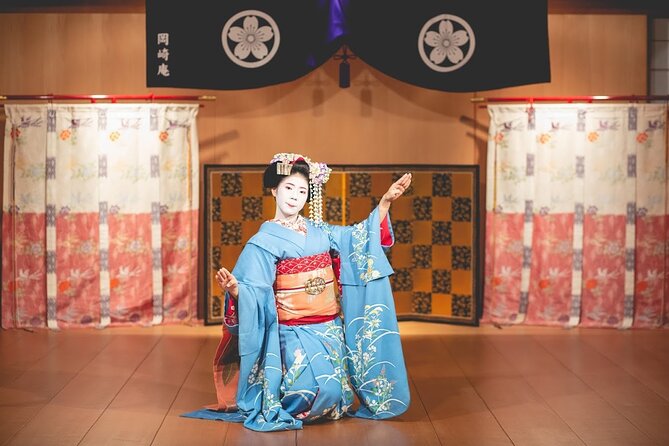
The meeting point is Okazaki-an, at 9165 Okazaki Enshojicho, Sakyo Ward, Kyoto, postal code 606-8344. The venue is near public transportation, and the activity begins at 6:00 p.m.
Doors open at 5:50 p.m. If you arrive early, you can wait in the first-floor café area rather than standing outside. That ten-minute cushion is useful, especially if you are coming from another Kyoto sight and need to find the building.
At 6:00 p.m., you go to the second floor of the Noh stage. You need socks or tabi footwear for the stage, and bare feet are not allowed. Food and drinks are also prohibited during the initial photo time on the stage, so follow the staff’s instructions before the dinner begins.
The group can hold up to 20 people. That is not a private evening, but it is still far more manageable than a mass performance. Your experience will depend partly on where you sit and how actively you take part in the questions and games.
The Noh stage photo time
The evening begins with free photo time on the Noh stage. This gives you a chance to appreciate the venue before the formal program starts. It also means you can take in the stage without trying to photograph the maiko while she is dancing.
Remember the footwear rule. Socks or tabi are required, and you should not bring food or drinks onto the stage. Oversize luggage is not included in the activity, so leave large bags elsewhere and arrive with only what you can manage easily.
The stage is also where the later two-shot photo with the maiko takes place. That backdrop gives the picture a stronger sense of place than a standard restaurant snapshot. Still, be prepared for an organized photo opportunity rather than a long personal photo session.
Dinner, toast, and Kyoto food
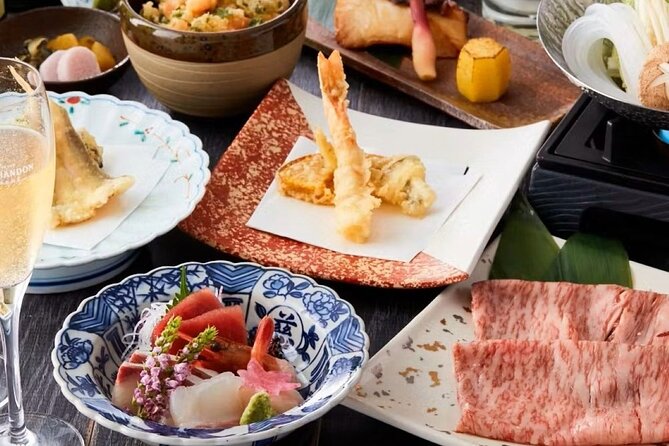
After the opening stage time, the program moves into a welcome toast and dinner. The meal is described as traditional Kyoto cuisine in a kaiseki style. Kaiseki is valued for careful presentation, seasonal balance, and small courses rather than one large plate of food.
You should think of dinner as part of the cultural setting, not the sole reason to book. The meal adds context to the evening and gives you time to settle in before the performance and conversation. It also makes the $150 price easier to assess, since food and free drinks are included.
The available information does not specify the exact menu, number of courses, or drink list. If you have strict dietary needs, ask before booking rather than assuming the kitchen can adapt. The same applies to allergies and preferences, since no special menu policy is provided.
Drinks are included for two hours, described as unlimited or free throughout the program. Drink responsibly, since the point of the evening is conversation and cultural participation, not simply having as much as possible.
Same city, a completely different kind of day:
- PERFECT KYOTO 1-Day Bus Tour
★ 5.0 · 13,518 reviews - Kyoto: Fushimi Inari, Kinkakuji, Bamboo Grove 1 Day Bus Tour
★ 4.8 · 4,316 reviews - Kyoto: Tea Ceremony in a Traditional Tea House in Kiyomizu
★ 4.9 · 3,519 reviews - Kyoto Geisha Walking Tour: Gion District & Hidden Gems
★ 4.7 · 3,273 reviews
Maiko dance with live shamisen
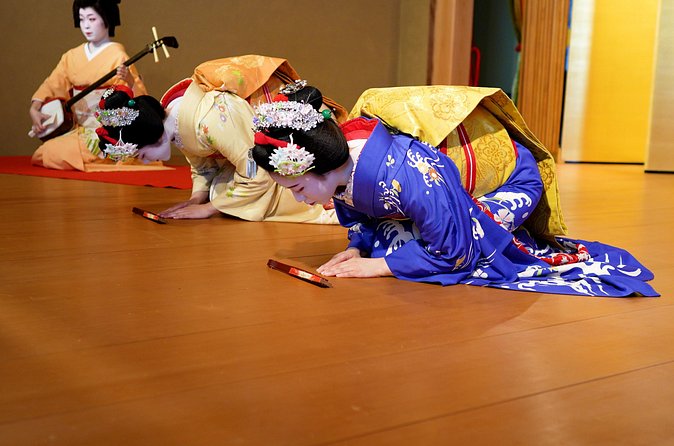
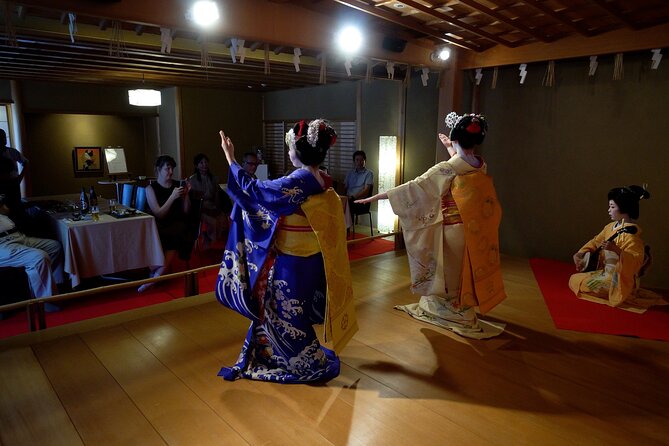
The maiko enters with the jikata, the musician who plays live shamisen. The shamisen is a three-stringed Japanese instrument with a sharp, expressive sound. Hearing it live changes the feel of the performance. You notice the relationship between the musician’s rhythm and the maiko’s controlled movements.
The dance takes place on the Noh stage, close to the audience. The program includes multiple maiko dance performances, with the evening schedule placing the main performance after the welcome and dinner. You should expect refinement and restraint rather than a fast stage spectacle.
Pay attention to the small movements. The appeal is in posture, timing, hand gestures, and the way the kimono moves. The performance may last only part of the evening, but it provides the formal center around which the rest of the program is built.
Photography is part of the activity, but you should still follow staff directions about when and where to take pictures. The early stage photo time, formal two-shot, and dance viewing each have a different purpose.
Meeting the maiko face to face
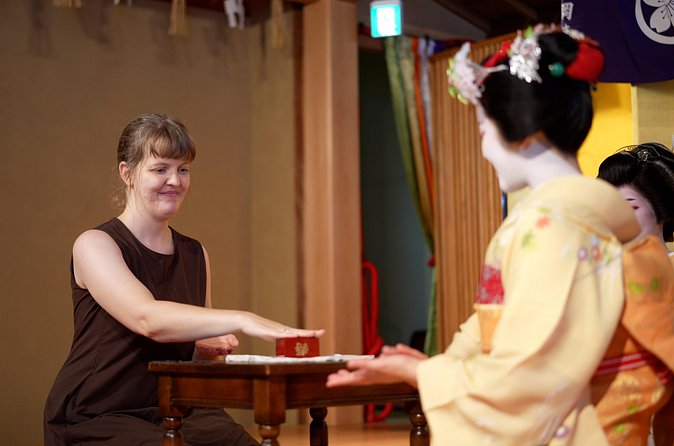
After the dancing, there is a greeting and self-introduction period for the maiko, the jikata, and participants. This is where the evening changes from performance to exchange.
You can ask questions through the Kyoto-certified interpreter. The interpreter is especially useful for questions about daily life, training, customs, and the meaning of clothing details. Direct conversation is a major reason to choose this program over a short public dance show.
A kimono and kanzashi introduction follows. Kanzashi are the ornamental hairpins worn with traditional hairstyles, and they can signal season and occasion. Seeing them explained in person helps you notice details that are easy to miss from a distance.
The information supplied for this experience does not name the individual maiko, geiko, or interpreter, and the performer may vary by date. Book for the format and cultural access, not for a particular named artist.
Questions, photos, and the two-shot portrait
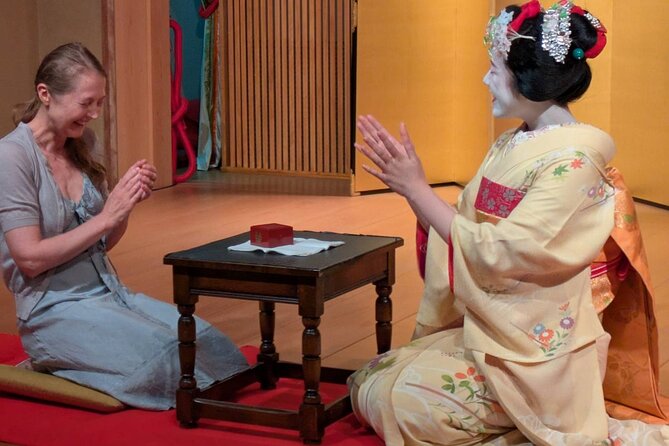
The two-shot photo with the maiko is taken on the Noh stage. For many people, this becomes the keepsake from the night. It is also a practical benefit: you do not need to rely on a hurried street sighting or hope that a passing maiko has time for a photograph.
Keep your expectations respectful. The program offers a planned photo opportunity, not unrestricted personal photography. The maiko is working, and the evening’s value comes from treating the portrait as one part of a larger cultural meeting.
Conversation time follows or surrounds the question session. You can ask about the maiko’s work and life, though the quality of the exchange will depend on the interpreter, the group’s questions, and how much time each person takes. If you have one question you especially want answered, prepare it before arriving.
Ozashiki games on the stage
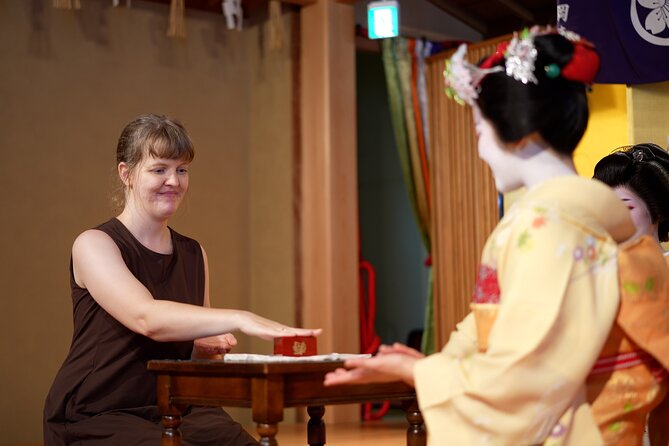
The ozashiki games are the most playful part of the evening. These traditional party games are designed for interaction, with the maiko and live shamisen helping set the pace.
You do not need to be an expert in Japanese customs. Instructions and interpretation are provided, and the games are meant to be social rather than competitive in a serious way. If you are shy, you may feel more comfortable watching one round before joining.
This portion also explains why the program is more than a dinner with entertainment. Ozashiki culture combines music, quick reactions, humor, and etiquette. Taking part gives you a small sense of that social rhythm, even though a two-hour program cannot reproduce a full private teahouse evening.
The live shamisen continues to matter here. It turns the games into a shared performance rather than a simple activity led by a host. A small group works well because participants can see what is happening and have a better chance to join.
Is $150 a fair price?
At $150, this is expensive compared with an ordinary Kyoto dinner or a basic cultural performance. You are paying for several elements together: a traditional meal, two hours of drinks, live music, maiko performances, interpreter support, a photo, direct conversation, and the use of a historic Noh stage.
The price makes the most sense if you value access and intimacy. A cheaper show may give you a dance, but it probably will not combine a meal, questions, a two-shot photograph, and ozashiki games in a small setting. If your main goal is simply to see a maiko dance once, a lower-cost performance may suit you better.
The meal and drinks also affect the calculation. Since both are included, you do not need to add the cost of dinner afterward. Transportation to and from the venue is not included, so budget separately for getting to Okazaki-an.
I would call it good value for a special Kyoto night, not a bargain. It is particularly suited to a first visit to Japan, a birthday or anniversary evening, or anyone who has read about maiko culture and wants more than a staged glimpse.
Who should book this experience?
I would recommend it to you if you want:
- A small-group evening rather than a large auditorium show
- A chance to ask questions with interpreter support
- Traditional food alongside a cultural performance
- A planned photograph with a maiko
- Participation in games instead of only watching
- A polished, formal Kyoto setting
It may not suit you if you dislike group activities, prefer a quiet meal with no program, or want a long performance focused only on dance. The experience asks you to take part. Conversation, introductions, photos, and games are central, not optional extras.
Families and older visitors can generally participate, since most people can join the activity. The venue is near public transportation, but the supplied details do not provide full accessibility information. If you have mobility concerns, contact the provider before booking.
Timing, clothing, and useful planning tips
Plan to arrive close to the 5:50 p.m. door opening. That gives you time to use the first-floor café space, check the footwear requirement, and reach the second floor before the 6:00 p.m. start.
Wear or carry clean socks. Bare feet are not permitted on the Noh stage, and this is an easy detail to overlook during a summer visit.
Avoid bringing oversize luggage. Transportation from your home to the venue is also your responsibility, so check your route in advance. The address is in Kyoto’s Sakyo Ward, and the activity ends back at the same meeting point at about 8:00 p.m.
The booking confirmation arrives at the time of reservation. Cancellation is free up to 24 hours before the start time. Inside that 24-hour window, refunds are not available and changes are not accepted, so do not book until your evening plans are firm.
Should you book the Kyoto maiko dinner?
Book it if you want a carefully structured introduction to maiko culture that includes real conversation, live shamisen, traditional food, and playful participation. The strongest parts are the intimate questions, the Noh stage setting, and the chance to see how dance, music, clothing, and hospitality fit together.
Skip it if $150 feels too high for a two-hour activity or if you only want a short dance performance. You may also prefer another option if you want a private experience, since the group can reach 20 people.
For the right person, this is a memorable Kyoto evening with substance behind the spectacle. You leave with a photograph, a meal already covered, and a better understanding of the people and customs behind the makeup and kimono.
FAQ
Where does the maiko dinner experience take place?
It takes place at Okazaki-an, 9165 Okazaki Enshojicho, Sakyo Ward, Kyoto, postal code 606-8344. The main program is held on the second floor of a Noh stage venue.
What time does the experience start and end?
Doors open at 5:50 p.m. The program begins at 6:00 p.m. and ends at about 8:00 p.m., for a duration of approximately two hours.
Is dinner included?
Yes. A traditional Kyoto meal, described as kaiseki cuisine, is included in the experience.
Are drinks included?
Yes. Free drinks are included for the two-hour program, and the experience is described as offering unlimited drinks during that time.
Can I take a photo with the maiko?
Yes. A two-shot photo with the maiko on the Noh stage is included. There is also free photo time on the stage before the main program begins.
Are children or people with limited mobility allowed to participate?
Most people can participate, but full accessibility details are not provided. Contact the provider before booking if you have specific mobility needs.
What happens if I need to cancel?
You receive a full refund if you cancel at least 24 hours before the local start time. Cancellations or changes made less than 24 hours before the start time are not accepted and are not refundable.
Just added around Kyoto
- Private Guided Traditional Buddhist Cooking in Japan★ 5.0 · 16 reviews
- Kyoto: Gion Geisha District & Sake-in-Hand Walking Tour★ 5.0 · 37 reviews
- Your Private Vacation Photography Session In Kyoto★ 5.0 · 110 reviews
- Kyoto: Zen Meditation at a Private Temple with a Monk★ 5.0 · 25 reviews
- Traditional Japanese Washi Papermaking- Kyoto morning★ 5.0 · 77 reviews
- Kyoto Wagashi(Japanese sweets) Cooking Class near Fushimiinari★ 5.0 · 60 reviews
- Private Pewter Sake Cup Experience with a Kyoto Artisan★ 5.0 · 31 reviews
- Kyoto Private 6 hour Tour: English Speaking Driver Only, No Guide★ 5.0 · 88 reviews
Dinner Experiences, compared.
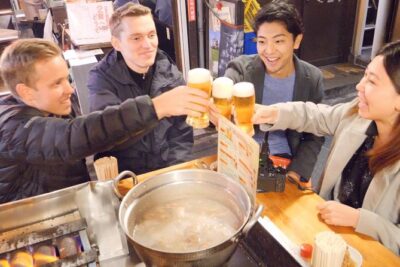
Tokyo Bar Hopping Tour in Shinjuku (All-You-Can-Drink + Dinner)
Read our review →
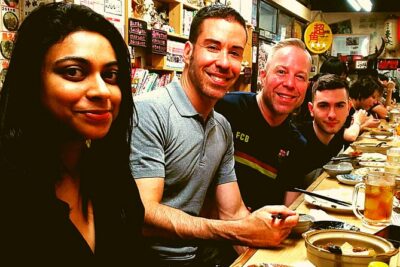
Deep Backstreet Osaka Tours (Option to add Dinner)
Read our review →
Deep Backstreets Walking Tour with Dinner Option
Read our review →
Sumida River: Japanese Traditional Yakatabune Dinner Cruise
Read our review →
Kyoto Gion Cultural Walk & Geisha Show with Dining Options
Read our review →Kyoto Gion Cultural Walk & Geisha Show with Dining Options
Read our review →
Tokyo Bay Yakatabune Dinner/Day Cruise with Japan Show and Drinks
Read our review →Browse the lists this tour appears in