
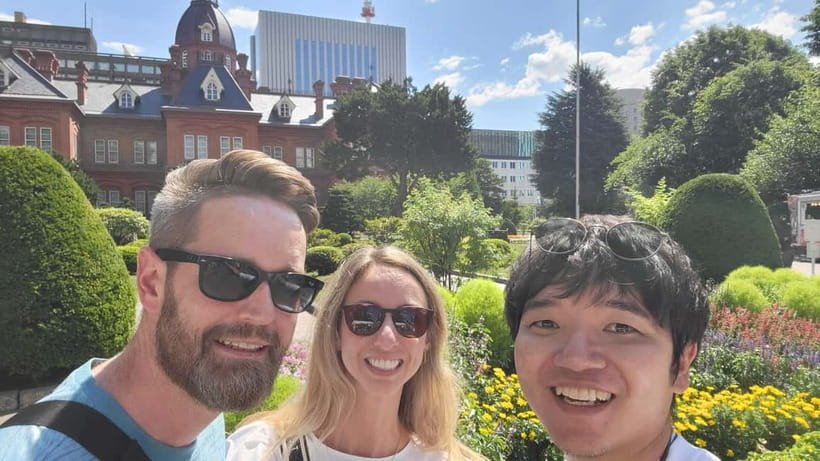
REVIEW · WALKING TOURS
Sapporo Highlights: Golden Route Morning Guided Walking Tour
Sapporo’s compact city center makes it easy to see the essentials on foot, and this two-hour morning route links the city’s best-known landmarks in a sensible order. You start at the TV Tower, walk through the civic core, and finish at the Red Brick Government Building, ready for lunch or your next stop.
I like the included TV Tower admission, since the view helps you understand Sapporo’s tidy street plan before you walk it. I also like the small groups, limited to eight people, and the personal guiding style reported with Tom and Iku. The main drawback is simple: 3.2 kilometers on foot can feel demanding in rain, snow, or heavy winter clothing, and the Clock Tower ticket costs about 200 yen extra.
In This Review
- Key points to know before you book
- Why this is a smart first morning in Sapporo
- Beginning under the TV Tower
- City Hall and the question of Sapporo’s future
- The Clock Tower’s quirky place in Sapporo
- Walking Kita-1-Jou Dori
- Aka-Renga Plaza and the red-brick story
- What the guides add to the walk
- Price, pace, and what you receive
- Weather, shoes, and the 3.2-kilometer reality
- Who will get the most from this experience
- Is the morning walk worth booking?
- FAQ
- How long is the Sapporo Highlights walking tour?
- Where does the tour begin?
- Where does the tour finish?
- Is admission to Sapporo TV Tower included?
- Do I need to pay separately to enter the Clock Tower?
- What languages are available, and how large is the group?
Key points to know before you book
- TV Tower entry is included: Begin with a high view over central Sapporo before walking at street level.
- The route covers major landmarks efficiently: See City Hall, the Clock Tower, Kita-1-Jou Dori, Aka-Renga Plaza, and the Red Brick Government Building.
- Small groups keep it personal: The tour accepts no more than eight participants, with some departures feeling almost private.
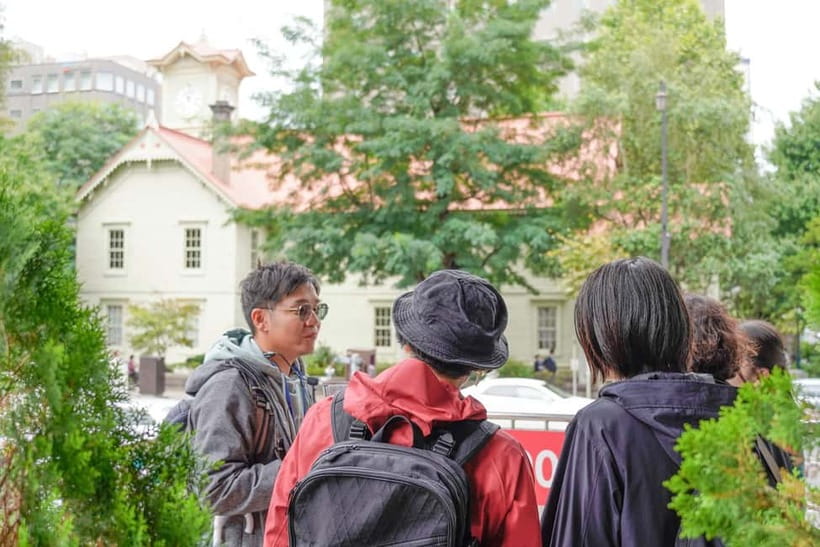
- Tom and Iku receive strong praise: Their friendly manner, clear English, local stories, and practical recommendations add real value.
- The tour is short but active: Allow two hours for about 3.2 kilometers, with comfortable shoes and weather protection.
- The finish is useful: You end at the Red Brick Government Building, close to central sights and onward city exploring.
Why this is a smart first morning in Sapporo
I see this walk as an orientation tour rather than a full historical survey. In two hours, you get a working map of downtown Sapporo, a few central stories, and a guide who can help you decide what to do next.
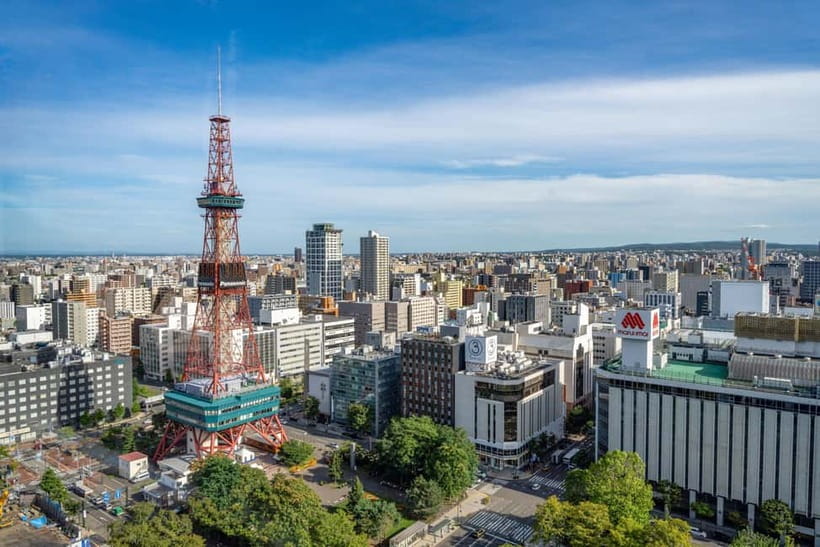
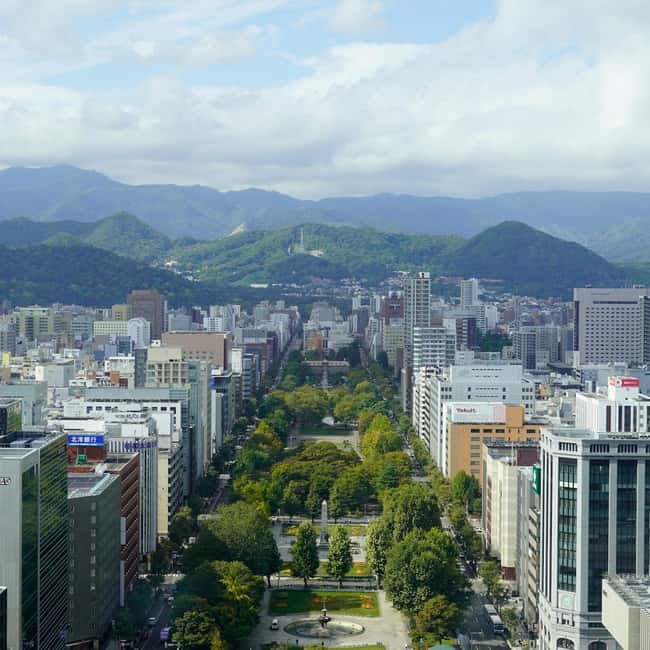
That matters in a city built on a broad, orderly grid. From the ground, the streets can seem similar, especially if you arrive after dark or during a snowy season. Starting above the city at the TV Tower gives you a quick sense of direction before you begin walking between the main public buildings.
The timing is also useful. A 10:00 start leaves much of the day open. After finishing around noon at the Red Brick Government Building, you can continue sightseeing, find lunch, or use the guide’s recommendations to plan the afternoon.
The tour works best during your first day or two in Sapporo. You will recognize the Clock Tower and government buildings later, and the explanations about roads, street trees, and city planning can make the center feel less like a collection of isolated photo stops.
More walking tours in Sapporo:
- Sapporo Private Tour with a Local – Highlights & Hidden Gems
★ 5.0 · 91 reviews - Sapporo: The Indigenous Ainu People & Jozankei walking tour
★ 4.9 · 25 reviews - Sapporo: Custom Highlights and Hidden Gems Tour with a Local
★ 4.9 · 21 reviews
Beginning under the TV Tower
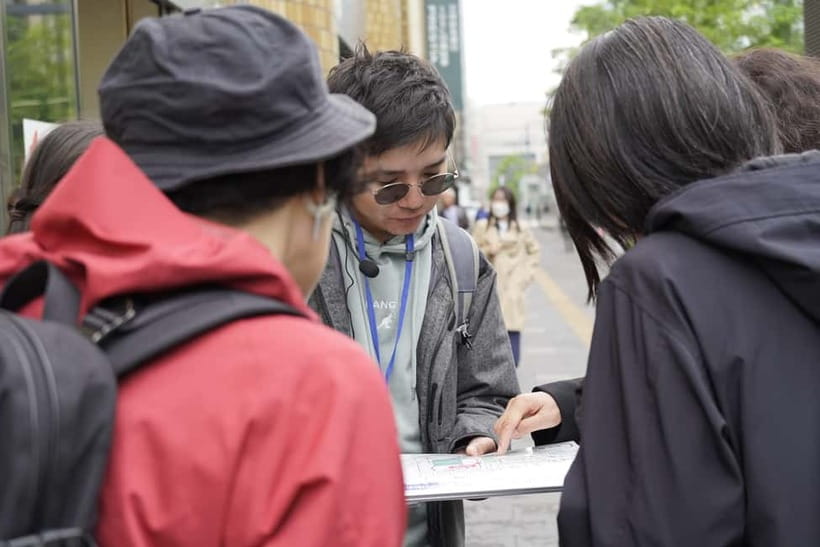
Meet the guide at ground level, beneath Sapporo TV Tower. Look for a board marked KAPPO SAPPORO. This is an important practical detail, since the tower area can be busy and you do not want to waste the opening minutes searching.
The TV Tower is more than a meeting point. You receive admission, then spend about 35 minutes on a guided visit and photo stop. From above, you can get your bearings across central Sapporo and see the straight lines of the city’s main streets.
I especially like this choice as the opening stop. A guide can point out how the central district fits together, then connect what you see from the tower to the walk that follows. The view also gives you a better sense of scale than a street map alone.
Do not expect a long tower visit with time for every part of the attraction. The tour has a tight schedule, so the point is orientation and a clear city view, not an extended stay. If you want to linger at the tower, you may need to return on your own.
City Hall and the question of Sapporo’s future
After leaving the tower, you walk for about 10 minutes to Sapporo City Hall. The visit here lasts roughly 20 minutes, with commentary and sightseeing rather than a lengthy indoor tour.
This is where the walk moves beyond a simple checklist of famous buildings. The guide uses the city’s growth to raise a useful question: has modern Sapporo become what its founders imagined about 200 years ago?
That kind of question gives the city a human scale. You are not only looking at a building. You are thinking about how a planned settlement became Hokkaido’s major city, and how its original goals still appear in the roads, public spaces, and trees around you.
The City Hall section should appeal to you if you like context. If your ideal tour means entering every building or spending a long time inside museums, this stop may feel brief. It is better understood as a guided pause in the city center, where the streets themselves become part of the story.
The Clock Tower’s quirky place in Sapporo
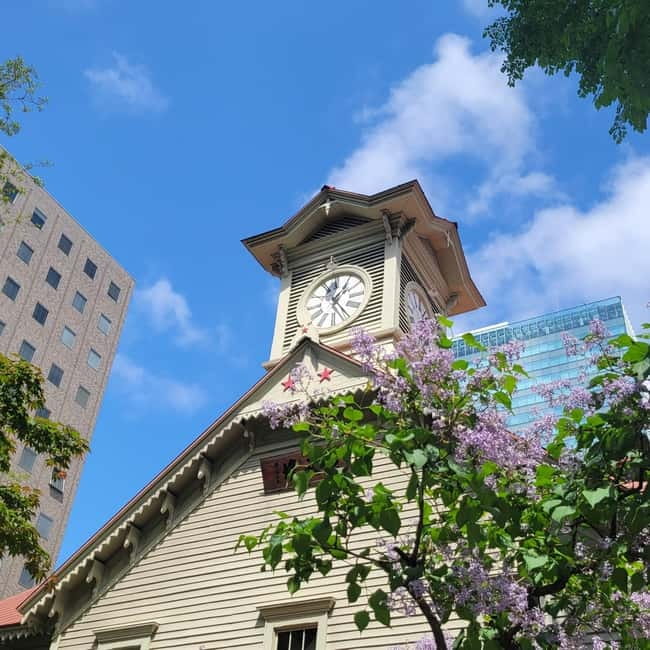
The Sapporo Clock Tower comes next, after about five minutes on foot. You have around 15 minutes here for a photo stop, a visit, guided explanation, and a pass-by.
The Clock Tower is one of Sapporo’s most familiar sights, but its fame can create a small surprise. The building is not enormous, and its position amid modern downtown streets means the experience is more about symbolism and history than grand scale.
That is exactly why a guide helps. Tom and Iku are praised for explaining the stories behind the main sights, and the Clock Tower is a place where a few well-chosen details can make a quick stop more rewarding than simply taking a picture and moving on.
Entry is not included. The additional charge is about 200 Japanese yen, a modest cost, but you should carry some cash or be ready to pay separately if you want to go inside. The tour schedule also means you should not expect a long independent visit.
For me, the Clock Tower works well as part of this route because it is one piece of a larger picture. You see it after the TV Tower and City Hall, then continue through the streets toward the former political center of Hokkaido.
A few more Sapporo trips to weigh up
- Kyoto Early Morning Tour with English-Speaking Guide
★ 5.0 · 1,427 reviews - Kyoto: Early Morning Tour with English-Speaking Guide
★ 4.9 · 1,128 reviews - Kanazawa: World Heritage Shirakawa-go Morning Guided Tour
★ 4.9 · 988 reviews - Nara Early Morning Tour (Kyoto or Osaka Departure Available)
★ 5.0 · 676 reviews
Walking Kita-1-Jou Dori
From the Clock Tower, the group walks for about 10 minutes to Kita-1-Jou Dori. The visit and guided walk here take around 10 minutes.
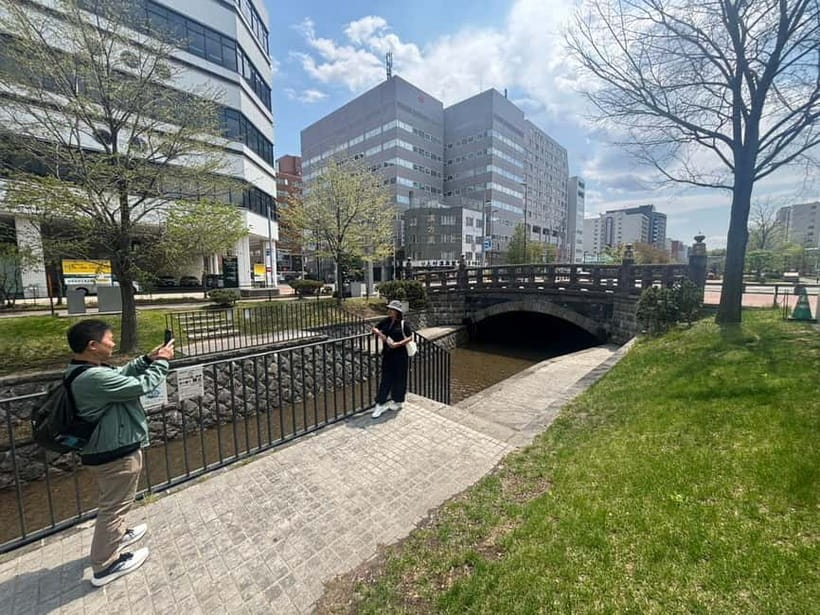
This may be the least famous stop by name, but it is one of the more useful parts of the experience. The tour asks you to notice what is underfoot and overhead: the shape of the roads, the spacing of the streets, and the city’s trees.
That approach helps you read Sapporo as a planned city. Rather than rushing from one monument to another, you get a sense of how the center connects. The guide can also answer questions as you go, which is more useful than trying to absorb a long speech at one fixed point.
This part is weather-dependent in the practical sense. On a clear day, the walk should feel easy and pleasant. On a rainy or snowy morning, the open street time may be the hardest section. Several guides have kept the tour engaging in bad weather, but good shoes, a rain jacket, and warm clothing still matter.
Aka-Renga Plaza and the red-brick story
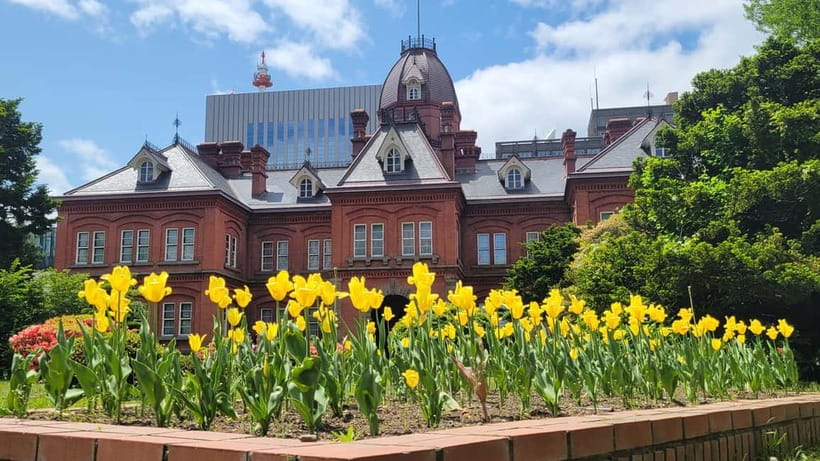
The route then continues on foot for about 10 minutes before a 15-minute visit and photo stop at Aka-Renga Plaza. The name refers to the red-brick setting, which leads naturally to the final stop, the Red Brick Government Building.
Here, the focus shifts from city planning to Hokkaido’s political past. The red brick buildings recall the period when the region was being organized and developed, and the guide connects those walls with the pioneer spirit of early Hokkaido.
You will get more from this stop if you pay attention to the setting around the building, not just the façade. The tour’s central idea is that history also remains in street lines, trees, and public spaces. Aka-Renga Plaza helps tie those pieces together.
The route ends at the Hokkaido Government Office, also called the Red Brick Government Building or Former Hokkaido Government Office. This is a satisfying finish because the building brings together the themes introduced earlier: planning, government, development, and the changing identity of Sapporo.
What the guides add to the walk
The strongest part of this experience is the guide’s role. Tom is repeatedly praised for a friendly manner, good English, useful local information, and a relaxed pace. Iku is also praised for making rainy walks engaging, explaining Sapporo’s past clearly, and offering practical suggestions for restaurants and a sento.
Those details matter. A two-hour route can easily become a rushed march if the guide only points at buildings. Here, the best version of the tour sounds more like a conversation, with time for questions and a few stories that you would probably miss alone.
Group size changes the feel. With a maximum of eight people, the guide can respond to individual interests. One departure had only one participant, while another group of four felt almost private. You should not count on having the guide to yourself, but the small format gives you a better chance to ask about food, neighborhoods, baths, or the rest of your Sapporo plans.
The guides speak English and Japanese. If you book in English, the available guide may be Tom, Iku, or another member of the team, so treat the named guides as examples rather than a guarantee.
Price, pace, and what you receive
At $36 per person, the tour is priced reasonably for a small-group city walk that includes admission to Sapporo TV Tower. The ticket matters because the tower is the one paid attraction built into the route.
You still pay about 200 yen if you enter the Clock Tower. Food and drinks are also separate, and this is not a tasting walk. Bring your own drink, especially in cold or dry weather, since the route stays outdoors for much of its two hours.
The value comes from the combination of access, structure, and interpretation. You could walk between these sights without a guide, but you would need to organize the order yourself and research the city’s story in advance. The tour saves that planning time and gives you a clear introduction at the start of your stay.
The short duration is both a strength and a limit. Two hours is enough to cover the key downtown sights without taking over your day. It is not enough for an in-depth visit to every building or a relaxed stop at each attraction.
Weather, shoes, and the 3.2-kilometer reality
Sapporo weather can change the feel of this tour. Rain did not prevent the guides from keeping past departures interesting, but wet streets and cold wind still make outdoor sightseeing harder. In winter, bulky clothes can make a modest walk feel longer than the distance suggests.
Wear comfortable shoes with good grip. Bring rain gear and a drink, and dress for the forecast rather than the calendar. The activity notes also suggest bringing a change of clothes, which is sensible if you are walking in rain or snow.
The route covers about 3.2 kilometers and requires a moderate level of fitness. Large bags, heavy luggage, and oversize items are not recommended. This is not a suitable choice for wheelchair users, and it is not intended for people who are unwell.
Pets, bikes, drones, smoking, alcohol, drugs, and party groups are not allowed. Assistance dogs are permitted. These rules keep a small walking group manageable, but they also mean you should arrive ready to walk without extra gear.
Who will get the most from this experience
I would choose this tour for a first visit to Sapporo, especially if you want history and orientation without giving up a whole day. Solo visitors and couples should benefit from the small group format, while families with older relatives may appreciate the measured pace, as long as everyone can manage the distance.
It is also a good fit for repeat visitors. One experienced Sapporo visitor learned new facts and gained fresh insight into the city’s layout, which shows that the walk is not only for people seeing the Clock Tower for the first time.
You will probably like it if you enjoy asking questions, learning why a place looks the way it does, and getting local suggestions for the rest of your stay. You may like it less if you want shopping, food sampling, long museum visits, or lots of free time at each landmark.
The tour is not designed as a strenuous hike, but it is still a real walking activity. If you have mobility concerns or are carrying luggage, choose another plan or contact the operator before booking.
Is the morning walk worth booking?
I would book Sapporo Highlights if you want a friendly introduction to the city’s center, especially at the beginning of a Sapporo visit. The included TV Tower entry, small group, clear route, and strong guide feedback make $36 a fair price.
Book it for the explanations, not just the landmarks. The Clock Tower and Red Brick Government Building are easy to photograph on your own, but a good guide gives the roads, trees, buildings, and political stories a useful connection.
Skip it if you need an indoor activity, cannot comfortably walk 3.2 kilometers, or want a tour focused on food. For everyone else, this is a compact and practical way to get oriented before spending the rest of the day exploring on your own.
Free cancellation is available up to 24 hours before the start, and you can reserve now and pay later. That flexibility helps if your Sapporo schedule depends on weather, but the most important decision is still your comfort with the walking distance and forecast.
FAQ
How long is the Sapporo Highlights walking tour?
The tour lasts two hours and covers about 3.2 kilometers on foot.
Where does the tour begin?
Meet the guide at ground level beneath Sapporo TV Tower. The guide will hold a board marked KAPPO SAPPORO.
Where does the tour finish?
The walk ends at the Hokkaido Government Office, also known as the Red Brick Government Building or Former Hokkaido Government Office.
Is admission to Sapporo TV Tower included?
Yes. Entry to Sapporo TV Tower is included in the tour price.
Do I need to pay separately to enter the Clock Tower?
Yes. Entry to Sapporo Clock Tower is not included and costs about 200 Japanese yen per person.
What languages are available, and how large is the group?
The tour is offered in English and Japanese, with groups limited to eight participants.
Just added around Sapporo
- Sapporo Winter : Asahiyama Zoo (Penguin Fun & Snowmobile)★ 5.0 · 28 reviews
- Sapporo: Otaru Asarigawa Ski Resort Day Trip with Gear★ 4.9 · 27 reviews
- Sapporo Walking Tour★ 4.9 · 17 reviews
- Sapporo: The Indigenous Ainu People & Jozankei walking tour★ 4.9 · 25 reviews
- Sapporo: Furano Lavender & Biei Blue Pond Tour with Lunch★ 4.6 · 13 reviews
- Sapporo TV Tower Admission Ticket★ 4.7 · 21 reviews
- Sapporo: Furano Flower Sea & Biei Blue Pond Tour w/ Pickup★ 4.0 · 40 reviews
- Sapporo: Private Customized Guided Tour★ 4.9 · 30 reviews
Walking Tours, compared.
Kyoto Geisha Walking Tour: Gion District & Hidden Gems
Read our review →
Tokyo Tsukiji Fish Market Food and Culture Walking Tour
Read our review →
Gion Magical Night Walking Tour with Geisha Trivia
Read our review →
Imperial Palace and Shogun Historical Walking Tour
Read our review →
Gion Geisha District Walking Tour – Stories of Geisha
Read our review →
Asakusa Walking Tour with Sensoji Temple Visit
Read our review →
Kyoto Gion Geisha District Walking Tour – The Stories of Geisha
Read our review →Browse the lists this tour appears in