
REVIEW · CYCLING TOURS
Private eBike Tour Exploring Fushimi with Torii Red Gate Ride
Fushimi Inari is famous for its endless tunnel of red torii gates, but reaching it by bicycle gives you more than a shrine visit. You pedal through Kyoto’s quieter lanes, pause at Sanjusangen-do’s thousand Buddha statues, and return beside the Kamo River instead of spending the whole morning in traffic.
I like two things right away: the private group size and the route’s variety. With two to six people per guide, you can ask questions and set a comfortable pace. You also get temples, a major shrine, small streets, a former Nintendo building, and riverside nature in one well-shaped outing.
The main consideration is time. Three and a half hours includes cycling between stops, so you will not have long for every site. Fushimi Inari can also be crowded near the entrance, and cycling in Kyoto still requires road awareness, even with an electric bicycle.
In This Review
- Key points to know before you book
- Why this Kyoto bike route works so well
- Starting at Kyoto Station and passing Nintendo’s old office
- Sanjusangen-do and its thousand seated figures
- Tofuku-ji, a shorter Zen temple pause
- Fushimi Inari and the famous red gates
- Returning beside the Kamo River
- What the $111.05 price buys you
- Guides, group size, and the personal touch
- Weather, clothing, and booking details
- Who should book this ride?
- Should you book the Fushimi e-bike tour?
- FAQ
- How long does the private e-bike tour last?
- Where does the tour start and finish?
- What is included in the tour price?
- What is the group size?
- Can children join the bicycle tour?
- Does the tour run in rainy weather?
Key points to know before you book
- Fushimi Inari by bicycle: Reach the shrine through quieter Kyoto streets, then walk the famous torii-gate paths with your guide.
- Sanjusangen-do gets a full hour: This is the tour’s most substantial temple visit, with time to see its remarkable thousand statues.
- A genuinely small private group: Two to six people join each guide, with an extra guide available for groups of seven to twelve.
- Several praised guides: Guides named in the tour feedback include Kaz, Yuichi, Tibor, JJ, Kay, Kas, and Y Yagyu.
- The Kamo River closes the loop: The return ride follows a calm embankment with wildlife and open views.
- Rain is not an automatic cancellation: Rain ponchos are supplied, though wet roads may make the ride less comfortable.
Why this Kyoto bike route works so well
Kyoto can feel slow by car and crowded on foot. A bicycle gives you a useful middle ground. You cover more ground than a walker, yet you can slip into side streets and narrow lanes that buses cannot use.
This route also avoids the common problem of a sightseeing tour that strings together only famous monuments. You see major places, but the connecting ride matters too. The quiet streets between Kyoto Station, the temples, Fushimi, and the Kamo River show you how the city fits together.
The e-bike helps keep the outing leisurely. You are not signing up for a hard athletic ride, but you still need to ride safely on the road without assistance. Children must be at least 10 years old, at least 145 centimeters tall, and able to handle a bicycle safely.
The private format is particularly useful for families and couples. Guides such as Tibor have been praised for keeping children interested and answering questions patiently. Adults also get room to ask about local customs, shrine rituals, or the city’s past without holding up a large group.
A few more Kyoto trips to weigh up
- Hidden Kyoto E-Biking tour
★ 5.0 · 1,843 reviews - Bike Tour Exploring North Kyoto plus Lunch
★ 5.0 · 1,087 reviews - Arashiyama Bamboo Forest & Hidden Gems Bike Tour (Early Bird)
★ 5.0 · 613 reviews
Starting at Kyoto Station and passing Nintendo’s old office
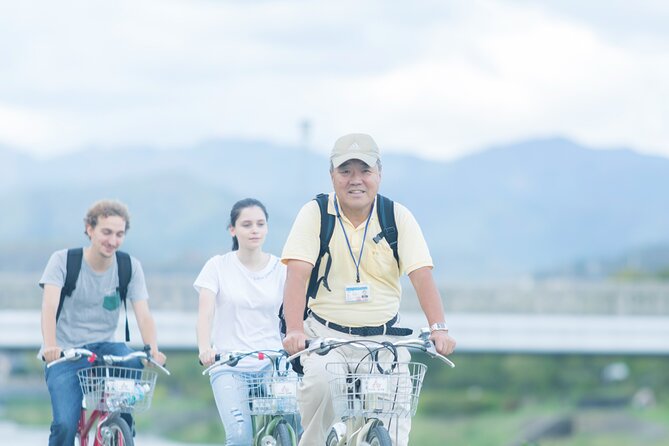
The meeting point is the Kyoto Cycling Tour Project at Kyoto Station Cycle Terminal, at 552-13 Higashiaburanokōjichō in Shimogyo Ward. The activity ends at the same place, which keeps your transport simple at the start and finish.
One early stop is the former building connected with Nintendo, one of Kyoto’s best-known companies. You spend about 10 minutes cycling past it, with no admission charge. It is a brief pause rather than a museum visit, so set your expectations accordingly.
I like this opening because it places modern Kyoto beside the temples that soon follow. The tour is not only about old shrines and polished heritage sites. You get a small reminder that Kyoto is also a working city and the birthplace of a global entertainment company.
The ride itself counts toward the three-and-a-half-hour duration. That means the exact amount of time spent pedaling depends on the group’s pace and road conditions. The tour is designed to be relaxed, but it is not a long stop-by-stop walking tour with unlimited time at every location.
Sanjusangen-do and its thousand seated figures
Sanjusangen-do receives about an hour, including time inside with the guide. This is the most focused temple visit on the route, and for many people it may be the most striking.
The temple is known for its long wooden hall and one thousand statues of Kannon, the Buddhist figure associated with compassion. The sight works best when you take your time. Rather than rushing through a small room of objects, you walk along a vast interior corridor filled with repeated figures.
Your guide explains the temple’s meaning and history while you are inside. That context helps you understand why the hall feels so powerful, even if Buddhist art is new to you. The quiet corridor also offers a useful change of mood after the road ride.
An hour is a sensible amount of time here. You can see the main interior, listen to an explanation, and have a moment to take in the scene without turning the temple visit into a long academic lesson.
Remember that this is a sacred place, not just a photo stop. Follow your guide’s instructions about where photography is allowed and keep your voice low inside. The attraction is the stillness as much as the statues.
Tofuku-ji, a shorter Zen temple pause
The route then reaches Tofuku-ji for about 15 minutes. The tour does not include an admission ticket here, and the stop is mainly for photographs and a look at the imposing Zen temple.
Fifteen minutes is enough to appreciate the setting and architecture, but not enough for a full temple visit. If Tofuku-ji is high on your personal list, you should plan a separate visit on another day rather than expect this tour to cover every corner.
That short stop still earns its place. It breaks up the ride before Fushimi Inari and gives you another style of Buddhist temple after Sanjusangen-do. The contrast is useful: Sanjusangen-do is famous for its long hall and statues, while Tofuku-ji gives you a briefer taste of a large Zen complex.
Your guide can also help you see details you might pass without noticing. Kas, JJ, and Y Yagyu are among the guides praised for combining local information with humor, which should make these short pauses feel more connected to the rest of the route.
Same city, a completely different kind of day:
- PERFECT KYOTO 1-Day Bus Tour
★ 5.0 · 13,518 reviews - Kyoto: Fushimi Inari, Kinkakuji, Bamboo Grove 1 Day Bus Tour
★ 4.8 · 4,316 reviews - Kyoto: Tea Ceremony in a Traditional Tea House in Kiyomizu
★ 4.9 · 3,519 reviews - Kyoto Geisha Walking Tour: Gion District & Hidden Gems
★ 4.7 · 3,273 reviews
Fushimi Inari and the famous red gates
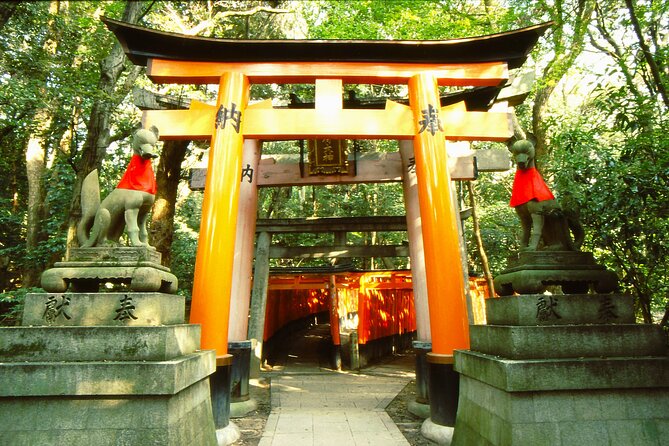
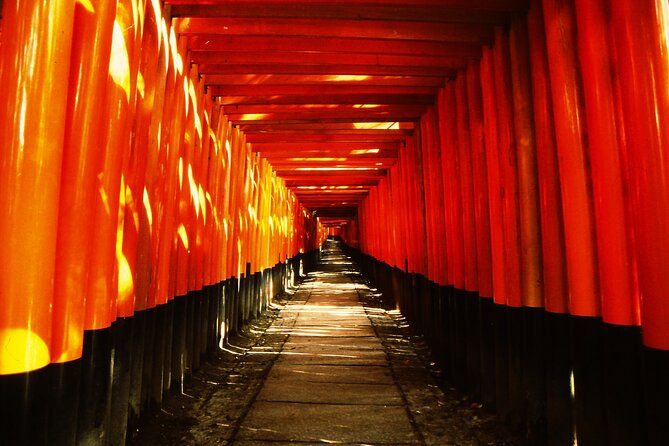
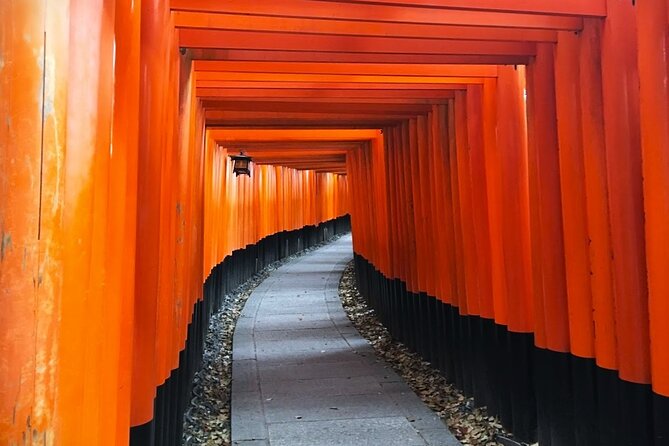
Fushimi Inari-taisha is the headline stop. The shrine is known around the world for its rows of vermilion torii gates climbing the wooded paths of Mount Inari.
The guide takes you along the thousand-gate paths and explains the shrine as you walk. You do not simply arrive, take one picture at the first gate, and leave. The walking portion gives you a chance to see how the gates form long corridors and how the shrine opens into a larger religious site.
The bicycle is useful here because it gets you to Fushimi without making the whole outing a public-transport transfer. You also approach through local streets rather than arriving already tired from a long walk or crowded train ride.
There is a practical limit. Fushimi Inari is one of Kyoto’s most popular sights, so the entrance area can be busy. A bicycle does not make the torii paths private, and you will be walking once you reach the shrine. Stay close to the guide, especially if your group includes children.
The tour gives this stop about an hour. That is enough for the main torii experience and an explanation, but not for a full climb to the upper mountain. If you want to walk every gate path to the summit, plan another visit and allow much more time.
The shrine also has shops and food stalls around it. Snacks are not included, but you can use the stop to try local specialties if time allows. Bring money for anything you want to buy, since the tour price covers the bike, guide, helmet, insurance, and listed equipment, not food.
Returning beside the Kamo River
After Fushimi Inari, you get back on the bicycles for the ride toward Kyoto Station. The return follows the peaceful embankment beside the Kamo River, with nature and wildlife along the way.
This is one of the route’s smartest choices. After two temples and a major shrine, a riverside ride gives you space to process what you have seen. The pace feels less like ticking off monuments and more like moving through the city under your own power.
The river section also provides a different view of Kyoto. You are not looking up at gates or statues. You are watching the banks, water, and open space while the city continues around you. It is a calm finish before returning the bikes.
Your guide may take photos during the outing. Yuichi was specifically praised for doing this, which is helpful when you want a picture of the whole group rather than another solo shot taken at arm’s length. Still, tell the guide if you prefer to keep the ride moving or spend more time at a particular stop.
What the $111.05 price buys you
At $111.05 per person, this is not the cheapest way to reach Fushimi Inari. You can visit the shrine on your own by train and spend less. The price makes more sense if you value the route design, private guiding, bicycle use, and the chance to combine several places without planning the connections yourself.
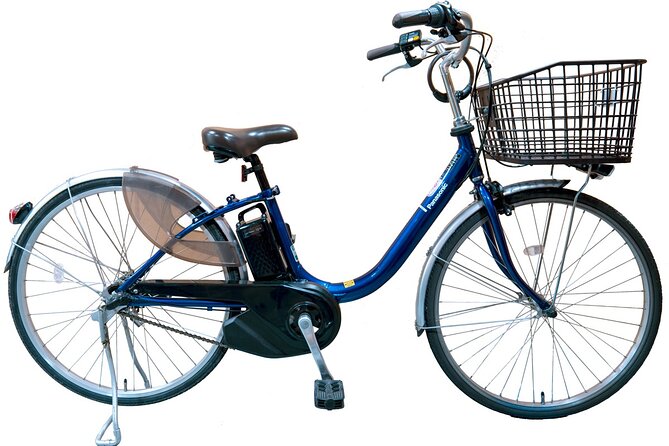
You receive an e-bike, helmet, accident insurance, rain poncho use, an original cycling map, and a licensed or certified English-speaking guide. Admission to Sanjusangen-do is included. Tofuku-ji has no admission charge on this route, and Fushimi Inari is also free to enter.
For a private group, the value improves when you are traveling with family or friends. You are paying for a shared experience, not just a seat on a bicycle. A guide can adjust explanations and the pace to suit your group, within the limits of the fixed schedule.
The price is harder to justify if you want a serious cycling workout or extensive time at each temple. This is a sightseeing ride, not a full-day exploration of Fushimi. It gives you a broad sample and a pleasant way to move between places.
The activity is often reserved about 24 days ahead. That suggests you should not leave it until the last minute if your Kyoto dates are fixed, especially since each guide normally takes only two to six people.
Guides, group size, and the personal touch
The guide can make or break a short private tour. The named guides connected with this experience include Kaz, Yuichi, Tibor, JJ, Kay, Kas, and Y Yagyu. Their praised qualities include warmth, humor, patience with children, strong local knowledge, and a willingness to help when problems arise.
One especially useful point is the guide’s role beyond formal sightseeing. JJ once spent about two hours helping with a small medical emergency and navigating the local healthcare system. That is not a service you should expect as part of the itinerary, but it shows the practical value of having a local person beside you when an unexpected problem appears.
Group size is capped at six people per guide. Groups of seven to twelve can arrange an extra guide without an added fee. A single-person booking is not accepted, so solo visitors would need to join someone else or choose another activity.
The small format also helps with road safety. You are not trying to keep up with a large line of cyclists. Even so, you must be comfortable riding on roads and following directions. If you rarely cycle, this may not be the right Kyoto tour for you.
Weather, clothing, and booking details
The tour operates in rain, and a poncho is available. That makes the activity more dependable during Kyoto’s changeable weather, but rain still affects comfort, visibility, and road conditions. Wear clothing that lets you pedal easily and shoes suitable for both cycling and walking through temple and shrine grounds.
Confirmation is sent within 48 hours of booking, subject to availability. The activity is near public transportation, and most people can participate if they meet the cycling requirements.
The supplied cancellation information includes two different conditions. One says you can request a refund at least three days before the tour date by 18:00 Japan time, while another says the experience is non-refundable and cannot be changed. Check the current terms carefully before paying, rather than relying on either rule alone.
If the minimum number of participants is not met and the operator cancels, you are offered another date or experience, or a full refund. This is separate from a cancellation you make yourself.
Who should book this ride?
I would choose this tour for a first or second visit to Kyoto when you want to see Fushimi Inari but also want more than one famous stop. It suits couples, families with older children, and small groups who like a guide but do not want to spend the day in a coach or on a packed walking tour.
It is also a good match if you enjoy seeing how a city connects. The route links Kyoto Station, the former Nintendo building, two Buddhist temples, Fushimi Inari, and the Kamo River in one continuous outing.
I would be more cautious if you have limited cycling confidence, want a long climb through every torii gate, or need a fully flexible schedule. The tour has a set route, a three-and-a-half-hour limit, and a fair amount of road riding.
Should you book the Fushimi e-bike tour?
Book it if you want a small, guided Kyoto outing that blends famous sights with quiet streets and a riverside finish. The strongest reasons are the private format, the useful mix of stops, and the guides’ repeated strengths in humor, patience, photography, and local insight.
Skip it if your priority is saving money, spending half a day at Fushimi Inari alone, or avoiding bicycles in traffic. For the right group, though, the $111.05 cost buys an easy way to connect several important Kyoto sights without handing the whole day over to a bus timetable.
FAQ
How long does the private e-bike tour last?
The tour lasts approximately three hours and 30 minutes. This total includes the time spent cycling between the different stops.
Where does the tour start and finish?
It starts at the Kyoto Cycling Tour Project, Kyoto Station Cycle Terminal, at 552-13 Higashiaburanokōjichō, Shimogyo Ward, Kyoto. The activity ends back at the same meeting point.
What is included in the tour price?
The price includes the bicycle, helmet, rain poncho use, accident insurance, an original cycling map, and a licensed or certified English-speaking guide. Admission to Sanjusangen-do is included. Snacks are not included.
What is the group size?
A guide accepts a minimum of two and a maximum of six guests. Groups of seven to twelve can arrange an additional guide without an extra fee. A one-person booking is not accepted.
Can children join the bicycle tour?
Children must be at least 10 years old, at least 145 centimeters tall, and able to ride a bicycle safely on the road without assistance.
Does the tour run in rainy weather?
Yes. The tour operates in rain, and rain ponchos are available for use.
Just added around Kyoto
- Private Guided Traditional Buddhist Cooking in Japan★ 5.0 · 16 reviews
- Kyoto: Gion Geisha District & Sake-in-Hand Walking Tour★ 5.0 · 37 reviews
- Your Private Vacation Photography Session In Kyoto★ 5.0 · 110 reviews
- Kyoto: Zen Meditation at a Private Temple with a Monk★ 5.0 · 25 reviews
- Traditional Japanese Washi Papermaking- Kyoto morning★ 5.0 · 77 reviews
- Kyoto Wagashi(Japanese sweets) Cooking Class near Fushimiinari★ 5.0 · 60 reviews
- Private Pewter Sake Cup Experience with a Kyoto Artisan★ 5.0 · 31 reviews
- Kyoto Private 6 hour Tour: English Speaking Driver Only, No Guide★ 5.0 · 88 reviews
Cycling Tours, compared.

3h Tokyo E-Bike Tour: Hidden Gems, and Local Life with guide
Read our review →
Arashiyama Bamboo Forest & Hidden Gems Bike Tour (Early Bird)
Read our review →
Hiroshima in a Nutshell: Morning Bike Adventure
Read our review →
5 Top Highlights of Kyoto Full Day Bike Tour (E-bike option)
Read our review →Browse the lists this tour appears in