
REVIEW · COOKING CLASSES
Osaka Okonomiyaki Cooking Experience!
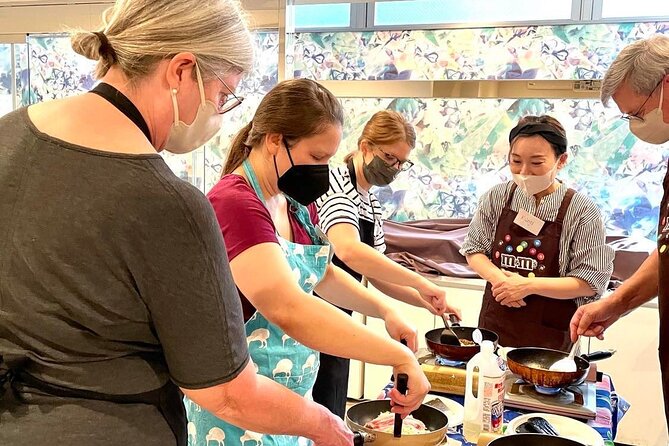
Osaka’s famous savory pancake is at its best when you make it yourself, then sit down with the people who taught you. This small class brings you into a hostel near Nagahoribashi, where Keiko, her mother, and invited Osaka locals turn dinner into a friendly cultural exchange. You learn the basic method, cook your own okonomiyaki, and leave with a dish you can repeat at home.
I like the maximum of six people, which gives you real hands-on time instead of a quick demonstration from the back of a crowded room. I also like the personal touches: Keiko’s mother makes the class aprons and small bags from used kimono material, and local Japanese participants join the conversation.
The main consideration is that this is a shared group kitchen, not a private restaurant meal. Cross-contamination is possible, and ingredients may contain refined sugar. The class lasts about two hours, so it suits an afternoon or early evening plan rather than a long, multi-course cooking workshop.
In This Review
- Key points to know before booking
- Why making okonomiyaki in Osaka matters
- Meeting Keiko near Nagahoribashi
- A two-hour class with real hands-on cooking
- The social side, with Osaka locals at the table
- Keiko, her mother, and the small personal details
- What you actually eat
- Is $49.55 a fair price?
- Who will enjoy this class most?
- Practical details that affect your choice
- My call: book it if you want more than dinner
- FAQ
- Where does the okonomiyaki cooking class meet?
- What time does the experience start?
- How long does the cooking experience last?
- Where does the experience finish?
- How many people can join?
- What food will I learn to make?
- Can dietary requests be accommodated?
- Are there allergy or ingredient concerns?
- Is the activity available at night?
- What is the cancellation policy?
Key points to know before booking
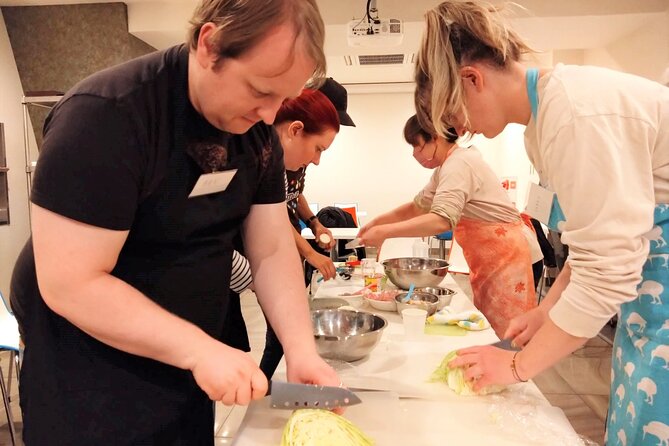
- Cook, rather than simply watch: You make Osaka-style okonomiyaki and miso soup with guidance from Keiko and her assistants.
- A genuinely small class: The group is limited to six people, allowing room for questions and personal help.
- Local conversation is part of the meal: Osaka friends are invited to cook, eat, and chat with the group.
- Useful for home cooks: The recipe is designed around simple methods and ordinary equipment, so you can recreate it at home.
- Dietary requests are possible: Vegan, vegetarian, and halal needs can be accommodated, but cross-contamination remains possible.
- Convenient timing: The class begins at 4 pm near Nagahoribashi subway station and ends where it starts.
Why making okonomiyaki in Osaka matters
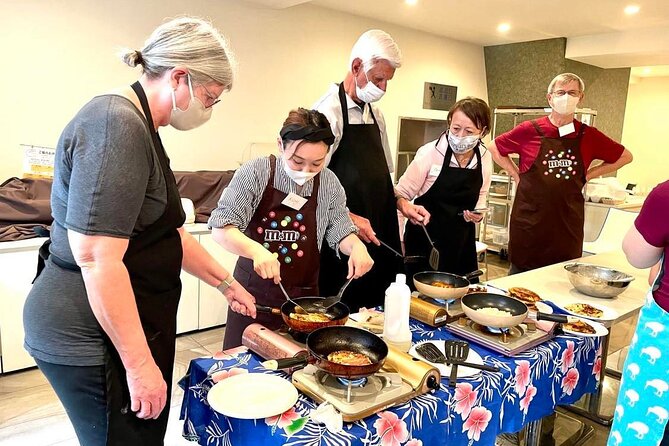
Okonomiyaki is often described as a Japanese pizza or pancake, but those labels only get you partway there. It is a savory, filling dish built around a batter and cabbage, with ingredients mixed in and cooked on a hot surface. The name points to the idea of cooking what you like, which helps explain why the dish adapts so well to different tastes and local ingredients.
In Osaka, okonomiyaki is commonly treated as comfort food and everyday family cooking. That makes this experience more useful than a polished demonstration aimed only at tourists. You are learning a dish people can make at home, adjust to suit the ingredients on hand, and share around a table.
Keiko has offered this activity since 2015. Her focus is not on making you perform a difficult restaurant technique. Instead, she teaches a straightforward process that you can carry back to your own kitchen. That practical approach is one of the class’s strongest features.
You also get context about the difference between Osaka-style and Hiroshima-style okonomiyaki. The class does not just hand you a plate and send you on your way. It explains how regional versions differ and why okonomiyaki has so many variations.
A few more Osaka trips to weigh up
- Osaka: Ramen and Gyoza Cooking Class in Dotonbori
★ 5.0 · 378 reviews - Osaka Cooking Class: Okonomiyaki &Japanese cuisines experience
★ 5.0 · 261 reviews - Ramen and Gyoza Cooking Class in Osaka
★ 5.0 · 202 reviews
Meeting Keiko near Nagahoribashi
The meeting point is 1-chōme-1-3 Higashishinsaibashi, Chuo Ward, Osaka, 542-0083. The activity is near public transportation and close to Nagahoribashi subway station, making it a sensible choice if you are staying around central Osaka.
The start time is 4 pm. That timing gives you a useful middle ground. You do not have to sacrifice the morning, and the cooking can serve as an early dinner or a relaxed evening meal. Keiko can sometimes arrange the activity at night, depending on the day, but you should not treat a nighttime start as automatic.
Plan enough time to locate the meeting point without rushing. The experience takes place in a hostel setting, and the exact atmosphere is more casual than a purpose-built cooking school. That is part of its charm, but it also means you should expect a social room rather than a formal studio.
At the end, you return to the same meeting point. There is no separate drop-off or final sightseeing stop, so you can easily continue your evening in Osaka after the meal.
A two-hour class with real hands-on cooking
The class begins with an introduction to okonomiyaki, its ingredients, and its place in Osaka food culture. Keiko speaks English well and explains the process clearly, which helps if you have little cooking experience or are unfamiliar with Japanese ingredients.
You then prepare the mixture and cook your own Osaka-style pancake. The small format matters here. With no more than six people, Keiko and her assistants can help you through the process rather than leaving you to guess when to turn or serve the dish.
The method is intended to be easy to follow at home. You do not need special equipment to repeat it, a useful point if you want to turn the class into a meal for friends after returning home. Several people have found the instructions simple enough to adapt with ingredients available in their own countries.
Miso soup is included as part of the cooking lesson. It gives the meal a second element and lets you learn more than one basic Japanese preparation. You then sit down and eat what you made, rather than treating the cooking as the entire event.
Some sessions also include mochi dessert and other small extras. These additions are not described as a fixed part of every class, so I would view them as pleasant possibilities rather than guaranteed courses.
The social side, with Osaka locals at the table
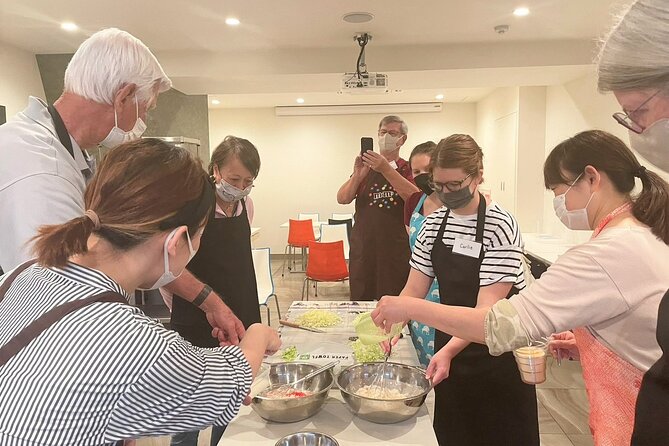
The cooking is only half of the appeal. Keiko often invites Osaka friends to join the session, giving you a chance to talk with local people instead of spending the whole class with an instructor alone.
That exchange works in both directions. You can ask about Japanese food, family cooking, and Osaka life, while local participants may enjoy practicing English and hearing about ingredients or food traditions from your home country. If you are studying Japanese, the class can also give you a relaxed place to try speaking without the pressure of a formal lesson.
The group mix can change from one date to another. You might cook with a couple, a family, solo participants, or people from several countries. One session had an especially international mix, with participants from New Zealand, Australia, England, and Singapore, along with a Japanese participant from Himeji.
That variety is useful if you enjoy conversation as much as food. It is less ideal if you want a quiet, private meal with no social element. The format clearly favors participation, questions, and shared conversation.
Same city, a completely different kind of day:
- Osaka Go Karting Tour with Funny Costume
★ 5.0 · 2,658 reviews - Osaka Castle: Museum and Tower Entry Ticket
★ 4.5 · 2,380 reviews - Osaka: Shinsekai Food Tour with 13-15 Dishes at 5 Eateries
★ 4.8 · 2,204 reviews - Osaka Food Tour: 13 Dishes at 5 Local Eateries
★ 5.0 · 2,149 reviews
Keiko, her mother, and the small personal details
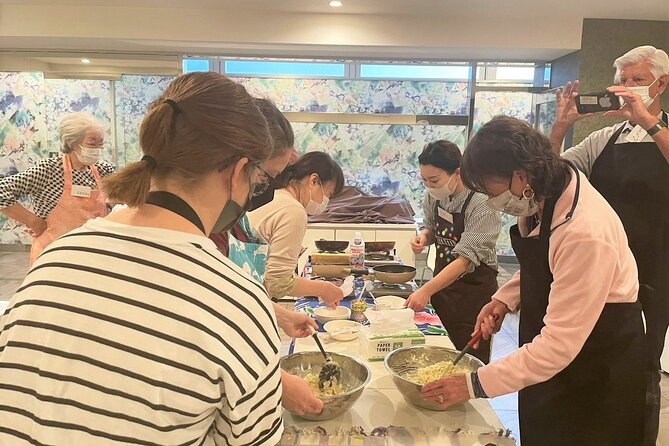
Keiko is the main host and teacher. Her mother often helps with the session, adding a warm family presence to the cooking. Assistants such as Sachiko may also help guide the group and join the meal.
The personal touches are memorable without being flashy. The aprons are made from kimono fabric, and Keiko’s mother has also made small souvenir bags from reused kimono material. These gifts are not the reason to book the class, but they add meaning because they connect the cooking lesson with Japanese craft and reuse.
Keiko’s teaching style is patient and conversational. She explains the history and regional differences of the dish, then lets you take part. You can ask questions throughout the process, including questions about how to adapt the recipe at home.
That balance suits people who want instruction without a rigid classroom feel. Families have also found the format workable, including a family with children aged eight and eleven. Still, children need to be comfortable taking part in a group cooking session, and the provided information does not specify a minimum age.
What you actually eat
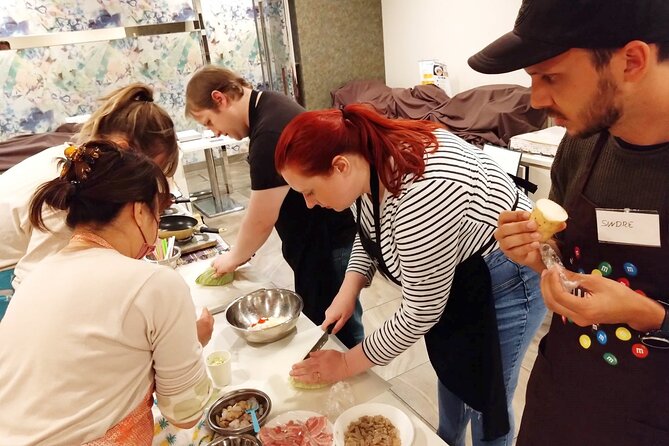
The central dish is Osaka-style okonomiyaki. You prepare and cook your own serving, then eat it with the group. The food is described as delicious and filling, but the greater value is that you understand how the dish comes together.
Miso soup is also taught and served. Depending on the session, you may receive mochi dessert or another small extra. The class is not presented as a broad survey of Japanese cuisine, so do not book it expecting sushi, ramen, tempura, or a full multi-course menu.
Instead, you get a close look at one important Osaka dish and the everyday role it can play. The recipe can be changed to suit local vegetables and other ingredients, which makes it practical for home cooking. You can even use the lesson as a starting point for your own version.
The experience provider says vegan, vegetarian, and halal requests can be accommodated. You should communicate your needs when booking, not wait until you arrive. Ingredients may contain refined sugar, and cross-contamination is possible during the group lesson, so people with serious allergies or strict dietary requirements should assess the class carefully.
Is $49.55 a fair price?
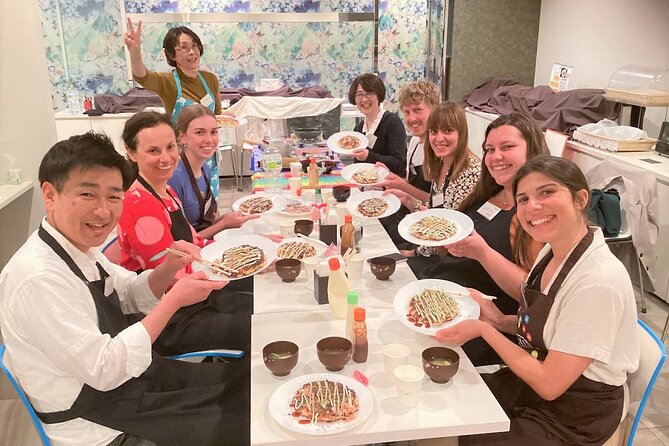
At $49.55 per person, this costs more than ordering an okonomiyaki at a casual Osaka restaurant. That comparison is fair, but incomplete. You are paying for about two hours of instruction, ingredients, the chance to cook your own food, miso soup, conversation with local people, and a small-group setting.
The six-person limit is important to the value. A larger class could offer the same dish for less, but you would likely receive less personal help and less time to ask questions. Here, the host can keep an eye on each cooking station and help you avoid turning the pancake too early or too late.
The recipe also has lasting value. You are not only buying one meal. You are learning a dish that needs no special equipment and can be adapted to ingredients at home. If you enjoy cooking for friends, the class may pay off well after your Osaka visit.
The price makes less sense if you only want to eat okonomiyaki and are not interested in learning or socializing. Osaka has plenty of restaurants for that. This class is best judged as a cooking lesson plus a cultural exchange, not as a budget dinner.
Who will enjoy this class most?
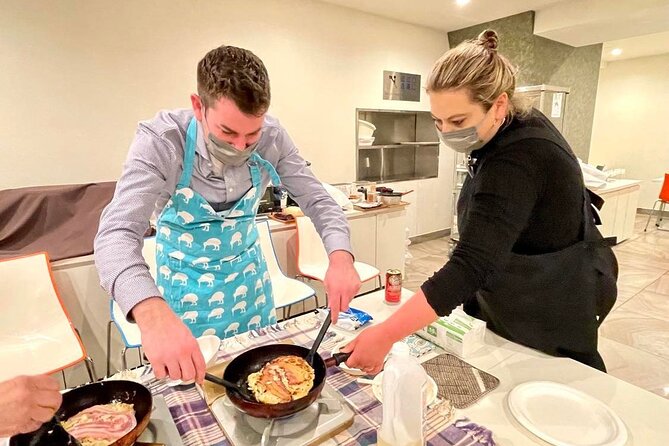
I would recommend it to first-time visitors who want a food experience with direct local contact. It is also a good fit for solo participants because the group format makes conversation easy, rather than leaving you alone at a restaurant table.
Couples and families can take part together. The activity gives everyone a job, and the meal at the end creates a natural moment to sit down and talk. The cooking is simple enough for beginners, based on the available descriptions and the host’s focus on an easy home method.
It also suits people who like practical souvenirs. Instead of taking home only a photo, you leave with a recipe and the ability to make your own version. The handmade kimono-fabric items add another small reminder of the afternoon.
You may want to skip it if your schedule is tightly packed around Osaka sightseeing. The class begins at 4 pm and takes about two hours, so it occupies the prime early evening period. You should also choose another food experience if you prefer a polished restaurant setting, a private lesson, or a class focused on several Japanese dishes.
Practical details that affect your choice
Confirmation is provided when you book, and the activity accepts a mobile ticket. The meeting point is near public transportation, but you should still allow time to find the hostel entrance and arrive ready for a 4 pm start.
The group can have up to six people. Smaller sessions are possible, and one date had only one student, creating a more personal conversation with Keiko and her assistants. You should not assume every session will have the same group mix, but the capacity keeps the class from becoming crowded.
Free cancellation is available if you cancel at least 24 hours before the local start time. Cancellations or changes made less than 24 hours ahead are not accepted for a refund. That policy is reasonable for a small class, but it means you should wait until your Osaka plans are firm.
There is no separate endpoint. You finish back at the meeting point, which makes it easy to plan a meal, walk, or subway trip afterward.
My call: book it if you want more than dinner
I would book the Osaka Okonomiyaki Cooking Experience if you want to learn one useful dish, meet local people, and enjoy a relaxed family-style afternoon. Keiko’s clear English, patient teaching, and long experience make the class approachable, while the six-person limit keeps it personal.
The strongest reason to go is the combination of cooking and conversation. You are not just watching a chef work. You are preparing the food yourself, learning how Osaka-style okonomiyaki differs from the Hiroshima version, and eating alongside people connected to Osaka.
Book with care if you have serious dietary restrictions, since cross-contamination is possible and ingredients may contain refined sugar. Also remember that the class is social and informal, not a private gourmet workshop.
For the right visitor, $49.55 buys a meal, a skill, and a warm connection to Osaka food culture. That is a better souvenir than another restaurant receipt.
FAQ
Where does the okonomiyaki cooking class meet?
The meeting point is 1-chōme-1-3 Higashishinsaibashi, Chuo Ward, Osaka, 542-0083, Japan. It is near public transportation and close to Nagahoribashi subway station.
What time does the experience start?
The scheduled start time is 4 pm.
How long does the cooking experience last?
The activity lasts approximately two hours.
Where does the experience finish?
The class ends back at the original meeting point.
How many people can join?
The activity has a maximum of six participants.
What food will I learn to make?
You will learn to prepare Osaka-style okonomiyaki and miso soup. Okonomiyaki is a savory pancake often associated with Osaka comfort food.
Can dietary requests be accommodated?
Vegan, vegetarian, and halal requests can be accommodated. You should provide those requests when booking.
Are there allergy or ingredient concerns?
Ingredients may contain refined sugar, and cross-contamination is possible because the activity uses a shared group lesson.
Is the activity available at night?
A nighttime session may be possible depending on the day. The stated start time is 4 pm, so confirm the available time for your chosen date.
What is the cancellation policy?
You can cancel at least 24 hours before the local start time for a full refund. Cancellations or changes made less than 24 hours before the experience are not accepted for a refund.
Just added around Osaka
- Samurai dress-up and shows, plus Tea Ceremony & Calligraphy★ 5.0 · 27 reviews
- Kyoto & Nara Private customized tour with English speaking Guide★ 4.5 · 99 reviews
- Well-balanced BENTO (lunch box) Cooking Class★ 5.0 · 35 reviews
- Volleyball in Osaka & Kyoto with Locals!★ 5.0 · 21 reviews
- Urban Canvas: Osaka Street Art Bike Tour★ 5.0 · 47 reviews
- OSAKA:Feel the Power! Learn Taiko Drum from Professionals★ 5.0 · 28 reviews
- 1.5〜2 Hours Traditional Kintsugi Work Shop in Namba Osaka★ 5.0 · 75 reviews
- Umami Town Street Food Tour★ 5.0 · 120 reviews
Cooking Classes, compared.

Ramen Cooking Class at Ramen Factory in Kyoto
Read our review →
Ramen & Gyoza Cooking Class in Tokyo with Local Supermarket Visit
Read our review →
Ramen Cooking Class at a Ramen Factory with Souvenir
Read our review →
Japanese Washoku Bento Small Group Cooking Class
Read our review →
Easy Ramen Cooking Experience in Kabukicho, Shinjuku
Read our review →
Ramen and Sushi Cooking Class with Sake Pairing Set in Tokyo
Read our review →Browse the lists this tour appears in