
REVIEW · NARA DAY TRIPS
Osaka & Nara in 1-Day by Private Van with Local Expert Guide
The most useful feature here is the private van and flexible route. In one afternoon and evening, you can move from Nara’s calm temple grounds and tame deer to Osaka’s bright signs, food stalls, arcades, and nightlife. Your pickup and drop-off can be in Kyoto, Osaka, or Nara, and they do not have to be the same city.
I like two things in particular: Daiki’s local knowledge and the chance to shape the day around your interests. I also like the easy transport, especially after a long temple visit or a late meal. The main drawback is time. Seeing both cities in roughly seven hours means short stops and limited time inside major sights.
In This Review
- Key points to know before booking
- Why this private afternoon works
- Nara Park, where the deer set the pace
- Todaiji and the giant Buddha
- Yoshikien Garden and the quieter side of Nara
- Osaka Castle, best treated as an exterior stop
- Osaka after dark: Dotonbori and Shinsaibashi
- American Village and Den Den Town
- Tsutenkaku, Shinsekai, and Osaka street food
- The red-light district note
- Transport, group size, and the real value of the price
- How Daiki shapes the day
- Who should book this experience?
- Should you book the Osaka and Nara private van tour?
- FAQ
- Where can the tour pick me up and drop me off?
- How long does the experience last?
- What time does the tour start?
- Is the tour private?
- What type of vehicle is used?
- Is Todaiji Temple admission included?
- Is dinner included?
Key points to know before booking
- Nara and Osaka in one private vehicle: You can cover two very different cities without changing trains or managing several station transfers.
- Daiki is the guide to request if available: He is praised for clear English, local stories, safe driving, restaurant help, and flexible planning.
- Todaiji costs extra: The temple admission is ¥800 per person, while Nara Park, Osaka Castle’s exterior stop, and most city walks are included.
- The tour starts at 1 p.m.: Expect Nara in the afternoon, Osaka after dark, and a possible dinner stop.
- The route is flexible but ambitious: Seasonal conditions and timing can change the smaller stops, and not every listed place is guaranteed.
- Best for small groups wanting comfort: The vehicle is a Nissan Serena for two to six people, or a Mini Convertible for one person.
Why this private afternoon works
This is not a slow, museum-by-museum tour. It is a fast orientation to two major destinations, with your own driver and guide handling the roads, parking, and transitions.
That matters in this part of Japan. Kyoto, Nara, and Osaka are close on a map, but each has its own transport patterns and busy areas. A private vehicle lets you leave your hotel, cruise between cities, and finish wherever dinner or your evening plans take you.
The usual pattern begins at 1 p.m. with Nara, then continues to Osaka as the daylight fades. That order makes sense. Nara Park and Todaiji are best seen while you still have daylight, while Dotonbori, Shinsaibashi, and Tsutenkaku are at their most atmospheric after sunset.
I would not book this expecting a relaxed full tour of every stop. I would book it if you want a well-organized first look at both places and prefer local guidance to a packed group bus.
More Nara Day Trips in Kyoto
- Kyoto/Osaka: Nara, Fushimi Inari Taisha, Arashiyama Bus Tour
★ 4.7 · 1,275 reviews - Osaka/Kyoto: Arashiyama, Nara & Fushimi Inari Shrine w/Lunch
★ 4.4 · 754 reviews - Kyoto and Nara Day Trip from Kyoto
★ 4.5 · 445 reviews
Nara Park, where the deer set the pace
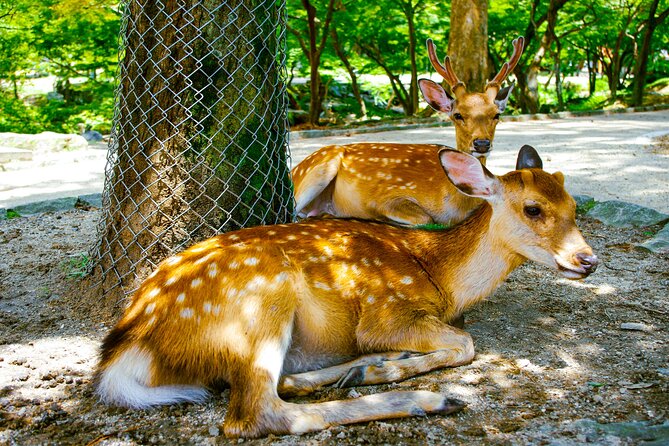
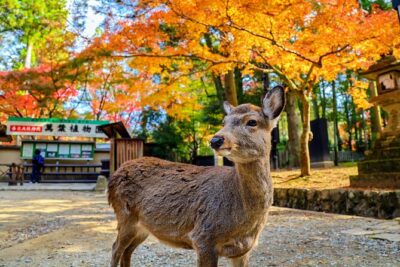
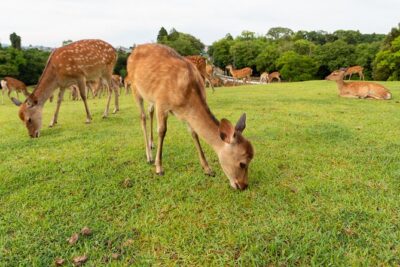
Nara Park is the first major stop, with about an hour planned here. The park is famous for its free-roaming deer, which wander near paths, temple grounds, roads, and open green spaces.
The deer are unusually comfortable around people. You can see them resting in the shade, moving through the temple area, or approaching visitors. Their calm behavior makes the park feel less like a formal wildlife attraction and more like a shared public space.
Your guide can help you get oriented and explain local customs. The most practical lesson is simple: keep an eye on anything edible and be ready for the deer to come close. The park is free, but feeding deer crackers are an additional purchase if you choose to buy them.
One hour is enough to meet the deer and get a taste of the park. It is not enough for a long, unhurried walk through every temple path. If Nara is your main reason for booking, ask to give the city more time and trim some Osaka stops.
Todaiji and the giant Buddha
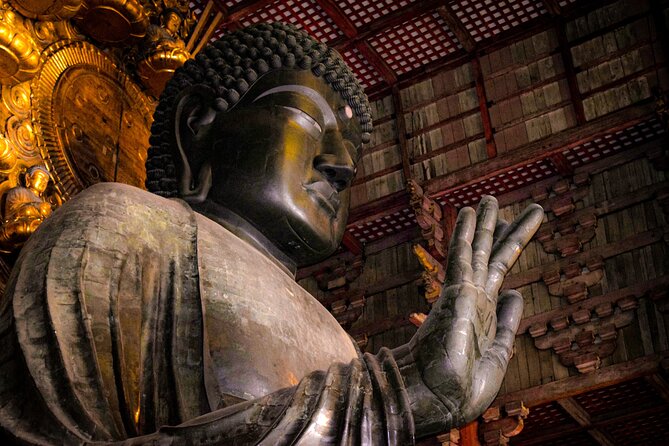
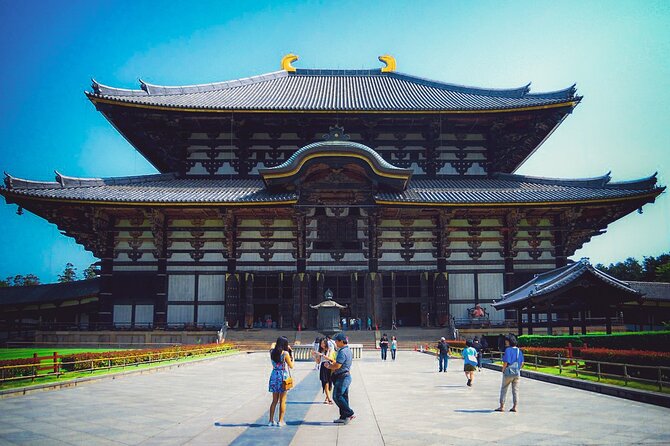
Todaiji Temple is the centerpiece of the Nara portion. The wooden main hall houses a huge seated Buddha and is one of Japan’s most important Buddhist sites.
The planned visit lasts about an hour, which is much better than a quick photo stop. You have time to enter the hall, look up at its enormous timber structure, and hear about the temple’s religious role and long past.
Admission is not included. The stated fee is ¥800 per person, so budget for that separately. Nara Park itself has no admission charge.
The guide’s explanations are important here. Without context, the giant Buddha can become a quick wow moment followed by a photograph. With a guide, you get more help understanding why the temple matters and how its architecture, statue, and Buddhist traditions fit together.
Yoshikien Garden and the quieter side of Nara
Yoshikien Garden is listed as a 15-minute stop. It is made up of several garden areas with seasonal flowers, trees, moss, and traditional Japanese design.
Fifteen minutes is brief, so think of this as a small visual pause rather than a full garden visit. It may be especially pleasant when seasonal plants are at their best, but the experience can vary with the time of year.
The garden gives the Nara section a useful change of mood. After the deer and the scale of Todaiji, a mossy garden offers something quiet and close-up. If gardens are high on your list, ask about extending this stop.
Another Nara point is the Todaiji Bell Tower. The stop is planned for about 10 minutes and brings you near an old bronze bell in Nara Park. The timing may not line up with the evening ringing, since the bell is traditionally rung at 8 p.m., while this tour begins at 1 p.m. Treat it as a quick historic sight, not a guaranteed bell-ringing experience.
Same city, a completely different kind of day:
- PERFECT KYOTO 1-Day Bus Tour
★ 5.0 · 13,518 reviews - Kyoto: Fushimi Inari, Kinkakuji, Bamboo Grove 1 Day Bus Tour
★ 4.8 · 4,316 reviews - Kyoto: Tea Ceremony in a Traditional Tea House in Kiyomizu
★ 4.9 · 3,519 reviews - Kyoto Geisha Walking Tour: Gion District & Hidden Gems
★ 4.7 · 3,273 reviews
Osaka Castle, best treated as an exterior stop
Osaka Castle is scheduled for about 20 minutes. It has been a symbol of Osaka for more than four centuries and is one of the city’s most recognizable sights.
The short time tells you what to expect: this is mainly a look at the castle and its grounds, not a detailed museum visit. The attraction is the exterior, the surrounding park, and the chance to hear about the samurai-era figures linked to Osaka’s past.
If you want to go inside the castle, confirm the plan with your guide before setting out. The listed stop includes no admission charge, but the short schedule does not suggest a full interior visit.
I like this stop as a visual introduction. You get the classic Osaka image without spending a large part of the day indoors. Still, history fans may prefer to trade one or two shopping districts for more castle time.
Osaka after dark: Dotonbori and Shinsaibashi
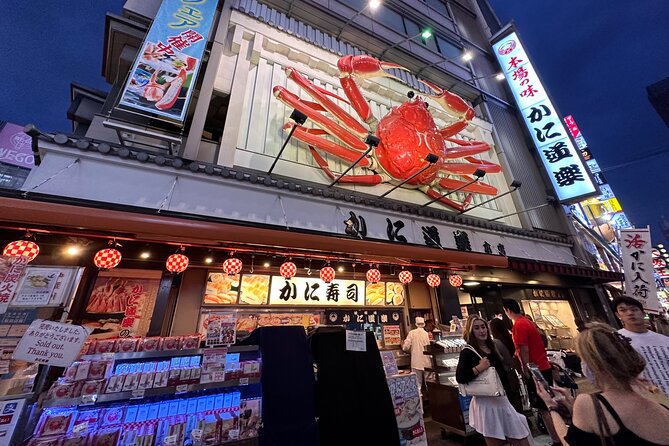
Dotonbori is where Osaka turns up the volume. The riverside district is known for large neon signs, the famous running man image, food shops, and crowds moving along the canal and nearby streets.
The planned stop is 15 minutes, which is enough for photos and a quick look. It is not enough to browse the full shopping area, eat at several places, and watch the city at leisure.
Nearby Shinsaibashisuji is a major shopping arcade. The listed visit is only five minutes, so you will mainly see the flow of people and get a quick sense of its scale. The area is often compared with Tokyo’s busiest pedestrian zones, but the mood here is distinctly Osaka: food-focused, direct, and informal.
This is one place where the van is useful and limited at the same time. It gets you close to the action, but the best way to understand Dotonbori is on foot. Ask your guide where to walk and where to meet again if you want more independent time.
American Village and Den Den Town
The route can include American Village, a youth-oriented area with a street culture often compared with Tokyo’s Shibuya and Harajuku. The district is associated with fashion, music, clubs, and a younger Osaka crowd.
Another possible stop is Den Den Town, Osaka’s electronics and anime district. It is often described as a more concentrated version of Tokyo’s Akihabara.
These areas add variety. You are not seeing only famous monuments, but also the modern neighborhoods that shape Osaka’s identity. The tradeoff is time. They are listed as flexible stops rather than guaranteed timed visits, and the guide may adjust the route for weather, season, traffic, or your priorities.
If you care about anime, electronics, street fashion, or nightlife, say so early. The private format gives the guide a chance to weight the afternoon toward those interests.
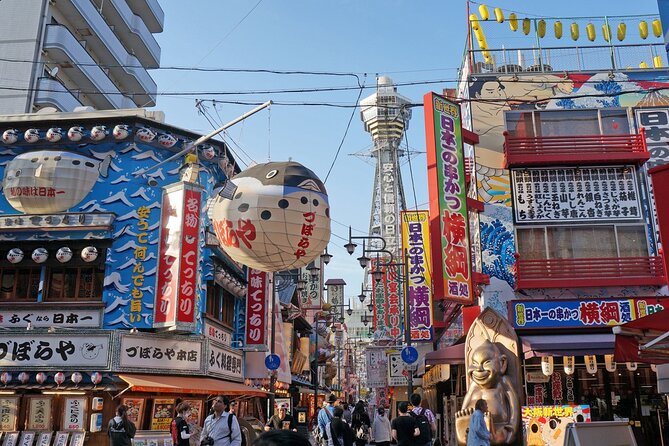
Tsutenkaku, Shinsekai, and Osaka street food
Tsutenkaku Hondori Shopping Street gives you a taste of Shinsekai, one of Osaka’s most recognizable old-style entertainment districts. The planned stop is about 15 minutes.
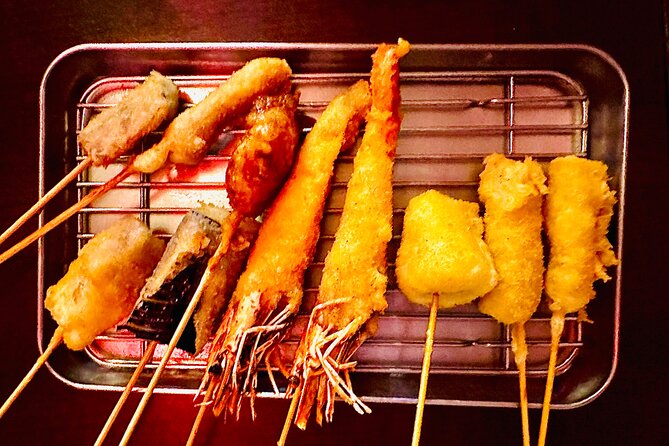
This is a good place to try Osaka specialties such as takoyaki, the hot octopus-filled balls sold at casual food stands. Your guide can help you choose a local place and explain what to order.
The area is more than a food photo opportunity. The signs, narrow shopping streets, and informal atmosphere show the Osaka style of enjoying a night out. You might find the tone rougher and less polished than central shopping districts, which is part of its appeal.
Dinner is not included, but dinner time and local restaurant guidance are part of the service. Several tour plans described a ramen meal or a typical Osaka restaurant, with the guide helping choose dishes and finding another option when the first choice did not work.
That can be one of the most valuable parts of the day. Food decisions in a new city take time, and a local guide can steer you away from a convenient but forgettable meal. You still pay for your own dinner, so set a food budget before you go.
The red-light district note
The description includes a visit to Osaka’s historic red-line district, presented in blunt terms. This is not a standard sightseeing stop for every group, and the material does not give it a fixed stop number or duration.
If you are uncomfortable with adult nightlife areas, tell the guide to skip it. The private format makes that easy. Families and visitors who want temples, food, shopping, and architecture can build a full day without this portion.
This is also an example of why you should discuss your interests before pickup. The route can be customized, but not every listed small site is assured.
Transport, group size, and the real value of the price
The price is listed as $300.61 per group of up to one, which is an unusual way to display a private tour price. Before booking, confirm how the final cost applies to your party size.
The vehicle is an air-conditioned Nissan Serena for two to six people. A solo participant may ride in a Mini Convertible. Fuel, highway fees, parking, and pickup and drop-off within Kyoto, Osaka, or Nara cities are included.
For a group sharing the cost, the value is easy to understand. You are paying for a private vehicle, a driver, an English-speaking local guide, parking, and the ability to start and finish in different cities. A train-based day may cost less, but it requires more planning and walking, especially when you are moving between distant neighborhoods.
The value is weaker if you want long visits at each attraction. The tour covers a lot, but its design is closer to a private highlights drive than a slow cultural day.
The experience lasts about 6 hours 30 minutes to 7 hours 30 minutes. Traffic, weather, seasonal conditions, and your choices can affect the final length. Most travelers can participate, service animals are allowed, and the tour is private for your group only.
How Daiki shapes the day
Daiki Fukashi is the guide name that appears most often in the supplied experience details. He is described as fluent in English, punctual, friendly, and a safe driver. His strengths are not limited to reciting facts. He can explain temple customs, Japanese history, Osaka food, and changes he has seen in the city while growing up there.
The strongest reason to request him is his ability to adjust the route. He has helped groups spend more time in Nara, find a ramen shop, choose local food, visit less obvious neighborhoods, and add a shrine event when the timing worked.
He also helps with photographs, which is a small but useful service when you are moving as a private group. One unusual detail is that he is also a DJ, and one tour included music during the drive. That will appeal to some people and not to others, so you can simply tell him the kind of ride you prefer.
Guide availability is not guaranteed from the information provided, so ask when booking if having Daiki matters to you.
Who should book this experience?
I would choose this tour if you have limited time in the Kansai region, want to combine Nara and Osaka, or dislike navigating crowded train stations. It is especially useful for families, older visitors, small groups, and anyone carrying luggage between cities.
It also suits people who care about local food and neighborhood atmosphere as much as famous sights. The guide’s restaurant advice and personal Osaka stories can add more value than another short photo stop.
I would hesitate if you want a slow day at Todaiji, a full Osaka Castle visit, or several hours shopping in Dotonbori. In that case, book Nara and Osaka on separate days, or use the private tour for one city only. The option to focus on just Osaka or just Nara is one of the tour’s best features.
Cancellation is free up to 24 hours before the local start time. Changes or cancellations inside that window are not accepted for a refund.
Should you book the Osaka and Nara private van tour?
Book it if your priority is seeing the main character of both cities in one day: deer and the giant Buddha in Nara, then castles, neon, street food, and nightlife in Osaka.
The tour earns its price through comfort, local guidance, parking, and flexibility. Its weakness is the schedule, since many Osaka stops last only 5 to 15 minutes. For the best result, choose your top three priorities before pickup and ask the guide to protect time for them.
If you want a broad, friendly introduction and a local guide who can handle the practical details, this is a strong choice. If you want depth at every temple and district, choose one city and slow down.
FAQ
Where can the tour pick me up and drop me off?
Pickup and drop-off are available anywhere in Kyoto, Osaka, or Nara cities. The pickup and drop-off cities can be different.
How long does the experience last?
The tour lasts approximately 6 hours 30 minutes to 7 hours 30 minutes.
What time does the tour start?
The listed start time is 1 p.m.
Is the tour private?
Yes. Only your group participates in the activity.
What type of vehicle is used?
Two to six participants ride in an air-conditioned Nissan Serena. For one participant, the vehicle may be a Mini Convertible.
Is Todaiji Temple admission included?
No. Todaiji admission costs ¥800 per person. Nara Park and the listed Osaka Castle exterior stop have no admission fee shown.
Is dinner included?
No. Dinner is not included, but dinner time and local restaurant guidance are provided. Lunch is also not included.
More 1-Day Tours in Kyoto
- PERFECT KYOTO 1-Day Bus Tour
★ 5.0 · 13,518 reviews - Kyoto: Fushimi Inari, Kinkakuji, Bamboo Grove 1 Day Bus Tour
★ 4.8 · 4,316 reviews - 10 Must-see Spots in Kyoto One Day Private Tour (up to 7 people)
★ 5.0 · 1,108 reviews - Kyoto 1 Day Tour from Kyoto
★ 4.0 · 582 reviews
Just added around Kyoto
- Private Guided Traditional Buddhist Cooking in Japan★ 5.0 · 16 reviews
- Kyoto: Gion Geisha District & Sake-in-Hand Walking Tour★ 5.0 · 37 reviews
- Your Private Vacation Photography Session In Kyoto★ 5.0 · 110 reviews
- Kyoto: Zen Meditation at a Private Temple with a Monk★ 5.0 · 25 reviews
- Traditional Japanese Washi Papermaking- Kyoto morning★ 5.0 · 77 reviews
- Kyoto Wagashi(Japanese sweets) Cooking Class near Fushimiinari★ 5.0 · 60 reviews
- Private Pewter Sake Cup Experience with a Kyoto Artisan★ 5.0 · 31 reviews
- Kyoto Private 6 hour Tour: English Speaking Driver Only, No Guide★ 5.0 · 88 reviews
Nara Day Trips, compared.
World Heritage Kyoto & Nara Uji Authentic Matcha Experience
Read our review →
Kyoto/Osaka: Nara, Fushimi Inari Taisha, Arashiyama Bus Tour
Read our review →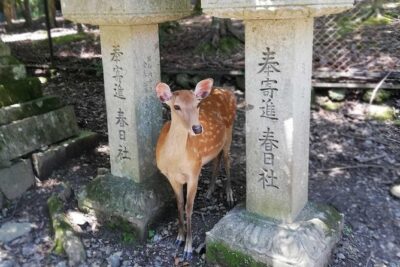
Nara Half Day Trip Walking Tour (Private Option Available)
Read our review →
Osaka/Kyoto: Arashiyama, Nara & Fushimi Inari Shrine w/Lunch
Read our review →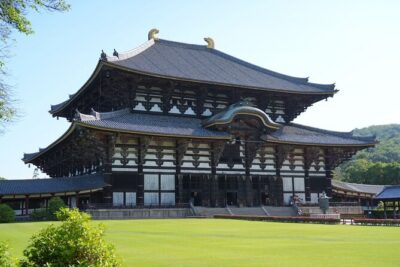
Nara Early Morning Tour (Kyoto or Osaka Departure Available)
Read our review →
Full Day Guided Tour to Kyoto and Nara from Osaka by Van
Read our review →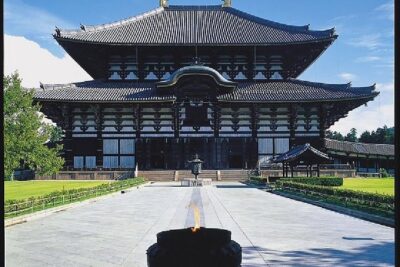
Browse the lists this tour appears in