
REVIEW · WALKING TOURS
Tokyo: Asakusa Walking Tour with Japanese Comedian
Asakusa is one of Tokyo’s best places for a first look at old Japan, and this tour gives the famous sights a human voice. Ryo, a local comedian with six years of experience driving rickshaws in Asakusa, leads you from the Tokyo Cruise station toward Senso-ji while explaining the area’s temples, shrines, statues, and customs. His English humor adds a personal twist to the usual sightseeing walk.
I like the small group limit of eight, which makes it easier to ask questions, and I like the free view of Asakusa from a nearby building before the main temple visit. The main drawback is that the route covers sights many visitors already plan to see, so the tour’s value depends on how much you want historical explanation and local perspective rather than new attractions. Ryo’s energy may also feel more calm than theatrical.
In This Review
- Key points to know before booking
- Why this short Asakusa walk is worth considering
- Meeting Ryo beside the Tokyo Cruise station
- Sumida Park and the opening city views
- Kaminarimon Gate and the first great photo stop
- Nakamise Shopping Street without a shopping detour
- Asakusa Shrine and the meeting of Buddhist and Shinto traditions
- Senso-ji, statues, and the stories behind the objects
- Ryo’s local background and comedy style
- The strongest reasons to book, and the limits
- Who will get the most from this Asakusa tour
- Should you book this $31 walking tour?
- FAQ
- How long does the Asakusa walking tour last?
- How much does the tour cost?
- Who guides the tour?
- What languages are available?
- Where does the tour meet?
- How early should I arrive?
- What places are included on the route?
- Does the tour include shopping or food stops?
- Is the tour wheelchair accessible and how large is the group?
Key points to know before booking
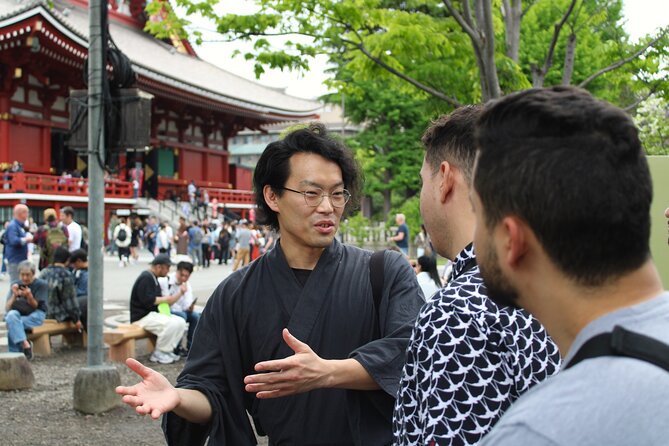
- Ryo brings two unusual skills: six years as an Asakusa rickshaw driver and experience as a Japanese standup comedian in English.
- The route links two faiths: you visit Buddhist Senso-ji and nearby Shinto Asakusa Shrine, with an explanation of how these traditions fit into Japanese life.
- The free viewpoint comes early: you get a look across Asakusa before walking through the major temple grounds.
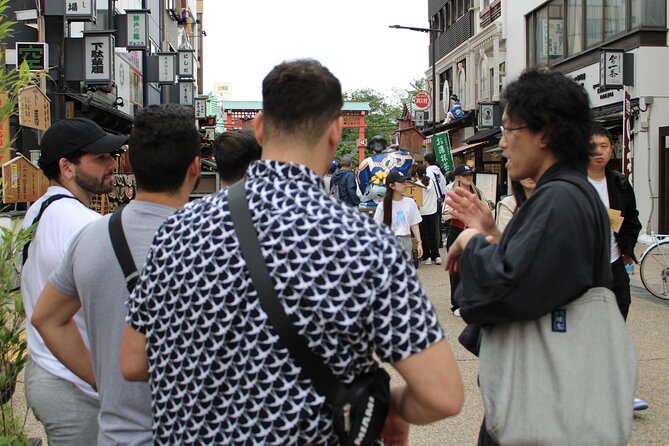
- The group stays small: no more than eight people, useful in crowded Nakamise Shopping Street.
- The tour is about context, not shopping: there is no food or souvenir stop, but Ryo can suggest places to visit afterward.
- Plan your arrival carefully: meet outside Tokyo Cruise one or two minutes from Asakusa Station, at least five minutes before departure.
Why this short Asakusa walk is worth considering
At $31 per person, this is not a bargain-priced stroll, but it is a reasonable fee for a small-group introduction to one of Tokyo’s most visited districts. You are paying less for admission, since the main sights are public religious sites, and more for a guide who can explain what you are seeing.
That distinction matters in Asakusa. You can walk through Kaminarimon Gate, follow Nakamise Shopping Street, and enter Senso-ji on your own. What is harder to supply yourself is the meaning behind the statues, the difference between a temple and shrine, and the story of how Senso-ji gained support from ordinary residents and powerful military leaders over the centuries.
I would think of this as a first-day orientation. It helps you recognize the main places, understand the basic customs, and decide where to return later. If you already know Senso-ji well and have read about Asakusa’s religious sites, you may find the route familiar. The added value comes from Ryo’s explanations and conversation.
The tour lasts 90 minutes, though one account describes spending closer to two hours with the guide. That may depend on group size, questions, and the pace on the day. Keep a little room in your schedule rather than booking a tight lunch or train connection immediately afterward.
More Walking Tours in Tokyo
- Tokyo Tsukiji Fish Market Food and Culture Walking Tour
★ 5.0 · 3,184 reviews - Tokyo: Imperial Palace and Shogun Historical Walking Tour
★ 5.0 · 2,251 reviews - Tokyo: Shinjuku Local Bar and Izakaya Guided Walking Tour
★ 4.9 · 1,794 reviews
Meeting Ryo beside the Tokyo Cruise station
The starting point is in front of Tokyo Cruise, the water bus station near Asakusa Station on the Tokyo Metro Ginza Line. The walk from the station takes only one or two minutes, but Asakusa has several transport points and busy streets, so I would not leave the meeting point until the last second.
You need to arrive five minutes early. The walk begins on time, and the guide cannot wait for late arrivals or collect you from a hotel. You also finish at the main hall of Senso-ji rather than being escorted to a station.
The location is practical. Starting near the river lets you see Asakusa from a wider angle before entering the temple district. It also gives Ryo a natural place to point out two recognizable landmarks: Tokyo Skytree and the Asahi Beer Company building.
Since the group is capped at eight people, you should have a better chance to hear explanations than on a large bus tour. The activity is listed as wheelchair accessible, though the detailed route and crowd conditions can still affect ease of movement around the temple area.
Sumida Park and the opening city views
The walk begins around Sumida Park, where Ryo introduces the wider setting of Asakusa. This is useful because the district can feel like a collection of gates, shops, statues, and worship halls when you first arrive. A guide can help you connect those pieces before you reach Senso-ji itself.
One appealing feature is a free view of Asakusa from the top of a nearby building. This is not a ticketed observation deck or a major attraction, but it gives you a chance to see the neighborhood from above without paying extra. You can take in the relationship between the riverfront, temple grounds, modern towers, and commercial streets.
I like this early viewpoint because it gives scale to the walk. Senso-ji is famous, but Asakusa is more than one temple gate. The views of Tokyo Skytree and the Asahi Beer Company building also show the contrast that defines the area: old religious landmarks beside modern city symbols.
Do not expect a long stop here. The tour is only 90 minutes, so the viewpoint works as a quick orientation rather than a separate sightseeing session. If you want extensive photos or time to linger by the river, return on your own after the guided portion.
Kaminarimon Gate and the first great photo stop
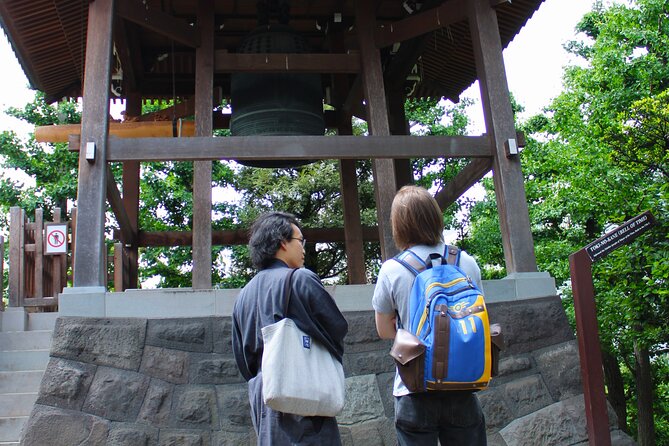
From the park area, Ryo leads you to Kaminarimon, or Thunder Gate, the best-known entrance to Senso-ji. Its large lantern and imposing guardian figures make it an easy place to understand why this is the visual symbol of Asakusa.
The gate is also where the crowds become more noticeable. It is a natural meeting point and a popular photo stop, so the small group size helps. Ryo can keep the walk moving while still giving you time to look and take pictures.
This is a place where a guide’s details can change your experience. Instead of treating the gate as a quick backdrop, you learn how it fits into the approach to Senso-ji. The stop also sets up the difference between the public face of a famous site and the quieter religious spaces nearby.
If your main goal is uninterrupted photography, a guided group will impose some timing. You will not have unlimited time at each landmark. The tradeoff is that you get a clear route and an explanation without needing to research every feature yourself.
Same city, a completely different kind of day:
- Mt Fuji and Hakone 1-Day Bus Tour Return by Bullet Train
★ 5.0 · 26,383 reviews - 1-Day Tokyo Bus Tour
★ 5.0 · 14,250 reviews - Tokyo: TOKYO SKYTREE® Admission ticket
★ 4.5 · 11,192 reviews - Tokyo: teamLab Planets TOKYO Digital Art Museum Entry Ticket
★ 4.6 · 9,779 reviews
Nakamise Shopping Street without a shopping detour
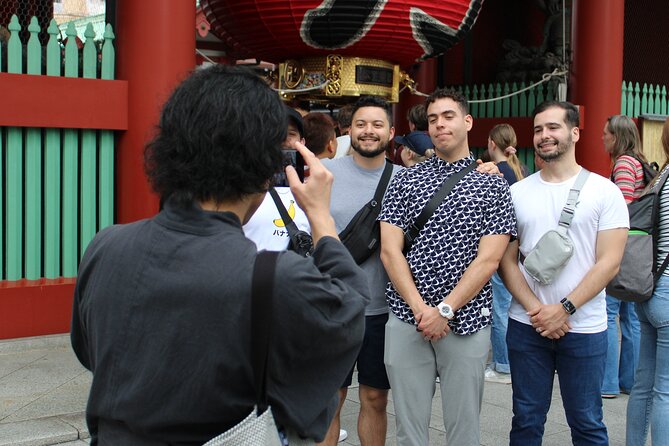
Nakamise Shopping Street leads from Kaminarimon toward Senso-ji. It is lined with shops and is one of the most recognizable approaches to the temple. Ryo explains the origin of Senso-ji here, using illustrations to make the story easier to follow.
This is not a food tour or souvenir walk. The group does not stop to shop, eat, or browse at length. That may disappoint you if you want to sample snacks or hunt for gifts during the tour, but it protects the short itinerary from turning into a sales stop.
I see that as a useful boundary. You get an introduction to the street and its role in the temple approach, then you can return later with your own time and money. Ryo can recommend shopping options after the tour, including places connected with local specialties. One person used his advice to buy souvenirs and try a highly praised melon pan.
Nakamise can be crowded, and a guide cannot make the street quiet. Keep your belongings close and stay aware of the group. The value here lies in understanding what you are passing, not in having a private shopping experience.
Asakusa Shrine and the meeting of Buddhist and Shinto traditions
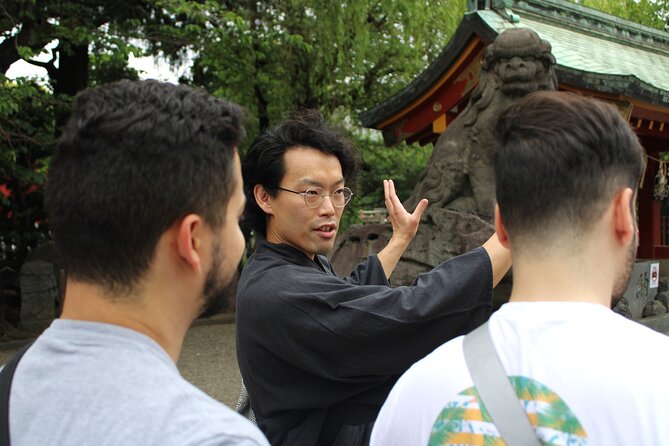
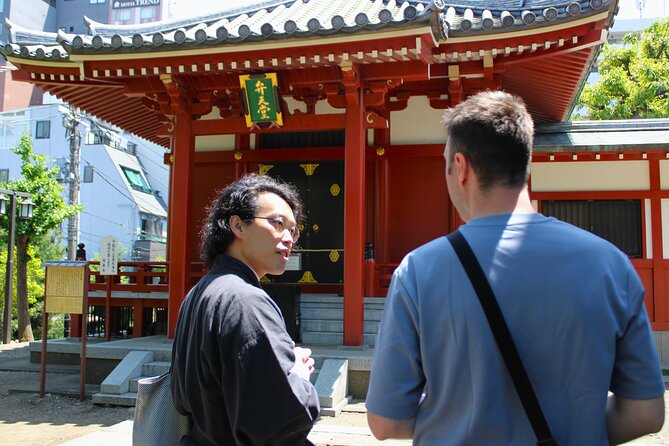
One of the most useful parts of the route is the visit to Asakusa Shrine beside Senso-ji. Asakusa lets you see a Buddhist temple and a Shinto shrine close together, which gives Ryo a clear setting for discussing Japanese religious life.
You will learn more about how Japanese people view and use these traditions. The explanation is especially helpful if you are visiting Japan for the first time and are unsure why a shrine and temple may appear side by side, or how their customs differ.
This stop adds substance to the walk. The large gates and lanterns are easy to photograph, but the religious context helps you behave respectfully and understand what you are seeing. Ryo’s local perspective is important here because the subject can be more subtle than a simple list of architectural features.
Do not expect a formal religious lecture. The tour is designed as an accessible walking experience, with humor and conversation mixed into the history. Ryo’s style has been described as friendly and detailed, though not every person finds his presentation highly energetic. If you prefer a calm guide who leaves room for questions, that may suit you. If you want constant performance, it may not.
Senso-ji, statues, and the stories behind the objects
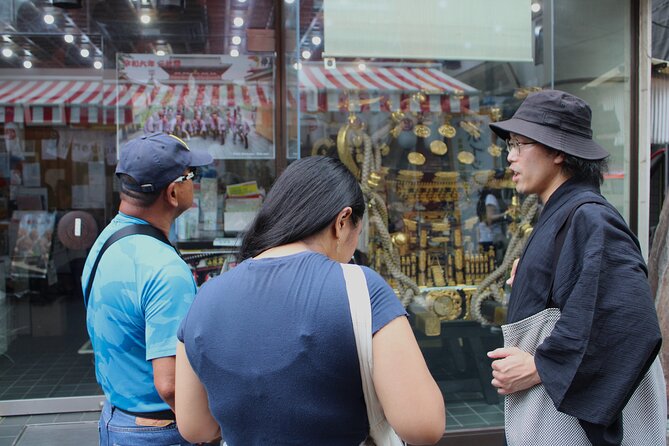
Senso-ji is the central stop and the finish point at the main hall. Ryo explains how the temple developed and how it received support from different groups, from local people to generals in various periods of Japanese history.
That background helps you see Senso-ji as more than a photogenic building. The site has been loved, maintained, and passed through changing eras, which explains its importance to both Asakusa residents and people visiting from across Japan.
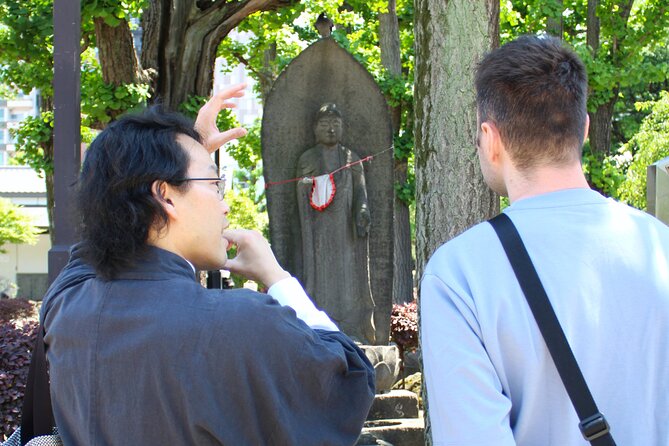
Ryo also takes you to smaller temples and shrines around the district. These secondary stops may be the most useful part for repeat visitors, since they are easier to miss when you walk straight from Kaminarimon to the main hall. You will also see a range of Buddhist statues, with explanations of the deities they represent and why their forms matter.
The route is still centered on the main sights, so do not book it expecting a completely offbeat Asakusa. The strength is not avoiding famous places. It is seeing them with a local guide who can add details between the headline stops.
The tour finishes at the main hall. That is convenient if you want to continue exploring Senso-ji, pray, take more photographs, or return to Nakamise. It also means you are responsible for finding your next destination. Ryo does not escort the group to a station.
Ryo’s local background and comedy style
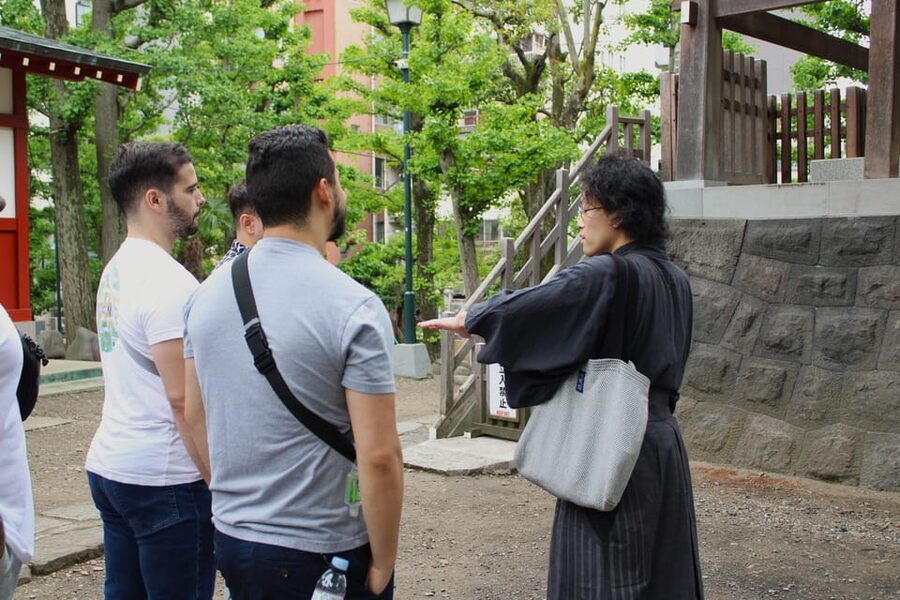
Ryo brings a combination that is unusual for a Tokyo walking tour. He has worked as an Asakusa rickshaw driver for six years, so his connection with the district is tied to explaining it face to face. He also performs standup comedy in English and uses humor drawn from his life as a Japanese comedian.
The comedy is a supplement, not the whole show. You should book this for the Asakusa history and cultural explanation first, then treat the jokes as an extra layer. People who enjoyed the experience especially liked his humor, modest manner, and ability to answer questions about Japanese history.
I would set your expectations correctly. This is not a professional comedy set with a long string of punchlines. The humor appears within the walk, and his manner may feel understated. One account found him pleasant but not especially enthusiastic as a guide, while other accounts describe him as kind, friendly, detailed, and eager to explain local culture.
That range is worth noting because personality affects any small-group tour. Ryo appears best suited to people who want conversation, local observations, and clear explanations rather than a loud, theatrical performance.
The strongest reasons to book, and the limits
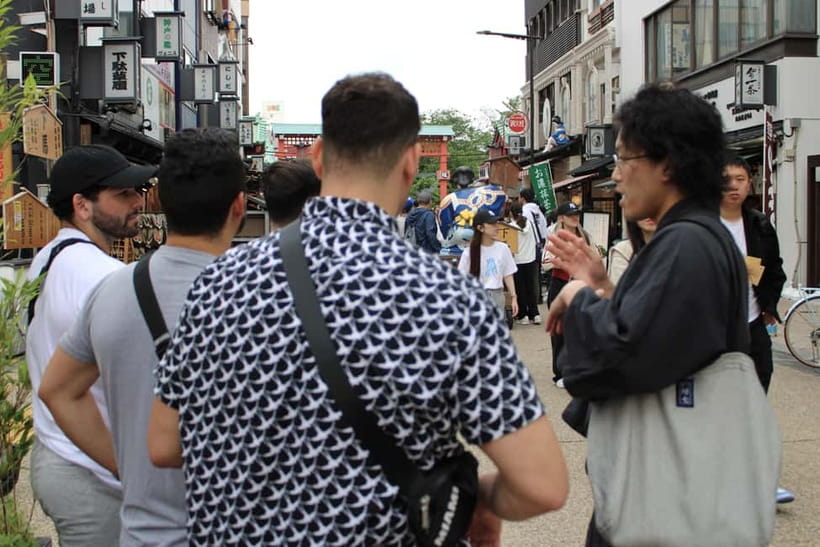
The main strength is context. You will see Senso-ji on your own either way, but Ryo can tell you why the gate matters, what the statues represent, how the shrine and temple relate, and how the district changed over time.
The second strength is the format. Eight people or fewer is a comfortable size for asking questions. A private tour is possible if nobody else books, and one person described having that experience with Ryo. You should not count on a private walk, but a small group gives you a better chance of personal attention.
The main limitation is coverage. Most of the sights are standard Asakusa stops, and you may already have them on your plan. If you want unusual neighborhoods far from the main temple, this is not the right tour.
The second limitation is time. Ninety minutes moves quickly through Sumida Park, the viewpoint, Kaminarimon, Nakamise, Asakusa Shrine, smaller religious sites, and Senso-ji. You will get an overview, not a slow study of every building.
At $31, I think the price is fair for a compact introduction with a live English-speaking guide. It is best value at the start of your Asakusa visit, when the information can shape the rest of your day. It is less useful if you only want photos or if you already have detailed knowledge of the area.
Who will get the most from this Asakusa tour
I would recommend it to first-time visitors who want help reading the religious and historical details of Asakusa. Families and couples may also like the short duration, since it provides structure without taking up half a day.
It suits you especially well if you want:
- A small group rather than a large coach tour
- An English-speaking local guide
- A simple explanation of Buddhist and Shinto sites
- A little humor alongside history
- Recommendations for shopping after the walk
- A clear orientation before exploring independently
You may want to skip it if you have already spent substantial time at Senso-ji, prefer to explore silently, or want a food-focused walk. The tour does not include shopping stops, tastings, hotel pickup, or a station transfer.
Book with enough time to reach Tokyo Cruise five minutes early. Wear shoes suitable for a city walk, and keep your schedule flexible enough to allow for questions or a slower pace. After the tour, you can return to Nakamise, continue around Senso-ji, or follow Ryo’s suggestions for shopping.
Should you book this $31 walking tour?
Book it if you want meaning behind the monuments rather than a simple checklist of Asakusa sights. Ryo’s six years in the district, English comedy background, and local cultural explanations make the walk different from an unguided visit, and the small group is a real advantage.
Skip it if your Asakusa plans already include a detailed guidebook route and you do not need help with history or religious customs. The attractions themselves are free to visit, so the decision rests on how much you value Ryo’s interpretation.
For most first visits, I would place this tour near the beginning of your Tokyo schedule. It gives you the basic map, the key stories, and practical shopping ideas, then leaves you at Senso-ji with time to continue at your own pace.
FAQ
How long does the Asakusa walking tour last?
The scheduled duration is 90 minutes. One account describes a tour lasting about two hours, so you may want to leave some flexibility after the planned finish.
How much does the tour cost?
The price is $31 per person.
Who guides the tour?
Ryo leads the walk. He is a Japanese comedian who performs in English and has six years of experience working in Asakusa as a rickshaw driver.
What languages are available?
The tour is offered in English and Japanese.
Where does the tour meet?
Meet in front of Tokyo Cruise, the water bus station near Asakusa Station on the Tokyo Metro Ginza Line.
How early should I arrive?
You should arrive at the meeting point five minutes before the scheduled start. The tour begins on time and cannot wait for late arrivals.
What places are included on the route?
The route includes Sumida Park, Kaminarimon, Nakamise Shopping Street, Asakusa Shrine, and Senso-ji Temple. It finishes at the main hall.
Does the tour include shopping or food stops?
No. The itinerary does not stop for food or souvenir shopping, though Ryo can give recommendations for shopping afterward.
Is the tour wheelchair accessible and how large is the group?
The tour is listed as wheelchair accessible, and the group is limited to eight participants.
Just added around Tokyo
- Tokyo: Customizable Private Guided Walking Tour★ 4.5 · 129 reviews
- Private Harajuku Omotesando Architecture Tour★ 4.9 · 18 reviews
- Tokyo: Guided Helicopter Ride★ 4.9 · 24 reviews
- Tokyo: Guided Walking Tour of Tsukiji Market with Lunch★ 4.4 · 24 reviews
- Tokyo: Private Personalized Local Food Tour★ 4.5 · 101 reviews
- Tokyo GINZA: KONPARU Japanese Cabaret Show with Drink★ 4.8 · 38 reviews
- Tokyo: Guided Walking Tour of Tsukiji Market with Breakfast★ 4.4 · 134 reviews
- Tokyo: Gotokuji Cat Temple, Shinjuku Cat Cafe & 3D Cat Tour★ 4.9 · 38 reviews
Walking Tours, compared.
Kyoto Geisha Walking Tour: Gion District & Hidden Gems
Read our review →
Tokyo Tsukiji Fish Market Food and Culture Walking Tour
Read our review →
Gion Magical Night Walking Tour with Geisha Trivia
Read our review →
Imperial Palace and Shogun Historical Walking Tour
Read our review →
Gion Geisha District Walking Tour – Stories of Geisha
Read our review →
Asakusa Walking Tour with Sensoji Temple Visit
Read our review →
Kyoto Gion Geisha District Walking Tour – The Stories of Geisha
Read our review →Browse the lists this tour appears in