

REVIEW · GARDEN & PALACE TOURS
Ramen-Making Experience in the Osaka Castle Area with Souvenir
Making ramen from scratch is the heart of this Osaka class. You knead and shape noodles, prepare tender chicken chashu, choose your soup, then sit down to eat the bowl you made. I like the hands-on format and the chance to choose tonkotsu, shoyu, or miso rather than simply watching a demonstration.
I also like the small group size, capped at eight, and the studio’s unusual details, including a more than 100-year-old glass entrance door. The main consideration is price: at $85.39 per person, this is not a cheap meal, so the value depends on how much you want the cooking lesson, English guidance, cultural setting, and souvenir.
In This Review
- Key points to know before booking
- What happens during the two-hour ramen class
- Fresh noodles made with Japanese wheat flour
- Preparing chicken chashu in the studio broth
- Choosing tonkotsu, shoyu, or miso
- Eating the bowl you helped create
- A studio filled with Japanese touches
- Getting there from Osaka Castle and central Osaka
- Is $85.39 a fair price?
- Who will enjoy this class most
- Morning or late afternoon?
- What makes the staff important
- Booking, cancellation, and final practical notes
- My booking call
- FAQ
- Where does the ramen-making experience take place?
- How long does the class last?
- How many people can join the class?
- Is the class suitable for beginners?
- What kinds of ramen soup can I choose?
- Do I make the ramen noodles myself?
- Is the class near Osaka Castle?
- What happens if I need to cancel?
Key points to know before booking

- You make the noodles yourself: Japanese wheat flour is used to create fresh, chewy ramen noodles.
- Three soup styles are available: Pick tonkotsu, shoyu, or miso for your finished bowl.
- The class includes more than noodles: You also prepare chicken chashu simmered in the studio’s original broth.
- The group stays small: A maximum of eight people makes it easier to get help at the worktable.
- The studio is close to Osaka Castle: The castle is about a 20-minute walk away, with three stations within roughly 5 to 10 minutes.
- You receive a souvenir: The class ends with a take-home gift, adding a lasting reminder beyond the meal.
What happens during the two-hour ramen class
This is a practical cooking class, not a quick food tasting. Over about two hours, you work through the main parts of a ramen bowl, from fresh noodles to toppings and broth.
The order may vary slightly as the instructors manage the class, but you can expect three core tasks: making noodles, preparing chashu, and selecting and finishing your soup. English-speaking staff guide the process and answer questions as you go, which is useful if you want to understand not only what to do but why each step matters.
The class is open to all skill levels. You do not need to arrive with cooking experience, and the family-friendly setup makes it a reasonable choice for parents looking for an activity that gives children something active to do. Still, ramen preparation involves food handling and following instructions, so very young children may need close help from an adult.
The small group limit matters here. With no more than eight people, the instructor can watch your technique and step in when needed. This is far more useful than a large demonstration where you spend most of the time looking over someone else’s shoulder.
More Garden & Palace Tours in Osaka
- Osaka Castle: Museum and Tower Entry Ticket
★ 4.5 · 2,380 reviews - Ultimate Osaka Walking Tour: Castle, Dotonbori & Hidden Gems
★ 5.0 · 862 reviews - Osaka Castle Walking Tour and Castle Tower Admission
★ 5.0 · 561 reviews
Fresh noodles made with Japanese wheat flour

The noodle session is likely to be the most memorable part for many people. You use Japanese wheat flour made for ramen and turn it into your own noodles rather than receiving a prepackaged portion.
Fresh noodles have a different texture from dried noodles. The finished strands are described as chewy, and that texture comes from the fresh preparation and the way the dough is worked. You get a better sense of ramen as a craft because the bowl begins with a basic ingredient and your own hands.
This is also the part where the class feels most different from simply eating at a ramen shop. In a restaurant, the noodles arrive ready. Here, you see one of the key building blocks of the dish and learn a process you can try to repeat at home.
Do not expect to become a professional noodle maker in one short session. The value is in learning the method, getting direct practice, and seeing how fresh noodles affect the final bowl. If you enjoy food experiences that leave you with a skill rather than only a photograph, this section earns its place in the schedule.
Preparing chicken chashu in the studio broth
The class also covers chashu, the savory meat topping commonly served with ramen. In this version, you prepare chicken simmered in the studio’s original broth.
That detail makes the experience a little different from the pork chashu many people associate with ramen. You should know what you are making before you book, especially if you have a firm expectation of pork. The chicken approach keeps the class distinct and gives you a chance to work with a tender, juicy topping that fits the finished soup.
Cooking the chashu also shows how ramen depends on more than noodles and stock. The topping adds texture, salt, and substance to the bowl. You are not just assembling decorations at the end. You take part in making one of the elements that gives the meal its character.
The information provided does not list every seasoning or cooking step, so I would not book this expecting a full professional recipe for every component. You will, however, work directly on the chicken and learn the basic preparation under staff guidance.
Choosing tonkotsu, shoyu, or miso
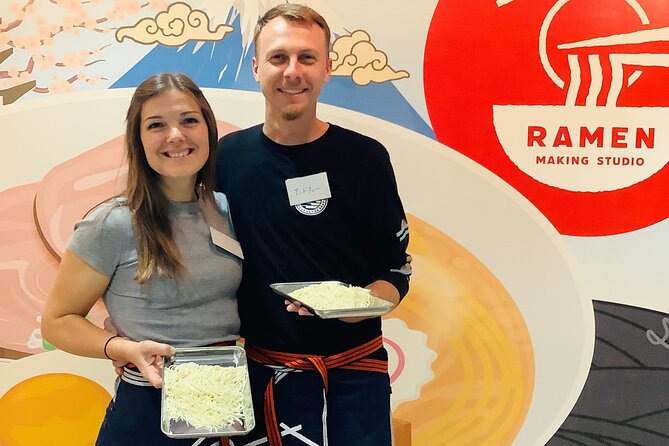
You choose one of three soup bases: tonkotsu, shoyu, or miso. That choice gives you some control over the flavor of your finished ramen.
Tonkotsu is generally associated with a fuller, pork-bone style broth. Shoyu is soy-sauce based, and miso brings a savory, fermented flavor. The studio uses recipes based on those from well-known ramen shops, so the selection is designed to reflect familiar Japanese ramen styles rather than a single generic soup.
If you are booking with a family or a group of friends, the choice adds a nice comparison point. You can order different bases and talk about the differences over the meal. If you are unsure, ask the English-speaking instructor for help before settling on your soup.
The class description does not specify whether every dietary request can be handled or whether the soup bases contain particular allergens. If you have food allergies or strict dietary needs, contact the provider before booking. Do not assume that selecting miso or shoyu makes a bowl vegetarian, since the available information does not confirm that.
Same city, a completely different kind of day:
- Osaka Go Karting Tour with Funny Costume
★ 5.0 · 2,658 reviews - Osaka: Shinsekai Food Tour with 13-15 Dishes at 5 Eateries
★ 4.8 · 2,204 reviews - Osaka Food Tour: 13 Dishes at 5 Local Eateries
★ 5.0 · 2,149 reviews - Hungry Osaka Street Food Tour:15 Tastings & 3 Drinks with a Local
★ 5.0 · 1,727 reviews
Eating the bowl you helped create
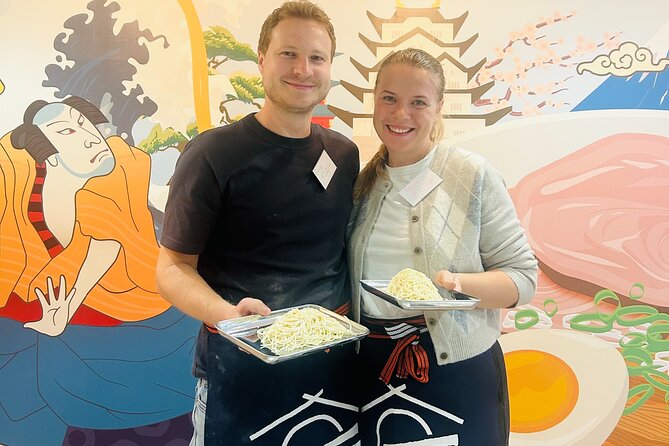
The payoff comes when the noodles, chashu, and soup come together. You get to eat the ramen you prepared, which gives the meal more meaning than a standard lunch stop.
The practical advantage is timing. A two-hour class can replace part of a meal period while also giving you an activity. You should not think of it as the fastest way to get fed, but it offers more than a restaurant visit for roughly the same part of your day.
The finished bowl may not look exactly like a chef’s version, and that is part of the appeal. The point is to understand the work behind ramen and enjoy a meal that reflects your choices. The class is especially satisfying for people who like food with a story attached to it.
Past feedback highlights the tasty final dish, clear instruction, and the pleasure of making the noodles from scratch. The strongest praise centers on staff warmth, good English, and the fact that participants remained actively involved instead of watching from a distance.
A studio filled with Japanese touches
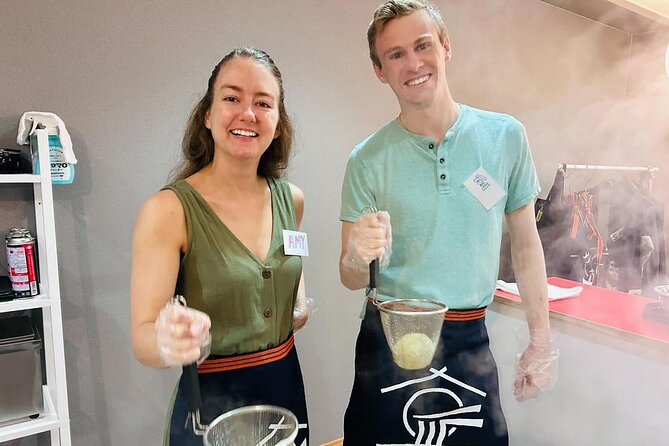
The setting gives the class more personality than a plain teaching kitchen. The walls are decorated with ramen and Japanese motifs, creating a colorful background for photographs.
The most unusual feature is the glass entrance door, made more than 100 years ago with a technique that no longer exists. That is a small detail, but it gives you something to notice before the cooking begins. The studio also contains objects connected with Japanese culture, and staff introduce some of them during the visit.
This cultural material is not a substitute for a museum visit, and you should not expect a long historical lecture. It works better as a layer added to the cooking lesson. You make food, learn a little about the surrounding objects, and leave with a stronger sense of place than you would get from a generic cooking studio.
The room is also useful for families and small groups because it provides an attractive setting for photos. Staff may take photographs or videos for social media and advertising. If you do not want your image used, tell the staff before the experience starts.
Getting there from Osaka Castle and central Osaka

The studio is at 1-chōme 4, Higashitenma, in Osaka’s Kita Ward, postal code 530-0044. It is within walking distance of Osaka Castle, though the stated walking time is about 20 minutes, so allow enough time if you are coming directly from the castle grounds.
Three stations are nearby:
- Tenmabashi Station, exit 13, about 10 minutes on foot
- Minamimorimachi Station, exit 6, about 10 minutes on foot
- Osaka Temmangu Station, exit 7, about 5 minutes on foot
The studio is therefore fairly easy to combine with other sightseeing. Umeda Sky Building and Namba are both said to be about 20 to 30 minutes away by train. That makes a morning class workable before afternoon sightseeing, while a late afternoon class can fit after a day around Osaka Castle or central Osaka.
Use the full meeting address and station exit information carefully. Osaka has several large stations and busy streets, and a few extra minutes spent confirming your route is better than arriving rushed. The activity returns to the same meeting point when it ends.
Is $85.39 a fair price?
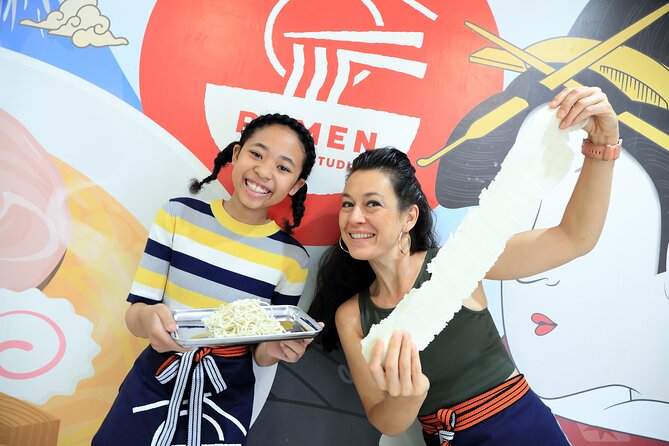
At $85.39 per person, this class sits in the paid-experience category rather than the casual lunch category. You are paying for roughly two hours of instruction, ingredients, a small group, the chance to make noodles and chashu, your meal, and a souvenir.
If you only want to eat ramen, this is poor value compared with a bowl from a local restaurant. You can find a meal for much less. But that comparison misses the main point. This is a food activity with instruction and participation, not simply a restaurant booking.
I see the price as easier to justify if you value three things: direct English guidance, a small group where you can get help, and the chance to learn a process you can use at home. The souvenir and cultural features add to the experience, though they should not be the main reason to book.
The price is also more reasonable for a family or group that wants a shared activity. Everyone takes part, and the finished meal becomes part of the event. Solo visitors can enjoy it too, but a person traveling alone should consider whether a hands-on class is worth more than spending the same money across several local meals.
Who will enjoy this class most
I would recommend this experience to several types of visitors:
- First-time visitors to Osaka who want an approachable introduction to a famous Japanese dish
- Families looking for a structured activity open to different skill levels
- Food lovers who want to understand how ramen is made, not just eat it
- Small groups of friends who enjoy comparing soup choices and cooking together
- Visitors staying near Osaka Castle, Umeda, or Namba who can fit the studio into a larger day
It may not suit you if you dislike cooking, want a fast meal, or need a highly specialized dietary menu. It is also not the right pick if your top priority is a traditional restaurant setting rather than a teaching studio.
The class is family-friendly, but the supplied information does not give a minimum age or detailed accessibility information. Ask the provider directly if those details matter for your group.
Morning or late afternoon?
Morning and late afternoon classes are available. That flexibility helps you build the experience around Osaka’s many sightseeing areas.
A morning booking can work well before exploring Osaka Castle, assuming you allow for the roughly 20-minute walk from the castle area and arrive at the meeting point on time. After class, you can continue toward other parts of the city.
A late afternoon booking may fit after a morning around Osaka Castle or another central Osaka attraction. It also gives you a meal near the end of the day, although you should check your wider plans so the two-hour session does not crowd out an evening reservation.
The best time depends on your eating habits and schedule. Since the class includes preparing and eating ramen, you may want to avoid booking immediately after a large meal.
What makes the staff important
Good instruction is central to this experience. You are working with dough, broth choices, and meat preparation, so clear explanations matter more than a polished presentation.
The staff speak English and are available to answer questions during the process. Strong feedback focuses on their friendly, professional manner and the right balance between interaction and information. That is an important distinction: you get help without the class becoming a long lecture.
The kitchen has also been described as spotlessly clean, which matters when you are handling food. Cleanliness does not make the class exciting by itself, but it supports confidence in the preparation area and helps the experience feel organized.
No individual guide names are provided, so I cannot tell you to look for a particular instructor. You can expect an English-speaking team rather than a named private guide.
Booking, cancellation, and final practical notes
Confirmation is provided when you book, and the experience uses a mobile ticket. Public transportation is nearby, with the closest listed station, Osaka Temmangu, about five minutes away on foot.
The group maximum is eight people. If you want the best chance of joining a small class at your preferred time, booking ahead is sensible, particularly since the activity recorded more than 10 bookings in the previous month.
You can cancel free of charge up to 24 hours before the start time for a full refund. Cancellations and changes made less than 24 hours before the start are not accepted for a refund, and the cut-off follows local Osaka time.
My booking call
I would book this ramen class if you want an active food experience near Osaka Castle and care about learning how the dish comes together. The fresh noodle work, English instruction, three soup choices, and chicken chashu make it more substantial than a simple tasting.
I would skip it if your main goal is the cheapest bowl of ramen in Osaka or if you have strict dietary requirements that the provider cannot confirm. For everyone else, the two-hour format, small group, cultural details, and souvenir give the $85.39 price a fair chance of feeling worthwhile, especially on a first visit to Japan.
FAQ
Where does the ramen-making experience take place?
The class meets at Ramen Making Studio at Japan, 530-0044 Osaka, Kita Ward, Higashitenma, 1-chōme 4, Higashitenma Heights.
How long does the class last?
The experience lasts approximately two hours.
How many people can join the class?
The activity has a maximum of eight participants.
Is the class suitable for beginners?
Yes. The class is open to all skill levels and is family-friendly.
What kinds of ramen soup can I choose?
You can choose from tonkotsu, shoyu, or miso soup.
Do I make the ramen noodles myself?
Yes. You use Japanese wheat flour made for ramen to create fresh noodles.
Is the class near Osaka Castle?
Yes. The studio is about a 20-minute walk from Osaka Castle. Tenmabashi and Minamimorimachi stations are about 10 minutes away on foot, while Osaka Temmangu Station is about five minutes away.
What happens if I need to cancel?
You can cancel at least 24 hours before the start time for a full refund. Cancellations or changes made less than 24 hours before the experience are not accepted for a refund.
Just added around Osaka
- Samurai dress-up and shows, plus Tea Ceremony & Calligraphy★ 5.0 · 27 reviews
- Kyoto & Nara Private customized tour with English speaking Guide★ 4.5 · 99 reviews
- Well-balanced BENTO (lunch box) Cooking Class★ 5.0 · 35 reviews
- Urban Canvas: Osaka Street Art Bike Tour★ 5.0 · 47 reviews
- OSAKA:Feel the Power! Learn Taiko Drum from Professionals★ 5.0 · 28 reviews
- Volleyball in Osaka & Kyoto with Locals!★ 5.0 · 21 reviews
- 1.5〜2 Hours Traditional Kintsugi Work Shop in Namba Osaka★ 5.0 · 75 reviews
- Umami Town Street Food Tour★ 5.0 · 120 reviews
Garden & Palace Tours, compared.

Imperial Palace and Shogun Historical Walking Tour
Read our review →
Tokyo Castle & Imperial PalaceーShogun Walking Tour
Read our review →
Nijo-jo Castle and Ninomaru Palace Guided Tour
Read our review →


Ultimate Osaka Walking Tour: Castle, Dotonbori & Hidden Gems
Read our review →Tokyo Castle & Imperial PalaceーShogun Walking Tour
Read our review →Browse the lists this tour appears in