
REVIEW · WALKING TOURS
Private Harajuku Omotesando Architecture Walking Tour
Harajuku and Omotesando pack an astonishing range of architecture into a manageable walk, from Kenzo Tange’s sweeping Yoyogi Gymnasium to Prada’s curved glass walls and quiet residential lanes. This private tour turns a famous shopping district into an open-air lesson in how Tokyo mixes bold design, fashion, religion, and everyday neighborhood life.
I like the custom route, which lets you spend more time on architecture, urban history, interiors, or local culture. I also like the prepared guides, several of whom bring photos, floor plans, and background on the architects. The main consideration is price: at $132.14 per person, this makes the most sense for a small private group with a strong interest in design.
In This Review
- Key points to know before you book
- Why this Harajuku walk is different
- Starting at Meiji Jingu and looking toward Yoyogi
- Omotesando’s designer buildings, one block at a time
- Tadao Ando, Kenzo Tange, and other major names
- The backstreets reveal another Harajuku
- A short cafe pause in the middle of the walk
- How much does $132.14 per person buy you?
- Timing, meeting point, and route details
- Who will enjoy this most?
- Should you book the Harajuku architecture tour?
- FAQ
- How long does the private Harajuku architecture tour last?
- How much does the tour cost?
- Where does the tour begin?
- Where does the tour end?
- Is this a private tour?
- What is included in the price?
- Is hotel pickup included?
- Can I cancel for a full refund?
Key points to know before you book
- Yoyogi Gymnasium begins the architecture story: See Kenzo Tange’s famous Olympic-era work from the Meiji Jingu area.
- Omotesando becomes a design gallery: Prada, Dior, Louis Vuitton, Tod’s, The Iceberg, and Sunny Hills provide striking examples of fashion-led architecture.
- The backstreets change the mood: Quiet lanes reveal houses, small businesses, and buildings that are easy to miss on the main avenue.
- Your guide can shape the walk: Yoshi, Yoko, Aki, Taka, Mari, Eriko, Junko, and other guides have led tours with different strengths and interests.
- A cafe pause is included: You get a short rest with drinks, useful during a long urban walk.
- The walk ends in Aoyama: The final point is at the Omotesando and Aoyama-dori intersection, near Mizuho Bank.
Why this Harajuku walk is different
Most first visits to Harajuku follow a simple pattern: Meiji Jingu, Takeshita Street, a few shops, then a crowded train station. This tour takes a more thoughtful route. You still see the famous parts of the district, but the focus shifts from shopping lists to the buildings and ideas behind them.
That matters because Omotesando is not just a luxury shopping street. Its storefronts were designed by major architects, and many use unusual materials, dramatic angles, planted roofs, or carefully controlled light. The result is a compact display of modern architecture that you can study without entering a museum.
The private format also changes the pace. You are not tied to a large group or a fixed lecture. If you care about postwar Japanese architecture, your guide can develop that theme. If you are more interested in fashion, design, Tokyo’s growth since the 1960s, or local customs, you can shift the conversation.
The experience is rated 4.9 from 67 ratings, with 99 percent recommending it. More useful than the number itself is the consistent pattern: guides are praised for preparation, enthusiasm, patience, and their ability to adjust the route.
More Walking Tours in Tokyo
- Tokyo Tsukiji Fish Market Food and Culture Walking Tour
★ 5.0 · 3,184 reviews - Tokyo: Imperial Palace and Shogun Historical Walking Tour
★ 5.0 · 2,251 reviews - Tokyo: Shinjuku Local Bar and Izakaya Guided Walking Tour
★ 4.9 · 1,794 reviews
Starting at Meiji Jingu and looking toward Yoyogi
The meeting point is in front of Meiji Jingu near Harajuku Station, at 1 Yoyogikamizonocho. This is a practical place to begin because it puts you beside one of Tokyo’s best-known religious sites and close to the Olympic architecture of Yoyogi.
Meiji Jingu is not treated as the entire subject of the walk. Instead, it provides a useful opening contrast. The shrine represents a more traditional visual language, while nearby Yoyogi Gymnasium points toward the daring structural work of the postwar period.
The gymnasium, designed by Kenzo Tange, is admired for its suspended roof forms and strong sense of movement. The tour views it from a distance rather than taking you inside, so you should set your expectations accordingly. You will study its shape and place in Tokyo’s Olympic story, not receive an indoor stadium visit.
This opening also gives your guide a chance to explain how Tokyo changed around the 1964 Olympics. The tour description refers to Olympics history, and the guide-led discussion connects the landmark with the city’s growth and architectural ambition.
If you want a conventional shrine tour with detailed religious interpretation, this is not the main purpose of the experience. If you like seeing how different eras sit beside one another, the opening works very well.
Omotesando’s designer buildings, one block at a time
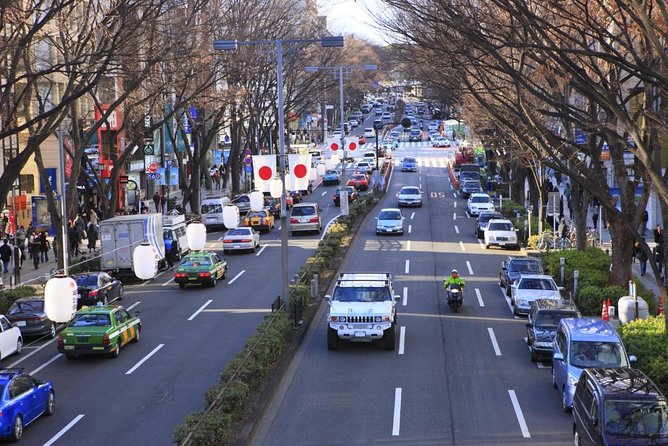
From the Meiji Jingu area, the route moves toward Omotesando, the broad avenue often compared with the Champs-Elysees or Rodeo Drive. The comparison is easy to understand: international luxury labels line the street, but the real attraction here is the architecture wrapped around their shops.
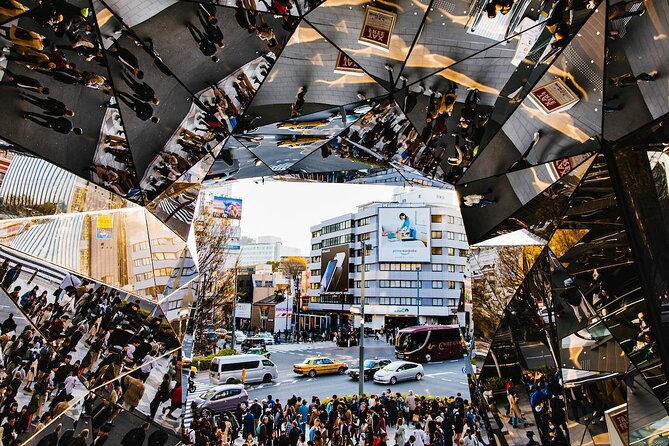
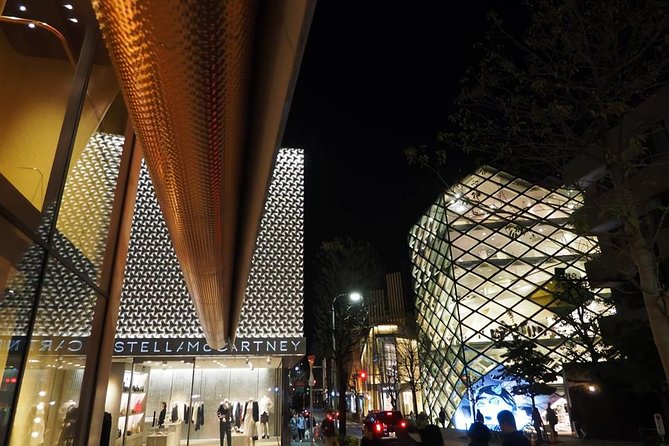
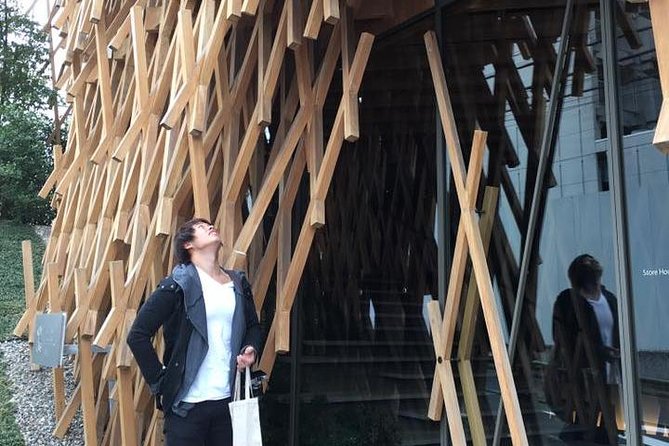
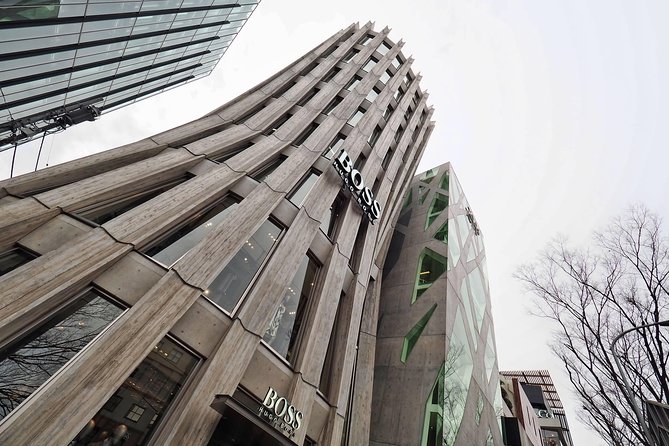
You may stop at buildings associated with The Iceberg, Dior, Louis Vuitton, Tod’s, Sunny Hills, and Prada. These are not simply brand locations. Their facades use glass, concrete, steel, unusual geometry, and carefully framed entrances to make the building part of the shopping experience.
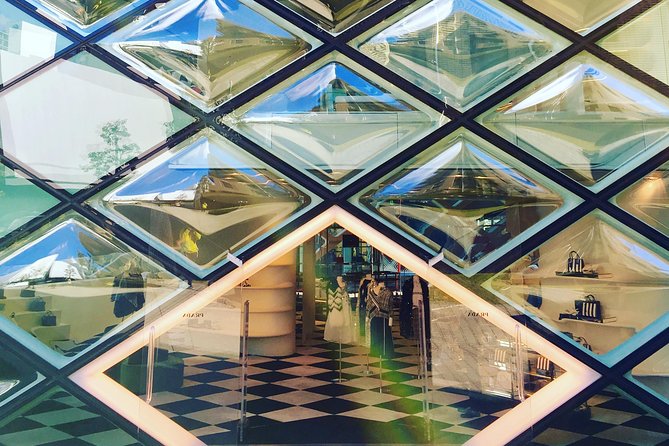
Prada is a particularly strong stop. The building is known for its convex and concave glass panels, which distort reflections and give the facade a changing appearance as you walk past. It was designed by Jacques Herzog and Pierre de Meuron, and the tour can help you look beyond the store’s name to the structural and visual choices.
Other stops provide useful contrast. Tod’s uses a patterned exterior that echoes the branching form of trees, while the Louis Vuitton building and Dior offer different answers to the question of how a luxury shop should meet a major city street. Sunny Hills brings another mood, with a distinctive exterior that makes a small retail building memorable.
The exact balance of stops can vary because the tour is customizable. That is a strength, but it also means you should tell the guide early what you want. An architecture student may want names, dates, materials, and design comparisons. Someone with a general interest in Tokyo may prefer a broader explanation of fashion, urban change, and neighborhood identity.
Tadao Ando, Kenzo Tange, and other major names
A strong reason to book this walk is the concentration of important architects within a short distance. One route has included buildings by five Pritzker Prize winners, including Kenzo Tange, Tadao Ando, and the team of Herzog and de Meuron.
Tadao Ando’s Collezione is an especially interesting example because part of the building sits underground. That decision changes the way the structure meets the street. Instead of competing for attention with a tall facade, it reveals itself through concrete, geometry, and the relationship between visible and concealed space.
A guide such as Taka, a retired architect, can add a professional layer to the visit. He has used an iPad to show photographs of architects, floor plans, other projects, and recommended places to stand for the best view. This kind of visual aid is valuable because architectural details can be hard to read from a pavement crowded with shoppers.
Aki and Yoko have also been praised for explaining design differences and connecting individual buildings with broader changes in Tokyo. Yoshi is known for bringing a notebook of building photographs and architect portraits. These details suggest that the quality of the walk depends partly on the guide assigned to your date, but the provider has a strong bench of guides with serious preparation.
One caution: one otherwise positive experience included difficulty understanding the guide’s English. Other experiences specifically describe excellent or perfect English, so this does not appear to be a general problem. Still, if architectural vocabulary matters greatly to you, it is reasonable to state that preference when booking.
Same city, a completely different kind of day:
- Mt Fuji and Hakone 1-Day Bus Tour Return by Bullet Train
★ 5.0 · 26,383 reviews - 1-Day Tokyo Bus Tour
★ 5.0 · 14,250 reviews - Tokyo: TOKYO SKYTREE® Admission ticket
★ 4.5 · 11,192 reviews - Tokyo: teamLab Planets TOKYO Digital Art Museum Entry Ticket
★ 4.6 · 9,779 reviews
The backstreets reveal another Harajuku
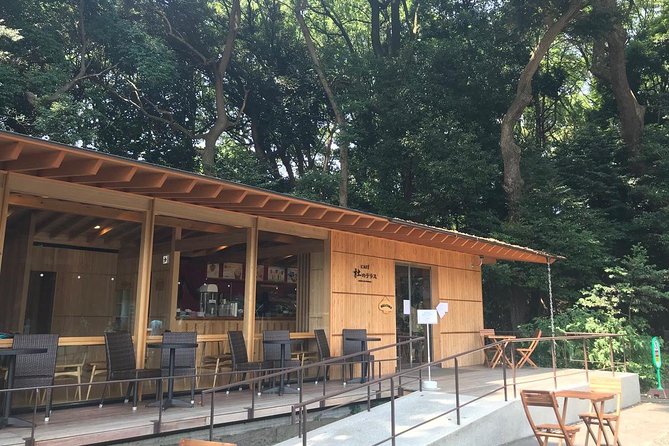
The main avenue gives you polished facades and international brands. The side streets provide the needed counterpoint. Your guide can lead you away from Omotesando into backstreets where the scale drops, the pace slows, and the mix of homes, small shops, offices, and unusual buildings becomes more personal.
This is where the tour feels less like a greatest-hits route. You might pass architecture that does not have a famous designer attached to it but still explains how Harajuku works as a neighborhood. The contrast between high-end retail and ordinary local streets is one of the best parts of the walk.
The backstreet section also helps explain why a private guide is useful. On your own, you could walk down the same lanes, but you would not necessarily know which building deserves a second look or how the area developed from the 1960s to the present.
Yoko has focused on that growth in past tours, explaining how design influences changed over time. Junko has also been praised for using the walk as an introduction to Japanese history, culture, etiquette, and city orientation. If this is your first day in Japan, that wider context can be just as useful as the architecture itself.
A short cafe pause in the middle of the walk
The tour includes a cozy pause with drinks at a cafe along a less obvious backstreet. This is a small feature, but it improves the rhythm of a 3 to 3.5-hour urban walk.
You get a chance to sit, cool down, and continue the conversation without trying to examine a facade while crossing a busy street. Guides can use the break to answer questions or adjust the rest of the route around your interests.
The pause is especially helpful in hot weather. One guide extended the indoor portion for a group because conditions outside were uncomfortable. That is a good example of what customization can mean in practice, although you should not assume the cafe stop becomes a long indoor tour.
Bring comfortable walking shoes and plan for a moderate level of physical activity. There is no hotel pickup or drop-off, and the experience is built around walking between neighborhoods and buildings.
How much does $132.14 per person buy you?
The listed price is $132.14 per person, with group discounts available. For one or two people, that is a significant cost for a walking tour. For a small group sharing a private guide, the value improves, especially if everyone cares about architecture or wants a flexible introduction to Tokyo.
You are paying for more than movement between landmarks. The price includes a licensed local guide, a private experience for your group, the cafe pause with drinks, and the ability to ask questions without competing with a large party.
The value is strongest if you would otherwise spend hours trying to identify buildings and research architects on your phone. It is weaker if you mainly want a quick orientation to Harajuku or a shopping stroll. Much of the tour’s appeal depends on your willingness to look closely and listen.
The tour is booked an average of 53 days ahead, so advance planning is sensible. That timing may be especially important if you want a particular guide or have limited days in Tokyo, though the available guide cannot be guaranteed from the information provided.
Timing, meeting point, and route details
The experience lasts approximately 3 hours and 30 minutes. The walking itinerary itself is also described as a three-hour route, with the remaining time allowing for the pause and transitions. Treat the duration as approximate rather than a minute-by-minute schedule.
You meet at Meiji Jingu near Harajuku Station. The tour ends at 5-chome-1-27 Minamiaoyama, at the Omotesando and Aoyama-dori intersection in front of Mizuho Bank.
That endpoint is useful because you finish near major shopping streets and public transportation. There is no return to your hotel, so arrange your next stop from Aoyama rather than expecting the guide to escort you back.
A mobile ticket is provided, and confirmation arrives at booking. The meeting location is near public transportation, but hotel transfers are not part of the experience.
Who will enjoy this most?
I would choose this tour if you have a serious interest in modern architecture, interior design, fashion retail, or the way Tokyo has changed since the 1960s. It also suits first-time visitors who want an informed introduction to Harajuku rather than a simple list of famous sights.
Families and mixed-interest groups can benefit from the private format because the guide can shift between architecture, culture, and local history. Aki, Mari, Eriko, Yuki, and other guides have been praised for friendly conversation and flexible explanations, while Junko has helped people continue to their next destination by navigating the subway.
You do not need an architecture degree. The tour can work for curious beginners, provided you enjoy walking and are happy to spend time looking at buildings from the outside.
I would skip it if you want a relaxed cafe crawl, a shrine-focused visit, or a low-cost group tour. The route requires moderate fitness, and the main rewards come from details that may not interest someone who sees Omotesando mainly as a shopping district.
Should you book the Harajuku architecture tour?
Book it if you want to understand why Harajuku and Omotesando look the way they do. The best parts are the compact group of major buildings, the shift into quieter lanes, and the chance to ask a private guide about details that most people walk past.
Before booking, tell the provider what matters most: Olympic architecture, famous architects, interiors, fashion buildings, local history, or neighborhood culture. That gives the guide a clear starting point and makes the $132.14 price easier to justify.
The biggest practical warning is the cost and the amount of walking. If those fit your plans, this is one of the more focused ways to see Harajuku, and it can give the rest of your Tokyo visit a sharper eye for design.
FAQ
How long does the private Harajuku architecture tour last?
The experience lasts approximately 3 hours and 30 minutes. The walking itinerary is also described as about 3 hours, including a short pause along the way.
How much does the tour cost?
The listed price is $132.14 per person. Group discounts are available.
Where does the tour begin?
The meeting point is in front of Meiji Jingu near Harajuku Station, at 1 Yoyogikamizonocho, Shibuya, Tokyo 151-0052, Japan.
Where does the tour end?
The tour ends at 5-chome-1-27 Minamiaoyama, Minato City, Tokyo 107-0062, at the Omotesando and Aoyama-dori intersection in front of Mizuho Bank.
Is this a private tour?
Yes. Only your group participates in the activity.
What is included in the price?
A local licensed tour guide and a cozy pause with drinks along the way are included.
Is hotel pickup included?
No. Hotel pickup and drop-off are not included.
Can I cancel for a full refund?
Yes, if you cancel at least 24 hours before the experience start time. Cancellations or changes made less than 24 hours in advance are not accepted for a refund.
Just added around Tokyo
- Private Memorable Tokyo Tour with English Speaking Driver★ 5.0 · 30 reviews
- Private Tokyo Custom Full-Day Tour by Chartered Vehicle★ 5.0 · 16 reviews
- Private Sightseeing to Mt Fuji and Hakone with English Driver★ 5.0 · 51 reviews
- Tokyo Photography Masterclass – Private Photography Lesson★ 5.0 · 25 reviews
- Private Mt. Fuji Day Trip from Tokyo with English-Speaking Driver★ 5.0 · 33 reviews
- 4 Day Tour – Mount. Fuji, Tokyo, Hakone, Kamakura and Yokohama★ 5.0 · 19 reviews
- Private Unforgettable Mt Fuji Tour with English Speaking Driver★ 5.0 · 142 reviews
- Private Tokyo Food Tour – A Journey Through Time Through Food★ 5.0 · 36 reviews
Walking Tours, compared.

Kyoto Geisha Walking Tour: Gion District & Hidden Gems
Read our review →
Tokyo Tsukiji Fish Market Food and Culture Walking Tour
Read our review →
Gion Magical Night Walking Tour with Geisha Trivia
Read our review →
Imperial Palace and Shogun Historical Walking Tour
Read our review →
Gion Geisha District Walking Tour – Stories of Geisha
Read our review →
Asakusa Walking Tour with Sensoji Temple Visit
Read our review →
Kyoto Gion Geisha District Walking Tour – The Stories of Geisha
Read our review →Browse the lists this tour appears in